
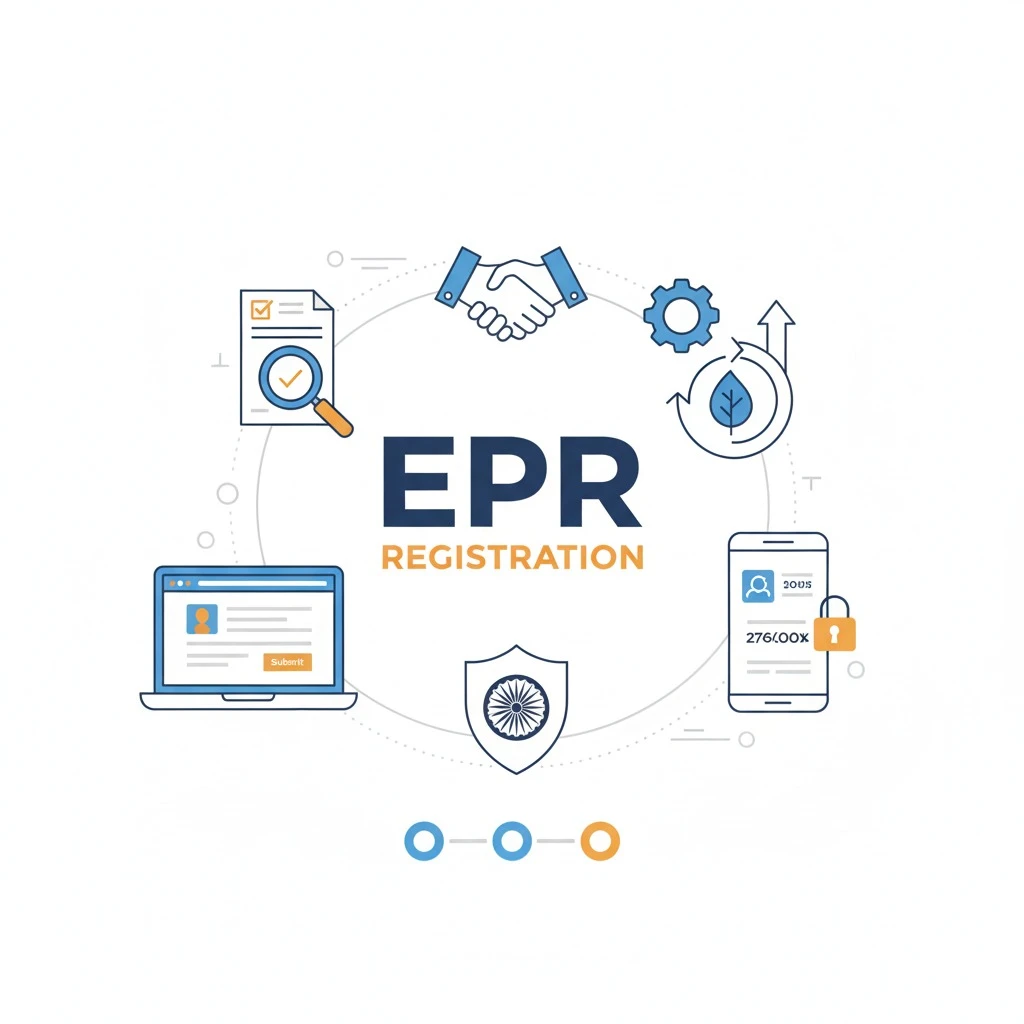
EPR Registration in Bhubaneswar
EPR Registration in Bhubaneswar depends on what a business manufactures, imports, brands or places into the Indian market. Legal Papers India assists Bhubaneswar applicants remotely from Delhi and Noida with applicability assessment, product classification, document preparation and registration coordination without representing a physical office or local EPR registration centre in Bhubaneswar.
The brief specifically requires remote service delivery where no physical city office exists and prohibits false local-presence signals.
The first decision is not simply whether the company needs an “EPR certificate.” The more useful question is:
Which regulated waste stream is created by the product or packaging, and what role does the applicant perform?
Depending on the business, the review may involve:
- Plastic Waste EPR
- E-Waste EPR
- Battery Waste EPR
- Multiple EPR frameworks for the same product
For example, a company importing rechargeable electronic devices in plastic packaging should not assume that one registration automatically covers the equipment, battery and packaging.
Expert recommendation: Complete a product-and-role assessment before starting portal filing. Incorrect classification at the first stage often creates unnecessary revisions later.
Why Bhubaneswar’s Business Ecosystem Makes EPR Relevant
Bhubaneswar is developing across electronics manufacturing, IT-linked businesses, food processing, plastics and MSMEs, which creates practical EPR exposure for product-led companies. Businesses selling packaged goods, importing electronics, manufacturing battery-powered products or developing consumer brands should include EPR review in product launch and sourcing decisions rather than waiting for a compliance query.
Invest Odisha identifies an Electronics Manufacturing Cluster in Bhubaneswar, along with Info Valley, electronics-related infrastructure and broader opportunities across electronics manufacturing, food processing, chemicals and plastics. Odisha’s MSME policy also identifies plastics and polymers, pharmaceuticals, automobile components and related manufacturing sectors among focus areas.
That creates locally relevant scenarios:
| Bhubaneswar Business Situation |
EPR Question |
|
Electronics startup |
Is the product covered under e-waste rules? |
|
FMCG brand using plastic packs |
Does Brand Owner registration apply? |
|
Medical-device importer |
Are electronic or battery components regulated? |
|
D2C consumer brand |
What packaging enters the market under its brand? |
|
Battery-powered product company |
Does Battery Waste EPR apply separately? |
|
Plastics manufacturer |
Is the entity a producer, manufacturer or processor under the relevant framework? |
Common mistake: Businesses assess EPR only after expanding to national marketplaces or institutional buyers.
Better approach: Add an EPR checkpoint when approving a new SKU, private-label arrangement, packaging redesign or direct import.
Which Bhubaneswar Businesses Should Assess EPR Applicability?
Manufacturers, producers, importers and brand owners dealing with regulated plastic packaging, batteries or covered electrical and electronic equipment should assess EPR requirements. The correct regulatory role comes from the actual supply chain, so a business describing itself as a trader or distributor may still require further review if it imports goods or sells under its own brand.
Businesses that commonly need assessment include:
- Electronics manufacturers
- Electronics importers
- Battery manufacturers and importers
- Plastic packaging businesses
- FMCG companies
- D2C brands
- Private-label sellers
- E-commerce businesses
- Industrial manufacturers
- Medical-equipment businesses
- Importers of regulated products
Practical Role Test
Ask:
- Do we manufacture the product?
- Do we directly import it into India?
- Does our brand or trademark appear on it?
- Does the product use regulate plastic packaging, electronics or batteries?
Odisha’s policy environment specifically highlights electronics manufacturing, plastics and polymers, food processing and MSME clusters, making these questions commercially relevant for Bhubaneswar businesses.
Overlooked requirement: One legal entity can perform multiple roles. It may manufacture one product locally, import another and sell both under the same brand.
Plastic Waste, E-Waste or Battery EPR: Which One Applies?
An EPR License in Bhubaneswar should not be treated as a single universal approval. Plastic packaging, e-waste and batteries operate under separate regulatory structures. Businesses should map the finished product into individual regulated components before deciding which EPR registration route or combination of routes applies.
| Product Element |
EPR Stream to Review |
Main Data Needed |
|
Plastic packaging |
Plastic Waste EPR |
Packaging type and quantity |
|
Covered electronic equipment |
E-Waste EPR |
Product category and quantity |
|
Batteries |
Battery Waste EPR |
Battery category and quantity |
|
Composite product |
Multiple EPR streams |
Component-level mapping |
Practical Example
Consider a Bhubaneswar-based electronics brand selling a smart handheld device with:
- Electronic circuitry
- Rechargeable battery
- Plastic retail packaging
The commercial department sees one SKU. Compliance should assess three separate streams.
Decision guideline: Break the SKU into product, battery and packaging before deciding whether one or multiple registrations require action.
EPR Registration Online in Bhubaneswar
EPR Registration Online in Bhubaneswar should begin with business-role classification and product data preparation before portal filing. Applicants should compile a complete SKU list, reconcile market or import quantities and validate company records so that information submitted during registration can later be supported during returns, modifications or compliance reviews.
| Stage |
Purpose |
Common Mistake |
Recommended Action |
|
Applicability Review |
Identify EPR stream |
Treating all EPR as one category |
Review each product separately |
|
Applicant Classification |
Identify legal role |
Relying on internal business title |
Map actual supply-chain activity |
|
SKU Mapping |
List regulated products |
Missing variants |
Use one product master |
|
Quantity Review |
Establish reportable volume |
Using rough estimates |
Reconcile source records |
|
Entity Validation |
Check legal records |
PAN/GST/name mismatch |
Standardize applicant data |
|
Portal Filing |
Submit application |
Wrong category selection |
Review before submission |
|
Query Handling |
Address observations |
Weak supporting evidence |
Maintain source records |
|
Approval Review |
Check issued details |
Not verifying certificate |
Compare with application |
|
Ongoing Compliance |
Track future duties |
Treating registration as final |
Maintain compliance calendar |
A useful internal sheet is:
SKU → Brand → Manufactured/Imported → Product Category → Battery → Packaging → EPR Stream → Quantity → Source Record
Approval-delay reason: Different figures from finance, import and sales teams frequently create avoidable clarification work. Reconcile them before filing.
Documents Required for EPR Registration in Bhubaneswar
Documents required for EPR Registration in Bhubaneswar vary according to the applicant's legal constitution, regulatory role and applicable waste stream. Company records establish legal identity, while product, packaging, manufacturing or import data establish the actual EPR position of the applicant.
| Business Type |
Common Records |
|
Proprietorship |
PAN, GST/business records, proprietor details |
|
Partnership |
Partnership Deed, PAN, GST, partner information |
|
LLP |
Incorporation documents, LLP Agreement, PAN, GST |
|
Private Limited Company |
Incorporation Certificate, PAN, GST, authorized-person details |
|
OPC |
Incorporation and authorized-signatory records |
|
Manufacturer |
Entity records plus product/manufacturing information |
|
Importer |
Entity records plus import/product information |
|
Brand Owner |
Entity records plus brand and packaging data |
Additional information can include:
- Product categories
- Brand names
- Packaging types
- Battery categories
- Import quantities
- Production quantities
- Market-placement figures
- Existing environmental registrations
- Authorized signatory details
- Supporting declarations
Compliance tip: Numbers submitted for EPR purposes should be traceable to invoices, ERP records, import documents, production data or packaging procurement information.
What Professional EPR Assistance Should Actually Cover
Professional EPR assistance should resolve applicability, classification and data-quality issues before the filing is submitted. For Bhubaneswar product businesses, the real value lies in determining the correct role, mapping regulated product streams, reconciling quantities and explaining continuing obligations rather than simply uploading documents.
Useful assistance should address:
Operational considerations
- SKU classification
- Packaging mapping
- Internal data ownership
- Quantity reconciliation
Regulatory considerations
- Correct applicant category
- Application preparation
- Query-response support
- Registration review
Future compliance
- EPR targets
- Recycling certificates
- Returns
- Product/category changes
- Registration modifications
Current competitor pages often focus heavily on documentation and filing but provide less detail about how businesses should structure product data before registration or manage multi-stream products afterward.
Buyer hesitation point: Ask whether a quotation covers registration only or also regulator queries and post-registration compliance. These are materially different scopes.
Why Bhubaneswar Businesses Can Use Remote EPR Assistance
CPCB EPR Registration in Bhubaneswar can be coordinated remotely because much of the process involves legal-entity records, product specifications, packaging data, quantity reconciliation and online regulatory systems. Legal Papers India operates from Delhi and Noida and can serve Bhubaneswar applicants digitally without creating a false local branch impression.
A remote engagement can involve:
- Initial applicability discussion
- Producer/importer/brand-owner classification
- Plastic/e-waste/battery assessment
- Product-data organization
- Document checklist
- Application preparation
- Regulatory-query coordination
- Post-registration compliance discussion
For manufacturers and electronics businesses, involve both product and finance teams early.
Why? Product teams know what the SKU contains; finance and imports teams know how much was manufactured, sold or imported.
Expert observation: A large proportion of avoidable filing problems arise when no single internal owner reconciles these datasets.
EPR Registration Cost and Timeline in Bhubaneswar
The cost and timeline for EPR Registration in Bhubaneswar depend on the waste stream, applicant role, number of products, packaging complexity, import activity, data quality and scope of support. A single fixed fee or guaranteed processing period cannot responsibly represent every EPR application.
Main Cost Drivers
| Factor |
Why It Matters |
|
EPR stream |
Plastic, e-waste and battery requirements differ |
|
Number of SKUs |
More products require more classification |
|
Packaging complexity |
Multiple categories increase data work |
|
Import activity |
Import information needs reconciliation |
|
Multiple streams |
Separate assessments may apply |
|
Poor records |
More preparation is required |
|
Regulatory queries |
Additional clarification work |
|
Ongoing compliance |
Separate from initial registration |
A small packaged-goods brand and a multi-product electronics importer should not expect identical scopes.
Expert recommendation: Request quotations broken into:
Applicability review → filing preparation → regulator-query support → continuing compliance
For timelines, distinguish internal preparation from regulatory processing. Better records can shorten internal preparation, but regulatory review should not be presented as a guaranteed approval date. Read more About Us
Frequently Asked Questions
1. Do electronics startups in Bhubaneswar need EPR Registration?
They may, if they manufacture, import or sell covered electrical or electronic equipment under circumstances that bring them within the applicable producer framework. Bhubaneswar has established electronics and ESDM ecosystem, but location alone does not determine liability; the exact product category and business role need assessment.
2. Can a plastic-packaging brand in Bhubaneswar require CPCB EPR Registration?
Yes, where the company qualifies as a Producer, Importer or Brand Owner under the applicable plastic EPR framework. The business should map packaging categories and market quantities and avoid assuming that the packaging manufacturer carries every downstream obligation.
3. Can EPR Registration in Bhubaneswar be completed online?
Relevant EPR systems use online registration mechanisms, so application preparation and professional consultation can largely be coordinated digitally. Applicants still need accurate company, product, packaging and quantity records. Online submission changes the filing method; it does not remove classification or post-registration responsibilities.
4. Can one Bhubaneswar company need multiple EPR registrations?
Yes. An electronic product containing a battery and supplied in plastic packaging may require separate assessment under e-waste, battery-waste and plastic-waste frameworks. The finished product should therefore be broken into its regulated components before the company decides which registrations or compliance obligations apply.
5. What affects EPR Registration cost in Bhubaneswar?
Cost depends on the EPR stream, applicant role, number of products, packaging complexity, import activity, data readiness and whether the engagement includes only registration or also query handling and continuing compliance. Businesses should compare scope rather than headline price.
6. How long does CPCB EPR Registration take?
There is no universal timeline suitable for every application. Internal preparation depends on the quality of product, quantity and entity records, while regulatory processing depends on application completeness and observations. Businesses should separate preparation time from regulator processing instead of relying on unsupported guaranteed approval dates.
7. Does changing packaging require an EPR review?
Yes. A change in packaging material, format or quantity can affect future EPR classification and reporting. FMCG, D2C and food businesses should include environmental compliance review within packaging-change approval instead of waiting until the next filing cycle.
8. Is EPR Authorization the same as Odisha Pollution Control Board consent?
No. EPR deals with responsibility for specified products and waste streams placed into the market. Operational environmental permissions or consents can apply separately to manufacturing or industrial facilities. One should not automatically be treated as replacing the other.
9. Does EPR compliance end once the registration certificate is issued?
No. Depending on the applicable framework, businesses may have continuing obligations involving targets, recycling certificates, returns, amendments and data maintenance. Registration should therefore be treated as the beginning of an ongoing compliance cycle rather than a one-time certificate exercise.
10. Can Legal Papers India assist Bhubaneswar businesses without a local office?
Yes. The supplied brief identifies Delhi and Noida as the operating locations and requires a Pan-India remote service model unless a physical local office is expressly stated. Documentation, product-data review and consultation can therefore be coordinated digitally without representing an unverified Bhubaneswar office.
Build EPR Compliance into Your Product Decisions
EPR Registration in Bhubaneswar becomes easier to manage when it is considered during product, packaging and import planning instead of after commercial launch. Legal Papers India can remotely review your business role, product portfolio and available data so that the correct compliance route is identified before unnecessary filing work begins.
Before the first review, keep ready:
- Legal entity details
- PAN and GST information
- Product/SKU master
- Brand names
- Manufacturing or import status
- Packaging details
- Battery specifications
- Electronic-product information
- Relevant quantities
- Existing EPR registrations
The recommended decision path is:
Identify regulated products → define applicant role → map EPR streams → reconcile quantities → prepare application → maintain future compliance
Choose Legal Papers India for Expert Guidance. Contact Us
Legal Papers India Business Solution Private Limited, F 2, Sector 8, Noida, Uttar Pradesh, 201301
Monday to Saturday 10:00 AM to 06:30 PM





Please submit all general enquiries in the contact form below and we look forward to hearing from you soon.


Captcha:







Or sign in with:
LOGIN WITH GOOGLESign up for early Sale access plus tailored new arrivals, trends and promotions. To opt out, click unsubscribe in our emails.
Forgot your password? No worries! Enter your registered email to receive a link and securely reset it in just a few steps.