Get Copyright Registration starting at just ₹9999/- only!
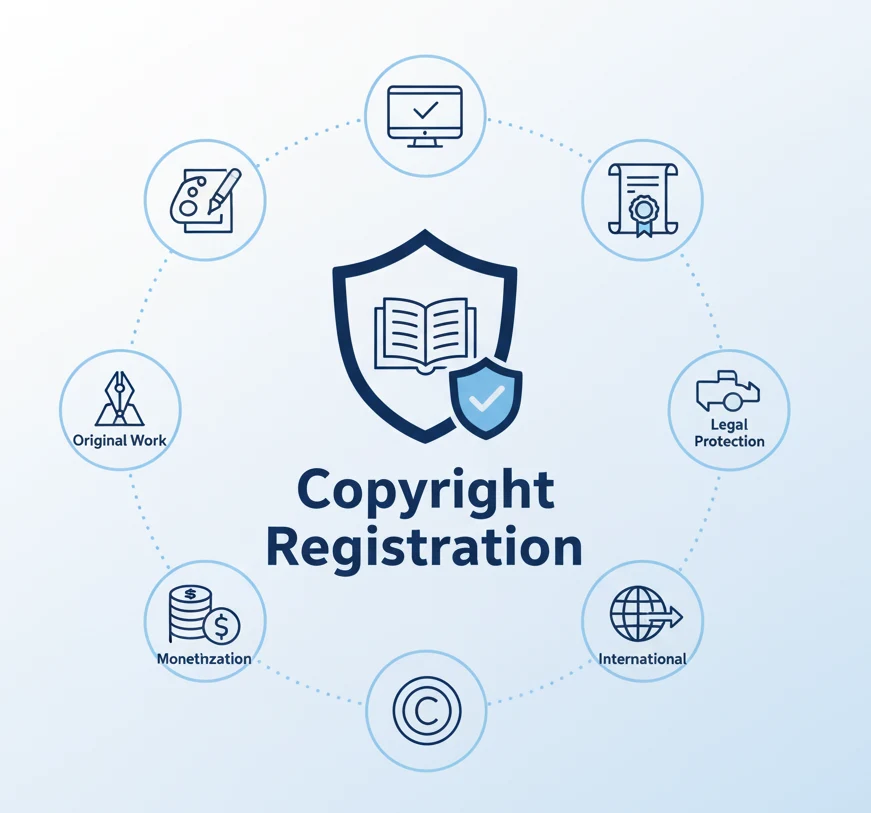
Copyright Registration is the process of legally protecting your original creative works such as books, music, software, films, and artistic creations under the Copyright Act. It grants the creator exclusive rights, prevents unauthorized use, and ensures long-term ownership recognition in legal disputes.
Copyright registration is a legal process that records your ownership of an original creative work. In India, it provides official recognition that you are the rightful author or owner, protecting against unauthorized use, reproduction, or distribution. Although copyright automatically exists once a work is created, registration offers stronger evidence in court. This applies to literary works, artistic works, musical compositions, cinematographic films, sound recordings, and computer software.
At Legal Papers India, we guide creators, businesses, and organizations through the entire registration process, ensuring compliance with all legal requirements. We manage documentation, submission, and follow-up, so you can focus on your work while we secure your rights. Whether you are an author, designer, developer, or producer, copyright registration is a vital step to safeguard your intellectual property. Our approach is precise, lawful, and efficient, ensuring your creative output is officially protected under the Copyright Act, 1957.
Introduction to Copyright Registration in India
Copyright registration in India serves as a formal acknowledgment of the creator’s rights over their work. While the Copyright Act, 1957 automatically protects original creations, registering the work provides stronger enforceability. Registration records the work in the official Register of Copyrights maintained by the Registrar of Copyrights.
This official record acts as primary evidence in infringement disputes, helping the owner claim damages or stop unauthorized usage.
It applies to a wide range of works including books, photographs, films, sound recordings, software, and artistic creations.
Legal Papers India helps creators understand and complete this process correctly, ensuring applications are complete, documents accurate, and filings submitted without delays.
For creators seeking recognition and security, registration in India is both a legal safeguard and a strategic investment in intellectual property rights. It is a vital step in protecting the value of original work.
What is Copyright?
Copyright is an exclusive legal right given to the creator of original works, allowing them to control how their work is used, reproduced, and distributed.
It covers literary, artistic, musical, dramatic works, films, sound recordings, and software.
Copyright prevents others from copying, performing, or adapting the work without permission.
In India, protection arises automatically once a work is created and expressed in a tangible form, but registration strengthens this protection.
The law grants the creator rights to authorize reproduction, translation, adaptation, public communication, and sale of the work.
It is an essential form of intellectual property that safeguards creative output from unauthorized exploitation.
Legal Papers India assists individuals and businesses in understanding their rights under the Copyright Act, 1957.
Our role is to ensure your work receives proper legal recognition, enabling you to exercise full control over its use and benefit commercially from your intellectual efforts.
Importance of Copyright Registration
Aspect
Benefits
Legal Papers India Support
Automatic vs. Registered Copyright
Copyright exists automatically upon creation, but registration creates an official government record
We ensure your registration is filed correctly and documents are complete
Proof of Ownership
Simplifies proving rights in disputes and reduces legal battle risks
We manage the process to provide strong legal evidence of ownership
Enforcement & Damages
Strengthens ability to claim damages and makes enforcement faster and more effective
We help ensure timelines are met so your protection is enforceable
Deterrence
Public records deter unauthorized use
We make certain the registration is visible in official records
Business Value
Increases IP value, enabling licensing or sale
We guide businesses in leveraging copyright for commercial advantage
International Protection
Supports enforcement in treaty-member countries
We provide guidance for international recognition and enforcement
Strategic Importance
Protects long-term creative and commercial interests
We manage the end-to-end process for straightforward, legally secure protection
Overview of the Copyright Registration Process in India
The copyright registration process in India involves a series of clearly defined legal steps. First, the applicant prepares a detailed application with the required documents, including copies of the work. The application is filed online through the official portal or physically at the Copyright Office. Upon submission, the Registrar of Copyrights issues a diary number, marking the official filing date.
This is followed by a 30-day mandatory waiting period, during which objections can be raised.
If no objections are received, or if objections are resolved, the Registrar examines the application for legal compliance.
After successful verification, the Registrar records the work in the Register of Copyrights and issues the official certificate.
Legal Papers India manages each of these stages on behalf of clients, ensuring accuracy, timely submission, and full compliance.
This careful approach minimizes delays and strengthens the chances of quick and successful registration approval.
Packages
Basic
Application initiation within 2 working days
₹20000
50% off
₹9999
+ Govt. Fee (to be paid later)
Lowest Cost first time ever We offer competitive professional fees without compromising on quality
Instant 2000 less Availale for 24 hours to do fastcheck out process and unlock your offer.
What you'll get
Registration for single work
Online filing of application
Digital Copyright Certificate
Standard
Application initiation within 2 working days
₹30000
50% off
₹14999
+ Govt. Fee (to be paid later)
Lowest Cost first time ever We offer competitive professional fees without compromising on quality
Instant 2000 less Availale for 24 hours to do fastcheck out process and unlock your offer.
What you'll get
Inclusive Of Basic
Registration for up to 3 works
Online filing + fee handling
Power of Attorney filing
Regular status updates
Premium
Application initiation within 2 working days
₹40000
50% off
₹19999
+ Govt. Fee (to be paid later)
EMI options available.
Lowest Cost first time ever We offer competitive professional fees without compromising on quality
Instant 2000 less Availale for 24 hours to do fastcheck out process and unlock your offer.
It signals that the creator reserves all rights to reproduction, adaptation, and distribution.
The symbol is recognized internationally and serves as a warning to potential infringers.
For registered works, it complements the legal recognition by making ownership clear to all users.
Legal Papers India advises clients to display the copyright symbol on their works, particularly in digital formats, publications, and commercial products.
This practice asserts ownership, enhances credibility, and works effectively alongside registration to reinforce intellectual property protection in India and abroad.
Why Consider Registering Your Work Under Copyright Law?
Aspect
Individual Ownership
Joint Authorship
Definition
Single creator has full rights over the work
Two or more individuals collaborate and contribute significantly
Rights
Full control over reproduction, adaptation, and distribution
All authors share equal rights unless otherwise agreed in writing
Common Users
Independent authors, artists, developers
Teams, co-creators, collaborative projects
Agreements Needed
Typically, no special agreements required
Clear agreements on usage, licensing, and profit sharing are essential
Legal Protection
Rights secured through registration and documentation
Registration and written agreements help prevent disputes and clarify contributions
Support from Legal Papers India
Assists with registration and documentation
Drafts and reviews agreements, clarifying rights and obligations for all parties
Purpose
Secures the creator’s legal position and exclusive control
Prevents misunderstandings and protects interests of all contributors
Types of Copyrights in India
In India, copyright protection covers the following categories of works under the Copyright Act, 1957:
Literary Works – books, articles, computer programs, and databases.
Artistic Works – paintings, drawings, photographs, sculptures, and architectural designs.
Musical Works – compositions and musical scores.
Sound Recordings – recorded performances or audio files.
Cinematograph Films – visual recordings with or without sound.
Dramatic Works – plays, choreography, and scripts.
Rights Conferred – owners can reproduce, adapt, translate, or distribute their works.
Professional Assistance – Legal Papers India helps identify the correct category to ensure proper classification and reduce the risk of rejection or disputes.
Legal Framework for Copyright Registration in India
The legal framework for copyright registration in India is governed by the Copyright Act, 1957, along with the Copyright Rules, 2013. The Act outlines the rights of creators, the procedure for registration, and penalties for infringement. It recognizes both economic rights (such as reproduction and distribution) and moral rights (such as authorship attribution). Protection extends to original literary, dramatic, musical, artistic works, cinematograph films, and sound recordings. The Registrar of Copyrights, operating under the Ministry of Commerce and Industry, maintains the Register of Copyrights and oversees applications.
Legal Papers India ensures that clients’ applications meet all statutory requirements outlined in the Act and Rules. Our process includes verifying the originality of the work, preparing compliant documentation, and submitting applications on time. Understanding this legal framework is crucial for protecting creative assets, and we guide clients through every stage to ensure full compliance and enforceability of their rights.
Role of the Registrar of Copyrights
The Registrar of Copyrights in India oversees the copyright registration process and handles the following responsibilities:
Application Processing – receives copyright applications and issues diary numbers.
Document Examination – reviews submitted documents and resolves any objections.
Registration Decisions – grants or refuses registration based on compliance.
Public Inspection – manages access to the Register of Copyrights for public viewing.
Legal Record Maintenance – keeps official records for enforcement and dispute resolution.
Dispute Handling – may hold hearings and issue orders in case of conflicts.
Professional Assistance – Legal Papers India ensures filings comply with procedural standards, tracks applications, responds to notices, and manages communications with the Registrar’s office.
International Copyright Conventions
India’s international copyright agreements allow creators to protect their works beyond national borders:
Berne Convention – automatic protection in other member countries without separate registration.
Universal Copyright Convention (UCC) – provides standardized international copyright recognition.
TRIPS Agreement (WTO) – ensures minimum global standards for intellectual property protection.
World Intellectual Property Organization (WIPO) – coordinates international copyright protections.
Professional Assistance – Legal Papers India ensures Indian registrations comply with global standards and helps creators leverage these conventions for international enforcement.
Legal Rights of a Copyright Owner
Exclusive Rights Under the Copyright Act, 1957
Copyright owners are granted a set of exclusive rights under the Copyright Act, 1957, allowing them to control how their work is used. These rights include reproducing the work, issuing copies to the public, performing or displaying it publicly, adapting or translating it, and communicating it to the public. Owners can also license or sell these rights to derive commercial benefits from their creations.
Moral Rights of Authors
In addition to economic rights, authors enjoy moral rights, which ensure recognition and protect their work from distortion or modification that could harm their reputation. These rights acknowledge the personal connection between the author and their creation, safeguarding both integrity and attribution.
Duration of Copyright
Copyright protection generally lasts for the life of the author plus sixty years after their death, although the exact duration may vary depending on the type of work. This extended period allows owners and their heirs to continue benefiting from the work over the long term.
Legal Support by Legal Papers India
Legal Papers India helps copyright owners understand, enforce, and monetize their rights effectively. Our services include assistance with licensing agreements, managing infringement actions, and negotiating usage terms. We also guide clients through the registration process, which strengthens legal standing and enhances the ability to exercise rights in court. With proper legal support, copyright owners can maintain full control over the use, distribution, and commercialization of their creative works.
Copyright Registration Process in India
Step 1: Prepare the Application - Collect necessary details, including copies of the work, author’s information, and classification of the work.
Step 2: File Online or Offline - Submit the application through the official portal or at the Copyright Office with the required fee.
Step 3: Receive Diary Number - Once filed, the Registrar issues a diary number to track the application.
Step 4: Wait for the Objection Period - A 30-day period allows third parties to file objections, if any.
Step 5: Examination by Registrar - If no objection or once resolved, the application is examined for compliance.
Step 6: Registration and Certificate - Upon approval, the work is entered in the Register of Copyrights and a certificate is issued.
Documents Required for Copyright Registration in India
Applicants must submit the following documents for smooth copyright registration in India:
Completed Form XIV – accurate details of the work being registered.
Copies of the Work – three copies for literary or artistic works; for software, include both source code and object code (in part).
Registration Fee Proof – demand draft or payment receipt.
Power of Attorney – required if filing through an agent, signed by the applicant.
Identity and Address Proof – PAN card, Aadhaar card, or passport of the applicant/author.
Publication Details – for published works, include publication date and publisher information.
Professional Assistance – Legal Papers India verifies documents, ensures proper formats, size limits, and labeling to meet Registrar requirements and prevent technical rejection.
Issuance of Diary Number in Copyright
Aspect
Details
Definition
A diary number is issued once the application is officially received by the Registrar of Copyrights.
Purpose
Serves as the reference number for all future correspondence regarding the registration.
Significance
Confirms the application has been accepted for processing and marks the start of the 30-day objection period.
Public Scrutiny
Application is open to third-party objections during the 30-day period.
Tracking Objections
Diary number is used to track hearings and communications if objections are filed.
Support from Legal Papers India
Secures the diary number promptly, updates clients, and monitors the objection period.
Procedural Milestone
Marks the transition of the application into the examination phase, leading toward copyright registration and certificate issuance.
Handling Copyright Objections
Handling objections to a copyright application in India involves the following steps:
Objection Notice – the Registrar issues a notice to the applicant specifying the objection.
Response Submission – provide a written reply within the given timeframe, including legal arguments and evidence of ownership.
Hearing (if required) – both parties may present their case before the Registrar.
Decision – the Registrar evaluates the submissions and issues a ruling on the objection.
Professional Assistance – Legal Papers India prepares comprehensive replies, manages communication with the Registrar, attends hearings if necessary, and ensures objections are resolved efficiently.
Timely Action – failure to respond can result in rejection of the application, making prompt and accurate handling essential.
Copyright Registration Fees in India
In India, copyright registration fees vary depending on the type of work and the applicant category.
Literary, artistic, and musical works typically attract lower fees compared to cinematographic films or sound recordings.
Fees are also different for individual authors and organizations or businesses.
Payment can be made online or through a demand draft in favor of the Registrar of Copyrights.
Additional costs may arise if professional services are used for drafting and filing.
Legal Papers India offers competitive, transparent pricing for handling complete copyright registration, from documentation to certificate issuance.
We inform clients of the exact government fee applicable to their case and ensure timely payment to avoid rejection.
Clear knowledge of fees helps applicants budget effectively and prevents surprises during the process.
Proper fee submission is essential, as applications without the prescribed payment are not accepted for processing by the Registrar.
Duration and Validity of Copyright
The duration of copyright protection in India depends on the type of work. For literary, dramatic, musical, and artistic works, protection lasts for the author’s lifetime plus 60 years after their death. For cinematograph films, sound recordings, photographs, and works of government or international organizations, the term is 60 years from the date of publication. This extended period ensures the creator or their legal heirs enjoy exclusive rights for a substantial time.
Once the term expires, the work enters the public domain and can be used without permission. Legal Papers India helps track the validity period for registered works and advises on renewal where applicable. Understanding the protection term allows creators to plan licensing, publication, and monetization strategies effectively. Securing registration early maximizes the time during which the owner can exercise control and derive commercial benefits from their intellectual property.
Renewal and Cancellation of Copyright
Renewal of Copyrights in India : In India, most copyrights do not require renewal during their protection term, as the duration is fixed by law. However, certain categories, such as broadcasting rights, may need periodic renewal to maintain legal protection.
Cancellation of Copyrights : A copyright may be cancelled under specific circumstances, including if the registration was obtained through fraud, if the work is later found not original, or by a court order. Additionally, owners may choose to voluntarily surrender their rights, but such actions must be formally recorded with the Registrar.
Legal Support by Legal Papers India : Legal Papers India guides clients on whether renewal is applicable for their specific category of work and handles the process when required. We also assist in defending against cancellation attempts by providing evidence of originality and lawful registration. Professional guidance ensures creators retain protection for the entire legal term and minimizes risks of procedural errors or legal challenges that could compromise the copyright’s validity.
Rights Granted by Copyright Registration
Exclusive Rights Through Registration :
Copyright registration grants the owner exclusive rights over their work, including the ability to reproduce it, issue copies, perform or communicate it to the public, translate or adapt it, and license or sell it. These rights enable creators to control commercial use, prevent unauthorized exploitation, and claim damages in cases of infringement.
Moral Rights of Authors :
In addition to economic rights, authors retain moral rights that protect their name and reputation. These rights prevent distortion, alteration, or misuse of the work that could harm the author’s standing.
Legal Strength of Registration :
Registration provides legal proof of ownership, strengthening the ability to enforce rights in court. Legal Papers India ensures clients understand each right and how it can be applied. We assist in drafting licensing agreements, managing negotiations, and pursuing legal action against violators.
Commercial and Long-Term Benefits :
Having registered copyright offers a competitive advantage, allowing creators to monetize their work through controlled licensing while safeguarding against misuse. These rights remain enforceable for the duration specified under the law, ensuring long-term benefits for the copyright owner.
Copyright Infringement and Legal Remedies
Copyright infringement occurs when a protected work is used, reproduced, or distributed without the owner’s permission. Common violations include unauthorized copying, adaptation, public performance, or sale of the work. Legal remedies include civil actions for injunctions to stop the infringement, monetary damages, and seizure of infringing copies. Criminal penalties, including fines and imprisonment, may apply in serious cases. Registration strengthens enforcement by serving as legal proof of ownership. Legal Papers India assists clients in detecting infringement, collecting evidence, and initiating legal action.
We also handle negotiations for settlement when appropriate. Acting quickly is essential to limit losses and prevent further unauthorized use. With the right legal strategy, owners can recover damages and reinforce their rights. Infringement cases can be complex, making professional assistance critical to securing a favorable outcome in both civil and criminal proceedings.
Copyright Exceptions and Fair Use
Fair use refers to specific situations where copyrighted material can be used without permission. In India, exceptions under Section 52 of the Copyright Act allow uses such as private study, research, criticism, review, reporting current events, and certain educational purposes. Libraries, archives, and judicial proceedings also benefit from these exceptions.
The scope of fair use depends on factors like the purpose, nature of the work, amount used, and effect on the market.
Legal Papers India helps creators understand how fair use applies to their works and advises on enforcement where exceptions do not apply.
Misunderstanding fair use can lead to disputes or lost revenue.
While these exceptions protect public interest, they do not permit unrestricted copying.
Balancing the rights of creators and the needs of users is central to copyright law, and knowing these boundaries helps avoid unintentional violations.
Copyright Exceptions in India
The Copyright Act, 1957 provides the following exceptions allowing use of copyrighted works without infringement:
Personal or Private Use :Reproduction for individual, non-commercial purposes.
Criticism and Review: Use for commentary, analysis, or review of the work.
Reporting Current Events : Inclusion of copyrighted material in news or media reporting.
Educational Use : Use in teaching or research within educational institutions.
Religious or Judicial Performances : Works performed during religious ceremonies or in court proceedings.
Accessibility for Visually Impaired : Reproductions or performances for persons with visual impairments.
Professional Guidance : Legal Papers India advises clients on applying these exceptions correctly to avoid disputes and focus enforcement on genuine infringements.
Difference between Copyright, Patents, Trademarks, and Trade Secrets
Aspect
Copyright
Patents
Trademarks
Trade Secrets
Definition
Protects original creative works like literature, art, music, and software
Safeguards inventions and technical innovations
Protects brand identifiers like names, logos, and slogans
Protects confidential business information, such as formulas, processes, or methods
Purpose
Ensures creators control reproduction, adaptation, and distribution
Grants exclusive rights to inventors for a limited period
Prevents misuse of brand identifiers in commerce
Maintains competitive advantage by keeping information secret
Duration
Typically lifetime of author + 60 years
Usually 20 years from filing date
Can be renewed indefinitely as long as used
As long as secrecy is maintained
Registration
Optional but strengthens legal protection
Mandatory for legal protection
Optional but recommended for stronger enforcement
No registration; relies on confidentiality measures
Legal Requirements
Originality and creativity required
Novelty, non-obviousness, and industrial applicability
Distinctiveness and use in commerce
Reasonable measures to maintain secrecy
Common Uses
Books, music, software, art
Gadgets, processes, new technology
Company names, logos, product names, slogans
Recipes, formulas, business strategies, manufacturing processes
Support from Legal Papers India
Advises on registration, ownership, and strategy
Assists with filing, documentation, and protection
Guides on registration, enforcement, and monitoring
Helps implement confidentiality agreements and protection strategies
Conditions for Filing a Copyright Application
Eligibility Requirements
The work must be original and expressed in a tangible form (e.g., written text, recorded sound, digital files).
The applicant must be the creator or legal owner of the copyright.
Declarations and Authorizations
Unpublished works require a declaration of originality.
Filing on behalf of another person requires a Power of Attorney.
Classification of Work
The work must be correctly classified under the categories defined by the Copyright Act, 1957.
Fee Payment
Payment of the applicable filing fee is mandatory.
Legal Papers India Support
Verifies originality of the work.
Prepares proper classification and necessary declarations.
Ensures all conditions are met to avoid rejection or delays.
Benefits of Proper Preparation
Strengthens the legal standing of the registered copyright.
Prevents complications or disputes during enforcement or licensing.
Online vs. Offline Submission
Aspect
Online Filing
Offline Filing
Definition
Application submitted through the official copyright portal
Application physically submitted at the Copyright Office
Speed & Convenience
Faster processing, instant acknowledgment, easy tracking via diary number
Slower processing due to physical submission
Location Advantage
Suitable for applicants outside Delhi
Requires physical presence or courier to Delhi office
Document Handling
Legal Papers India ensures correct formatting and upload
Legal Papers India ensures documents are properly compiled for submission
Recommendation
Recommended for efficiency and convenience
Used when online access is not possible
Critical Factor
Accuracy and completeness crucial for timely approval
Accuracy and completeness crucial for timely approval
Professional Support
Helps avoid procedural errors and delays
Helps avoid procedural errors and delays
Checking the Status of Your Copyright Application
After filing, applicants can check the status of their copyright application online using the diary number issued by the Registrar.
The status updates reflect key stages such as “waiting for documents,” “under examination,” “objection received,” or “registered.”
Regular monitoring ensures timely responses to any notices or objections.
For offline applicants, status updates may require direct inquiry with the Copyright Office.
Legal Papers India tracks all applications on behalf of clients, providing regular updates and addressing issues immediately.
This proactive monitoring prevents missed deadlines and accelerates resolution of any procedural concerns.
Knowing the application status also offers reassurance to the applicant, confirming that the process is moving forward.
A well-monitored application has a higher chance of smooth completion without unnecessary delays or complications, making status tracking a vital part of the registration process.
Why Choose Legal Papers India for Copyright Registration?
Comprehensive Filing Support
Verification of originality of the work.
Preparation and submission of copyright applications.
Handling objections and securing the final registration certificate.
Compliance and Accuracy
Ensures filings meet the Copyright Act, 1957 and Registrar’s guidelines.
Minimizes risk of rejection by addressing technical details upfront.
Keeps clients informed throughout the process.
Expert Classification and Documentation
Guidance on accurate work classification across multiple categories.
Assistance in documentation and declarations to strengthen applications.
Post-Registration Support
Help with licensing agreements, enforcement, and international protection strategies.
Client Benefits
Efficient, secure, and error-free copyright registration.
Professional guidance ensures creative assets are safeguarded and rights are ready for enforcement.
Frequently Asked Questions
Is copyright registration mandatory in India?
No, but it provides strong legal evidence of ownership and aids enforcement.
How long does the process take?
It usually takes 8–10 months, depending on objections and examination delays.
Can software be copyrighted?
Yes, as a literary work under the Copyright Act.
Does registration cover international protection?
Yes, in countries that are members of relevant copyright treaties.
Can I register unpublished works?
Yes, with a declaration of originality.
What if my application is rejected?
Legal Papers India can help revise and refile with corrected details.
Social Share:
Why Choose Us
Expert Guidance
Providing reliable compliance and business support with accuracy, transparency, and trust. Our experienced professionals ensure smooth compliance and help businesses grow.
Time-Saving Process
We simplify complex tax and compliance procedures with efficiency and accuracy, ensuring quick documentation and approvals so your business can focus on growth seamlessly.
Affordable Pricing
We offer cost-effective registration and compliance solutions without compromising on quality, ensuring every business receives professional support within a transparent and fair budget.
Trusted by Thousands
Our commitment to excellence and customer satisfaction has earned the trust of countless clients who rely on us for seamless registration and business compliance services.
Compliance Alerts
Stay updated with timely reminders and notifications about renewals, filings, and registration to ensure your business remains fully compliant without missing any deadlines.
Secure and Confidential
We prioritize data protection with advanced security measures, ensuring all your business and personal information remains completely safe, private, and handled with utmost confidentiality.
Register Your Business with Confidence
We handle everything from paperwork to compliances and making company registration simple and stress-free.
NOW YOUR COMPLIANCE PARTNER ONE CLICK AWAY WITH LEGAL PAPERS INDIA APP !
Download our free application from Play store to get current time compliances update and track your order status.
Easy to connect with our professional on call, chat & email.