
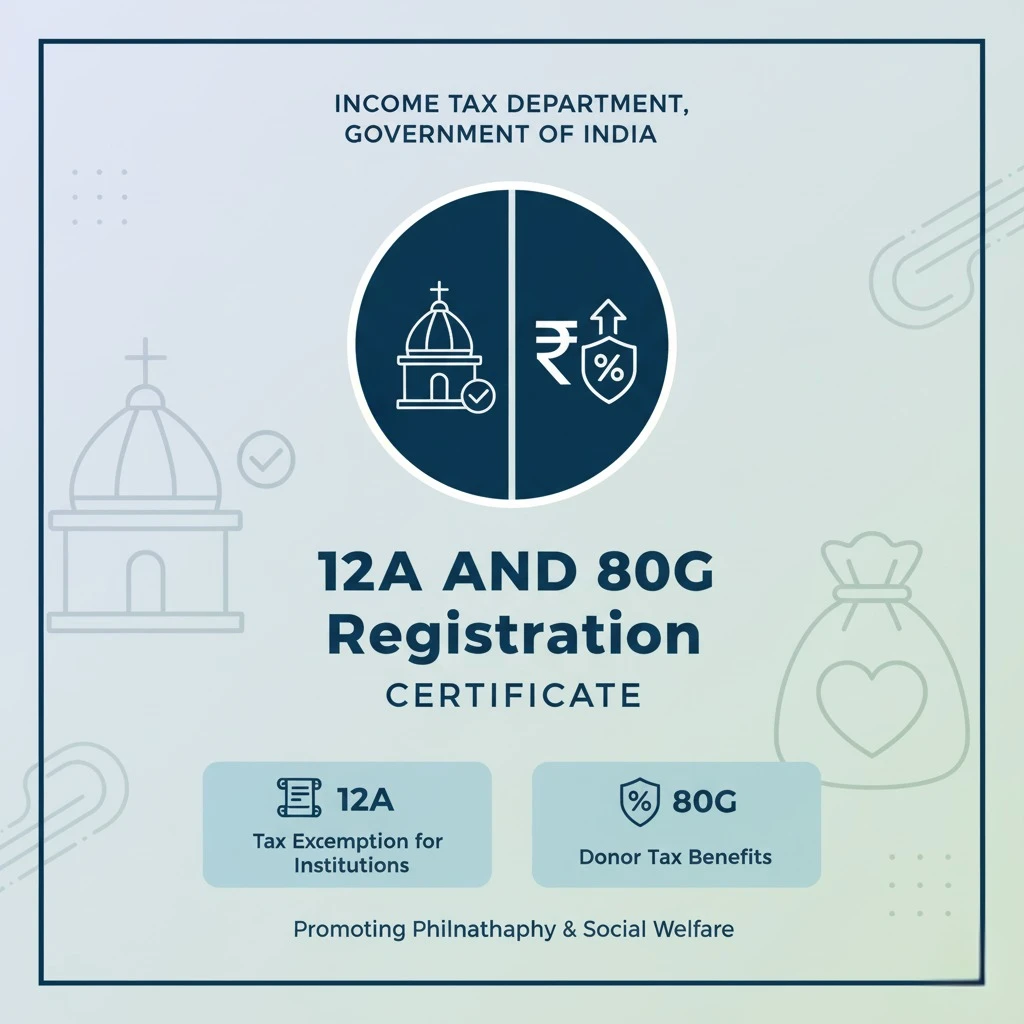
12A & 80G Registration in Bhopal
For Bhopal-based NGOs, 12A and 80G-type registrations serve two connected but different purposes: recognition for eligible income-tax exemption and approval that enables qualifying donors to claim tax deductions. Since 1 April 2026, fresh applications operate under the Income-tax Act, 2025, so organisations should first identify whether provisional or regular registration applies before preparing documents.
Legal Papers India assists NGOs in Bhopal through a remote consultation and documentation model from its Delhi and Noida offices. There is no need to represent the service as a physical Bhopal branch; the supplied brief specifically defines the business as Pan-India with remote service unless a city office is separately verified.
This distinction matters because an NGO that has not started activities may follow a different filing route from an established organisation already collecting donations or running charitable programmes.
Practical recommendation: verify the organisation's activity status and previous Income Tax registrations before deciding which form to file.
Why Bhopal NGOs Should Plan Tax Registration Around Their Fundraising Model
NGOs in Bhopal may operate across education, healthcare, community welfare, environmental initiatives, religious-charitable activities and other public-benefit programmes. Their registration strategy should therefore be based not only on entity type but also on how the organisation earns income, conducts activities and expects to raise donations.
The practical difference is straightforward:
| Requirement |
Main Purpose |
Why It Matters |
|
Registration under the tax-exemption framework |
Supports eligible income-tax exemption |
Important for the NGO itself |
|
Donation-related approval |
Supports eligible donor deductions |
Important for fundraising |
|
Both |
Covers organisational and donor-facing objectives |
Relevant for many donation-funded NGOs |
Under the current framework, Form 105 allows an NPO to select an application under section 332, section 354, or both, depending on its circumstances. The Department also states that section 354 approval has registration-related prerequisites that applicants need to satisfy.
For example, a Bhopal educational society that mainly depends on donations may need to consider both organisational tax status and donor deduction approval. A newly created charitable trust that has not started operations may first need to evaluate the provisional route.
Common mistake: treating 12A and 80G as two names for the same certificate. Their tax functions are different.
Decision guideline: start with the NGO's fundraising and activity model, then determine which registration/approval is actually required.
Which Organisations in Bhopal Should Evaluate 12A & 80G Registration?
Charitable trusts, registered societies and Section 8 companies are among the principal organisation types that may apply under the current NPO registration framework. Form 105 expressly identifies public trusts, societies registered under applicable law, and Section 8 companies among recognised applicant categories.
Common Bhopal applicants can include:
- Public Charitable Trusts;
- Registered Societies;
- Section 8 Companies;
- Education-Focused Ngos;
- Healthcare And Community-Health Organisations;
- Social-Welfare Institutions;
- Environmental Organisations;
- Religious-Cum-Charitable Organisations;
- Newly Incorporated Non-Profits; And
- Established Ngos Seeking Renewal Or Regular Registration.
Entity formation and tax registration should not be confused. Forming a society or incorporating a Section 8 company establishes the organisation under the relevant entity law; it does not automatically grant the tax treatment associated with 12A or donor-related approval.
Another important distinction concerns activities. For section 354-related applications, Form 105 limits the displayed nature-of-activity choices to
Charitable and Public Religious and Charitable.
Overlooked requirement: review the objects written in the trust deed, memorandum or constitutional documents against the activities actually being carried out.
Practical example: if a Bhopal society was formed for education but later starts unrelated activities, its constitutional documents and registration position should be reviewed before filing.
Choosing Form 104 or Form 105 for a Bhopal NGO
The correct form depends primarily on whether charitable activities have commenced and the organisation's existing registration status. For applications filed after 1 April 2026, Form 104 is the provisional-registration route corresponding to the former Form 10A, while Form 105 handles regular registration or approval under sections 332 and 354.
The Income Tax Department's Form 104 guidance specifically says that where activities have already started, Form 104 is not applicable and the organisation should file Form 105 for registration or approval.
| Situation |
Route to Evaluate |
Key Check |
|
New NGO; activities not started |
Form 104 |
Provisional registration/approval |
|
Activities already commenced |
Form 105 |
Operational and activity evidence |
|
Provisional registration expiring |
Form 105 |
Filing category and validity |
|
Existing registration due for renewal |
Form 105 |
Current order and validity period |
|
Objects have been modified |
Form 105 |
Revised objects and supporting records |
|
Registration + donation approval required |
Form 105 where applicable |
Select 332, 354 or both |
The Department describes Form 105 as the consolidated regular application used when activities have commenced, provisional registration is expiring, existing registration requires renewal or organisational objects have changed.
Compliance warning: older websites may still tell every NGO to file Form 10A or Form 10AB. That advice should not be followed blindly for a fresh post-April-2026 application.
Expert tip: check both the filing date and applicable Tax Year on the portal because old and new form versions can coexist during the transition.
Documents to Prepare for 12A & 80G Registration in Bhopal
Document requirements vary according to the NGO's legal structure, operational history and application category. Form 105 examines applicant particulars, previous recognition, office bearers, operations, assets and liabilities, income, religious activities and supporting attachments, so established organisations generally need more than their basic registration certificate.
| Applicant |
Important Records to Prepare |
|
Charitable Trust |
Trust deed, PAN, trustee details, registration records, activity/financial evidence |
|
Registered Society |
Registration certificate, memorandum/rules, PAN, governing-body information |
|
Section 8 Company |
Incorporation documents, MOA/AOA, PAN, director/office-bearer details |
|
Newly Formed NGO |
Constitution documents, PAN, authorised-person details and provisional filing records |
|
Operating NGO |
Activity records, accounts, existing orders and earlier tax registrations |
|
Educational/Healthcare NGO |
Entity documents plus evidence supporting stated charitable activities |
Form 105 requires an active PAN and registered e-Filing user profile; where DSC verification is used, the DSC must be valid and registered on the portal. Previous registration history also matters. Form 105 asks whether an earlier registration or approval application was rejected, and the filing treatment can differ depending on whether a previous rejection arose under the old or new framework.
Common mistake: uploading entity documents without checking whether names, addresses, office-bearer details and objects are consistent across the records.
Checklist: reconcile PAN, registration records, governing documents, earlier Income Tax orders and current organisational details before submission.
Existing 12A or 80G Approval: Should a Bhopal NGO Apply Again?
An existing approval does not automatically become invalid because the Income-tax Act, 2025 took effect on 1 April 2026. The Income Tax Department states that an approval or recognition granted under the 1961 Act continues where it is not inconsistent with corresponding provisions of the 2025 Act.
This creates three practical cases.
Existing valid registration:
Check its validity and future compliance requirements before filing anything new.
Application pending on 31 March 2026:
Applications filed during FY 2025–26 and still pending on that date continue to be disposed of under the Income-tax Act, 1961. A fresh application is not required solely because the new Act commenced.
Fresh application after 1 April 2026:
Apply under the new forms and provisions applicable to the organisation's circumstances.
This distinction is particularly important for older Bhopal trusts and societies that already possess registration orders but are unsure whether the 2026 transition means they must start again.
Decision framework: check the date, validity and type of the existing order first.
Compliance warning: filing a duplicate application simply because legislation changed can create unnecessary procedural confusion.
Professional Assistance: Where It Adds Practical Value
Professional assistance is most useful when the difficulty lies in choosing the correct application route, reconciling historical registrations or presenting the organisation's records consistently. The Income Tax Department examines the NPO's objects, activities and compliance position, so professional support should improve preparation rather than be marketed as a guarantee of approval.
For Bhopal applicants, assistance can be particularly relevant where:
- The Organisation Has Already Started Activities;
- Provisional Registration Is Nearing Expiry;
- Governing Objects Have Changed;
- An Earlier Application Was Rejected;
- Old 12a/12ab Or 80g Orders Need Review;
- Both Registration And Donation Approval Are Being Considered;
- Organisational Records Contain Inconsistencies; Or
- The Department Requests Additional Information.
A useful safeguard under the new system is that Form 105 can be withdrawn within seven days of filing if the applicant discovers an error.
Buyer hesitation point: ask exactly what the quoted professional fee covers—document review, filing, clarification of application category, query handling and post-registration guidance should not be assumed unless stated.
Expert recommendation: avoid consultants who promise guaranteed approval or present themselves as an Income Tax authority. Get to know About Us
Cost and Timeline for 12A & 80G Registration in Bhopal
There is no credible single professional price or guaranteed approval period for every Bhopal NGO because the work varies substantially between a new provisional applicant and an established organisation seeking regular approval. Application history, document quality, changes in objects and departmental examination can all affect the effort and timeline.
Key factors include:
| Factor |
Effect on Work |
|
Provisional vs regular application |
Changes filing route and supporting evidence |
|
One approval vs combined application |
Changes application scope |
|
Existing registration history |
Requires order and validity review |
|
Modified objects |
Requires constitutional-document assessment |
|
Previous rejection |
May affect filing treatment |
|
Inconsistent records |
Requires correction/reconciliation |
|
Departmental examination |
Can create additional response work |
After Form 105 is submitted and examined, the Income Tax Department may issue its order in Form 107. Where regular registration or approval is granted, the Department states that a 16-digit Unique Registration Number (URN) is issued and must be used in future compliances.
Form 105 also contains registration-period options. The Department notes that eligible section 332 applicants may have 5-year or 10-year registration options subject to statutory conditions, whereas section 354 approval is for five years in the relevant Form 105 workflow.
Pricing recommendation: compare written scope rather than choosing purely on the lowest advertised “certificate cost.”
Approval-delay consideration: incomplete historical information, inconsistent objects/activities and weak supporting records can make an otherwise straightforward application more difficult.
Frequently Asked Questions
1. How can an NGO apply for 12A Registration in Bhopal in 2026?
For fresh applications after 1 April 2026, the organisation should first determine whether its activities have started. An NGO that has not commenced activities can apply for provisional registration through Form 104. If activities have already started, the Income Tax Department directs applicants towards Form 105 for regular registration or approval.
2. Can a newly registered Bhopal trust apply before receiving donations?
A newly established eligible trust that has not commenced activities can consider the provisional registration/approval framework. Form 104 specifically covers provisional applications where activities have not started. The trust should nevertheless have its entity records, PAN and portal-related requirements in order before filing rather than waiting until fundraising creates an urgent compliance requirement.
3. Is 80G Registration in Bhopal compulsory for every NGO?
No. Donation-related approval is not simply an automatic compulsory certificate for every non-profit. It becomes particularly relevant where an eligible organisation wants qualifying donors to access applicable tax deductions. The organisation should separately assess its own tax-registration requirements and its fundraising model instead of assuming that entity registration alone provides donor benefits.
4. Can a Section 8 company in Bhopal apply?
Yes. The current Form 105 framework expressly lists companies registered under section 8 of the Companies Act, 2013 among eligible applicant categories under section 332. Incorporation itself, however, does not automatically grant tax registration or donor-related approval; these are separate Income Tax compliance matters requiring the appropriate application.
5. What is the cost of 12A and 80G Registration in Bhopal?
Professional charges depend on the NGO's circumstances rather than simply its city. A newly established organisation seeking provisional registration may require a different scope from an operating NGO with historical approvals, amended objects or previous rejection. Before engaging a consultant, request a written quotation stating what document review, filing and post-filing assistance are included.
6. Does an old 12A/80G certificate become invalid after April 2026?
Not merely because the new Income-tax Act commenced. The Income Tax Department confirms that recognition or approval granted under the 1961 Act continues to operate, so far as it is not inconsistent with the corresponding provisions of the 2025 Act. Existing NGOs should therefore check their actual approval and validity rather than automatically filing again.
7. What if our Bhopal NGO started charitable activities before applying?
If activities have already commenced, Form 104 is not the appropriate provisional route. The Department's Form 104 guidance expressly directs such organisations to Form 105 for registration or approval. Activity records, financial information and consistency between actual operations and stated objects become particularly important when preparing a regular application.
8. Can a religious organisation in Bhopal obtain 80G-type approval?
The nature of the organisation and its activities must be examined carefully rather than treating every religious institution identically. Under Form 105, when section 354 or “Both” is selected, the nature-of-activity choices available are Charitable and Public Religious and Charitable. The organisation's constitutional objects and actual activities therefore require careful review before filing.
9. What happens if the NGO changes its objects after registration?
A modification of organisational objects can trigger the need to review or file through the regular registration framework. The Income Tax Department specifically identifies modification of objects as one of the situations in which Form 105 is generally used. Do not wait until renewal to check the effect of a material constitutional change.
10. Do we need to visit a Legal Papers India office in Bhopal?
No physical Bhopal office is stated in the supplied brief. Legal Papers India operates on a Pan-India service model, with Delhi and Noida identified as head-office locations and remote documentation and consultation intended for other cities. This allows a Bhopal organisation to seek assistance without creating a false local-office representation.
Make the Filing Decision Before Preparing the Application
For a Bhopal NGO, the most important first decision is not simply “12A or 80G?” It is determining the organisation's current compliance position: activities not started, activities underway, provisional approval held, existing registration approaching renewal, objects modified, previous rejection, or an old approval still valid.
That assessment determines which form and supporting evidence should be considered. It also reduces the risk of relying on pre-April-2026 instructions that still refer exclusively to Form 10A or Form 10AB.
Legal Papers India can assist Bhopal-based trusts, societies, Section 8 companies and other eligible non-profits through remote consultation and document review from its Delhi and Noida offices.
Simplify Compliance with Legal Papers India. Contact Us
Legal Papers India Business Solution Private Limited, F 2, Sector 8, Noida, Uttar Pradesh, 201301
Monday to Saturday 10:00 AM to 06:30 PM





Please submit all general enquiries in the contact form below and we look forward to hearing from you soon.


Captcha:











Or sign in with:
LOGIN WITH GOOGLESign up for early Sale access plus tailored new arrivals, trends and promotions. To opt out, click unsubscribe in our emails.
Forgot your password? No worries! Enter your registered email to receive a link and securely reset it in just a few steps.