
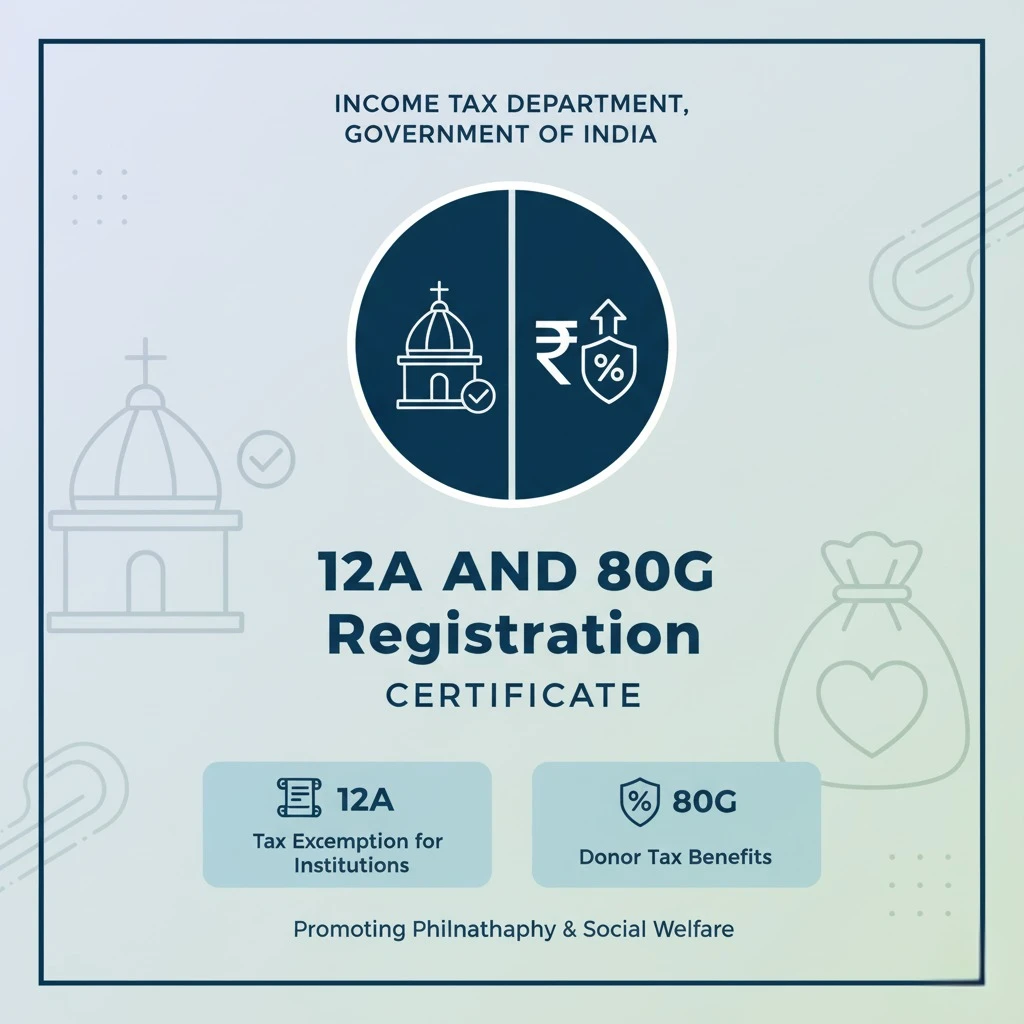
12A & 80G Registration in Bhubaneswar
For a Bhubaneswar NGO, the first compliance question in 2026 is not simply whether it wants “12A and 80G.” The organisation must determine whether it has started charitable activities, whether an earlier approval exists, and whether it needs organisational registration, donor-related approval, or both.
The regulatory framework changed from 1 April 2026. Regular registration under section 332(3) and regular donation-related approval under section 354(2) of the Income-tax Act, 2025 now use Form 105, filed electronically under Rule 181 of the Income-tax Rules, 2026. After examination, approval is issued through Form 107 with a 16-digit Unique Registration Number.
Legal Papers India assists Bhubaneswar organisations remotely from its Delhi and Noida offices. The supplied brief specifically requires Pan-India remote consultation and prohibits an unverified local office or registration-centre claim.
Practical recommendation: identify the NGO’s legal structure, activity commencement date, old registration history and current fundraising plans before deciding what to file.
Bhubaneswar NGOs Often Operate Across Government, CSR and Voluntary-Sector Frameworks
Bhubaneswar has a strong government-linked social-welfare ecosystem, so many NGOs may interact with welfare departments, CSR programmes, voluntary-organisation platforms or disability-sector registrations in addition to Income Tax compliance. These systems can complement one another, but they do not replace 12A/80G-type registration.
Odisha’s State Social Welfare Board specifically works with registered voluntary organisations, promotes welfare organisations and supports programmes involving women, children, persons with disabilities and weaker sections. Its stated functions include scrutinising voluntary organisations and supporting approved welfare programmes.
The state’s Loka Kalyan NGO empanelment system separately requires registered NGOs to disclose geographical areas of operation, thematic expertise, notable work and organisational documentation, while committing to reporting, audit and transparency obligations.
| Bhubaneswar NGO Situation |
Main Tax Question |
Other Compliance Layer |
|
Women/child welfare NGO |
Is tax registration current? |
Odisha welfare programmes |
|
Disability NGO |
Is donor approval also needed? |
RPwD-related registration |
|
CSR implementing organisation |
Does fundraising status align? |
Odisha CSR platform |
|
Healthcare NGO |
Do activities match charitable objects? |
Health-sector programme records |
|
New charitable trust |
Have activities started? |
Entity-registration records |
|
Existing society |
Is renewal or regularisation required? |
Previous tax orders |
Common mistake: assuming state empanelment, CSR participation or government programme recognition automatically creates Income Tax exemption or donor deduction eligibility.
Decision guideline: treat welfare registration, CSR implementation and Income Tax approval as separate compliance tracks.
Who Should Evaluate 12A and 80G Registration in Bhubaneswar?
Public charitable trusts, societies, Section 8 companies and other qualifying non-profit organisations should review their tax-registration position where they seek eligible income-tax treatment or approval for qualifying donor deductions.
The current Form 105 framework expressly recognises public trusts, societies registered under applicable law and Section 8 companies among eligible organisational categories under section 332.
Typical Bhubaneswar applicants can include:
- Social-Welfare Trusts;
- Women And Child Development Organisations;
- Disability-Support Ngos;
- Section 8 Companies;
- Educational Societies;
- Healthcare Charities;
- Rural-Development Organisations;
- Cultural And Community Organisations;
- Public Religious And Charitable Institutions; And
- Newly Formed Ngos Preparing For Institutional Or Individual Fundraising.
Bhubaneswar also sits within Odisha’s wider CSR ecosystem. The state CSR portal lists implementing agencies including trusts, societies and Section 8 entities across themes such as education, skill development, gender equality, rural development and social inclusion.
Overlooked requirement: being eligible as an NGO or CSR implementing agency does not automatically mean the organisation has the correct Income Tax registration. Each approval serves a different legal purpose.
Form 104 or Form 105? Activity Status Is the First Filing Filter
Fresh provisional applications after 1 April 2026 should be assessed under Form 104, while an organisation whose activities have commenced or whose existing registration is reaching a regular-registration trigger generally needs to review Form 105.
Form 105 covers regular registration under section 332 or regular approval under section 354 and is generally used where activities have commenced, provisional registration is expiring, existing registration is due for renewal, or the organisation has modified its objects.
| NGO Status |
Route to Review |
Common Filing Risk |
|
Newly formed; activities not started |
Form 104 |
Using legacy Form 10A guidance |
|
Activities already commenced |
Form 105 |
Treating first-time applicant as provisional |
|
Provisional registration expiring |
Form 105 |
Missing regular application |
|
Existing approval due for renewal |
Form 105 |
Assuming validity is indefinite |
|
Objects modified |
Form 105 |
Not reflecting constitutional changes |
|
Registration + donor approval |
Section 332 + 354 review |
Selecting the wrong combination |
For section 354 approval, the Income Tax Department states that the NPO must generally have the required registration position under section 332 or corresponding legacy provisions, or make the relevant simultaneous application.
Compliance warning: current competitor content still creates confusion. IndiaFilings pages published in July and August 2026 continue to foreground Form 10A/10AB and the Income-tax Act, 1961 process, while ClearTax also continues to explain Form 10AB as the core registration/revalidation route.
That makes current Form 104/Form 105 treatment an important trust and ranking advantage for this page.
Documents Bhubaneswar NGOs Should Reconcile Before Filing
The correct supporting-record set depends on the legal form and registration history, but every application should present a consistent organisation: same legal identity, management, charitable objects, activity history and previous tax-registration details.
Form 105 includes sections dealing with applicant particulars, previous recognition, office bearers, operations, assets and liabilities, income, religious activities and attachments. It requires an active PAN, a registered e-Filing profile and, where DSC verification is used, a valid registered DSC.
| Organisation |
Records to Review |
|
Charitable Trust |
Trust deed, PAN, trustee details, registration and activity records |
|
Registered Society |
Registration certificate, memorandum/rules, PAN, governing body |
|
Section 8 Company |
Incorporation documents, MOA/AOA, PAN, directors/signatory |
|
New NGO |
Constitutional records, PAN, authorised-person information |
|
Operating NGO |
Activity evidence, financial statements and old tax orders |
|
NGO with Changed Objects |
Amended governing document and existing approval |
Where a Bhubaneswar NGO is also empanelled with Odisha welfare systems, its key functionaries, operating areas, and activity descriptions should be consistent across records. Loka Kalyan’s current empanelment conditions specifically require NGOs to update changes in key functionaries and maintain audited/reporting records.
Common mistake: maintaining updated project records but outdated trustee, director or address details in the tax profile.
Checklist: reconcile PAN, governing documents, current management, charitable objects, e-Filing data, prior Income Tax orders and programme records before submission.
Existing Approvals, Rejections and State Registrations Need Separate Review
An older 12Aor 80G order should not be replaced automatically simply because the law changed. The organisation should first establish whether the approval remains valid, whether a regularisation or renewal event is approaching, and whether an earlier rejection affects the present application.
Form 105 specifically asks whether the applicant has previously faced rejection. It also limits re-application treatment depending on the type of earlier rejection and whether the relevant order arose under the new Form 107 framework or legacy Form 10AD system.
This matters for Bhubaneswar organisations that may already hold multiple state or central registrations.
For example, registration under the RPwD Act, Odisha Social Welfare Board empanelment or listing as a CSR implementing agency does not remove the need to separately examine Income Tax registration. Odisha’s Social Security department maintains a separate registration-status framework for NGOs/institutions under the disability legislation.
Compliance warning: a second filing should not be used as a substitute for understanding an earlier rejection or existing approval.
Expert recommendation: prepare a one-page compliance history showing entity registration, old 12A/12AB/80G orders, rejection/cancellation if any, current validity, CSR/NGO registrations and amended objects.
When Professional Assistance Adds Value
Professional review matters most when the difficulty is deciding the correct filing strategy rather than simply uploading documents. A Bhubaneswar NGO with state empanelment, CSR projects, old Income Tax approvals or changed governing documents may need reconciliation across several compliance systems.
Professional assistance is particularly useful where:
- Activities Have Already Commenced;
- Provisional Registration Is Approaching Expiry;
- Old 12a/12ab Or 80g Approvals Exist;
- Trustees Or Governing-Body Members Have Changed;
- Objects Have Been Amended;
- Section 332 And Section 354 Are Being Pursued Together;
- A Previous Application Was Rejected; Or
- Welfare/Csr Records Do Not Match Current Tax Records.
Form 105 also allows an incorrectly filed application to be withdrawn within seven days of filing, which is useful but should not replace a proper pre-filing review.
Buyer hesitation point: ask whether the consultant’s quotation includes classification review, supporting-document reconciliation, filing, query-response assistance and post-registration guidance—not merely portal submission. Read more About Us
Cost and Timeline for 12A & 80G Registration in Bhubaneswar
There is no responsible universal professional fee or guaranteed approval period for every Bhubaneswar NGO. The work differs substantially between a newly created inactive trust and an operating organisation with old approvals, audited accounts, amended objects or previous rejection.
| Cost/Timeline Factor |
Why It Matters |
|
Provisional vs regular filing |
Different application route |
|
Section 332, 354 or both |
Changes application scope |
|
Existing approval |
Historical orders need review |
|
State NGO/CSR registrations |
Records may need reconciliation |
|
Modified objects |
Governing documents require comparison |
|
Previous rejection |
Application category requires care |
|
Departmental examination |
Additional clarification may be requested |
The Income Tax Department examines Form 105 before issuing Form 107 and the 16-digit URN; approval is not automatic merely because the form has been filed.
Approval-delay reason: inconsistent management information, incomplete activity evidence or an incorrect application category can create avoidable queries.
Pricing recommendation: compare scope of professional work instead of choosing only by the lowest advertised fee.
Frequently Asked Questions
1. How can a new NGO apply for 12A Registration in Bhubaneswar?
A new organisation should first determine whether its charitable activities have commenced. Fresh provisional applications after 1 April 2026 use the current provisional-registration framework, while organisations whose activities have already begun should evaluate regular registration under Form 105. The entity structure, PAN and previous registration history should be checked before filing.
2. Does Odisha NGO empanelment replace 80G Registration?
No. Odisha’s Loka Kalyan system is an NGO empanelment framework that checks organisational authenticity, geographical operation, thematic work, governance and reporting. It does not substitute for central Income Tax registration or donor-related approval. A Bhubaneswar NGO may therefore maintain both state-level empanelment and separate Income Tax compliance.
3. Can a Section 8 company in Bhubaneswar seek 12A and 80G-type approval?
Yes, an eligible Section 8 company is among the organisation types recognised under section 332. However, incorporation itself does not create tax-exemption or donor-deduction status. Its MOA, charitable objects, PAN, directors, activities and previous Income Tax history should be reviewed before determining whether registration, approval, or both are appropriate.
4. Can a CSR implementing organisation in Bhubaneswar apply?
Potentially, subject to the Income Tax framework and the organisation’s facts. Odisha’s CSR portal includes implementing agencies structured as trusts, societies and Section 8 entities, but CSR participation and Income Tax approval are separate legal matters. The NGO should independently verify its section 332/354 position and maintain consistent activity and governance records.
5. How much does 12A and 80G Registration cost in Bhubaneswar?
Professional charges depend on complexity rather than location alone. A new inactive NGO with organised records typically requires a different review from an established organisation with earlier approvals, amended objects, state empanelments or rejection history. Ask for a written scope covering document review, filing and post-filing assistance instead of relying only on a package price.
6. Does registration under the RPwD framework give an NGO 80G approval?
No. Odisha maintains a separate registration framework for NGOs and institutions under the Rights of Persons with Disabilities Act. That registration relates to disability-sector regulation and is distinct from Income Tax registration or donor-related approval. A disability NGO may therefore need to maintain both sets of compliance records independently.
7. What if our Bhubaneswar NGO already has an old 12A or 80G order?
The existing order should be reviewed before filing again. Current Form 105 rules distinguish original applications, renewals, regular applications and certain re-application situations. The safest approach is to verify the old registration, validity, earlier rejection/cancellation history and current activity status before selecting a new form.
8. Can a healthcare NGO in Bhubaneswar apply?
Potentially, provided the organisation satisfies the applicable non-profit tax requirements. Odisha's Health Department has historically worked with health-sector NGOs in Bhubaneswar and across the state, but programme participation does not itself grant tax approval. The NGO’s constitutional objects, activities, financial records and registration history must independently support the Income Tax application.
9. What happens after Form 105 is approved?
Following examination, the Income Tax Department issues the order through Form 107. Where regular registration or approval is granted, a 16-digit Unique Registration Number is issued and should be retained for future compliance. The process therefore continues beyond simple form submission; organisations should preserve the order and registration details carefully.
10. Does Legal Papers India have an office in Bhubaneswar?
The supplied brief identifies Legal Papers India’s head-office locations as Delhi and Noida and specifies remote service unless a physical city office is verified. Bhubaneswar organisations should therefore be offered online consultation, document review and filing guidance without suggesting an unverified local branch.
Build the Right Compliance Path Before Filing
For 12A & 80G Registration in Bhubaneswar, the strongest filing position comes from reviewing the organisation’s complete compliance map: legal entity, charitable objects, activity commencement, state NGO registrations, CSR role, old Income Tax orders, current management and donor requirements.
That is especially relevant in Odisha because a voluntary organisation may simultaneously interact with the Social Welfare Board, CSR programmes, disability-sector regulation or health initiatives while still needing separate central Income Tax registration.
Legal Papers India can assist Bhubaneswar trusts, societies, Section 8 companies, educational organisations, healthcare NGOs, disability organisations and social-welfare institutions remotely with application classification and document review from Delhi and Noida.
Get Trusted Compliance Support from Legal Papers India. Contact Us
Legal Papers India Business Solution Private Limited, F 2, Sector 8, Noida, Uttar Pradesh, 201301
Monday to Saturday 10:00 AM to 06:30 PM





Please submit all general enquiries in the contact form below and we look forward to hearing from you soon.


Captcha:







Or sign in with:
LOGIN WITH GOOGLESign up for early Sale access plus tailored new arrivals, trends and promotions. To opt out, click unsubscribe in our emails.
Forgot your password? No worries! Enter your registered email to receive a link and securely reset it in just a few steps.