
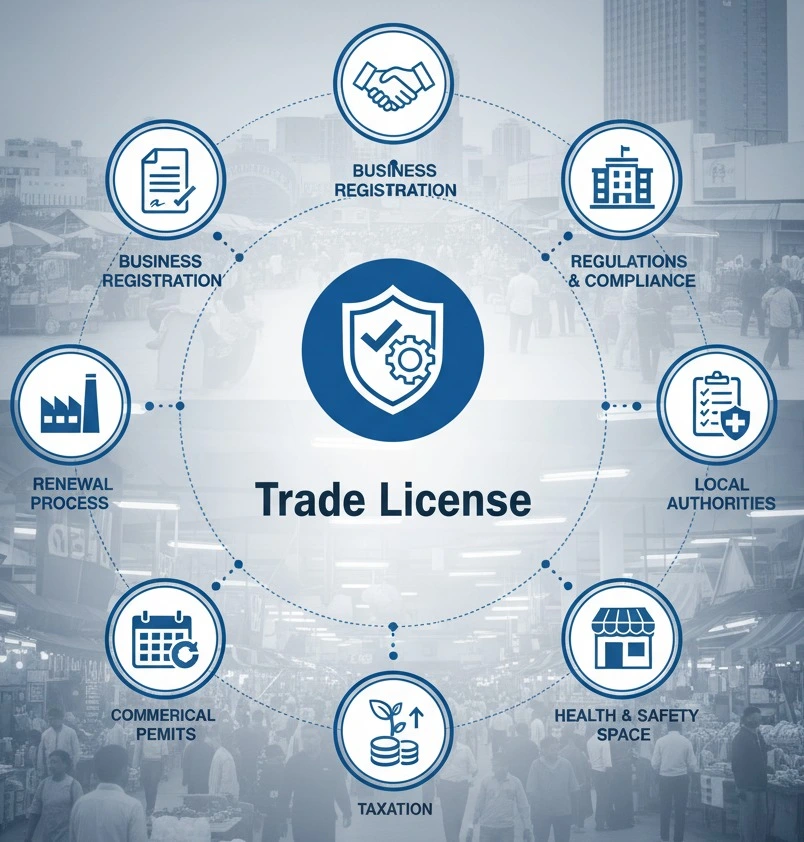
Trade License Registration in Chandigarh
Trade License Registration in Chandigarh should begin with an applicability check, not an automatic application. Chandigarh’s legal framework differs from ordinary Punjab municipal corporations because Sections 343–346 were omitted when the Punjab Municipal Corporation Act was extended to the Union Territory. Specific municipal licence categories nevertheless continue through Chandigarh’s official online licensing system.
Legal Papers India can assist Chandigarh businesses remotely with licence-applicability review, document preparation and online filing guidance. The company’s supplied head-office locations are Delhi and Noida, so this page should not imply that Legal Papers India maintains a Chandigarh branch.
The practical first question is therefore:
What activity are you carrying on, from what premises, and under which Chandigarh rule or licensing category is permission required?
For example, a café, manufacturer, retailer, street-vending activity and industrial workshop may each interact with different regulatory requirements. A generic “trade licence package” should not be selected before identifying the applicable authority and licence category.
Common mistake: Assuming that because another city requires a general municipal trade licence, Chandigarh necessarily follows the same structure.
Decision guideline: Verify the licence against the actual Chandigarh activity and portal category before paying professional or government fees.
Which Chandigarh Businesses Need a Licence or Municipal Permission?
Whether a Chandigarh business needs a Trade License depends on the activity and the specific regulatory provision rather than merely being a proprietorship, LLP or company. Shops, food establishments, manufacturers and other businesses may also need separate registrations such as Shops and Establishments, FSSAI, fire, factory or sector-specific permissions.
This matters because Chandigarh’s commercial economy includes sector markets, restaurants, retail outlets, offices, warehouses, professional firms and Industrial Area establishments, but the legal requirement is not created simply because an entity “does business.”
The official Chandigarh Smart City Trade License manual shows that applicants choose a License Type and then a corresponding Service Type, demonstrating that licensing is category-driven rather than a one-size-fits-all form.
|
Business Situation |
What Should Be Checked First |
|
Retail shop |
Whether the activity falls under a current MCC licence category and Shops/Establishment requirements |
|
Restaurant or café |
Food licensing, municipal/public-health requirements and applicable premises permissions |
|
Manufacturer |
Factory/industrial permissions, environmental/fire requirements and activity-specific municipal licensing |
|
Warehouse |
Premises use, fire and activity-specific licensing |
|
Trader/wholesaler |
Nature of goods, premises and sector-specific licences |
|
Meat/fish activity |
Specific health/veterinary permissions may apply |
|
Special regulated activity |
Relevant department-specific licence rather than a generic municipal licence |
Municipal Corporation Chandigarh’s published RTI material confirms, for example, that its veterinary function includes inspection of meat shops and issuing NOCs connected with licensing.
Expert recommendation: Prepare a compliance map before filing: business activity, premises type, municipal requirement, state/UT registration and sector licence.
Buyer warning: Do not pay for a generic “Trade License Chandigarh” application until the provider confirms the exact legal category being applied for.
How to Apply for Trade License Online in Chandigarh
Where a Chandigarh Trade License category applies, the official online system allows the applicant to log in, select the licence and service type, enter trade and owner details, upload supporting documents, review the application, submit it and complete the prescribed payment following approval. Status and payment receipts can also be tracked digitally.
The official citizen manual provides this workflow:
| Step |
What Happens |
Common Error |
|
1. Login |
Applicant accesses the citizen system |
Wrong/incomplete profile details |
|
2. Select Trade License |
Start a new licence application |
Choosing an unsuitable licence type |
|
3. Trade Details |
Select licence/service type and enter trade information |
Business activity described incorrectly |
|
4. Owner Details |
Enter applicant/owner information |
Identity data mismatch |
|
5. Documents |
Upload documents applicable to the selected category |
Missing or unreadable files |
|
6. Summary |
Review details and estimated fee |
Submitting without checking category |
|
7. Approval |
Application undergoes applicable scrutiny |
Queries remain unanswered |
|
8. Payment |
Prescribed licence fee is paid |
Payment before the correct approval stage |
|
9. Certificate |
Certificate/receipt can be downloaded |
Failure to preserve final records |
The official manual states that the system allows citizens to apply, pay online, track application status and download payment receipts. It further shows that payment is made after the application reaches the approved/pending-payment stage and that the Trade License Certificate can be downloaded after successful payment.
Overlooked requirement: Correct licence selection matters before document upload. An otherwise complete application can still be unsuitable if the business is placed under the wrong activity or service type.
Expert tip: Save the submitted application, acknowledgement, payment evidence and issued certificate together rather than retaining only the final PDF.
Documents Required for Trade License Registration in Chandigarh
Documents for a Chandigarh Trade License vary by the licence type shown in the municipal system, so there is no defensible universal document list for every shop, company or manufacturer. Applicants should first identify the applicable category and then prepare identity, address, ownership and category-specific evidence requested by the online application.
The official citizen manual lists proof of address/Chandigarh residence, proof of age and an applicant photograph among its core documents, with additional forms or supporting records triggered for specific licence types.
For broader business-compliance screening, this is the practical checklist:
| Business Type |
Records Commonly Kept Ready for Applicability/Filing Review |
|
Proprietorship |
Proprietor ID, premises proof, business/activity details |
|
Partnership |
Partnership deed, partner details, premises proof |
|
LLP |
LLP incorporation details, authorised-person records, premises documents |
|
Private Limited Company |
Incorporation records, authorised signatory data, premises proof |
|
OPC |
Incorporation and authorised-person documents, premises records |
|
Restaurant/Café |
Premises records plus applicable FSSAI/public-health/fire documents |
|
Manufacturer |
Premises, industrial/factory and activity-specific approvals where applicable |
|
Warehouse |
Occupancy/premises documentation and fire/activity-related approvals |
These broader records are preparation guidance, not a claim that every item is mandatory in the Chandigarh Trade License portal.
Common mistake: Copying a document checklist from Delhi, Punjab or another municipal corporation and assuming Chandigarh requests the same evidence.
Compliance tip: Use the current Chandigarh portal category as the final document authority at the time of filing.
Chandigarh’s Sector-Based Commercial Planning Makes Premises Use Important
A business licence cannot be reviewed independently of the premises from which the activity operates. Chandigarh has long-standing controls over commercial-site use and permitted trades, meaning an entrepreneur should check whether the intended activity is permissible at the chosen premises rather than treating licensing as the only municipal compliance question.
Chandigarh Administration material dealing with commercial premises recognises general and special trade categories and states that certain changes of trade can be subject to environmental, health, traffic, hygiene and sanitation considerations.
That creates an important distinction:
Business registration answers “who is operating?”
Premises-use compliance answers “can this activity operate here?”
Sector licence answers “does this activity need separate permission?”
Trade licence, where applicable, answers “has the specific municipal licence been obtained?”
A restaurant shifting into premises previously used as a normal retail outlet, for example, should not assume that merely obtaining GST registration or incorporating a company makes the location suitable for food-service operations.
Expert recommendation: Check activity plus premises before committing to expensive interiors or machinery.
Buyer hesitation point: If your consultant cannot identify the relevant authority for your business activity, obtain clarification before filing.
Benefits of Professional Trade Licence Applicability Support
Professional assistance is most valuable in Chandigarh when it prevents the wrong application from being filed. The adviser should identify whether the business falls within a municipal Trade License category, determine whether another registration is actually required, prepare category-specific records and explain dependencies involving the premises, food, fire or industrial permissions.
The useful benefits are therefore more specific than “saving time.”
Operational benefit: Fewer application corrections caused by mismatched business descriptions or documentation.
Compliance benefit: The business is less likely to confuse Trade License with GST, FSSAI, Shops and Establishments or another approval.
Commercial benefit: Premises and licensing issues can be identified before opening or expansion.
Future-compliance benefit: Renewal, amendment or related approvals can be tracked against the actual permission obtained.
Common mistake: Treating a Trade License as proof that all other registrations have automatically been satisfied.
A municipal licence does not replace GST registration, FSSAI licensing, company incorporation or other sector-specific permissions where those laws independently apply.
Decision guideline: Ask for a written applicability summary showing “required,” “not required” or “needs authority confirmation” for each relevant compliance.
Trade License Cost and Approval Timeline in Chandigarh
Trade License cost and processing time in Chandigarh depend on the licence category, period and municipal scrutiny applicable to the selected service. The official citizen system calculates or displays the fee based on information in the application, so publishing one universal government fee or guaranteed approval period for every Chandigarh business would be misleading.
The official manual states that a fee estimate is shown according to the selected licence period. It also shows that payment is completed after application approval rather than as an automatic first step.
Cost can therefore involve:
- Applicable municipal licence fee
- Category-specific charges
- Supporting approval expenses where applicable
- Professional assistance fee
- Additional compliance requirements outside the trade license itself.
Pricing warning: A competitor’s advertised professional package is not the same thing as the official municipal fee. IndiaFilings, for example, currently advertises commercial service pricing for its national Trade License assistance; that should not be presented as Chandigarh’s government fee.
Timeline warning: Avoid guarantees such as “approval in X days” unless the exact licence category and current Chandigarh service standard support them.
Recommended approach: Confirm applicability, portal category and document readiness first; only then estimate the filing timeline.
Trade License Renewal, Modification and Certificate Management
Renewal or modification should be handled according to the specific Chandigarh licence actually issued, not a generic annual-renewal assumption copied from another municipal corporation. Businesses should preserve the licence number, certificate, payment records and underlying application because these records are necessary when updating, replacing or validating permissions later.
This is another area where generic national pages can mislead. National guidance often says trade licences are renewed annually, but the applicable duration may depend on the Chandigarh licence category.
The official Chandigarh manual itself shows that the licence period can form part of the application and that fee estimation is linked to that period.
Before changing business details, check whether the change affects:
- Owner or authorised-person details
- Business activity
- Premises
- Licence category
- Entity structure
- Supporting departmental permission.
Common mistake: Changing premises or activity first and dealing with the licence afterwards.
Expert recommendation: Review licensing consequences before a material business change takes effect. Get to know About Us
Frequently Asked Questions
1. Is Trade License mandatory for every business in Chandigarh?
No blanket statement should be made that every Chandigarh business needs a general municipal Trade License. The 1994 legislation extending the Punjab Municipal Corporation Act to Chandigarh omitted Sections 343–346, while Chandigarh’s official online system nevertheless administers specific licence categories. Your business activity and applicable local rule should therefore be checked before filing.
2. Can I apply for a Trade License online in Chandigarh?
Where the relevant licence category is available, Chandigarh’s official Trade License System supports online application. The citizen manual shows login, licence/service-type selection, owner information, document upload, application review, submission, approval, payment and certificate/receipt download functionality. The first step should still be checking whether your activity belongs in that licensing system.
3. What documents are required for a Chandigarh Trade License?
Documents depend on the licence type. The official online manual lists Chandigarh address/residence proof, age proof and applicant photograph among the records used in its system, while additional documents appear for particular licence categories. Businesses should therefore avoid relying on a generic all-India checklist and verify the current category-specific portal requirements before submission.
4. How much does a Trade License cost in Chandigarh?
There is no single defensible fee for every Chandigarh activity. The official system calculates a fee estimate according to information such as the licence period and selected service. Professional-service charges advertised by private providers are separate from municipal fees. Request a cost breakdown distinguishing government charges, third-party permissions and advisory/filing fees before proceeding.
5. How long does Trade License approval take in Chandigarh?
The timeframe depends on the licence category, document completeness and any scrutiny required by the competent authority. The official manual shows an approval stage followed by payment, rather than promising a universal instant approval. Applicants should avoid relying on generic timelines copied from other municipalities and confirm the current service standard for their specific application.
6. Does a restaurant in Chandigarh need only a Trade License?
No. Food businesses can have separate regulatory obligations, including FSSAI and potentially public-health, fire, premises or other permissions depending on the operation. A municipal permission, where required, does not replace these independent licences. The safest approach is to map the restaurant’s activity, seating/premises characteristics and food operations before determining the complete compliance set.
7. Can a manufacturer in Chandigarh Industrial Area use the same licence as a retail shop?
Not necessarily. Manufacturing premises can trigger a different regulatory framework involving industrial/factory, fire, environmental or activity-specific permissions. Chandigarh Administration guidance also treats Industrial Area premises differently in certain trade-use contexts. The exact manufacturing activity, use of machinery, premises and statutory thresholds should therefore be reviewed before selecting any municipal licensing route.
8. Can a Chandigarh Trade License be modified after a business change?
Whether modification, fresh approval or another procedure applies depends on the licence category and type of change. Changes in activity, ownership, entity or premises may affect more than one registration. Businesses should review the original certificate and current municipal requirements before updating operations rather than assuming that every change can be handled through a simple amendment.
9. Is Trade License the same as GST Registration or MSME Registration?
No. GST Registration deals with indirect-tax registration, while Udyam/MSME Registration relates to MSME recognition. A Trade License, where applicable, concerns permission for a particular regulated activity or municipal licence category. One registration does not automatically replace another. The correct compliance combination depends on the business’s turnover, activity, legal structure and premises.
10. Does Legal Papers India have an office in Chandigarh?
The supplied brief identifies Delhi and Noida as Legal Papers India’s head-office locations, not Chandigarh. Chandigarh assistance should therefore be described as remote compliance consultation and documentation support. The page should not display a fictitious Chandigarh address or use Local Business schema unless an actual office is established and verifiable.
Confirm the Right Chandigarh Licence Before You File
Trade License Registration in Chandigarh should start with identifying whether your business falls within a current municipal licensing category and whether additional permissions apply to the premises or activity. Legal Papers India can remotely review the proposed business activity, documentation and related compliance requirements before an application is prepared.
Before requesting assistance, keep ready:
- Exact business activity
- Legal entity type
- Chandigarh premises address
- Ownership or tenancy status
- Existing GST/FSSAI/other registrations
- Whether manufacturing, food, storage or regulated goods are involved
- Details of any existing municipal certificate.
This reduces the risk of paying for the wrong application or discovering a separate permission only after business setup has progressed.
Start Your Compliance Journey with Legal Papers India. Contact Us
Legal Papers India Business Solution Private Limited, F 2, Sector 8, Noida, Uttar Pradesh, 201301
Monday to Saturday 10:00 AM to 06:30 PM





Please submit all general enquiries in the contact form below and we look forward to hearing from you soon.


Captcha:

Or sign in with:
LOGIN WITH GOOGLESign up for early Sale access plus tailored new arrivals, trends and promotions. To opt out, click unsubscribe in our emails.
Forgot your password? No worries! Enter your registered email to receive a link and securely reset it in just a few steps.