
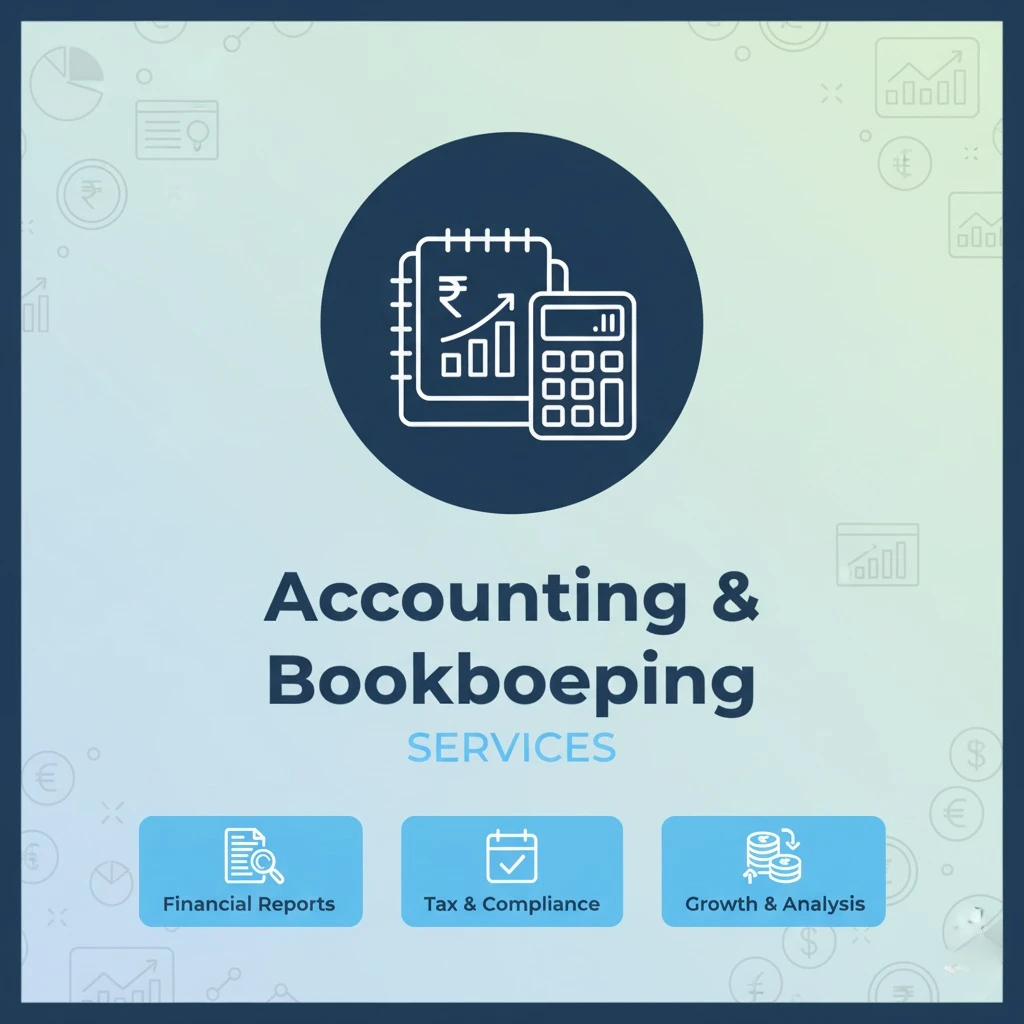
Accounting and Bookkeeping Services in Chandigarh
Accounting and Bookkeeping Services in Chandigarh are most useful when a business needs its transactions recorded consistently, bank and ledger balances reconciled, receivables and payables tracked, and financial records kept ready for GST, income-tax, audit and management reporting. The service can be delivered remotely without a physical Chandigarh office.
Legal Papers India operates from Delhi and Noida and can coordinate accounting records digitally for Chandigarh businesses. The uploaded brief specifically requires a Pan-India remote service model and prohibits creating an unverified Chandigarh branch or LocalBusiness signal.
The useful distinction is simple:
Bookkeeping records what happened. Accounting explains what those records mean and prepares them for reporting, taxation and management decisions.
For a growing business, the monthly workflow should normally be:
Collect documents → record transactions → reconcile bank and ledgers → review receivables/payables → reconcile GST/TDS where applicable → close the month → issue reports
Common mistake: Treating bookkeeping as a year-end exercise. Once six or nine months of invoices, expenses and bank entries accumulate, even straightforward reconciliation becomes slower and more expensive.
Why Chandigarh Businesses Benefit from Structured Monthly Accounts
Chandigarh has a large service, IT, professional and small-business base alongside light engineering and industrial activity. Those businesses often have fewer physical inventory complexities than large manufacturing centres, but they still face recurring invoicing, vendor payments, payroll, GST, expense allocation and receivable tracking that become difficult when records are maintained irregularly.
The Chandigarh Administration states that the city has thousands of small-scale units and a concentration of light engineering, fasteners, electrical/electronic items, machine tools, pharmaceuticals, plastics, furniture and food products. It also highlights IT as a major growth area through the Rajiv Gandhi Chandigarh Technology Park and its entrepreneurial ecosystem.
That creates several distinct accounting situations:
| Chandigarh Business |
Accounting Issue to Watch |
|
IT or software company |
Client invoicing, payroll, vendor expenses |
|
Consultant or agency |
Receivables, advances, TDS and expense allocation |
|
Small manufacturer |
Purchases, inventory-linked entries, vendor reconciliation |
|
E-commerce seller |
Marketplace settlements, returns and GST differences |
|
Trader |
Sales/purchase ledgers and ageing |
|
Startup |
Founder expenses, capital entries and monthly burn tracking |
|
Professional firm |
Income recognition, expenses and tax-ready books |
Practical observation: A profitable-looking agency can still face cash-flow stress if invoices are raised but not collected. Monthly accounting should therefore include receivable ageing, not just P&L preparation.
Expert recommendation: Close books monthly rather than waiting for GST, ITR or audit deadlines to expose missing entries.
Who Needs Accounting and Bookkeeping Services in Chandigarh?
Any Chandigarh business with recurring sales, purchases, expenses, bank transactions, GST obligations, or payroll can benefit from structured accounting. Outsourcing becomes particularly useful when transaction volume is too high for the owner to manage personally but not high enough to justify a full in-house accounting department.
Typical users include:
- Startups
- Proprietorship firms
- Partnership firms
- LLPs
- Private Limited Companies
- IT and software businesses
- Consultants and agencies
- Traders and wholesalers
- E-commerce sellers
- Small manufacturers
- Professional service firms
- Growing MSMEs
Companies have a specific statutory reason to maintain organised records. Section 128 of the Companies Act, 2013 requires companies to keep books of account and relevant records, while Sections 129 onward deal with financial statements and related reporting.
Decision guideline: Outsourcing is usually worth considering when the owner cannot answer basic questions such as “What do customers owe us?”, “Which vendors remain unpaid?”, or “Does the bank balance agree with the books?” without manually checking spreadsheets.
Overlooked requirement: Accounting scope should be defined by transaction complexity, not merely entity type. A proprietorship with thousands of marketplace transactions may need more work than a low-activity Private Limited Company.
How Online Accounting Services in Chandigarh Should Work Each Month
Online Accounting Services in Chandigarh should follow a repeatable monthly close rather than ad-hoc data entry. The accountant should receive source records, post transactions, reconcile balances, flag exceptions and provide management-ready reports. A good process also separates accounting work from tax filing so the books can be reviewed before figures reach GST or income-tax returns.
A practical monthly cycle looks like this:
| Stage |
Purpose |
Frequent Mistake |
Better Practice |
|
Document collection |
Gather sales, purchases and expenses |
Bills shared randomly |
Fixed monthly cut-off |
|
Transaction posting |
Update books |
Duplicate/missed entries |
Standard ledger rules |
|
Bank reconciliation |
Match books to bank |
Old unreconciled items |
Resolve monthly |
|
Vendor/customer review |
Confirm outstanding balances |
Ageing ignored |
Maintain ageing schedule |
|
GST reconciliation |
Align books and portal data |
Filing directly from software |
Review mismatches |
|
Month-end close |
Freeze reviewed period |
Backdated entries later |
Controlled adjustments |
|
Reporting |
P&L, balance sheet, MIS |
Reports without review |
Explain major variances |
Approval-delay reason: Accounting services themselves do not require government approval, but delayed records often create delays elsewhere—in GST returns, audits, loan documentation and tax filings.
Expert tip: Fix a document-sharing deadline, such as within the first week after month-end. A predictable calendar improves accuracy more than sending records whenever someone remembers.
Documents and Data Required for Accounting & Bookkeeping
Accounting work is driven primarily by transaction records rather than incorporation certificates. The accountant needs reliable sales, purchase, expense, bank and tax data, while the exact document mix changes according to whether the client is a trader, manufacturer, service provider or e-commerce business.
| Business Type |
Key Records Commonly Needed |
|
Proprietorship |
Bank statements, invoices, expenses, GST data |
|
Partnership |
Sales/purchase records, partner transactions, bank data |
|
LLP |
Books, bank records, invoices, statutory data |
|
Private Limited Company |
Complete ledgers, bank statements, payroll and statutory records |
|
OPC |
Company transactions, bank and compliance records |
|
Consultant/Agency |
Client invoices, vendor bills, expenses, TDS data |
|
Manufacturer |
Purchases, sales, inventory-related data, expenses |
|
E-commerce Seller |
Marketplace reports, settlements, returns, GST data |
A typical monthly file may include sales invoices, purchase bills, debit and credit notes, bank statements, expense receipts, payroll data, GST workings, marketplace statements and previous-period adjustments.
Common mistake: Sending only bank statements. A bank movement tells you money moved; it does not always identify whether the transaction was revenue, capital, loan, vendor advance, GST payment or reimbursement.
Practical recommendation: Use a shared monthly checklist so the same records are collected consistently every period.
What Professional Bookkeeping Adds Beyond Data Entry?
Professional bookkeeping is valuable when it turns raw transactions into reconciled, reviewable and decision-ready records. The purpose is not simply to enter vouchers faster; it is to create a financial trail that can support tax filings, audits, cash-flow decisions, customer collections and management reporting without repeatedly reconstructing the same information.
The value can be separated into five areas:
Operational: transactions are recorded on a regular schedule, reducing backlog.
Compliance: GST, TDS and tax filings can be prepared from more reliable books.
Business growth: receivable, expense and margin trends become visible earlier.
Platform: accounting software, bank data and GST information can be reconciled systematically.
Future compliance: year-end financial statements and audit requests become easier because underlying records already exist.
Buyer hesitation point: Ask whether the service includes reconciliation and review or only transaction entry. Those are not the same accounting service.
Expert recommendation: Request a sample monthly deliverable list—such as trial balance, P&L, ageing and reconciliation summary—before deciding between providers.
Why Chandigarh Clients Can Work with Legal Papers India Remotely
Accounting is document- and data-driven, so Chandigarh businesses can work with an accounting team remotely without sacrificing monthly control, provided document sharing, reporting schedules and query handling are clearly defined. Legal Papers India can coordinate this service from Delhi and Noida without presenting itself as a physical Chandigarh accounting office.
The uploaded brief specifically directs the page to state that services are delivered remotely unless a verified local office exists.
A workable remote arrangement should define:
- Monthly document cut-off
- Preferred accounting software
- Responsibility for invoice creation
- Bank statement sharing
- GST/TDS data responsibility
- Query-response turnaround
- Monthly reporting date
- Backlog-cleanup scope
- Data confidentiality process
Practical observation: Remote accounting works poorly when responsibility is unclear. For example, if the client assumes the accountant will obtain marketplace reports while the accountant assumes the client will upload them, month-end reconciliation fails before bookkeeping even starts.
Trust point: Ask who will have access to financial data and how corrections are documented. Get to know About Us.
Accounting and Bookkeeping Cost in Chandigarh
Accounting and bookkeeping pricing in Chandigarh should be based on workload and complexity rather than one universal monthly rate. Transaction volume, GST registrations, payroll, e-commerce settlements, inventory, reporting depth and backlog work can materially change the amount of time required to maintain accurate books.
Legal Papers India's national page currently displays package-based accounting plans and transaction limits, including different levels for smaller and higher transaction volumes. The exact current quote should still be checked against the client's real workload rather than selecting a package solely from the entity type.
Important pricing factors include:
| Cost Factor |
Why It Matters |
|
Monthly transactions |
Directly affects posting/review time |
|
Number of bank accounts |
More reconciliation work |
|
GST registrations |
Adds reconciliation and compliance coordination |
|
Payroll |
Additional recurring entries |
|
E-commerce channels |
Settlement and return complexity |
|
Inventory |
Requires additional accounting controls |
|
Historical backlog |
One-time cleanup effort |
|
MIS reporting |
Adds analytical work beyond bookkeeping |
Pricing recommendation: Ask for recurring monthly charges and one-time cleanup fees separately.
Timeline guidance: A clean monthly accounting cycle can be maintained continuously, while backlog reconstruction depends on how many months, accounts and missing documents need to be reviewed.
Frequently Asked Questions
1. Is outsourced bookkeeping suitable for a small Chandigarh business?
Yes. Outsourcing is often practical where a small business has regular transactions but does not need a full-time accountant. The key is choosing a scope that matches transaction volume. A low-volume consultant may need monthly bookkeeping and reconciliation, while a trader with frequent purchases and GST entries may require more frequent accounting updates and ledger review.
2. How often should books be updated?
Monthly updates are a reasonable minimum for many SMEs, while transaction-heavy businesses may benefit from weekly or near-daily posting. The important point is consistency. Waiting until year-end creates reconciliation problems because missing bills, unidentified bank transactions and customer balances become much harder to reconstruct several months later.
3. Can accounting services include GST reconciliation?
Yes, where GST reconciliation is included in the agreed service scope. Books can be compared with sales records, purchase records and available GST data before returns are prepared. Businesses should confirm whether the engagement covers only accounting entries or also GST reconciliation and return filing, because these are separate tasks and can be priced differently.
4. What reports should I expect from monthly bookkeeping?
A useful monthly pack can include a trial balance, profit and loss account, balance sheet, customer ageing, vendor ageing, bank-reconciliation status and exception list. A business may also request cash-flow or management reports. The reports should be tailored to what management actually uses rather than producing statements that are never reviewed.
5. Can Chandigarh IT and consulting firms use remote bookkeeping?
Yes. IT companies, consultants and agencies are particularly suited to remote bookkeeping because much of their documentation—client invoices, vendor bills, payroll data and bank records—is already digital. Chandigarh's IT Park and service-business ecosystem make this a locally relevant model. Clear document-sharing and monthly close procedures remain essential.
6. Can incomplete old books be cleaned up?
Usually, yes, provided sufficient source records remain available. Backlog cleanup may involve rebuilding ledgers from bank statements, invoices, GST records, vendor statements and previous filings. The cost and timeline depend on how many periods are incomplete and how much evidence is missing. Cleanup should normally be completed before relying on the books for major tax or financing decisions.
7. Do Private Limited Companies need proper books of account?
Yes. Section 128 of the Companies Act, 2013 requires companies to keep books of account and related records, while subsequent provisions govern financial statements and reporting. A Private Limited Company should therefore maintain structured books throughout the year rather than reconstructing accounts only when annual filing or audit work begins.
8. How is bookkeeping different from accounting?
Bookkeeping records individual financial transactions such as invoices, purchases, expenses and payments. Accounting uses those records to classify, reconcile, summarise and interpret financial information. In practice, a business normally needs both: clean bookkeeping creates the data, while accounting turns that data into financial statements and information management can use.
9. What should an e-commerce business provide each month?
An e-commerce seller should generally provide marketplace sales and settlement reports, refund/return data, platform fees, shipping charges, bank statements, purchase records and GST information. Simply recording the net amount deposited by a marketplace can misstate revenue and expenses because the settlement may already include fees, refunds and deductions.
10. Does Legal Papers India have an accounting office in Chandigarh?
This page does not represent Legal Papers India as maintaining a physical Chandigarh office. The supplied service model is remote Pan-India accounting and compliance assistance from Delhi and Noida. Documents, reconciliations and reports can be coordinated digitally while the company's verified head-office information remains unchanged.
Build a Monthly Accounting System Before the Backlog Builds Up
Accounting and Bookkeeping Services in Chandigarh work best when they create a predictable monthly financial routine rather than functioning as emergency year-end cleanup. Legal Papers India can coordinate bookkeeping, reconciliation and reporting remotely while defining the documents, reporting frequency and compliance responsibilities before work begins.
For an initial assessment, keep ready:
- Approximate monthly transaction count
- Number of bank accounts
- GST registration details
- Sales and purchase process
- Payroll requirements
- Accounting software currently used
- E-commerce platforms, if any
- Existing backlog period
- Reporting requirements
- Whether GST/TDS/ITR work is also required
A Chandigarh IT startup may primarily need invoice, payroll and cash-burn visibility. A trader may care more about vendor and customer ageing. A light-engineering unit may require stronger purchase and inventory-linked accounting.
Simplify Compliance with Legal Papers India. Contact Us
Legal Papers India Business Solution Private Limited, F 2, Sector 8, Noida, Uttar Pradesh, 201301
Monday to Saturday 10:00 AM to 06:30 PM





Please submit all general enquiries in the contact form below and we look forward to hearing from you soon.


Captcha:



















Or sign in with:
LOGIN WITH GOOGLESign up for early Sale access plus tailored new arrivals, trends and promotions. To opt out, click unsubscribe in our emails.
Forgot your password? No worries! Enter your registered email to receive a link and securely reset it in just a few steps.