
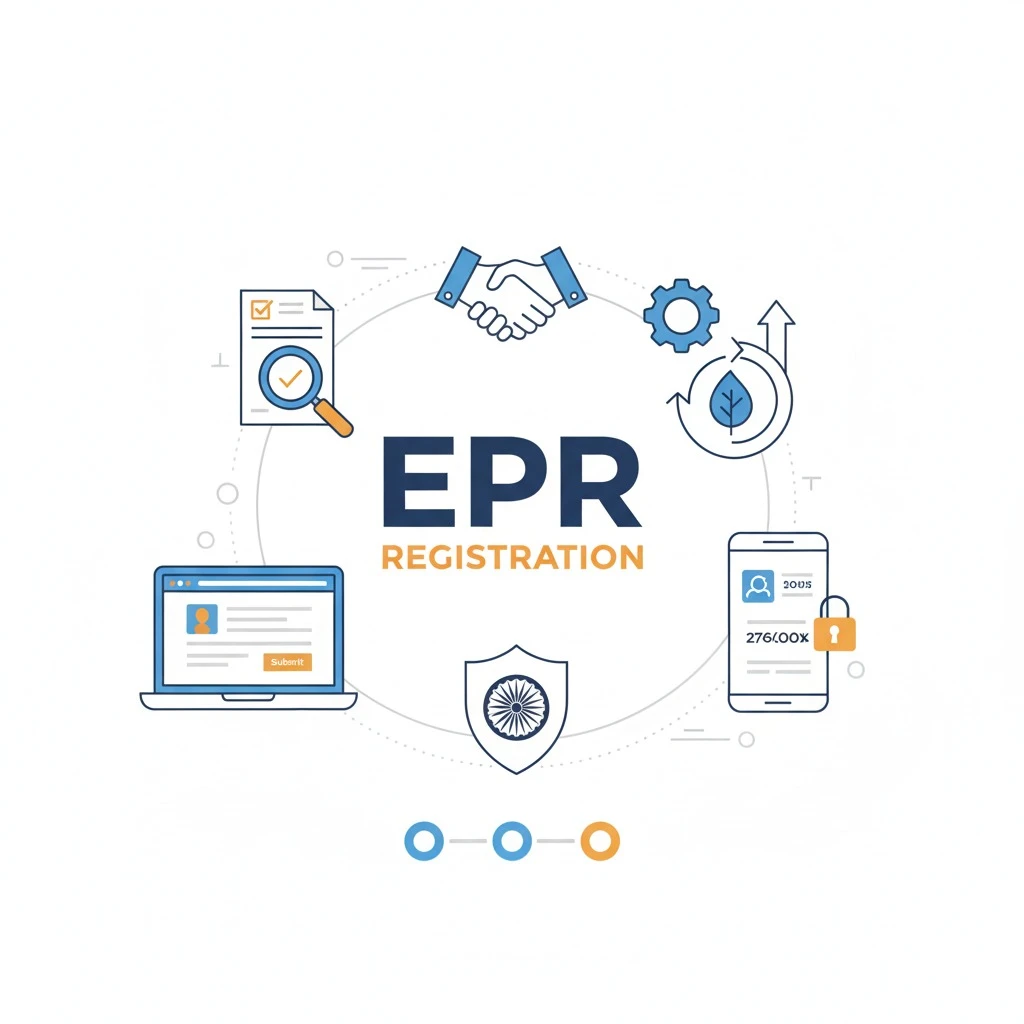
EPR Registration in Chennai
EPR Registration in Chennai should begin with identifying the regulated product, packaging or battery stream and the applicant's role in placing it on the Indian market. Legal Papers India can coordinate documentation and consultation remotely from Delhi and Noida, without representing a physical Chennai EPR office or registration centre.
The supplied model expressly requires remote service delivery where no physical city office is verified.
For a Chennai business, EPR may involve:
- Plastic Waste EPR
- E-Waste EPR
- Battery Waste EPR
- Multiple frameworks for one finished product
This distinction matters because CPCB maintains separate EPR systems and obligations for different waste streams. For plastic packaging, the centralized system covers Producers, Importers and Brand Owners. Under the current e-waste framework, covered producers must register and fulfil recycling obligations through registered recyclers.
Practical example: A company selling a rechargeable electronic device in plastic retail packaging should assess the device, battery and packaging independently instead of searching for one generic “EPR licence.”
Expert recommendation: Finish product classification before beginning portal data entry.
Chennai’s Electronics and EV Ecosystem Changes the EPR Conversation
Chennai's wider industrial ecosystem includes automobiles, auto components, electronics, electrical products and an expanding EV supply chain. These sectors create EPR questions that go beyond ordinary packaged consumer goods, particularly where products contain electronic assemblies, rechargeable batteries, imported components or plastic packaging.
Tamil Nadu's industrial infrastructure around Chennai includes electronics-manufacturing clusters and a planned EV park near the Chennai metropolitan region. SIPCOT identifies Manallur and Pillaipakkam electronics clusters, with focus areas that include electronic components, IT hardware, white goods, auto electronics and EV-related electronics. It also identifies an EV park aimed at vehicle, battery and charging-infrastructure manufacturing.
This creates locally relevant compliance situations:
| Chennai Business Situation |
EPR Question to Resolve |
|
Electronics manufacturer |
Is the equipment covered under the e-waste framework? |
|
EV component business |
Does the product contain a regulated battery or electronic assembly? |
|
Imported industrial electronics supplier |
Does importer status create producer obligations? |
|
Consumer appliance brand |
Are e-waste and plastic packaging both relevant? |
|
Auto accessory company |
Are electronic components or batteries covered? |
|
FMCG/D2C company |
Does plastic packaging create PIBO obligations? |
Tamil Nadu's MSME thrust sectors also include electrical and electronics, auto components, EV components, plastic products, medical devices and ESDM businesses.
Common mistake: A manufacturer assumes EPR is relevant only to products marketed as “electronics.” Modern machinery, vehicle accessories, medical devices and industrial equipment can contain electronic or battery elements that deserve separate assessment.
Decision guideline: Recheck EPR whenever a product design adds a battery, PCB, display, sensor, charger or new packaging format.
Which Chennai Businesses Should Assess EPR Requirements?
Manufacturers, producers, importers and brand owners handling regulated plastic packaging, electrical/electronic equipment or batteries should assess EPR applicability in Chennai. Importers and private-label businesses require particular attention because a company may become responsible under EPR even when the physical manufacturing is performed by another entity.
Businesses commonly needing a review include:
- Electronics manufacturers
- Electronics importers
- EV and battery businesses
- Auto-electronics suppliers
- Electrical-equipment manufacturers
- Consumer-appliance companies
- Plastic-packaging businesses
- FMCG companies
- D2C brands
- E-commerce sellers
- Private-label companies
- Medical-device businesses
- Import distributors
For e-waste, CPCB states that registration is mandatory for entities covered by the Producer definition for electrical and electronic equipment listed in Schedule I. CPCB also distinguishes Producers, Manufacturers, Recyclers and Refurbishers as portal-registration entities.
A More Reliable Eligibility Test
Instead of asking, “What industry are we in?”, ask:
- Who manufactures the finished product?
- Who imports it into India?
- Under whose brand is it sold?
- Does it contain covered electrical/electronic equipment?
- Does it contain a battery?
- What plastic packaging is placed into the market?
Overlooked requirement: One Chennai company may manufacture some SKUs locally and import other SKUs. Its EPR position therefore may not be uniform across the complete catalogue.
How to Separate Plastic, E-Waste and Battery Responsibilities
An EPR Certificate in Chennai is not a universal certificate covering all forms of producer responsibility. Plastic packaging, e-waste and batteries require separate regulatory assessment. Businesses selling composite products should map each regulated component first, then determine the appropriate registrations, data sets and continuing obligations.
| Product Component |
Framework to Examine |
Key Compliance Data |
|
Plastic packaging |
Plastic Waste EPR |
Packaging category and quantity |
|
Covered electrical/electronic equipment |
E-Waste EPR |
EEE category and quantity |
|
Battery |
Battery Waste EPR |
Battery category and market quantity |
|
Composite product |
Multiple streams |
Component-wise regulatory mapping |
Chennai EV-Accessory Example
Suppose a Chennai company imports a smart EV charging accessory containing:
- Electronic control circuitry
- Rechargeable backup battery
- Plastic protective packaging
The sales department sees one SKU.
The compliance function should assess three potentially different streams.
Compliance warning: Do not assume the most prominent product category automatically absorbs the EPR obligations attached to its other components.
EPR Registration Online in Chennai
EPR Registration Online in Chennai is more efficient when the business completes classification and data reconciliation before creating or finalising its portal application. Product descriptions, models, import/manufacturing status, packaging information and quantities should be consistent with supporting records because CPCB can examine documentation and raise deficiencies during registration.
For plastic PIBO registration, CPCB's current SOP lists documents such as PAN, GST, CIN, IEC for importers, authorized-person identity records, process-flow information for producers and relevant consent information for production facilities. It also states that a Brand Owner that is additionally a Producer or Importer needs separate applications for those roles.
Practical Filing Sequence
| Stage |
Business Action |
Common Failure |
Recommended Control |
|
Product Screening |
Identify regulated streams |
Looking only at finished SKU |
Map components |
|
Role Mapping |
Identify producer/importer/brand-owner role |
Using internal job labels |
Trace supply chain |
|
SKU Preparation |
Build complete product list |
Omitting models/accessories |
Use product master |
|
Quantity Reconciliation |
Verify relevant quantities |
Sales/import data differ |
Reconcile source records |
|
Entity Validation |
Match legal records |
GST/address mismatch |
Use one master dataset |
|
Portal Filing |
Enter relevant information |
Wrong category selected |
Technical review before filing |
|
Query Response |
Resolve observations |
Unsupported explanations |
Cite internal evidence |
|
Registration Check |
Verify approved particulars |
Certificate not cross-checked |
Compare to filing |
|
Compliance Setup |
Track continuing duties |
Treating approval as final |
Assign calendar owner |
Approval-delay reason: Portal filing often exposes inconsistencies that already existed internally. Correcting product and quantity data beforehand is usually faster than explaining discrepancies afterward.
Documents Required for EPR Registration in Chennai
The documents required for EPR Registration in Chennai depend on the legal constitution of the applicant and the applicable EPR framework. Entity records establish who is applying, while product, manufacturing, import, packaging and battery information establish the applicant's regulatory role and the scope of responsibility.
| Business Type |
Common Records to Prepare |
|
Proprietorship |
PAN, GST/business details, proprietor records |
|
Partnership |
Partnership Deed, PAN, GST, partner details |
|
LLP |
Incorporation records, LLP Agreement, PAN, GST |
|
Private Limited Company |
Incorporation Certificate, PAN, GST, authorized-person details |
|
OPC |
Incorporation and authorized-signatory information |
|
Manufacturer |
Entity records plus product/manufacturing data |
|
Importer |
Entity records plus IEC, import and product information |
|
Brand Owner |
Entity records plus brand and packaging information |
Plastic PIBO guidance currently references PAN, GST, CIN, IEC for importers, Aadhaar/PAN of the authorized person, process-flow documentation for producers, relevant SPCB/PCC consents for production facilities, signatures and a covering letter.
Additional working data may include:
- Product/model lists
- Packaging categories
- Brand names
- Battery types
- Import quantities
- Manufacturing quantities
- Product-market quantities
- Existing environmental registrations
Compliance tip: Create a source-reference column next to every quantity in the working file. This makes future reporting far easier than rebuilding the calculation later.
Why Professional EPR Assistance Can Be Valuable in Chennai
Professional EPR assistance is most useful when it resolves classification, documentation and data-quality issues before filing. Chennai companies with electronics, EV components, imported products or large SKU portfolios often need product-level assessment and cross-department data coordination, not simply someone to upload documents to a portal.
The practical value can include:
- Determining producer/importer/brand-owner status
- Separating plastic, e-waste and battery streams
- Reviewing SKU/product classifications
- Reconciling manufacturing and import data
- Preparing application documentation
- Coordinating responses to regulator observations
- Planning subsequent EPR obligations
Current competitor service pages often explain documentation and filing but give less attention to product-component mapping and internal data governance.
Buyer hesitation point: Ask whether professional fees include classification and query support or only application submission.
Expert recommendation: For multi-product companies, ask for the deliverables in writing before comparing quotations.
Why Chennai Applicants Can Work with Legal Papers India Remotely
CPCB EPR Registration in Chennai can be coordinated remotely because most preparatory work involves business records, product specifications, packaging information, quantity data and online portals. Legal Papers India operates from Delhi and Noida, so Chennai should be presented as an area served rather than an unverified physical branch location.
A remote engagement can involve:
- Applicability discussion
- Regulatory-role assessment
- Plastic/e-waste/battery classification
- Product-master review
- Document preparation
- Portal-filing guidance
- Regulatory-query coordination
- Post-registration planning
For manufacturing businesses, data often needs to come from multiple functions.
Product/Engineering: specifications and product categories
Procurement: components and packaging
Finance: transactional quantities
Imports: IEC and import information
Compliance: filing and continuing obligations
Practical observation: Assigning one internal EPR coordinator significantly reduces the risk of contradictory figures reaching the application.
Get to know About Us
EPR Registration Cost and Timeline in Chennai
The cost and timeline for EPR Registration in Chennai depend on the relevant waste stream, applicant role, product portfolio, manufacturing/import activity, packaging complexity, data quality and scope of professional support. Businesses should avoid assuming that every EPR registration carries the same fee structure, documentation burden or processing time.
Main Cost Drivers
| Factor |
Why It Changes the Scope |
|
EPR framework |
Plastic, e-waste and battery requirements differ |
|
Number of SKUs |
More classification and data work |
|
Electronics/battery combination |
Multi-stream assessment may be needed |
|
Imports |
IEC and import data require reconciliation |
|
Packaging variety |
Additional category/quantity mapping |
|
Poor historical data |
More preparation effort |
|
Regulatory deficiencies |
Additional response work |
|
Continuing compliance |
Separate from registration-only support |
A two-SKU packaged-goods brand and an electronics importer carrying 100 models should not receive identical professional scopes.
Pricing guideline: Request separation between application preparation, applicable government/portal charges, query handling and continuing compliance.
Timeline guideline: Distinguish company-side preparation from CPCB processing. A consultant can improve application readiness but should not guarantee a regulatory approval date that is outside their control.
Frequently Asked Questions
1. Does an auto-electronics manufacturer in Chennai need EPR Registration?
It may, depending on whether the electrical or electronic products, components, consumables, parts or spares fall within the covered categories under the applicable e-waste framework. Chennai's automotive ecosystem does not itself determine liability. The exact product, market role and regulatory schedule should be reviewed before deciding whether producer registration applies.
2. Can a Chennai EV component company require Battery and E-Waste EPR?
Yes, potentially. A product containing electronic circuitry and a covered battery may require assessment under both e-waste and battery-waste frameworks. Plastic packaging can create another compliance stream. The business should map each component rather than assuming the EV or automotive classification determines the entire EPR requirement.
3. Can EPR Registration Online in Chennai be completed without visiting Delhi?
The relevant EPR systems operate online, so documentation and consultation can largely be coordinated remotely. Legal Papers India operates from Delhi and Noida, but Chennai applicants can exchange business records, product data and filing information digitally. Regulatory classification and accurate supporting information remain necessary even though the application process is online.
4. Does an electronics importer need CPCB EPR Registration in Chennai?
An importer selling covered electrical or electronic equipment in India may fall within the producer definition under the current e-waste framework. CPCB specifically includes entities offering imported covered EEE within producer responsibilities. The actual product category and import model should be checked before the application is prepared.
5. Does a Brand Owner need a separate plastic EPR application if it is also an importer?
Under CPCB's current plastic PIBO SOP, separate applications are required where a Brand Owner is also acting as a Producer or Importer, and vice versa. This is why applicant-role mapping should happen before portal filing rather than treating PIBO as one interchangeable category.
6. What is the cost of EPR Registration in Chennai?
There is no responsible single fee applicable to every applicant. Cost depends on the waste stream, applicant role, number of products, packaging formats, imports, existing data quality and whether the professional scope includes query handling and continuing compliance. Request a category-specific quotation rather than comparing only headline filing fees.
7. Why do CPCB EPR applications get delayed?
Common causes include incorrect applicant classification, inconsistent GST or address data, incomplete product lists, unsupported quantity figures and insufficient responses to deficiencies. Businesses can reduce preventable delays by reconciling legal, product and quantity records before submission and keeping the same evidence basis for later clarifications.
8. What happens if a Chennai manufacturer adds a battery to an existing product?
The product should be reassessed before commercial launch. Adding a battery can introduce a separate battery-waste compliance question, and changes in electronics or packaging may also affect existing EPR obligations. Product-change approval should therefore include an environmental-compliance checkpoint rather than waiting for the next registration or return cycle.
9. Is EPR Authorization the same as TNPCB consent?
No. EPR obligations relate to regulated products or waste streams placed into the market, whereas Tamil Nadu Pollution Control Board permissions can apply separately to manufacturing or operational activities. Businesses should evaluate facility-level environmental permissions and product-level EPR obligations independently rather than assuming one registration replaces the other.
10. Does EPR compliance stop after the registration certificate is issued?
No. Depending on the relevant framework, producers can have continuing recycling targets, certificate requirements, returns, amendments and record-maintenance obligations. The e-waste portal, for example, provides for producers to fulfil EPR obligations through certificates from registered recyclers and file continuing returns.
Build EPR Into Product and Supply-Chain Decisions
EPR Registration in Chennai becomes easier to control when environmental responsibility is considered during product development, importing, packaging and brand decisions—not after commercial launch. Legal Papers India can review these factors remotely and assist with the appropriate filing pathway while keeping applicant roles, documentation and future compliance expectations clear.
Before consultation, prepare:
- Legal entity information
- GST and PAN
- IEC where applicable
- Complete SKU/product list
- Product specifications
- Manufacturing/import status
- Brand information
- Battery details
- Packaging categories
- Quantity records
- Existing EPR registrations
The most useful sequence is:
Map products → classify applicant roles → identify EPR streams → reconcile records → prepare filing → manage continuing obligations
Choose Legal Papers India for Expert Guidance. Contact Us
Legal Papers India Business Solution Private Limited, F 2, Sector 8, Noida, Uttar Pradesh, 201301
Monday to Saturday 10:00 AM to 06:30 PM





Please submit all general enquiries in the contact form below and we look forward to hearing from you soon.


Captcha:



Or sign in with:
LOGIN WITH GOOGLESign up for early Sale access plus tailored new arrivals, trends and promotions. To opt out, click unsubscribe in our emails.
Forgot your password? No worries! Enter your registered email to receive a link and securely reset it in just a few steps.