
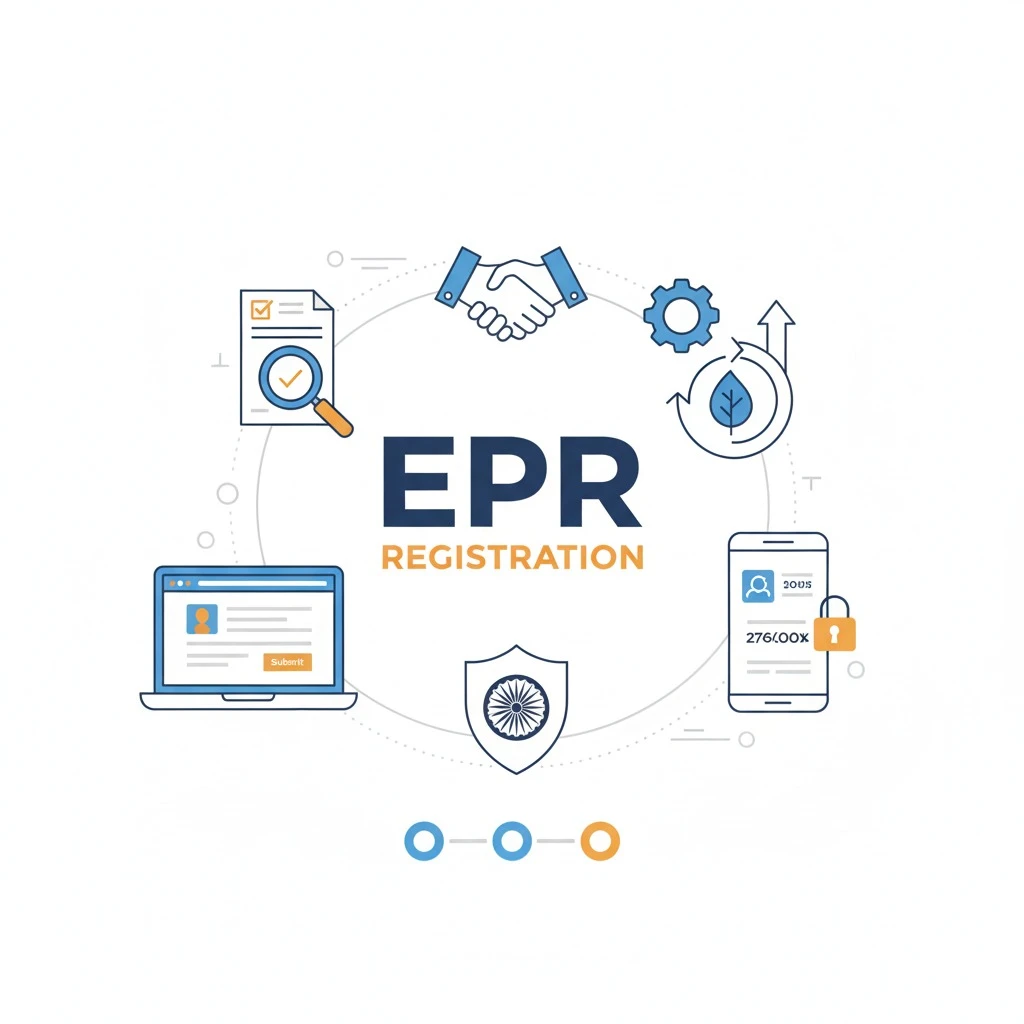
EPR Registration in Coimbatore
EPR Registration in Coimbatore is determined by the applicant's products, packaging and regulatory role rather than the physical location of its factory or office. Legal Papers India coordinates EPR documentation and consultation remotely from Delhi and Noida for Coimbatore businesses, without representing that it maintains a physical Coimbatore branch.
The practical starting point is to identify what the company puts into the market.
Depending on its operations, it may need to assess:
- Plastic Waste EPR
- E-Waste EPR
- Battery Waste EPR
- More than one EPR framework
For example, an engineering company may manufacture equipment that includes electronic controls, rechargeable batteries and plastic packaging. The commercial team sees one finished machine; environmental compliance may require several separate assessments.
Decision rule: Never choose an EPR application merely from the company's industry name. Start with the product, components, packaging and applicant's role.
Why Coimbatore’s Manufacturing Economy Creates Distinct EPR Questions
Coimbatore has a strong engineering, textile, pump, motor, machinery and manufacturing ecosystem, making product-level EPR assessment particularly relevant. Businesses supplying equipment nationally, importing components, launching private-label products or adding electronics and batteries to traditional machinery can encounter EPR obligations that may not be obvious from their primary industry classification.
Coimbatore's industrial ecosystem is widely associated with textiles, engineering, pumps, motors, auto components and machinery. This matters for EPR because modern industrial products increasingly combine mechanical equipment with controllers, sensors, batteries, electrical components and packaged accessories.
Consider these situations:
| Coimbatore Business Scenario |
EPR Question |
|
Pump manufacturer adding an electronic controller |
Does the new component affect e-waste applicability? |
|
Machinery importer |
Is the imported equipment covered under an EPR framework? |
|
Consumer appliance brand |
Which electronic product category applies? |
|
Textile-related D2C brand |
Does plastic packaging create PIBO obligations? |
|
Battery-powered equipment supplier |
Which battery category requires assessment? |
|
Private-label manufacturer |
Who is the Producer or Brand Owner for EPR purposes? |
Common mistake: A traditional engineering company may assume EPR is relevant only to consumer electronics businesses.
That assumption can become problematic when the company's product portfolio changes. A new battery-powered device, electronic control unit or branded packaged product can alter the compliance position.
Industry-specific recommendation: Add an EPR applicability check to the New Product Development or SKU approval process.
Which Coimbatore Businesses Should Check Their EPR Applicability?
Manufacturers, producers, importers and brand owners dealing with covered electrical/electronic products, batteries or plastic packaging should evaluate EPR requirements. For Coimbatore's manufacturing sector, particular attention should be given to businesses whose traditional mechanical products now incorporate electronic assemblies, batteries or branded packaged components.
Businesses that should assess applicability include:
- Engineering manufacturers
- Electronics manufacturers
- Electrical-equipment businesses
- Importers
- Battery manufacturers and importers
- Machinery businesses
- Consumer-product brands
- Plastic-packaging businesses
- FMCG companies
- D2C brands
- E-commerce sellers
- Private-label manufacturers
- Distributors that also import products
A Simple Role Test
Instead of asking, “Are we an engineering company?”, ask:
Do we manufacture it?
Do we import it?
Does our brand appear on it?
Does it contain covered electronics or batteries?
Do we introduce plastic packaging into the market?
These questions are much more useful for establishing the potential regulatory role.
Overlooked requirement: A distributor that directly imports goods or markets them under its own brand may need a different EPR assessment from a distributor merely purchasing finished goods domestically.
Plastic, E-Waste or Battery EPR: How Should the Product Be Classified?
An EPR Certificate in Coimbatore should not be treated as one universal environmental licence. Plastic packaging, covered electrical and electronic equipment, and batteries are governed through different EPR frameworks. A single product can therefore require more than one compliance assessment depending on its construction, packaging and route to market.
| Product Element |
Potential Compliance Stream |
Data to Check |
|
Plastic packaging |
Plastic Waste EPR |
Material/category and quantity |
|
Covered electronic equipment |
E-Waste EPR |
Product category and market quantity |
|
Battery |
Battery Waste EPR |
Battery category and quantity |
|
Composite finished product |
Multiple streams |
Product/component mapping |
Example: Smart Industrial Equipment
Suppose a Coimbatore manufacturer develops a smart industrial monitoring unit.
The finished product contains:
- Electronic circuitry.
- A rechargeable battery.
- Plastic protective packaging.
The company should not automatically classify the entire SKU under only e-waste. Each regulated component or stream needs assessment under the applicable rules.
Compliance warning: Changing a product specification can change its EPR position. Product-development teams should therefore inform compliance personnel when electronics, batteries or packaging formats are introduced or modified.
EPR Registration Online in Coimbatore: A Manufacturing-Focused Workflow
EPR Registration Online in Coimbatore is more reliable when the applicant prepares a product master before starting the portal application. Manufacturing businesses should reconcile SKU specifications, production or import quantities, packaging information and legal-entity details so that the registration can be supported by consistent source records.
Practical Registration Workflow
| Stage |
What the Business Should Do |
Frequent Problem |
Recommended Control |
|
Regulatory Screening |
Identify applicable waste streams |
Screening only the finished product |
Review components and packaging |
|
Applicant Mapping |
Identify producer/importer/brand role |
Relying on invoice terminology |
Map actual supply-chain activity |
|
SKU Classification |
Prepare product list |
Variants left out |
Use engineering/product master |
|
Quantity Preparation |
Compile relevant quantities |
Finance and production data differ |
Reconcile before filing |
|
Document Review |
Validate company records |
Different legal names/addresses |
Use consistent master data |
|
Application Filing |
Submit required information |
Wrong category chosen |
Conduct technical review |
|
Query Management |
Address observations |
Response unsupported by records |
Retain source documentation |
|
Registration Check |
Review issued details |
Certificate not cross-checked |
Compare with application |
|
Compliance Calendar |
Track future requirements |
Filing treated as one-time work |
Assign internal responsibility |
For manufacturing businesses, a useful master sheet is:
Product Code → Product Description → Brand → Manufactured/Imported → Electronic Component → Battery → Packaging → EPR Stream → Quantity → Evidence Source
Approval-delay reason: Starting the application before engineering, production, finance and import data have been reconciled often creates avoidable rework.
Documents Required for EPR Registration in Coimbatore
Documents required for EPR Registration in Coimbatore depend on the applicant's legal constitution, EPR category and supply-chain role. Company records establish the applicant's identity, while product, manufacturing, import and packaging records establish the substance of the EPR application. The latter often requires more internal coordination than businesses initially expect.
| Business Type |
Common Records to Prepare |
|
Proprietorship |
PAN, GST/business records, proprietor information |
|
Partnership |
Partnership Deed, PAN, GST, partner details |
|
LLP |
Incorporation records, LLP Agreement, PAN, GST |
|
Private Limited Company |
Incorporation Certificate, PAN, GST, authorized-person details |
|
OPC |
Incorporation and authorized-signatory information |
|
Manufacturer |
Entity documents plus manufacturing/product information |
|
Importer |
Entity documents plus import/product records |
|
Brand Owner |
Entity records plus brand and packaging information |
Depending on the applicable category, additional data may involve:
- Product or equipment categories
- Brand details
- Packaging material
- Packaging category
- Battery types
- Manufacturing quantities
- Import quantities
- Market-placement figures
- Authorized signatory details
- Existing environmental registrations
- Supporting declarations
Practical tip: Do not create an isolated “EPR quantity” spreadsheet without source references. Record where each figure came from—ERP, invoice data, production register, import record or another internal source.
What Professional EPR Assistance Should Actually Solve
Professional assistance should clarify the company's regulatory position before an application is filed. For a multi-product Coimbatore manufacturer, this means translating technical product information into the correct EPR categories, reconciling quantity data, identifying documentation gaps and explaining what obligations continue after registration—not simply uploading files to a portal.
Operational Benefits
A structured review can create:
- One product-compliance master
- Clear SKU classification
- Packaging mapping
- Better interdepartmental data ownership
- Defined compliance deadlines
Legal and Regulatory Benefits
Professional review can reduce:
- Incorrect applicant-role selection
- Product-category errors
- Entity-data inconsistencies
- Incomplete query responses
- Missed modification requirements
Commercial Benefits
A clearer compliance position can support businesses entering:
- National distribution networks
- E-commerce marketplaces
- OEM supply chains
- Corporate procurement
- Private-label arrangements
Future Compliance Benefits
Depending on the EPR framework, registration can be followed by obligations relating to recycling targets, certificates, returns, modifications and record maintenance.
Buyer hesitation point: Ask what happens after the EPR Registration is issued. A low initial quotation can be misleading if classification corrections, queries and later compliance are excluded.
How Remote EPR Support Works for Coimbatore Applicants
Coimbatore applicants do not necessarily need a consultant physically located in the city because EPR work is primarily driven by business records, technical product data and online regulatory systems. Legal Papers India operates from Delhi and Noida and can coordinate documents, application information and consultations digitally with businesses in Coimbatore.
The supplied brief specifically requires Pan-India remote delivery unless a physical office is verified and prohibits creating false local-presence signals.
A typical remote engagement can cover:
- Initial product discussion
- EPR applicability assessment
- Applicant-role mapping
- Product/SKU data review
- Plastic, battery or e-waste classification
- Documentation checklist
- Application preparation
- Query-response coordination
- Post-registration guidance
For a manufacturer, it is useful to involve someone from product/engineering as well as finance or compliance during the initial assessment.
Why? The accounts team knows quantities, but the engineering team usually knows what the product actually contains. Both can matter.
Cost and Timeline for CPCB EPR Registration in Coimbatore
The cost and processing time for CPCB EPR Registration in Coimbatore cannot be responsibly reduced to one universal figure. Scope changes according to the EPR stream, applicant role, number of SKUs, manufacturing or import activity, packaging complexity, quality of available data and whether post-registration compliance is included.
What Changes the Cost?
| Cost Factor |
Practical Impact |
|
Number of EPR streams |
Separate compliance work may be required |
|
Product portfolio |
More SKUs require more classification |
|
Product complexity |
Electronics/battery combinations need closer review |
|
Packaging formats |
More categories increase mapping work |
|
Import activity |
Additional source-data reconciliation |
|
Existing records |
Poor records increase preparation effort |
|
Regulatory observations |
May require additional responses |
|
Future compliance scope |
Registration-only and annual support differ |
For an engineering manufacturer with 40 product models, the professional workload may be very different from that of a small brand with two packaged SKUs.
Therefore, compare quotations by scope, not merely headline price.
A useful quotation should distinguish:
Registration preparation → applicable statutory/portal charges → query handling → continuing compliance
Timeline tip: Businesses can shorten their own preparation time by organizing product specifications and quantity records before the application begins. Regulatory processing itself should not be presented as a guaranteed approval date.
Read more About Us
Frequently Asked Questions
1. Do engineering manufacturers in Coimbatore need EPR Registration?
Not every engineering manufacturer requires EPR. Applicability depends on the actual products and packaging placed in the market. A company manufacturing purely mechanical equipment may have a different position from one producing equipment containing covered electronic assemblies, batteries or regulated plastic packaging. Product-level assessment is therefore more reliable than industry-level assumptions.
2. Does adding electronics to an existing machine affect EPR applicability?
It can. When an existing mechanical product is redesigned with electronic controls, sensors, displays or other electrical/electronic components, the revised product should be reassessed against the applicable e-waste framework. The compliance review should happen during product development rather than after the redesigned model has already entered commercial distribution.
3. Can EPR Registration in Coimbatore be completed online?
Relevant EPR systems use online mechanisms, allowing documentation and consultation to be coordinated remotely. However, online submission does not make product classification automatic. Manufacturers and importers still need accurate legal records, product categories, quantities, packaging information and other category-specific data before submitting an application.
4. Can a battery-powered industrial product require more than one EPR compliance review?
Yes. A battery-powered electronic product can involve separate considerations for the electronic equipment, its battery and the plastic packaging used to sell or transport it. The precise obligations depend on the product and regulatory role of the applicant, so the complete SKU should be mapped rather than assessing only its main component.
5. What determines EPR Registration cost in Coimbatore?
Cost varies according to the applicable EPR category, applicant role, number of products, packaging formats, import activity, complexity of product classification and quality of existing records. Businesses should also check whether the quoted scope includes portal queries, modifications and continuing compliance rather than comparing registration prices alone.
6. How long does EPR Registration take for a Coimbatore manufacturer?
There is no responsible single timeline for every application. Internal preparation depends on how quickly product, quantity and entity records can be compiled, while regulatory processing can vary according to application completeness and observations. Manufacturers with large product portfolios should allow additional time for SKU classification and data reconciliation before submission.
7. What happens if we launch a new product after obtaining EPR Registration?
The new product should be screened for its effect on existing registration and compliance obligations. Changes in electronic product categories, batteries, packaging materials or market quantities can affect the compliance position. Building EPR screening into the company's SKU-approval workflow reduces the risk of discovering such changes only during annual reporting.
8. Is CPCB EPR Registration the same as TNPCB consent?
No. EPR requirements and operational pollution-control permissions address different compliance areas. A manufacturing facility may separately need consents or authorizations applicable to its operations, while EPR deals with responsibility associated with specified products or waste streams placed in the market. One should not automatically be treated as replacing the other.
9. Is EPR Registration a one-time compliance activity?
Registration should not be viewed as the end of EPR compliance. Depending on the relevant regulatory framework, continuing responsibilities may involve recycling targets, EPR certificates, returns, record maintenance, amendments or other reporting. Businesses should understand these obligations before registration so that responsibility and data ownership can be assigned internally.
10. Can Legal Papers India assist a Coimbatore company without a local office?
Yes. The brief identifies Delhi and Noida as the head-office locations and specifies a remote Pan-India service model unless a physical city office is expressly stated. Documentation, product-data review and consultation can therefore be coordinated digitally without claiming an unverified Coimbatore branch.
Build EPR Compliance into Your Product Workflow
For a Coimbatore manufacturer, EPR compliance is easier to manage when it becomes part of product planning rather than an exercise performed after launch. Legal Papers India can remotely review your business role, product portfolio, packaging and available records before the appropriate EPR application route is finalized.
Before the first discussion, prepare:
- Legal entity information
- PAN and GST details
- Product/SKU master
- Product specifications
- Manufacturing/import status
- Brand details
- Battery information
- Packaging details
- Relevant quantity records
- Existing EPR registrations
This allows the discussion to move from “Do we need an EPR License in Coimbatore?” to the more useful questions:
Which products are covered? Which entity carries responsibility? Which EPR stream applies? What data must be maintained after registration?
Start Your Compliance Journey with Legal Papers India . Contact Us
Legal Papers India Business Solution Private Limited, F 2, Sector 8, Noida, Uttar Pradesh, 201301
Monday to Saturday 10:00 AM to 06:30 PM





Please submit all general enquiries in the contact form below and we look forward to hearing from you soon.


Captcha:







Or sign in with:
LOGIN WITH GOOGLESign up for early Sale access plus tailored new arrivals, trends and promotions. To opt out, click unsubscribe in our emails.
Forgot your password? No worries! Enter your registered email to receive a link and securely reset it in just a few steps.