
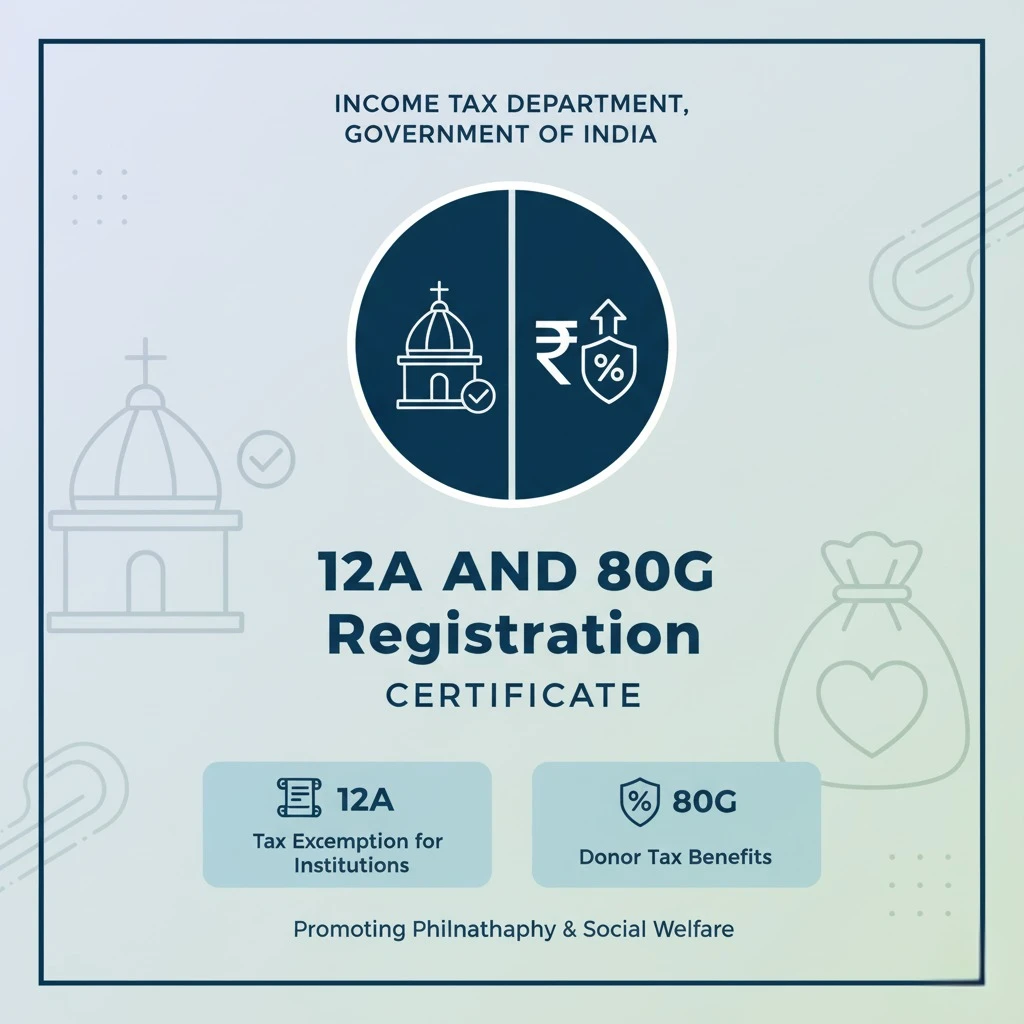
12A & 80G Registration in Lucknow
12A & 80G Registration in Lucknow is relevant to eligible NGOs that want recognised non-profit tax status and, where applicable, donor-related tax benefits. In 2026, organisations should also understand that the familiar “12A/12AB and 80G” terminology now sits within the new Income-tax Act, 2025 framework for fresh applications filed from 1 April 2026.
Legal Papers India assists Lucknow-based NGOs remotely from its Delhi and Noida offices. The consultation and document-review process can therefore be handled online without implying that Legal Papers India operates a physical Lucknow branch or Income Tax registration centre. The uploaded brief specifically requires this remote-service model.
A newly formed NGO and an organisation whose existing approval is nearing expiry do not need the same filing route.
Expert recommendation: first determine whether the organisation needs provisional registration, regular registration/approval, renewal-related filing, re-application, or an update after modifying its objects.
Why Lucknow NGOs Need a More Careful Registration Strategy
Lucknow has an active charitable and social-welfare ecosystem, with NGOs working in areas such as child welfare, education, community development and social support. The Lucknow district administration itself maintains an NGO public-utility directory, confirming a real local non-profit presence rather than merely a generic city-market assumption.
For an NGO, however, “12A” and “80G” solve different compliance needs.
| Requirement |
Practical Purpose |
Main Beneficiary |
|
Non-profit tax registration |
Supports eligible tax-exempt treatment of the organisation |
NGO |
|
Donation-related approval |
Supports eligible donor deduction claims |
Donor |
|
Both |
Aligns organisational tax status with fundraising requirements |
NGO + donor |
Under the current Income-tax Act, 2025 framework, regular registration is addressed under section 332, while donor-related approval is dealt with under section 354. Form 105 can cover registration, approval, or both depending on the application.
Common mistake: assuming an 80G-type approval means every donor automatically gets a 100% deduction. Income Tax guidance shows that eligible donations can fall into 50% or 100% categories, with or without qualifying limits.
Which Lucknow Organisations Should Evaluate 12A and 80G Approval?
Charitable trusts, societies, Section 8 companies and certain other non-profit institutions may need to evaluate registration where they seek tax recognition, structured fundraising or donor deduction eligibility. The current Form 105 framework expressly recognises public trusts, registered societies and Section 8 companies among eligible applicant categories. Typical Lucknow applicants include:
- Charitable Trusts;
- Registered Societies;
- Section 8 Companies;
- Educational Ngos;
- Healthcare Ngos;
- Child-Welfare Organisations;
- Women And Social-Development Organisations;
- Religious-Cum-Charitable Organisations;
- Disability-Support Organisations; And
- Newly Established Non-Profits Planning Formal Fundraising.
The local context matters. A Lucknow society running community education programmes may need donation approval primarily for fundraising, while a newly incorporated Section 8 company may still be working through entity, PAN and tax-registration sequencing.
Decision guideline: create or verify the underlying NGO entity first. 12A/80G-type tax registration does not itself create a trust, society or Section 8 company.
How 12A & 80G Registration Online in Lucknow Works After April 2026
Fresh applications filed from 1 April 2026 are governed by the Income-tax Act, 2025. The Income Tax Department states that Form 104 corresponds to the earlier Form 10A for provisional registration, while Form 105 is used for regular registration or regular approval under sections 332 and 354.
A practical filing path is:
| Stage |
Purpose |
Frequent Problem |
|
Check existing status |
Identify previous 12A/12AB/80G approval |
Wrong application category |
|
Review NGO constitution |
Verify trust/society/Section 8 structure |
Objects inconsistent with activities |
|
Check PAN and e-Filing profile |
Ensure portal readiness |
Incomplete organisation profile |
|
Select application type |
Provisional vs regular |
Using outdated Form 10A advice |
|
Prepare evidence |
Establish activities and compliance history |
Weak activity records |
|
Submit and respond |
Complete departmental examination |
Queries not answered properly |
|
Receive order |
Registration/approval and URN |
Assuming no future compliance remains |
Form 104 is intended for provisional applications where activities have not commenced. The Department’s guidance states that an organisation whose activities have already started should use Form 105 instead.
Form 105 is also relevant where provisional registration is expiring, an existing registration is due for renewal, or the organisation has modified its objects.
Compliance tip: a Lucknow NGO should not rely on older articles that automatically direct every applicant to Form 10A or 10AB.
Documents and Records to Prepare Before Filing
The documents needed depend on the organisation’s legal form, whether activities have started, earlier approvals and the type of application. Under Form 105, the Income Tax Department reviews applicant particulars, recognition history, office bearers, operations, assets/liabilities, income, religious activities and supporting attachments.
| Organisation Type |
Key Records to Review |
|
Charitable Trust |
Trust deed, PAN, trustee details, activity and financial records |
|
Society |
Registration certificate, memorandum/rules, PAN, governing-body information |
|
Section 8 Company |
Incorporation records, MOA/AOA, PAN, director/signatory details |
|
Existing NGO |
Earlier tax registration orders, financial statements, activity history |
|
Newly Formed NGO |
Constitutional documents, PAN, provisional application information |
|
Educational/Healthcare NGO |
Entity records plus evidence of stated charitable activities |
For example, a Lucknow healthcare NGO should be able to show that its governing objects and actual work are aligned. A broadly drafted object clause combined with unrelated commercial activity can create avoidable scrutiny.
The current Form 105 process also checks prior registration, rejection or cancellation history, and a revocable trust cannot file the application in the manner described under section 332.
Overlooked requirement: historical approvals matter. Do not prepare the application as if an old rejection, cancellation or previous registration never existed.
The 2026 Transition Creates a Different Decision for Existing NGOs
Existing Lucknow NGOs should not assume that every old 12A/12AB or 80G approval became invalid on 1 April 2026. The Income Tax Department explicitly states that approvals granted under the Income-tax Act, 1961 continue where they are not inconsistent with the corresponding provisions of the 2025 Act.
Similarly, applications filed during FY 2025–26 and still pending on 31 March 2026 are to be disposed of under the old Act; the organisation does not need to submit a fresh application merely because the new Act commenced.
This matters for Lucknow NGOs in three common situations:
Existing valid approval:
Check its validity and next compliance trigger instead of automatically refiling.
Pending pre-April-2026 application:
Review its pending status rather than creating a second application.
New post-April-2026 applicant:
Use the new Act and current forms.
Decision framework: classify the NGO by registration history first, not just by its legal structure.
80G-Type Approval Also Creates Donation Reporting Responsibilities
Obtaining donor-related approval is only one part of the fundraising compliance cycle. Under the Income-tax Act, 2025 framework, reporting persons must file Form 113 for donations from tax year 2026–27 onward and issue Form 114 to donors as the corresponding donation certificate.
Form 113 is intended to capture donation and donor details so that the Income Tax Department can match the deductions claimed by donors. Once Form 113 is filed, Form 114 is generated for issuance to the donor.
For organisations fundraising in Lucknow, this has an operational consequence: donor PAN/details, payment information and donation records should be captured accurately when the donation is received rather than reconstructed later.
A related donor rule is also important: Income Tax guidance states that no deduction is available for a cash donation exceeding ₹2,000 under the 80G framework.
Compliance warning: fundraising processes should be built around post-approval reporting obligations, not just around obtaining the approval certificate.
When Professional Assistance Is Worth Considering?
Professional assistance is most useful where the organisation needs help determining the correct form, application category, historical registration position or supporting evidence. This is particularly relevant after the 2026 transition because older online guidance may use forms and sections that no longer apply to fresh applications.
Assistance can be useful when:
- Activities Have Already Commenced;
- Provisional Approval Is Nearing Expiry;
- The Ngo Changed Its Objects;
- An Older 12a/12ab Or 80g Approval Exists;
- A Previous Application Was Rejected;
- The Organisation Wants Registration And Donation Approval Together;
- Financial/Activity Records Need Reconciliation;
- A Departmental Query Must Be Answered.
Form 105 also permits an application to be withdrawn within seven days of filing if the applicant discovers a mistake.
Buyer hesitation point: a professional can improve preparation and reduce avoidable filing errors, but cannot legitimately guarantee approval. The Income Tax Department examines the organisation’s objects, activities and compliance status. Read more About Us
Cost and Timeline for 12A & 80G Registration in Lucknow
There is no responsible single professional fee or guaranteed approval timeline that applies to every Lucknow NGO. A new provisional application, an established organisation moving to regular registration and an NGO with an earlier rejection can require very different levels of documentation and review.
Cost should therefore be evaluated by scope rather than by a headline “certificate price.”
| Cost/Timeline Factor |
Why It Matters |
|
New vs existing NGO |
Different filing category and evidence |
|
Provisional vs regular |
Different form and scrutiny level |
|
Existing approvals |
Historical records must be reviewed |
|
Modified objects |
May trigger a specific application route |
|
Weak activity records |
Can require additional preparation |
|
Departmental query |
Adds response work and time |
|
Both 332 and 354 |
Wider application scope |
Form 105 applications undergo examination by the Income Tax Department, after which an order in Form 107 may grant regular registration/approval with a 16-digit Unique Registration Number.
Pricing recommendation: ask for a written scope covering application review, document scrutiny, filing, departmental-query support and post-registration guidance rather than comparing providers only on advertised turnaround.
Frequently Asked Questions
1. Are 12A and 80G still used after 1 April 2026?
The terms remain widely used by NGOs and donors, but fresh applications after 1 April 2026 fall under the Income-tax Act, 2025. Provisional registration uses Form 104, while regular registration and donation-related approval are handled through Form 105 under sections 332 and 354. Existing valid old-law approvals do not automatically become invalid.
2. Can a newly formed NGO in Lucknow apply before starting activities?
Yes, an eligible newly formed organisation can apply for provisional registration/approval. The Income Tax Department states that Form 104 is used for provisional registration after 1 April 2026 and is intended where activities have not yet commenced. If activities have already begun, the Department’s guidance directs the applicant towards Form 105 instead.
3. Can a Lucknow society apply for both tax registration and donor approval?
Yes, an eligible registered society can apply within the current non-profit tax framework. Form 105 expressly recognises societies registered under the Societies Registration Act or other applicable law. Where donation approval is also sought, the organisation should review whether the application should cover section 332, section 354, or both.
4. Can a Section 8 company in Lucknow obtain 12A and 80G-type approval?
Yes. Section 8 companies are expressly included among the organisation types recognised in the current Form 105 framework. However, incorporation under the Companies Act does not automatically provide tax registration or donation-related approval. The company must separately satisfy the applicable Income Tax requirements and maintain ongoing compliance.
5. Does every donation to an approved NGO qualify for a 100% deduction?
No. Income Tax guidance shows that donations can qualify for 50% or 100% deduction and may also be subject to qualifying limits depending on the approved fund or institution. NGOs should therefore avoid promising donors a fixed deduction percentage without checking the applicable category.
6. What happens if the NGO already has a valid old 12A/80G approval?
A valid approval granted under the Income-tax Act, 1961 does not become invalid merely because the Income-tax Act, 2025 commenced on 1 April 2026. The organisation should check the validity period and applicable future filing requirements instead of submitting a fresh application automatically.
7. Do approved NGOs need to report donations after registration?
Yes, where the applicable reporting provisions apply. From tax year 2026–27, Form 113 is used for the statement of qualifying donations, and Form 114 serves as the donor certificate. NGOs should therefore maintain accurate donor information and donation records as part of routine fundraising compliance.
8. Can an NGO claim 80G-related donor benefits for large cash donations?
The Income Tax Department states that deduction is not available in respect of a cash donation exceeding ₹2,000 under the 80G framework. Organisations raising donations should encourage traceable payment modes and maintain proper donor records so eligible donors can support their deduction claims correctly.
9. Does 12A/80G-type registration need renewal?
The answer depends on the specific registration or approval category and its validity. Form 105 explicitly covers situations where an existing registration is due for renewal, provisional registration is expiring, or organisational objects have changed. NGOs should check the actual order and validity period rather than assuming every approval is permanent.
10. Can Legal Papers India assist Lucknow NGOs without a local office?
Yes. The supplied brief identifies Legal Papers India’s head-office locations as Delhi and Noida and specifies a Pan-India remote service model. Lucknow NGOs can therefore receive online consultation, document review and filing guidance without representing Legal Papers India as operating an unverified Lucknow branch or Income Tax registration centre.
Build the Right Tax-Registration Path Before Filing
For a Lucknow NGO, the first step should be identifying its present position: new and inactive, newly active, provisionally registered, regularly registered, approaching expiry, or operating under an older approval. That decision determines whether provisional or regular filing is relevant and prevents unnecessary duplicate applications.
The 2026 tax-law transition makes this particularly important because many search results and older compliance articles still use Form 10A/10AB terminology, while current fresh filings use Form 104 or Form 105 depending on the organisation’s circumstances.
Legal Papers India can assist Lucknow-based trusts, societies, Section 8 companies and other non-profits remotely with application review and filing guidance from Delhi and Noida.
Choose Legal Papers India for Expert Guidance. Contact Us
Legal Papers India Business Solution Private Limited, F 2, Sector 8, Noida, Uttar Pradesh, 201301
Monday to Saturday 10:00 AM to 06:30 PM





Please submit all general enquiries in the contact form below and we look forward to hearing from you soon.


Captcha:











Or sign in with:
LOGIN WITH GOOGLESign up for early Sale access plus tailored new arrivals, trends and promotions. To opt out, click unsubscribe in our emails.
Forgot your password? No worries! Enter your registered email to receive a link and securely reset it in just a few steps.