
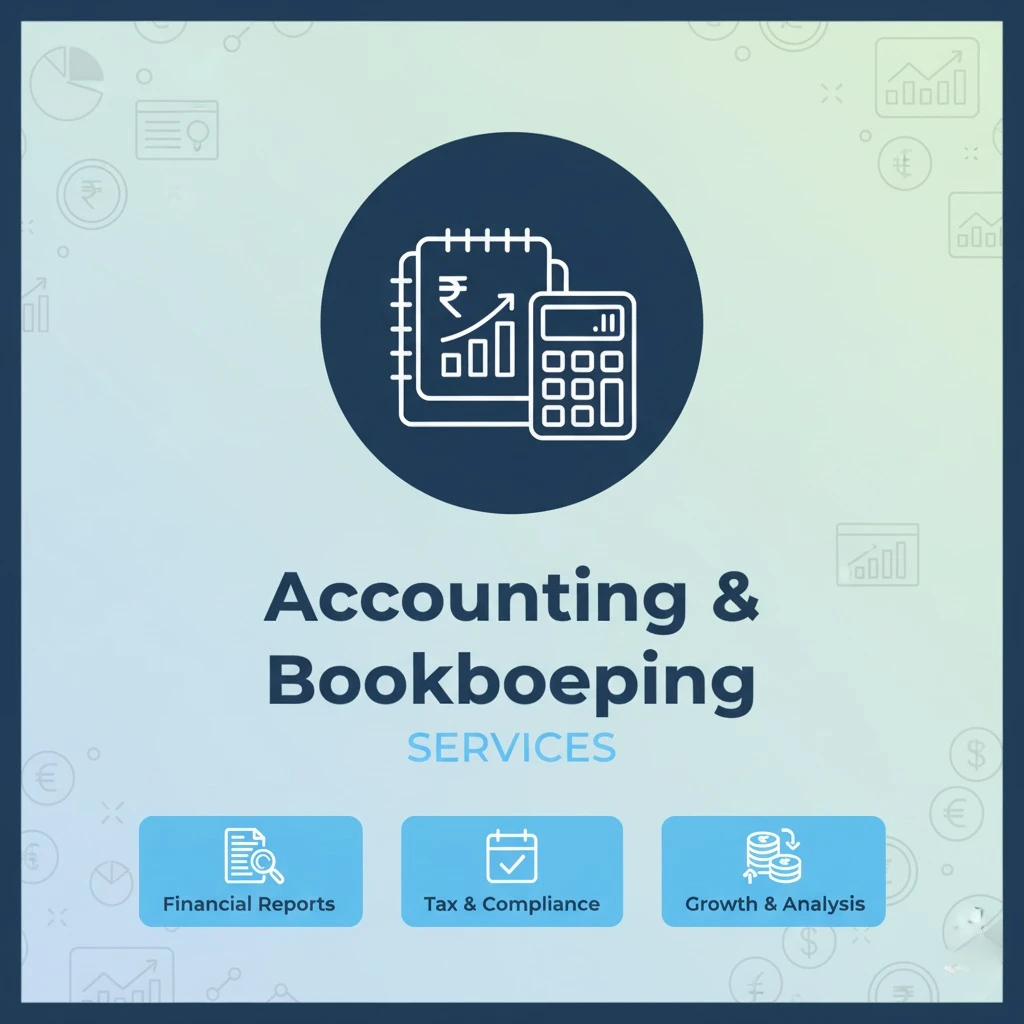
Accounting and Bookkeeping Services in Lucknow
Accounting and Bookkeeping Services in Lucknow give businesses a structured way to record transactions, reconcile banks and ledgers, monitor receivables and payables, and keep books ready for GST, tax, audit and management reporting. The work can be coordinated remotely, so businesses do not need an accounting provider with a physical Lucknow branch.
Legal Papers India operates through its Delhi and Noida base and can coordinate accounting records digitally for Lucknow businesses. The uploaded brief expressly requires remote Pan-India service delivery unless a real physical city office exists.
The distinction between bookkeeping and accounting is important:
Bookkeeping: records invoices, payments, purchases, expenses and other transactions.
Accounting: reconciles, classifies and interprets those records so they can support financial statements, tax filings and management decisions.
A practical monthly cycle is:
Collect documents → post transactions → reconcile bank accounts → review customer/vendor balances → reconcile GST/TDS where relevant → close books → issue reports
Common mistake: Waiting until GST filing or year-end to organise transactions. Backlogs make unidentified bank entries, missed invoices and vendor differences much harder to resolve.
Why Lucknow Businesses Need Better Monthly Financial Control
Lucknow’s mix of startups, IT and ITeS businesses, consultants, professional firms, retailers, e-commerce businesses and growing SMEs creates accounting needs that are often less about complex factory costing and more about recurring invoicing, vendor payments, payroll, GST, receivable tracking and cash-flow visibility. Structured monthly bookkeeping makes those areas measurable before problems become year-end surprises.
Uttar Pradesh’s current investment strategy positions IT, ITeS, GCCs and digital businesses as priority sectors, and Lucknow is specifically identified as a key technology location. The state also supports startups through incubators, policy incentives and a growing innovation ecosystem.
Different Lucknow businesses therefore need different accounting controls:
| Business Type |
Accounting Priority |
|
IT/Software Company |
Client invoices, payroll, subscriptions, vendor expenses |
|
Consultant/Agency |
Receivables, TDS, project expenses, cash flow |
|
Startup |
Burn rate, founder expenses, capital entries, MIS |
|
E-commerce Seller |
Marketplace settlements, returns, fees, GST reconciliation |
|
Trader |
Sales/purchase ledgers, customer/vendor ageing |
|
Small Manufacturer |
Purchases, stock-linked entries, vendor balances |
|
Professional Firm |
Billing, expense allocation, TDS and tax-ready records |
Practical observation: A consulting firm can show a healthy profit on paper while still struggling for cash because customers have not paid. Monthly receivable ageing is therefore more useful than looking only at the profit and loss account.
Expert recommendation: Review both profitability and cash collection every month.
Who Should Outsource Accounting and Bookkeeping in Lucknow?
Outsourced bookkeeping is suitable for businesses that have regular financial activity but do not want to build a complete in-house accounts function. It is especially useful when owners or managers cannot reliably track bank balances, pending customer payments, vendor dues or GST-linked books without manually checking multiple spreadsheets and portals.
Typical users include:
- Startups
- Proprietorship firms
- Partnership firms
- LLPs
- Private Limited Companies
- IT and ITeS businesses
- Consultants
- Digital and marketing agencies
- E-commerce businesses
- Traders and wholesalers
- Small manufacturers
- Professional service firms
- MSMEs
The decision should not depend only on legal structure. A sole proprietor processing hundreds of marketplace orders every day can need more bookkeeping work than a low-activity company.
Decision guideline: Outsourcing becomes commercially useful when accounting work is taking owner time away from sales, customer delivery or operations—or when financial answers cannot be produced without first “checking the books.”
Overlooked requirement: Define who will create invoices, approve expenses and upload documents. Outsourced bookkeeping does not work well when responsibility is unclear.
How Online Bookkeeping Services in Lucknow Should Operate
Online Bookkeeping Services in Lucknow should run on a fixed monthly close rather than irregular data entry. The accountant should receive source documents by an agreed cut-off date, reconcile balances, identify exceptions and deliver usable reports. The better the monthly routine, the less reconstruction is needed during GST filings, annual accounts or audits.
A robust workflow can follow this structure:
| Stage |
Purpose |
Common Mistake |
Better Practice |
|
Document collection |
Gather sales, purchases, expenses |
Files sent randomly |
Fixed monthly cut-off |
|
Transaction posting |
Update accounting records |
Duplicate or missed entries |
Standard ledger coding |
|
Bank reconciliation |
Match bank and books |
Old entries remain unresolved |
Reconcile every month |
|
Customer/vendor review |
Track outstanding balances |
Ageing ignored |
Maintain ageing schedules |
|
GST review |
Match sales/purchase records |
Filing before reconciliation |
Resolve exceptions first |
|
Month-end close |
Lock reviewed period |
Constant backdated edits |
Controlled adjustments |
|
Reporting |
Produce financial visibility |
Only raw ledger exported |
P&L + ageing + exceptions |
Common mistake: Treating a bank statement as the complete accounting record. A ₹50,000 bank credit may be a customer payment, director loan, capital contribution or refund; the transaction needs supporting context.
Expert tip: Maintain a monthly “unidentified transactions” list and resolve it before the books are closed.
Documents and Records Needed for Monthly Accounting
Accounting work depends on transaction records rather than a long registration-document checklist. Sales invoices, purchase bills, bank statements, expense records and tax data form the core, while manufacturers, e-commerce sellers and professional firms require additional records that reflect how money actually moves through their business model.
| Business Type |
Records Commonly Required |
|
Proprietorship |
Bank statements, invoices, expenses, GST data |
|
Partnership |
Sales/purchases, partner transactions, bank records |
|
LLP |
Books, invoices, bank data, statutory transactions |
|
Private Limited Company |
Ledgers, payroll, bank records, director/company transactions |
|
OPC |
Company transactions, statutory and bank records |
|
Consultant/Agency |
Client invoices, contractor bills, TDS, expenses |
|
Manufacturer |
Purchases, sales, stock-related data, operating costs |
|
E-commerce Business |
Marketplace reports, returns, fees, settlements, GST data |
A monthly file can typically include sales invoices, purchase invoices, credit/debit notes, bank statements, expense receipts, payroll summaries, GST reports, TDS information and prior-period adjustment details.
Practical recommendation: Use separate digital folders for sales, purchases, banks, payroll and tax records. The bookkeeping process becomes faster because missing documents can be identified immediately.
Common mistake: Providing only net marketplace settlements for e-commerce accounting. The books should ordinarily distinguish gross sales, returns, platform charges and other deductions rather than recording only the amount deposited into the bank.
What Professional Accounting Support Adds Beyond Voucher Entry?
Professional accounting support should convert transaction data into reconciled and decision-ready financial records. Data entry alone does not tell management whether customers are paying late, margins are falling, expenses are increasing or GST figures agree with the books. The useful output is a financial system that supports both compliance and business decisions.
The value can be separated into five areas:
Operational: regular posting prevents accounting backlog.
Legal/compliance: cleaner books support GST, TDS, ITR and audit work.
Business growth: receivable ageing, cash-flow and expense trends become visible.
Platform: bank data, accounting software and GST information can be reconciled more consistently.
Future compliance: year-end accounts can be prepared from an existing trail instead of rebuilding twelve months of transactions.
Buyer hesitation point: Ask whether the quoted service includes reconciliations and financial review or only ledger posting.
Expert recommendation: Request a defined monthly deliverable list before onboarding—for example, trial balance, P&L, ageing report and bank reconciliation status.
Remote Accounting Support for Lucknow Businesses
Remote accounting works well when documents are already digital and responsibilities are clearly defined. Lucknow’s IT companies, agencies, startups, consultants and e-commerce businesses are particularly suited to this model because invoices, bank data, payroll records and marketplace reports can be shared and reviewed electronically without daily physical coordination.
Legal Papers India can coordinate this work remotely from Delhi and Noida without claiming an office in Lucknow. This positioning follows the supplied prompt’s transparency requirements.
A good remote engagement should define:
- Accounting software to be used
- Monthly document cut-off
- Who raises customer invoices
- Bank-data sharing method
- Payroll-data responsibility
- GST/TDS scope
- Monthly reporting date
- Query-response process
- Backlog-cleanup scope
- Access controls for financial data
Practical observation: Remote accounting failures usually come from process gaps, not geography. If the accountant waits for marketplace data that nobody has responsibility for sending, monthly reporting will remain incomplete regardless of where the accountant sits.
Trust guideline: Access to accounting software and bank-related records should be role-based and documented. Get to know About Us
Accounting & Bookkeeping Cost in Lucknow
Accounting and bookkeeping pricing in Lucknow depends mainly on transaction volume and complexity. Two businesses with the same legal structure can require very different monthly effort if one has a single bank account and 50 entries while the other manages thousands of marketplace transactions, payroll, inventory and multiple GST registrations.
Legal Papers India’s national accounting page currently shows package-based pricing tiers, demonstrating that transaction volume and service scope affect cost. The final quote should nevertheless reflect the actual workload rather than simply matching an entity type.
Key cost factors include:
| Cost Factor |
Why It Changes Workload |
|
Monthly transaction count |
More posting and review |
|
Number of bank accounts |
More reconciliations |
|
GST registrations |
Additional tax-data reconciliation |
|
Payroll |
Recurring salary and deduction entries |
|
E-commerce channels |
Settlement and refund complexity |
|
Inventory |
Additional accounting controls |
|
Backlog |
One-time reconstruction work |
|
MIS/reporting |
Additional analytical effort |
Pricing recommendation: Separate recurring monthly fees from backlog-cleanup charges.
Timeline guidance: Ongoing books can follow a fixed monthly schedule; old records require a separate estimate based on the number of months and quality of available documents.
Frequently Asked Questions
1. Is outsourced bookkeeping useful for a startup in Lucknow?
Yes. Startups often need financial visibility before they need a full-time accounting department. Monthly bookkeeping can track founder expenses, customer invoices, vendor payments, payroll and cash burn while keeping records ready for compliance. Lucknow’s startup ecosystem is expanding through state-backed incubation and technology initiatives, making scalable finance processes increasingly relevant for early-stage companies.
2. How often should a Lucknow business update its accounts?
Monthly is a practical minimum for many SMEs, while transaction-heavy businesses may need weekly or even daily updates. The key is consistency. When entries remain pending for several months, bank reconciliation and customer/vendor balances become harder to reconstruct, and tax filings are more likely to rely on incomplete information.
3. Can accounting services include GST reconciliation?
Yes, if GST reconciliation is part of the agreed engagement. The accountant can compare sales and purchase records with available GST data before returns are prepared. Businesses should clarify whether the quoted scope includes bookkeeping only, reconciliation only, return filing, or all of these because they involve different levels of work.
4. What reports should I receive every month?
A useful monthly pack can include a trial balance, profit and loss account, balance sheet, customer ageing, vendor ageing and bank-reconciliation status. A startup may additionally want cash-burn reporting, while a trading business may need stronger receivable and inventory visibility. Reports should be chosen around management decisions, not generated merely because software offers them.
5. Can incomplete old books be reconstructed?
Usually, yes, if enough source material is available. Cleanup may use bank statements, invoices, GST filings, marketplace reports, vendor statements and previous financial records. The timeline depends on how many months are incomplete and how much supporting information is missing. Backlog work should be scoped separately from routine monthly bookkeeping.
6. Is remote bookkeeping suitable for Lucknow IT companies?
Yes. IT and ITeS businesses are well suited to digital accounting because most records—client invoices, subscriptions, payroll, vendor bills and bank transactions—already exist electronically. Lucknow is also being positioned as a technology hub under Uttar Pradesh’s IT and startup strategy, which strengthens the relevance of scalable remote finance operations.
7. What is the biggest bookkeeping mistake made by small businesses?
One recurring mistake is confusing money movement with accounting treatment. A bank deposit is not automatically revenue, and a payment is not automatically an expense. Loans, advances, capital contributions, reimbursements and tax payments all require different treatment. Recording everything directly from the bank statement can therefore distort both profit and liability figures.
8. Can e-commerce businesses outsource their accounting?
Yes. E-commerce bookkeeping can be outsourced, but the accountant needs complete marketplace reports rather than only bank settlements. Sales, returns, commissions, shipping charges, platform fees and GST implications may all sit inside one settlement. Proper reconciliation prevents net deposits from being incorrectly treated as total revenue.
9. How much do bookkeeping services in Lucknow cost?
There is no single responsible rate for every business. Pricing depends on transaction volume, bank accounts, GSTINs, payroll, e-commerce complexity, inventory, backlog and reporting requirements. Ask for a scope-based quote showing what monthly reports and reconciliations are included instead of comparing providers only on a headline monthly price.
10. Does Legal Papers India have a physical accounting office in Lucknow?
This page does not represent Legal Papers India as having a physical Lucknow office. The supplied service model is Pan-India remote accounting and compliance support from Delhi and Noida. Documents, reconciliations, monthly reporting and consultations can therefore be handled digitally while the business’s verified head-office information remains unchanged.
Build a Monthly Accounting Routine Before Compliance Deadlines Arrive
Accounting and Bookkeeping Services in Lucknow are most effective when they create a repeatable monthly process instead of acting as emergency cleanup before GST, ITR or annual accounts. Legal Papers India can coordinate records remotely and define the reporting schedule, document responsibilities and scope before monthly work begins.
For an initial assessment, keep ready:
- Approximate monthly transaction volume
- Number of bank accounts
- GST registrations
- Payroll size
- Accounting software currently used
- E-commerce platforms, if applicable
- Current backlog period
- Inventory requirements
- Reporting expectations
- Whether GST, TDS or ITR services are also required
A Lucknow startup may care most about cash burn and runway. A consulting firm may prioritise receivable ageing. A trader may need vendor and customer reconciliation. The accounting scope should reflect that operating reality.
Get Trusted Compliance Support from Legal Papers India. Contact Us
Legal Papers India Business Solution Private Limited, F 2, Sector 8, Noida, Uttar Pradesh, 201301
Monday to Saturday 10:00 AM to 06:30 PM





Please submit all general enquiries in the contact form below and we look forward to hearing from you soon.


Captcha:



















Or sign in with:
LOGIN WITH GOOGLESign up for early Sale access plus tailored new arrivals, trends and promotions. To opt out, click unsubscribe in our emails.
Forgot your password? No worries! Enter your registered email to receive a link and securely reset it in just a few steps.