
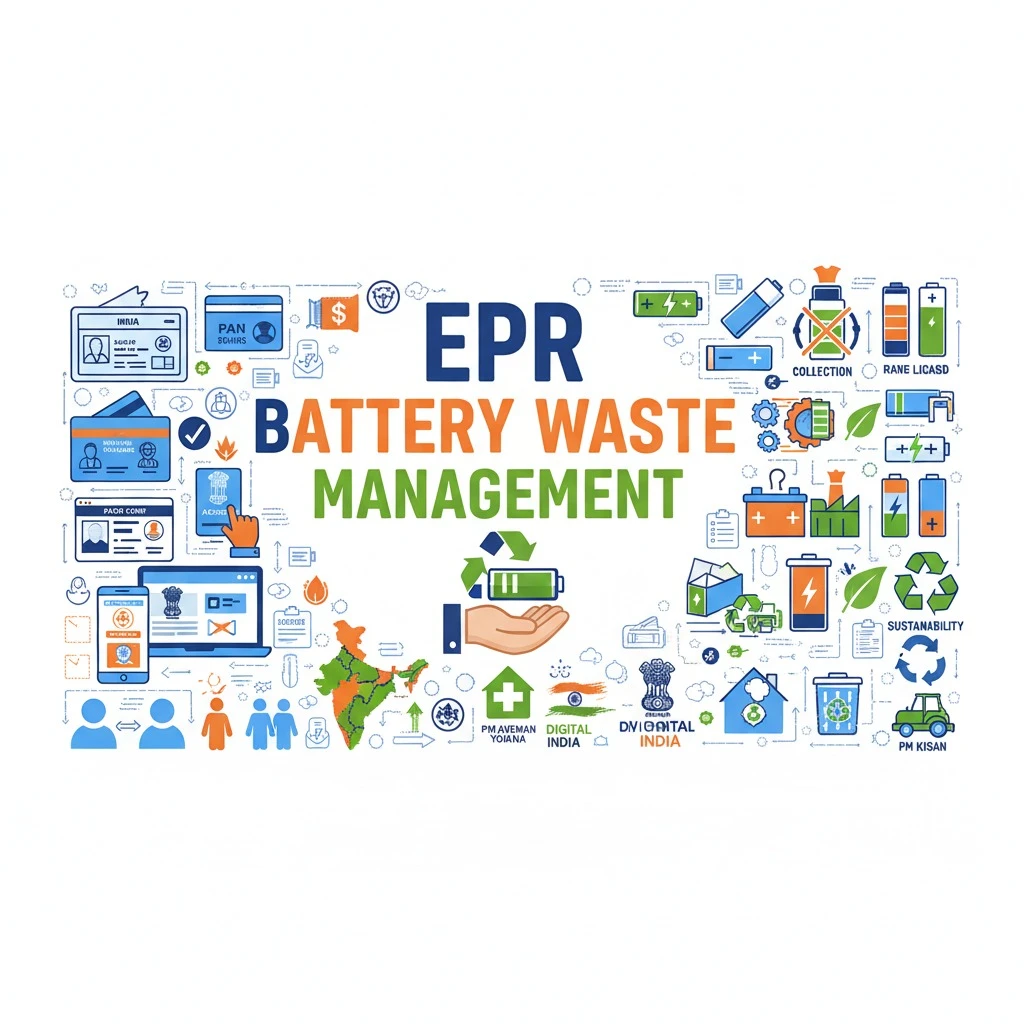
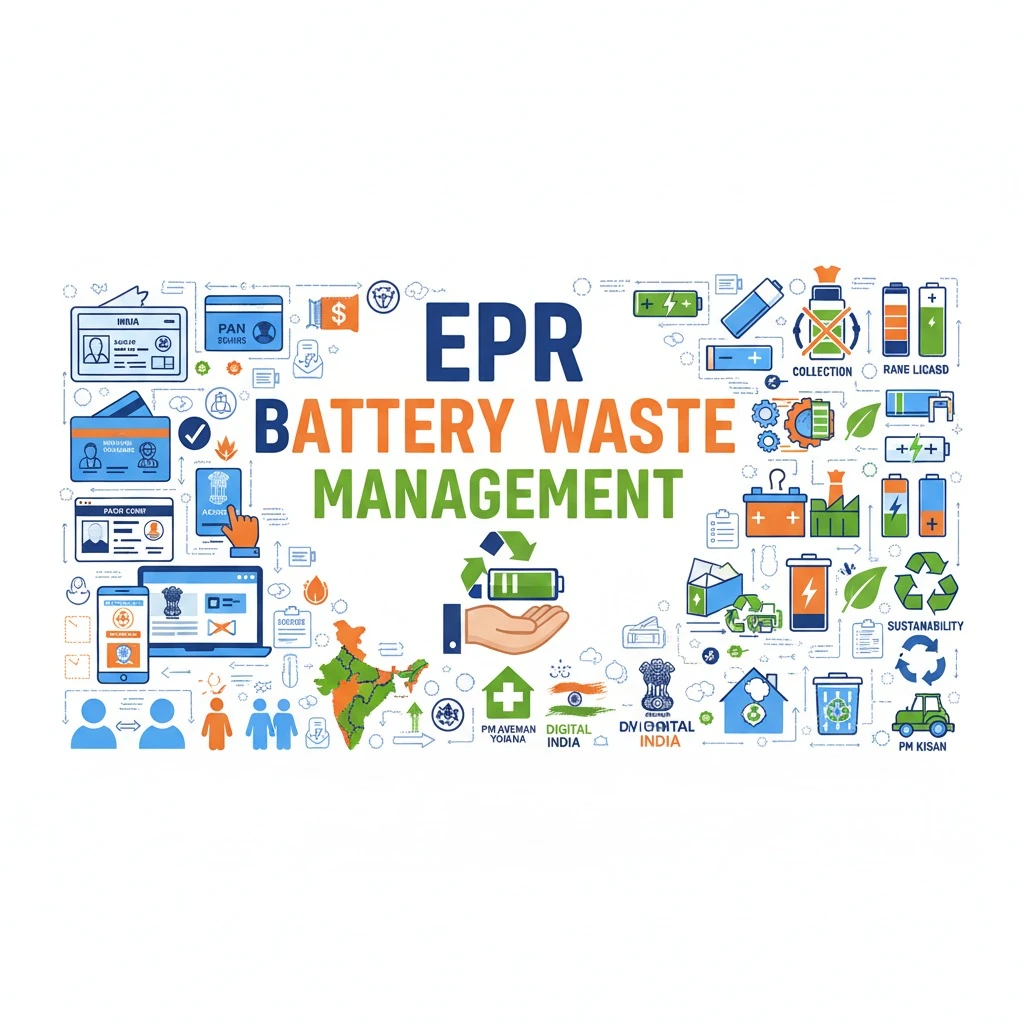
EPR Registration in Lucknow
EPR Registration in Lucknow applies according to what a business manufactures, imports, brands or places on the Indian market—not simply where its office is located. Legal Papers India assists Lucknow businesses remotely from Delhi and Noida with applicability assessment, documentation, category identification and registration coordination without representing a physical Lucknow office.
For a business owner, the critical first step is determining the applicable waste stream. Plastic packaging, electronic and electrical equipment, and batteries operate under different regulatory frameworks.
A company can even fall within more than one framework.
Consider an electronics brand that imports rechargeable devices packed in plastic. Depending on the precise products and business role, the company may need to examine:
Electronic equipment → battery → plastic packaging
as separate compliance questions.
CPCB's current EPR material separately defines Producers, Importers and Brand Owners for plastic-waste EPR and recognizes producer responsibilities under the e-waste framework.
Practical recommendation: Determine applicability before requesting an “EPR licence.” Otherwise, businesses can spend time preparing documents for the wrong regulatory category.
Why Lucknow’s Growing Business Base Makes EPR Planning Important
Lucknow-based brands increasingly operate beyond a purely local market, while Uttar Pradesh has substantial MSME, food-processing, electronics, packaging and manufacturing ecosystems. Businesses selling packaged consumer products, electronics or batteries should therefore assess EPR at the product-launch or import-planning stage rather than waiting for a marketplace, buyer or compliance query.
Lucknow also sits within Uttar Pradesh's broader MSME and startup ecosystem. Invest UP identifies food processing, electronics, electricals, plastics and packaging among sectors supported within the state's manufacturing environment.
This creates several practical EPR situations.
| Lucknow Business Situation |
Compliance Question |
|
Chikankari/lifestyle D2C brand using plastic mailers |
Does plastic packaging EPR apply to the brand owner? |
|
Packaged food company |
What packaging categories and quantities enter the market? |
|
Electronics seller importing its own branded equipment |
Does e-waste producer registration apply? |
|
Consumer-goods importer |
Are both product and packaging EPR obligations relevant? |
|
Battery-powered product brand |
Is battery EPR applicable separately? |
|
Online brand expanding across India |
Do EPR records reflect actual market quantities? |
Uttar Pradesh also continues to maintain policies covering electronics, MSMEs, food processing, EVs, warehousing and logistics, reinforcing the relevance of environmental compliance to businesses scaling within these sectors.
Common mistake: EPR is reviewed only after a product has already been imported or launched.
Better decision: Add an EPR applicability check to the product-launch, private-label or import checklist before commercial quantities increase.
Which Lucknow Businesses Should Check Their EPR Registration Requirement?
Manufacturers, producers, importers and brand owners dealing with regulated products or packaging should assess EPR applicability. For e-waste specifically, CPCB states that manufacturers, producers, refurbishers and recyclers are among the entities required to register on the E-Waste EPR Portal under the current rules.
CPCB also clarifies that covered electrical and electronic equipment is determined through Schedule I of the E-Waste (Management) Rules, 2022.
Business Applicability Matrix
| Business |
Likely Area to Examine |
|
FMCG Brand |
Plastic packaging |
|
Electronics Manufacturer |
E-waste + packaging |
|
Electronics Importer |
E-waste + packaging |
|
Battery Manufacturer/Importer |
Battery waste |
|
D2C Brand |
Packaging and product-specific EPR |
|
Private-Label Seller |
Brand-owner/producer status |
|
Plastic Packaging Producer |
Plastic-waste framework |
|
E-commerce Business |
Role under applicable waste rules |
|
Distributor |
Whether activities create an independent regulated role |
An important distinction exists between selling regulated goods and becoming a regulated entity yourself. A distributor merely reselling another company's compliant product may have a different position from an importer bringing the product into India under its own business arrangements.
Compliance tip: Map the supply chain:
Manufacturer → Importer → Brand → Distributor → Marketplace → Consumer
Then determine where your legal entity sits and what activity it actually performs.
Choosing Between Plastic, E-Waste and Battery EPR
The correct EPR registration depends on the waste stream created by the product or packaging. Plastic packaging EPR focuses on Producers, Importers and Brand Owners; e-waste rules apply to covered electrical and electronic equipment; battery-waste requirements operate under a separate framework. Multi-component products therefore need a category-by-category assessment.
| Category |
Typical Applicant Situation |
Main Data Concern |
|
Plastic Waste EPR |
PIBO placing plastic packaging in market |
Packaging category and quantity |
|
E-Waste EPR |
Producer of covered EEE |
Product category and EPR obligations |
|
Battery Waste EPR |
Producer/importer of covered batteries |
Battery category and market data |
|
Multiple EPR Streams |
Electronic/battery product with plastic packaging |
Separate datasets and compliance tracking |
For plastic EPR, CPCB defines a Producer, Importer and Brand Owner according to their respective roles in manufacturing packaging, importing packaged goods/materials and selling commodities under a registered brand or trademark.
For e-waste, packaging plastics and waste batteries are specifically addressed outside the E-Waste Rules under their respective waste-management frameworks.
Overlooked requirement: A product may look like one commercial SKU to the sales department but represent multiple environmental compliance streams.
How EPR Registration Online in Lucknow Is Prepared
EPR registration preparation begins with regulatory classification, not portal data entry. Businesses should identify their role, map products and packaging, reconcile quantities and prepare entity records before submission. This reduces inconsistencies between the registration application and the data later used for target fulfilment, certificate management or returns.
Practical Filing Workflow
| Stage |
What Should Be Done |
Frequent Error |
|
Applicability Review |
Determine waste stream |
Assuming every EPR is identical |
|
Entity Classification |
Identify regulatory role |
Incorrect producer/importer/brand-owner classification |
|
Product Mapping |
List applicable SKUs/categories |
Leaving out variants |
|
Data Preparation |
Compile quantities |
Using unverified estimates |
|
Document Review |
Check legal information |
PAN/GST/entity mismatches |
|
Portal Filing |
Submit applicable application |
Incorrect category selection |
|
Query Handling |
Respond with supporting records |
Giving incomplete explanations |
|
Registration |
Review approved particulars |
Ignoring errors on registration |
|
Continuing Compliance |
Track targets/returns |
Treating registration as final step |
CPCB operates EPR mechanisms for the relevant regulated streams, and its e-waste guidance confirms portal registration requirements for specified entities.
Expert recommendation: Maintain one master product-compliance sheet containing SKU, product category, brand, packaging type, applicable EPR stream and quantity source. This becomes increasingly useful as a Lucknow business adds marketplaces or expands distribution.
Documents Required for EPR Registration in Lucknow
EPR applications normally require legal-entity information together with product, packaging, manufacturing or import data relevant to the applicable waste stream. The exact checklist cannot responsibly be identical for every applicant because a plastic brand owner, electronics producer and battery importer operate under different regulatory frameworks.
| Entity Type |
Common Business Records to Prepare |
|
Proprietorship |
PAN, GST/business details, proprietor information |
|
Partnership |
PAN, Partnership Deed, GST and partner details |
|
LLP |
Incorporation records, LLP Agreement, PAN, GST |
|
Private Limited Company |
Incorporation Certificate, PAN, GST, authorized-person information |
|
OPC |
Incorporation and authorized-person records |
|
Manufacturer |
Entity records plus manufacturing/product information |
|
Importer |
Entity records plus import and product information |
|
Brand Owner |
Brand details plus product/packaging information |
Depending on the EPR stream, additional information may concern:
- Product categories
- Packaging categories
- Brand names
- Manufacturing details
- Import information
- Quantities introduced into the market
- Authorized signatory
- Supporting declarations
- Existing environmental registrations
- Portal-specific records
Common mistake: Sales quantity, import quantity and packaging quantity are compiled independently without reconciliation.
Practical check: Before filing, ask whether the numbers can be traced back to invoices, import records, manufacturing information or another reliable business record.
What Professional EPR Assistance Should Actually Cover
Professional assistance should do more than upload documents. Its practical value lies in determining applicability, organizing defensible data, reducing category errors, preparing the submission and explaining what continues after registration. This is particularly important for businesses handling several brands, SKUs, packaging materials or regulated product categories.
Operational Value
A structured engagement can establish:
- Product-to-EPR mapping
- Responsibility ownership
- Document checklist
- Quantity reconciliation
- Compliance calendar
Regulatory Value
Businesses gain clarity around:
- Applicable waste-management framework
- Correct applicant category
- Portal requirements
- Regulatory queries
- Post-registration responsibilities
Commercial Value
Proper compliance preparation can matter when expanding through:
- E-commerce marketplaces
- Institutional procurement
- National distribution
- Import channels
- Private-label products
- B2B supply contracts
Future Compliance Value
EPR is not simply a registration exercise. Depending on the framework, ongoing requirements may involve target fulfilment, EPR certificates, recycling records, returns and updates to registration information.
Buyer guideline: When comparing consultants, ask whether the quotation is for registration only or also covers subsequent compliance. A lower registration quote may exclude the work that becomes necessary afterward.
EPR Registration Cost and Approval Timeline in Lucknow
There is no responsible single quotation for every EPR Registration in Lucknow because cost depends on the applicable waste stream, applicant role, number of products, packaging complexity, quality of existing data and scope of professional support. Approval time likewise depends heavily on application completeness and regulatory queries.
What Changes the Cost?
| Factor |
Impact on Work |
|
One vs multiple EPR streams |
Multiple registrations may need separate preparation |
|
Number of products |
More mapping and classification |
|
Packaging complexity |
More category/quantity work |
|
Import operations |
Additional product/import reconciliation |
|
Existing data quality |
Poor data increases preparation effort |
|
Query support |
May require additional compliance work |
|
Ongoing compliance |
Different from registration-only support |
Applicants should also distinguish:
Professional fee + applicable statutory/portal requirements + continuing compliance costs
rather than treating everything as one undefined “EPR certificate price.”
Approval-delay reason: A fast submission is not necessarily a strong submission. Incorrect categories or unsupported quantities can create queries that cost more time than a proper pre-filing review.
Why Lucknow Clients Can Work Remotely with Legal Papers India
Legal Papers India can coordinate EPR applications for Lucknow businesses through digital document exchange and remote consultation from Delhi and Noida. Because EPR registration relies heavily on legal-entity, product, packaging and quantity information, applicants generally do not need a consultant to claim a physical Lucknow office to prepare their compliance file.
Support can include:
- Initial applicability discussion
- Plastic/e-waste/battery category review
- Producer/importer/brand-owner assessment
- Document checklist
- Product-data organization
- Application preparation
- Portal coordination
- Query-response guidance
- Post-registration compliance discussion
No fabricated Lucknow address or local registration centre should be represented.
Before engaging assistance, ask:
- Which EPR category applies?
- Can multiple registrations apply?
- What records must our finance/import/operations teams provide?
- What does the quoted fee include?
- Are portal queries covered?
- Is post-registration compliance separate?
Decision guideline: A consultant should be able to explain why a particular EPR framework applies before asking you to proceed with registration.
Read more About Us
Frequently Asked Questions
1. Is EPR Registration mandatory for every manufacturer in Lucknow?
No. The requirement depends on the products, packaging and regulatory role of the business. A manufacturer producing goods outside the applicable regulated categories should not assume EPR applies merely because it manufactures products. Plastic packaging, covered electronic equipment and batteries should be assessed against their respective rules.
2. Does a Lucknow D2C brand using plastic courier bags need EPR?
Potentially, depending on how the business qualifies under the plastic-waste EPR framework and the packaging it introduces into the market. A D2C company should assess its role as a brand owner and map primary, secondary and other applicable plastic packaging rather than assuming its packaging supplier carries the entire responsibility.
3. Can I obtain an EPR Certificate in Lucknow entirely online?
The relevant EPR systems use online registration and compliance mechanisms, so application preparation and professional consultation can largely be coordinated digitally. However, the applicant must provide genuine business, product and quantity information. Online filing does not remove the underlying regulatory responsibilities attached to the registration.
4. Does an electronics importer need both e-waste and plastic EPR?
It can, depending on the imported electronic equipment and its packaging. E-waste and packaging plastics are regulated under separate frameworks. If batteries are also involved, battery-waste obligations may need separate examination. The safest approach is to map each component instead of treating the imported item as a single compliance category.
5. How much does CPCB EPR Registration in Lucknow cost?
There is no universal figure applicable to every business. Cost depends on EPR stream, entity role, products, packaging categories, documentation quality and whether assistance covers registration only or subsequent compliance. Businesses should obtain a scope-based quotation showing professional and continuing compliance components separately.
6. Does EPR Registration require renewal?
Registration validity, renewal and continuing obligations depend on the applicable EPR framework and current regulatory provisions. Businesses should track the conditions attached to their specific registration rather than assuming that an EPR approval remains unchanged indefinitely. Product, business or regulatory changes can also create update requirements.
7. What if my company adds a new product after EPR registration?
The compliance impact should be reviewed before or when the new product is introduced. A new product may alter the applicable product category, packaging quantities or even introduce another EPR waste stream. Maintaining a product-change compliance checklist prevents marketing or procurement teams from launching SKUs without regulatory review.
8. Is EPR Authorization the same as a Pollution Control Board consent?
No. EPR obligations and operational pollution-control permissions serve different regulatory purposes. A business should not assume that an EPR Registration or EPR Authorization substitutes for every consent, licence or environmental approval applicable to its facility or operations.
9. What is the most common EPR mistake for an importer?
A frequent problem is evaluating only the imported finished product while ignoring packaging, batteries or another regulated component. Importers should map the full product configuration and reconcile import information with the quantities used for EPR compliance rather than preparing the application from approximate sales data.
10. Can Legal Papers India assist without a Lucknow office?
Yes. The service model specified for Legal Papers India is remote assistance from Delhi and Noida. Documents, product information and application data can be coordinated digitally. The company should therefore be represented as assisting businesses in Lucknow, not as operating an unverified physical EPR office there.
Start Your EPR Compliance Planning with Legal Papers India
Before applying for EPR Registration in Lucknow, establish exactly what your company manufactures, imports, brands and places into the market. Legal Papers India can then assist remotely with the applicable registration path, documentation and compliance preparation without creating an unnecessary local-office dependency.
For an initial assessment, keep the following ready:
- Legal entity type
- GST and business details
- Product list
- Brand information
- Import/manufacturing status
- Packaging materials
- Battery involvement, if any
- Existing EPR registrations
- Approximate regulated quantities
- Markets in which products are sold
This allows the discussion to focus on applicability first, registration second and continuing compliance third.
Simplify Compliance with Legal Papers India. Contact Us
Legal Papers India Business Solution Private Limited, F 2, Sector 8, Noida, Uttar Pradesh, 201301
Monday to Saturday 10:00 AM to 06:30 PM





Please submit all general enquiries in the contact form below and we look forward to hearing from you soon.


Captcha:



Or sign in with:
LOGIN WITH GOOGLESign up for early Sale access plus tailored new arrivals, trends and promotions. To opt out, click unsubscribe in our emails.
Forgot your password? No worries! Enter your registered email to receive a link and securely reset it in just a few steps.