
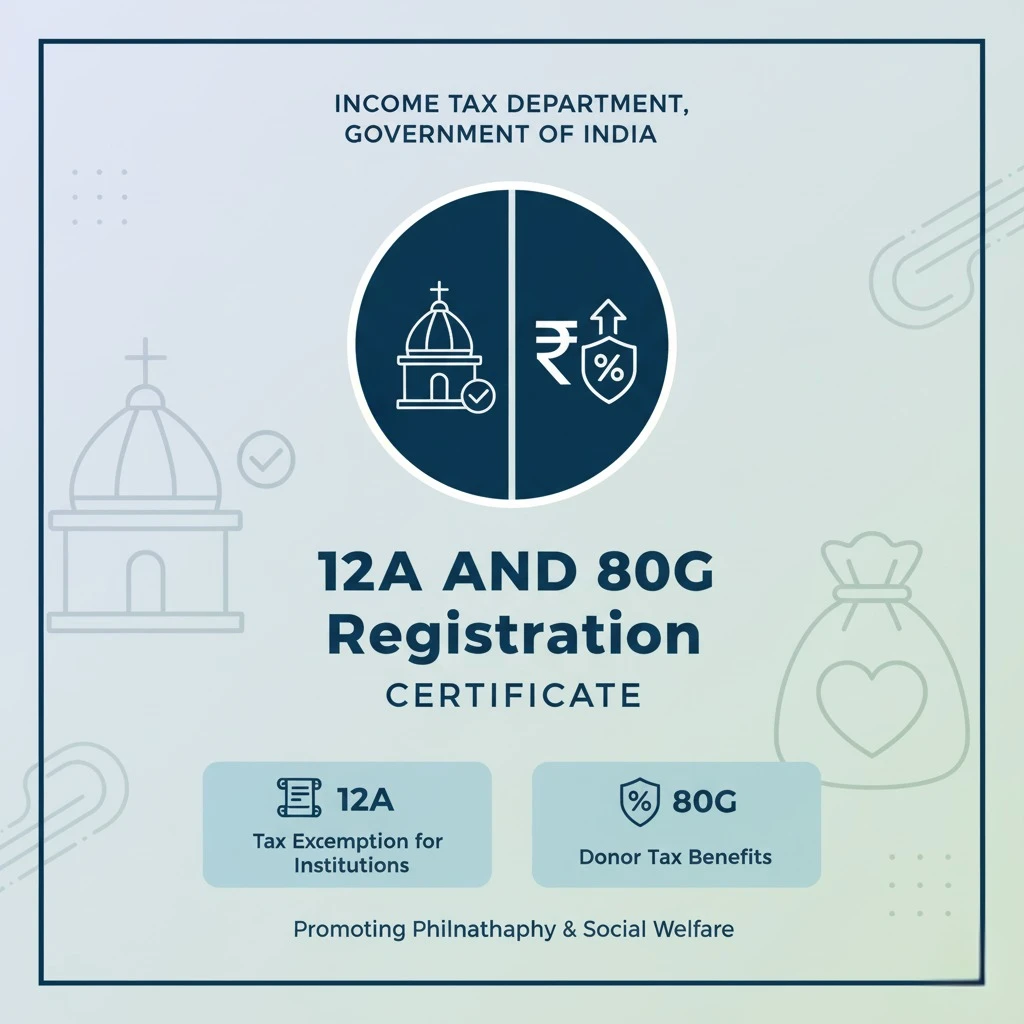
12A & 80G Registration in Mysore
For a Mysore NGO, the correct filing path depends on its present status rather than simply whether it wants “12A and 80G certificates.” A newly created trust that has not begun programmes, an established society already receiving donations and an organisation holding an older approval can each require a different registration route.
From 1 April 2026, fresh applications operate under the Income-tax Act, 2025. The Income Tax Department confirms that fresh provisional applications use Form 104, while regular registration under section 332(3) or regular donation-related approval under section 354(2) is obtained through Form 105.
Legal Papers India assists Mysore-based organisations remotely from its Delhi and Noida offices. No local Mysore branch, Income Tax centre or government registration office should be implied.
Practical recommendation: confirm the organisation's activity commencement date and earlier approval history before preparing the application.
Mysore’s NGO Landscape Makes Activity Evidence Especially Relevant
Mysuru has a substantial voluntary-sector ecosystem spanning rural development, education, women's welfare, health, disability support, social development and charitable services. That makes activity evidence important because Income Tax registration is assessed against what the organisation actually does—not merely what its incorporation or trust document says.
The official Mysuru district NGO directory lists organisations such as Asha Kirana Charitable Trust, All India Women's Conference Mysuru Zone, rural-development organisations, educational organisations, charitable trusts and disability-focused institutions.
The district Social Welfare Department also administers education-oriented welfare programmes, hostels, scholarships and other social-development schemes, while the Women and Child Development Department focuses on women development, child development and social-defence programmes.
| Mysore organisation |
Main compliance question |
|
Rural-development NGO |
Do field activities match registered objects? |
|
Education society |
Is its tax-registration history current? |
|
Women's welfare organisation |
Are governing and programme records aligned? |
|
Disability-support NGO |
Is donor approval needed for fundraising? |
|
New charitable trust |
Have activities commenced? |
|
Existing NGO |
Is renewal, regularisation or transition required? |
Common mistake: assuming inclusion in a government NGO directory or participation in a welfare programme automatically provides Income Tax exemption or donor deduction approval.
Decision guideline: treat welfare-programme recognition and Income Tax registration as separate compliance tracks.
Which Mysore Organisations Should Review 12A and 80G Registration?
Public charitable trusts, registered societies, Section 8 companies and other qualifying NPOs should review their registration position when seeking eligible income-tax treatment or donor-related approval. The legal structure matters, but so do the organisation's objects, activity history and previous registration orders.
Form 105 specifically recognises public trusts, societies registered under applicable law and Section 8 companies among organisation categories under section 332.
Potential Mysore applicants include:
- Charitable Trusts;
- Rural And Tribal-Development Ngos;
- Registered Educational Societies;
- Women's Welfare Organisations;
- Disability-Support Institutions;
- Healthcare Charities;
- Section 8 Companies;
- Child-Development Organisations;
- Public Religious And Charitable Organisations; And
- Newly Formed Ngos Preparing For Structured Fundraising.
Mysuru's official NGO directory itself reflects this variety, including organisations focused on rural literacy and health, visually impaired students, tribal development and community development.
Overlooked requirement: an organisation can have valid entity-registration documents and still have a weak Income Tax application if its actual programmes cannot be connected clearly to its stated charitable objects.
Form 104 or Form 105? Start With the Activity Question
The difference between provisional and regular filing is central to the current 2026 framework. A newly formed organisation that has not yet commenced activities can examine Form 104, while an operating NGO generally needs to evaluate Form 105 for regular registration or approval.
The notified Income-tax Rules, 2026 identify Form 104 as the application for provisional registration or provisional approval and specifically ask whether the organisation's activities have commenced. The Income Tax Department separately confirms that post-1-April-2026 fresh provisional applications use Form 104.
| Current position |
Route to examine |
Risk to avoid |
|
New NGO; no activities |
Form 104 |
Using old Form 10A guidance |
|
Activities already underway |
Form 105 |
Treating first application as automatically provisional |
|
Provisional status expiring |
Form 105 |
Missing conversion to regular registration |
|
Existing approval due for renewal |
Form 105 |
Assuming approval is indefinite |
|
Objects changed |
Form 105 implications |
Ignoring constitutional modification |
|
Registration + donor approval |
Section 332 + 354 review |
Choosing an incomplete application |
Form 105 is the consolidated regular application used where activities have commenced, provisional registration is expiring, registration is due for renewal or organisational objects have changed.
Compliance warning: an older article ranking for “12A Registration” may still refer to Form 10A or Form 10AB. Current applications should be checked against the 2026 framework rather than copied from legacy instructions.
Documents Mysore NGOs Should Reconcile Before Filing
A good application is not simply a bundle of uploaded documents. The organisation's legal name, PAN, constitution, management, actual activities and previous Income Tax orders should all describe the same entity consistently.
For Form 105, the Department reviews applicant details, previous recognition, office bearers, operations and other compliance information. An organisation should therefore conduct an internal document check before filing rather than discovering conflicts during departmental examination.
| Organisation |
Records to review |
|
Charitable Trust |
Trust deed, PAN, trustee details, activity and financial records |
|
Registered Society |
Registration certificate, memorandum/rules, PAN, governing body |
|
Section 8 Company |
Incorporation records, MOA/AOA, PAN, directors/signatory |
|
New NGO |
Constitution, PAN, authorised-person details |
|
Operating NGO |
Activity evidence, accounts and earlier Income Tax orders |
|
NGO with Modified Objects |
Amended constitution and current approval |
The official Form 104 itself captures PAN, address, contact details, application category, commencement of activities and trust irrevocability, showing why these issues should be settled before filing.
Common mistake: changing trustees, office bearers or organisational address operationally but leaving older information in governing or tax records.
Checklist: reconcile PAN, legal name, address, governing document, management, activity commencement date and earlier approval history before submission.
Existing Mysore NGOs Should Check Old Approvals Before Reapplying
An existing approval should be reviewed before any fresh filing. The commencement of the Income-tax Act, 2025 did not automatically cancel every old 12A/12AB or 80G approval, so duplicate filing can create unnecessary procedural confusion.
The Income Tax Department confirms that approval or recognition granted under the old Income-tax Act can continue after 1 April 2026, so far as it is not inconsistent with the corresponding provisions of the new Act.
It also states that applications filed in FY 2025–26 and still pending as of 31 March 2026 continue under the old Act; there is no need to submit a second application merely because the new law began.
For Mysore NGOs, separate these situations:
Valid old approval: check its validity and next compliance trigger.
Pending pre-April-2026 filing: do not duplicate it simply because legislation changed.
Fresh post-April-2026 filing: use the current framework.
Changed objects or operational status: review whether Form 105 is triggered.
Expert recommendation: create a simple registration-history sheet showing form filed, order date, validity, section, rejection/cancellation if any, and current status.
When Professional Assistance Is Worth Considering?
Professional assistance becomes useful when the difficult part is deciding what should be filed rather than simply entering information into the portal. Organisations with old approvals, changed objects, activity history or inconsistent records generally require more review than a newly formed NGO with clean documents.
Closer review is useful when:
- Activities Have Already Commenced;
- An Older 12a/12ab Or 80g Order Exists;
- Provisional Registration Is Approaching Expiry;
- The Trust Deed Or Society Memorandum Has Been Amended;
- Trustees Or Office Bearers Have Changed;
- The Ngo Wants Section 332 Registration And Section 354 Approval Together; Or
- Previous Records And Current Activities Do Not Align.
The Department uses Form 105 to assess regular registration or approval and verify an NPO's objects, activities and compliance position.
Buyer hesitation point: ask what a professional fee actually includes—classification review, documentation check, filing, correction support and response assistance should not be assumed unless stated.
Trust guideline: professional assistance cannot guarantee approval. Get to know About Us
Cost & Timeline for 12A & 80G Registration in Mysore
There is no reliable single professional price or approval timeline for every Mysore NGO because complexity differs significantly by organisation. A new inactive trust can require far less historical review than an established social-welfare society with older approvals, accounts, changed objects or unresolved filing history.
| Factor |
Why it changes the work |
|
Provisional vs regular filing |
Different application route |
|
Registration vs approval vs both |
Changes application scope |
|
Existing approval |
Previous orders require review |
|
Operating history |
Activity and financial records matter |
|
Changed objects |
Constitutional documents must be compared |
|
Previous rejection |
Filing strategy may change |
|
Record inconsistencies |
Corrections may be needed first |
For regular registration, Form 105 is examined by the Income Tax Department rather than automatically approved on submission.
Approval-delay reason: incomplete activity records, contradictory governing details or incorrect application classification can lead to queries or further review.
Pricing recommendation: obtain a written scope rather than comparing providers only by an advertised certificate fee.
Frequently Asked Questions
1. How can a new NGO apply for 12A Registration in Mysore?
A new organisation should first determine whether charitable activities have begun. Fresh provisional applications filed after 1 April 2026 use Form 104 under the Income-tax Act, 2025. If the organisation is already active, it should examine the regular registration framework rather than automatically treating itself as a provisional applicant.
2. Can an operating Mysore society apply through Form 104?
Activity commencement is a key filing factor. Form 104 is the provisional registration or approval form and expressly captures whether activities have started. An already operating society should therefore review whether regular Form 105 treatment applies instead of choosing the provisional route simply because this is its first Income Tax application.
3. Does being listed as an NGO by Mysuru District mean the organisation has 80G approval?
No. Mysuru District maintains an extensive official NGO directory, but inclusion there is not the same as Income Tax donation approval. Organisations such as charitable trusts, rural-development groups and educational bodies may appear in local records while their Income Tax registration remains a separate central compliance matter.
4. Can a Section 8 company in Mysore apply for 12A and 80G-type benefits?
Yes, an eligible Section 8 company is recognised among the organisation categories covered under section 332. Its MOA, charitable objects, PAN, management details, activities and previous Income Tax history should still be reviewed before determining whether registration, donation-related approval or both are appropriate.
5. How much does 12A and 80G Registration cost in Mysore?
Professional fees vary according to the organisation's circumstances. An inactive new trust generally requires less historical assessment than an established society with years of activities, earlier approvals or changed governing documents. Ask for a written scope covering document review, application classification, filing and post-filing support before comparing prices.
6. Is an old 12A or 80G approval still valid after April 2026?
It is not automatically invalid. The Income Tax Department states that approvals granted under the 1961 Act can continue after the Income-tax Act, 2025 commenced, so far as they are consistent with the corresponding new provisions. Review the actual approval and validity before filing again.
7. Can a Mysore educational or disability NGO apply?
Potentially, subject to the applicable tax-registration conditions. Mysuru's official NGO directory includes educational and disability-focused organisations, including schools for visually impaired and hearing-impaired beneficiaries. The organisation's sector alone does not establish approval, however; its constitution, activities and compliance records must support the application.
8. Does working with the Karnataka Social Welfare Department replace 12A or 80G?
No. Mysuru's Social Welfare Department manages educational, hostel, scholarship and other welfare programmes, but those schemes are separate from central Income Tax registration. An NGO may interact with welfare authorities and still need to evaluate its Income Tax registration and donor-approval status independently.
9. What should an NGO do if its charitable objects have changed?
A material modification to organisational objects should trigger a review of the existing registration. The Income Tax Department specifically identifies modification of objects as one situation where Form 105 is generally used. The amended trust deed, memorandum or other governing document should be compared with both current activities and the existing tax order.
10. Does Legal Papers India have a Mysore office?
The supplied brief identifies Legal Papers India's head-office locations as Delhi and Noida and states that services are delivered remotely unless a physical city office is specified. Mysore organisations should therefore be offered online consultation and documentation support without implying an unverified local branch.
Review the NGO’s Compliance History Before Starting the Application
For 12A & 80G Registration in Mysore, the best first step is to map the organisation's current position: newly created, already active, provisionally registered, holding an old approval, approaching renewal or operating with amended objects.
That review determines which filing path deserves consideration and reduces the chance of relying on legacy Form 10A/10AB guidance that does not accurately reflect the post-April-2026 framework.
Legal Papers India can assist Mysore-based trusts, societies, Section 8 companies, educational NGOs, disability-support organisations and social-welfare institutions remotely with application assessment and document review from Delhi and Noida.
Choose Legal Papers India for Expert Guidance. Contact Us
Legal Papers India Business Solution Private Limited, F 2, Sector 8, Noida, Uttar Pradesh, 201301
Monday to Saturday 10:00 AM to 06:30 PM





Please submit all general enquiries in the contact form below and we look forward to hearing from you soon.


Captcha:















Or sign in with:
LOGIN WITH GOOGLESign up for early Sale access plus tailored new arrivals, trends and promotions. To opt out, click unsubscribe in our emails.
Forgot your password? No worries! Enter your registered email to receive a link and securely reset it in just a few steps.