
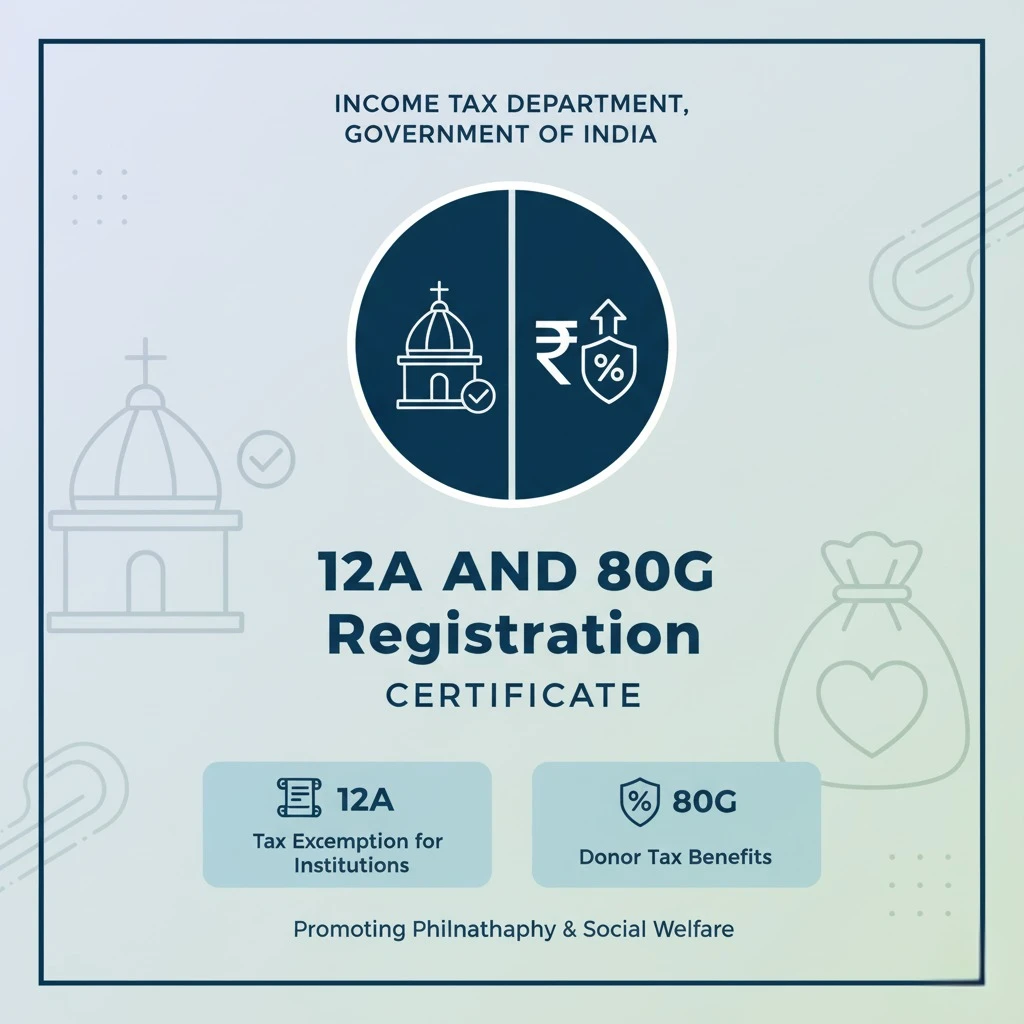
12A & 80G Registration in Nagpur
12A & 80G Registration in Nagpur should be approached according to the organisation's present status rather than as a standard two-certificate package. A newly formed NGO with no activities, an operating charitable society and a trust holding an older approval can each require a different application route under the current tax framework.
Legal Papers India assists Nagpur organisations remotely from its Delhi and Noida offices. The supplied brief specifically states that the business operates Pan-India, services are delivered remotely unless a city office is verified, and Local Business signals should not be created without a genuine physical office.
From 1 April 2026, fresh provisional applications use Form 104. Where activities have already commenced, the Income Tax Department directs organisations to Form 105 for regular registration or approval.
Practical recommendation: do not start by asking “Which documents do we upload?” Start by establishing whether the organisation is inactive, already operational, provisionally registered, due for renewal, or dealing with an earlier rejection.
Nagpur NGOs Should Connect Tax Registration with Their Actual Welfare Activities
Nagpur has a substantial social-welfare and voluntary-sector environment, so local NGOs often interact with education, social security, disability support, hostels, skill development and disadvantaged-community programmes. This makes activity evidence and record consistency especially important when an organisation later seeks tax recognition or donor-related approval.
The Zilla Parishad Nagpur Social Welfare Department administers welfare activities across education, skill development, social security and assistance for disadvantaged communities. Its official information also notes NGO involvement in backwards-class hostel operations, including 98 NGO-run hostels within the district framework.
For a Nagpur organisation, this creates an important distinction:
| NGO Situation |
Registration Concern |
Practical Check |
|
Education/hostel NGO |
Organisational tax status |
Activity records and governing objects |
|
Healthcare charity |
Tax exemption + fundraising |
Evidence of charitable healthcare activity |
|
Social welfare society |
Tax registration and grants |
Society documents and financial history |
|
New charitable trust |
Provisional route |
Whether activities have started |
|
Donation-funded NGO |
Donor deduction approval |
Section 354 eligibility |
Common mistake: assuming that because an organisation works with a government welfare department or receives some local recognition, it automatically has 12A/80G-type tax status.
Decision guideline: state-level or district welfare interaction and Income Tax registration are separate compliance layers.
Which Nagpur Organisations Should Evaluate 12A and 80G-Type Registration?
Public charitable trusts, societies and Section 8 companies are among the organisation types recognised in the current regular NPO registration framework. The correct filing route depends on legal constitution, activity status, earlier approvals and the nature of the tax benefit being sought.
The current Form 105 specifically recognises public trusts, societies registered under applicable law and Section 8 companies among applicant categories under section 332.
Typical Nagpur applicants may include:
- Charitable Trusts;
- Educational Societies;
- Healthcare Ngos;
- Section 8 Companies;
- Social-Welfare Institutions;
- Community Development Organisations;
- Disability-Support Ngos;
- Organisations Running Hostels Or Education Programmes;
- Public Religious And Charitable Organisations; And
- Newly Established Non-Profits Planning Structured Fundraising.
For section 354 approval, an organisation must also consider its section 332 or legacy registration position. The Department states that section 354 approval is not treated independently from the relevant registration prerequisites.
Overlooked requirement: if an earlier registration was cancelled or rejected, that history can affect the present application route.
Expert tip: create a chronological registration record before filing—entity formation date, PAN, old 12A/12AB order, 80G order, provisional registration, rejection or cancellation, if any.
Form 104 or Form 105? Decide Based on Activity Status
Form 104 is the provisional route for eligible organisations whose activities have not yet commenced, whereas Form 105 is used for regular registration or approval in cases where activities have begun, provisional status is expiring, an existing registration requires renewal, or organisational objects have changed.
The Income Tax Department expressly states that an organisation that has already commenced activities should not use Form 104 and should instead file Form 105.
| Current Position |
Route to Evaluate |
Main Risk |
|
New NGO, no activities |
Form 104 |
Filing regular route too early |
|
Activities already started |
Form 105 |
Using provisional form incorrectly |
|
Provisional approval expiring |
Form 105 |
Missing conversion/regular filing |
|
Existing registration due for renewal |
Form 105 |
Ignoring validity period |
|
Objects modified |
Form 105 |
Filing without amended documents |
|
Registration + donor approval |
Form 105 where applicable |
Selecting wrong section combination |
Form 105 allows the applicant to select section 332, 354 or both. It also includes options relating to application without delay, application with delay and re-application, subject to the relevant conditions.
Compliance warning: older content still ranks strongly for this topic. For example, current IndiaFilings and ClearTax pages continue to prominently describe Form 10A/10AB and the old Income-tax Act, 1961 framework.
That makes the post-April-2026 Form 104/Form 105 distinction a valuable ranking and trust signal for this Nagpur page.
Documents Nagpur NGOs Should Review Before Filing
The documents required depend on whether the organisation is a trust, society or Section 8 company and whether it is a provisional, regular, renewal, changed-object or re-application case. Form 105 examines the organisation's legal identity, recognition history, office bearers, operations, assets, liabilities, income and supporting attachments.
An active PAN and registered e-Filing account are prerequisites for Form 105. Where DSC mode is used, the DSC must be valid and registered on the e-Filing portal.
| Organisation |
Records to Review |
|
Charitable Trust |
Trust deed, PAN, trustee details, activity/financial records |
|
Registered Society |
Registration certificate, memorandum/rules, PAN, governing body |
|
Section 8 Company |
Incorporation records, MOA/AOA, PAN, director/signatory details |
|
New NGO |
Constitutive records, PAN, authorised person details |
|
Operating NGO |
Activity reports, accounts and previous tax orders |
|
NGO with amended objects |
Revised governing documents and previous registration order |
For trusts, Form 105 also asks whether the trust is irrevocable. The Department notes that a revocable trust cannot file the application in the relevant section 332 situation.
Common mistake: checking each document separately but not checking them against one another. Different addresses, inconsistent organisation names or outdated office-bearer information can complicate scrutiny.
Checklist: reconcile PAN, constitutional documents, e-Filing profile, previous approvals, activity records and current management details before submission.
An old 12A/12AB or 80G approval does not automatically become invalid merely because the Income-tax Act, 2025 came into force. Existing organisations should check the validity of their order and transition position before filing again.
The Income Tax Department states that approvals granted under the Income-tax Act, 1961 continue after 1 April 2026 where they are not inconsistent with corresponding provisions of the new Act.
It also confirms that applications filed during FY 2025–26 and still pending on 31 March 2026 continue to be disposed of under the old Act; a new application is not required solely because the new law commenced.
For Nagpur NGOs, separate these situations:
Valid old approval: review validity and next compliance trigger.
Pending application as of 31 March 2026: do not duplicate the filing purely because the law changed.
Fresh post-April-2026 case: use the current forms.
Previous rejection: review the order carefully before deciding whether the filing is an original application or permitted re-application.
Form 105 expressly asks whether an application was previously rejected and provides different treatment for certain old and new rejection orders.
Compliance warning: filing again without understanding the old order can produce a procedural problem rather than solving one.
Professional Assistance Matters Most Where the Filing History Is Complicated
Professional assistance is most useful when an NGO needs help determining the correct application category, reconciling old registration orders, reviewing amended objects or presenting operational evidence. It should not be sold as privileged access to Income Tax approval.
Relevant cases include:
- Activities Already Commenced;
- Provisional Registration Approaching Expiry;
- Old 12a/12ab And 80g Approvals;
- An Earlier Rejection;
- A Trust Deed Or Memorandum That Has Been Amended;
- Section 332 And 354 Being Sought Together;
- Inconsistent Office-Bearer Information;
- Unclear Financial Or Activity Records.
Form 105 also provides a useful correction mechanism: an application containing a filing mistake may be withdrawn within seven days of submission.
Buyer hesitation point: professional support should be evaluated by scope—application classification, document review, filing, response assistance and post-registration guidance—not simply by a “certificate package.”
Compliance tip: avoid guaranteed-approval claims. The tax authority ultimately examines eligibility, objects, activities and compliance. Get to know About Us
Cost and Timeline for 12A & 80G Registration in Nagpur
There is no single professional price or universal approval timeline that responsibly applies to every Nagpur NGO. A new inactive organisation, an established welfare society and a trust with an earlier rejection involve very different levels of review and evidence.
| Cost/Timeline Factor |
Why It Changes the Work |
|
Provisional vs regular filing |
Different form and evidence |
|
Section 332, 354 or both |
Different application scope |
|
Existing approval |
Historical order review required |
|
Changed objects |
Constitutional comparison required |
|
Previous rejection |
Filing route must be assessed carefully |
|
Weak activity evidence |
Additional preparation may be needed |
|
Departmental queries |
Additional response work |
After Form 105 examination, the Department may issue an order in Form 107. Where regular registration or approval is granted, a 16-digit Unique Registration Number is issued for future compliance.
For qualifying section 332 cases, Form 105 includes 5-year or 10-year registration options subject to statutory conditions; section 354 approval follows the applicable five-year treatment described in the Department's guidance.
Approval-delay reason: incorrect application category, incomplete records, inconsistent objects and activities, or unresolved historical approval issues can extend the process.
Pricing guideline: ask for a written professional scope instead of choosing purely from an advertised low fee.
Frequently Asked Questions
1. How can a new NGO apply for 12A Registration in Nagpur?
A newly constituted eligible NGO should first check whether charitable activities have started. If activities have not commenced, Form 104 is the current provisional route under the Income-tax Act, 2025. If operations have already begun, the Income Tax Department instructs the organisation to use Form 105 for regular registration or approval instead.
2. Can an operating Nagpur society use Form 104?
No, not merely because it is applying for the first time. The Department states that Form 104 applies where activities have not commenced. A society already running education, welfare, healthcare or another charitable programme should evaluate Form 105 and prepare operational records supporting its actual activities and stated objects.
3. Can a Section 8 company in Nagpur apply for 12A and 80G-type registration?
Yes, an eligible Section 8 company is among the applicant categories recognised under section 332. Its incorporation records, MOA/AOA, PAN, management details, actual activities and registration history should be reviewed before determining whether section 332, section 354, or both should form part of the application.
4. Does working with a government social-welfare programme automatically give an NGO 80G approval?
No. Participation in local or state welfare programmes and Income Tax approval are separate matters. Nagpur's Social Welfare Department works with voluntary organisations in areas such as NGO-operated hostels and welfare schemes, but that relationship itself does not substitute for registration or approval under the Income-tax framework.
5. How much does 12A and 80G Registration cost in Nagpur?
Professional charges vary according to the case. An inactive new NGO seeking provisional registration requires different work from an established organisation with financial records, previous approvals, amended objects or an earlier rejection. Applicants should ask for a written scope covering application review, document preparation, filing and post-filing assistance instead of relying on a single advertised certificate price.
6. Does an old 12A/80G approval become invalid after April 2026?
Not automatically. The Income Tax Department confirms that recognition or approval granted under the Income-tax Act, 1961 continues after 1 April 2026 where it is not inconsistent with the corresponding provisions of the 2025 Act. Existing NGOs should therefore review the actual order and validity before submitting another application.
7. What happens if our earlier application was rejected?
The earlier order should be reviewed before filing again. Form 105 asks whether a previous registration or approval application was rejected, and the current guidance distinguishes certain re-applications under Form 107 from older Form 10AD rejection cases. Ignoring the previous rejection can result in choosing the wrong current application category.
8. Can a trust apply for both organisational registration and donor approval together?
Where the organisation satisfies the applicable conditions, Form 105 permits selection of section 332, section 354 or both. However, approval under section 354 has prerequisites connected with section 332 or corresponding legacy registration/application status, so the correct combination should be checked rather than selected automatically.
9. Is there NGO-related government support in Nagpur?
Yes. The Zilla Parishad Nagpur Social Welfare Department administers multiple welfare programmes and works with voluntary organisations in education, social security and assistance initiatives. Its official information specifically identifies NGO-run backwards-class hostels within the district. This local welfare ecosystem is separate from central Income Tax registration.
10. Does Legal Papers India have a Nagpur office for 12A/80G Registration?
The supplied project brief identifies Legal Papers India’s head-office locations as Delhi and Noida and specifies remote delivery where no physical city office has been verified. Nagpur applicants should therefore be offered online consultation and documentation assistance without implying an unverified local branch or registration centre.
Review Your NGO's Current Position Before Filing
For a Nagpur NGO, the best first step is to classify its present position: not yet operational, already active, provisionally registered, holding an old approval, due for renewal, operating with amended objects, or dealing with a previous rejection. That classification determines the form and records that should be reviewed.
This is particularly important in 2026 because some prominent competitor pages still foreground the old Form 10A/10AB system despite fresh applications now operating under the 2025 Act.
Legal Papers India can assist Nagpur-based charitable trusts, societies, Section 8 companies and other eligible non-profits remotely with application classification, document review and filing guidance from its Delhi and Noida offices.
Get Trusted Compliance Support from Legal Papers India. Contact Us
Legal Papers India Business Solution Private Limited, F 2, Sector 8, Noida, Uttar Pradesh, 201301
Monday to Saturday 10:00 AM to 06:30 PM





Please submit all general enquiries in the contact form below and we look forward to hearing from you soon.


Captcha:





Or sign in with:
LOGIN WITH GOOGLESign up for early Sale access plus tailored new arrivals, trends and promotions. To opt out, click unsubscribe in our emails.
Forgot your password? No worries! Enter your registered email to receive a link and securely reset it in just a few steps.