
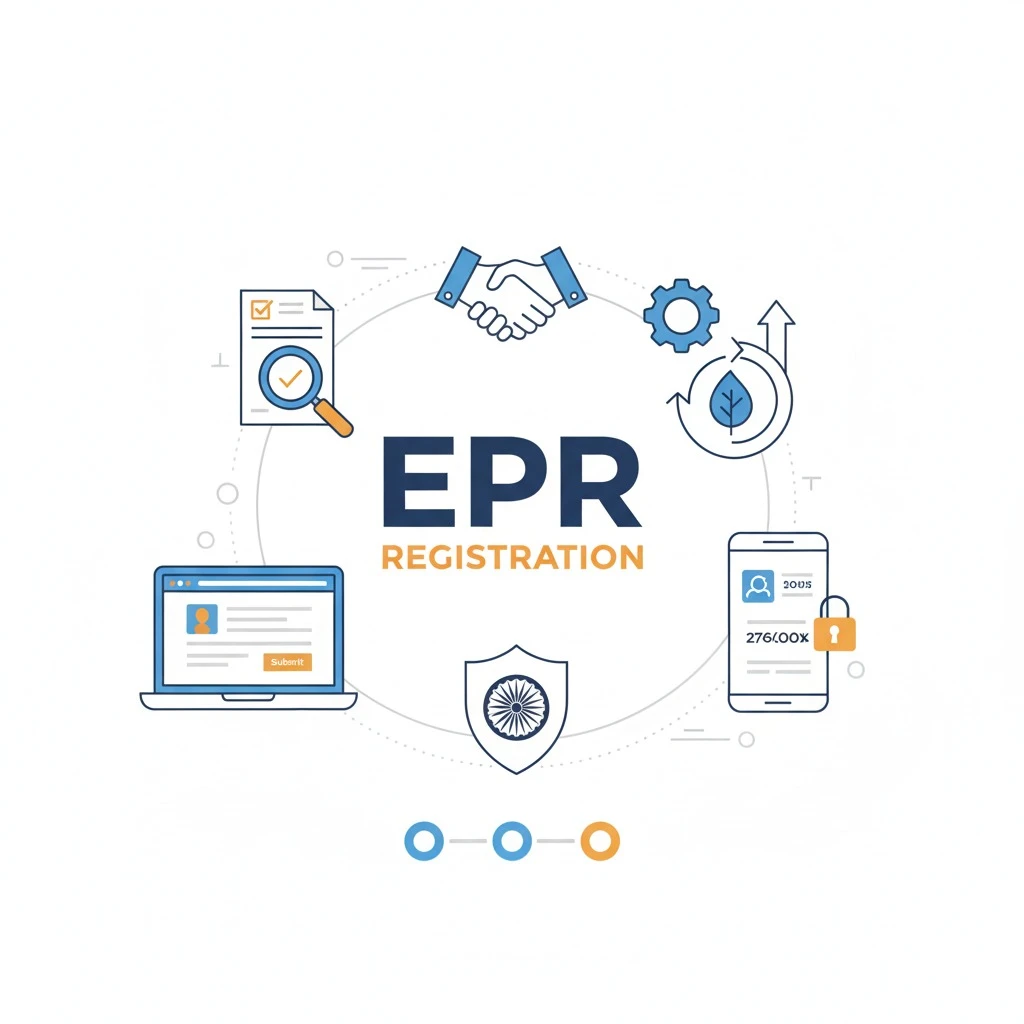
EPR Registration in Nashik
EPR Registration in Nashik depends on the products, packaging and regulatory role of the business—not merely its city location. Legal Papers India assists Nashik applicants remotely from Delhi and Noida with applicability assessment, documentation, product-category review and registration coordination without implying a physical Nashik office or local registration centre.
The first practical decision is identifying the correct EPR stream.
A company may need to assess:
- Plastic Waste EPR
- E-Waste EPR
- Battery Waste EPR
- Multiple EPR frameworks for one product
For plastic packaging, CPCB's centralized framework requires registration for Producers, Importers, Brand Owners, Plastic Waste Processors and certain additional regulated entities.
For e-waste, CPCB states that producer registration is mandatory for covered producers of electrical and electronic equipment listed under Schedule I of the E-Waste (Management) Rules, 2022.
Expert recommendation: Do not begin by asking which portal to use. Begin by asking what exactly the company manufactures, imports, brands or sells into the market.
Why Nashik Businesses Need Product-Level EPR Planning
Nashik has a commercially diverse base that includes food processing, beverages, manufacturing and other product-led sectors. This makes EPR especially relevant for businesses using plastic packaging, selling electrical products, importing equipment or handling batteries. Product and packaging compliance should ideally be reviewed before a new SKU reaches the market.
MIDC identifies Nashik as part of Maharashtra's food-processing ecosystem, including fruit, beverage and milk-related activity. Maharashtra also identifies electronics as a priority industrial sector and continues to support electronics and battery-linked manufacturing.
That creates several realistic Nashik scenarios:
| Nashik Business Situation |
EPR Question |
|
Beverage brand using plastic bottles |
Which plastic packaging category applies? |
|
Food-processing company |
Does the company qualify as a Brand Owner under plastic EPR? |
|
Electronics seller |
Is the product covered under the e-waste framework? |
|
Battery-powered equipment importer |
Are battery and e-waste obligations both relevant? |
|
D2C packaged-food brand |
Does plastic packaging EPR apply to the brand? |
|
Manufacturer introducing new SKUs |
Has the product launch changed EPR obligations? |
Common mistake: A company finalizes packaging, begins distribution and only later checks whether EPR applies.
Better decision: Add an EPR check to the product-development and procurement workflow, particularly when packaging material, batteries, electronics or import status changes.
Who Should Assess EPR Registration in Nashik?
Manufacturers, producers, importers, brand owners and businesses dealing with regulated packaging, electrical and electronic equipment or batteries should assess EPR applicability. The relevant legal role is determined by what the business actually does in the supply chain rather than the label it uses commercially.
Typical applicants include:
- Manufacturers
- Producers
- Importers
- Brand Owners
- Electronics Manufacturers
- Electronics Importers
- Battery Manufacturers
- Battery Importers
- Plastic Packaging Businesses
- FMCG Companies
- Beverage Companies
- Food-processing Brands
- D2C Businesses
- E-commerce Companies
Business Role vs Compliance Question
| Business Role |
Main Question |
|
Manufacturer |
What regulated product or packaging is being manufactured? |
|
Importer |
What covered goods enter India through the entity? |
|
Brand Owner |
Which products are sold under the company's own brand? |
|
Electronics Producer |
Is the product covered EEE? |
|
Battery Producer |
What battery category is introduced into the market? |
|
Distributor |
Is the business also importing, branding or producing? |
For e-waste, CPCB identifies Manufacturer, Producer, Recycler and Refurbisher as the entities that register on the EPR portal, while bulk consumers do not require such portal registration.
Decision framework: Map the chain:
Manufacturer → Importer → Brand Owner → Distributor → Consumer
That often makes the compliance role easier to determine.
Plastic, E-Waste and Battery EPR in Nashik
Plastic packaging, e-waste and battery waste operate under separate compliance frameworks. One EPR Certificate in Nashik should not automatically be treated as covering every regulated component of a product. Businesses with composite products should examine each waste stream individually and maintain separate data where needed.
| EPR Stream |
Typical Applicant |
Main Compliance Focus |
|
Plastic Waste EPR |
Producer, Importer, Brand Owner |
Packaging category and quantity |
|
E-Waste EPR |
Producer of covered EEE |
Product category and recycling obligation |
|
Battery Waste EPR |
Battery producer/importer |
Battery category and quantity |
|
Multi-Stream Product |
Electronic or battery product with plastic packaging |
Separate compliance mapping |
CPCB's plastic EPR framework currently includes specific category-wise obligations and recycling requirements.
For e-waste, CPCB defines EPR as the producer's responsibility to meet recycling targets through registered recyclers.
Practical example: A Nashik company importing rechargeable food-processing equipment in plastic protective packaging may need to review:
- E-waste obligations for electronic components.
- Battery obligations for included batteries.
- Plastic EPR obligations for the packaging.
Overlooked requirement: One commercial SKU can create several distinct environmental compliance streams.
EPR Registration Online in Nashik – Practical Process
EPR Registration Online in Nashik should begin with classification, product mapping and data reconciliation before portal submission. Applicants should identify their regulatory role, create a complete SKU list, check packaging or battery details and reconcile quantities against reliable source records before filing.
Step-by-Step Filing Workflow
| Step |
Purpose |
Common Mistake |
Expert Tip |
|
Applicability Review |
Identify relevant EPR stream |
Assuming one registration covers everything |
Review each waste stream separately |
|
Entity Classification |
Determine legal role |
Using internal business terminology |
Follow regulatory definitions |
|
SKU Mapping |
Identify regulated products |
Missing models or variants |
Maintain one master SKU list |
|
Quantity Review |
Prepare reportable figures |
Using approximate sales estimates |
Reconcile source records |
|
Document Validation |
Confirm entity information |
PAN/GST/name mismatch |
Standardize legal details |
|
Portal Filing |
Submit application |
Wrong product or packaging category |
Review before submission |
|
Query Handling |
Respond to regulator observations |
Incomplete evidence |
Keep source records organized |
|
Approval Review |
Check registration details |
Not checking certificate particulars |
Compare with filed application |
|
Ongoing Compliance |
Manage later obligations |
Treating registration as final |
Maintain a compliance calendar |
A useful internal record can look like:
SKU → Brand → Product Type → Packaging → Battery → Import/Manufacturing Status → EPR Stream → Quantity Source
Approval-delay reason: Incorrect classifications and unsupported quantities often cause more delay than spending additional time on a proper pre-filing review.
Documents Required for EPR Registration in Nashik
Documents for EPR Registration in Nashik depend on the applicant's legal structure, role and waste stream. Basic company records must be combined with product, packaging, import or manufacturing data relevant to the applicable EPR framework. A beverage brand owner and electronics importer therefore should not expect identical document requirements.
| Entity Type |
Common Records |
|
Proprietorship |
PAN, GST/business details, proprietor information |
|
Partnership |
Partnership Deed, PAN, GST, partner details |
|
LLP |
Incorporation records, LLP Agreement, PAN, GST |
|
Private Limited Company |
Incorporation Certificate, PAN, GST, authorized-person details |
|
OPC |
Incorporation and authorized-person records |
|
Manufacturer |
Entity records + manufacturing/product data |
|
Importer |
Entity records + import/product information |
|
Brand Owner |
Entity records + brand and packaging data |
Depending on the EPR category, additional information may concern:
- Product categories
- Packaging categories
- Brand names
- Import quantities
- Manufacturing quantities
- Battery types
- Authorized signatory
- Existing environmental registrations
- Market-placement data
- Supporting declarations
Common mistake: Sales, import and production quantities are prepared by different teams and never reconciled.
Compliance tip: Ensure major figures can be traced to invoices, import records, production data or another defensible source.
Benefits of Professional EPR Assistance
Professional EPR assistance is most useful when it clarifies applicability, reduces classification errors, structures reliable business data and explains what happens after registration. The value lies in building a defensible compliance file—not simply uploading documents to a portal.
Operational Benefits
- Structured product classification
- Clear packaging mapping
- Defined internal responsibility
- Organized quantity records
- Better compliance calendars
Legal and Compliance Benefits
- Lower risk of incorrect applicant category
- Better portal-readiness
- More consistent supporting documentation
- Stronger response to regulator queries
- Better visibility of continuing obligations
Commercial Benefits
EPR documentation can become relevant for:
- Marketplace onboarding
- National distribution
- Institutional procurement
- Private-label supply
- Imports
- B2B contracts
Future Compliance
Depending on the framework, post-registration obligations can include:
- Recycling targets
- EPR certificate management
- Annual returns
- Registration modifications
- Product/category updates
- Renewal requirements
Buyer tip: Ask whether the professional fee covers only the initial registration or also continuing compliance. Those are different scopes.
Why Nashik Businesses Can Use Remote EPR Assistance
EPR applications are largely data-, document- and portal-driven, so Nashik businesses can coordinate compliance remotely without requiring a consultant to maintain a physical office in the city. Legal Papers India operates from Delhi and Noida and can assist applicants in Nashik through digital document exchange and consultation.
The uploaded brief specifically requires a remote service model and prohibits false local-presence signals.
Support may include:
- Applicability assessment
- Plastic/e-waste/battery classification
- Producer/importer/brand-owner review
- Product and packaging data organization
- Document checklist
- Application preparation
- Portal guidance
- Query-response support
- Post-registration compliance discussion
Before selecting assistance, ask:
- Which EPR framework applies to our products?
- Could more than one EPR stream apply?
- What data must our internal team prepare?
- Are portal queries included?
- What compliance continues after registration?
- What changes when we add a new SKU?
Decision guideline: A useful consultant should explain why a registration applies before recommending the filing.
CPCB EPR Registration Cost and Timeline in Nashik
The cost and timeline for CPCB EPR Registration in Nashik depend on the waste stream, applicant role, number of products, packaging complexity, import activity, data quality and professional scope. Different EPR frameworks have different obligations, so one universal fee or approval period should not be applied to every applicant.
Cost and Processing Factors
| Factor |
Why It Matters |
|
EPR category |
Plastic, e-waste and battery requirements differ |
|
Number of SKUs |
More products require more classification work |
|
Packaging complexity |
More categories increase data work |
|
Import activity |
Requires reconciliation with import records |
|
Multiple waste streams |
Can require separate compliance assessments |
|
Data quality |
Poor records increase preparation effort |
|
Regulatory queries |
Additional clarification may be required |
|
Ongoing compliance |
Separate from registration-only scope |
Expert recommendation: Ask for a quotation that separates:
Application preparation + applicable regulatory/portal costs + continuing compliance
rather than relying on one undefined “EPR certificate fee.”
Approval-delay reason: Wrong categories and inconsistent quantity data are more likely to slow a filing than a properly prepared application.
Get to know About Us
Frequently Asked Questions
1. Does every manufacturer in Nashik need EPR Registration?
No. EPR applicability depends on the products, packaging and legal role of the manufacturer. Businesses dealing with regulated electronics, batteries or plastic packaging should assess the relevant framework, while another manufacturer may not require EPR merely because it operates in an industrial area.
2. Can EPR Registration in Nashik be completed online?
Relevant CPCB EPR systems operate through online mechanisms, so application preparation and consultation can largely be coordinated digitally. The applicant must still provide accurate legal, product, packaging and quantity information. Online filing does not reduce the underlying EPR obligations.
3. Does a Nashik beverage company need Plastic Waste EPR?
Potentially, if the company qualifies as a Producer, Importer or Brand Owner and places covered plastic packaging into the market. Nashik has a notable beverage and food-processing ecosystem, making packaging classification especially relevant for such businesses.
4. Can a Nashik electronics business need multiple EPR registrations?
Yes. A company selling electronic products with batteries and plastic packaging may need to examine e-waste, battery-waste and plastic-packaging obligations separately. One product can therefore create multiple compliance streams.
5. What affects EPR Registration cost in Nashik?
Cost depends on the applicable framework, applicant role, number of products, packaging categories, import activity, data quality and whether the scope includes only registration or also continuing compliance. A scope-based quotation is more useful than a fixed universal amount.
6. What commonly causes EPR application delays?
Common causes include wrong applicant classification, mismatched entity details, incomplete product lists, unsupported quantities and delayed responses to portal observations. Careful pre-filing review can reduce many of these avoidable problems.
7. What happens when a Nashik company launches a new SKU?
The new product should be reviewed for EPR implications because it may alter product categories, packaging quantities, battery involvement or applicable waste streams. Product approval processes should include an environmental compliance checkpoint before launch.
8. Is EPR Authorization the same as an MPCB consent?
No. EPR registration deals with producer-responsibility obligations, while Pollution Control Board consents or authorizations can apply separately to manufacturing or operational facilities. One should not be assumed to replace the other.
9. Does an importer need to check packaging as well as the product?
Yes. Importers should evaluate the regulated product and its packaging separately. Electronic equipment, batteries and plastic packaging can fall under different frameworks, so examining only the finished product may overlook another obligation.
10. Can Legal Papers India assist Nashik businesses without a Nashik office?
Yes. The brief identifies Delhi and Noida as the head-office locations and specifies remote service delivery unless a physical city office is stated. Documentation and compliance discussions can therefore be coordinated digitally without creating an unverified Nashik office claim.
Start Your EPR Compliance Journey with Legal Papers India
Before applying for EPR Registration in Nashik, identify your legal role, regulated product categories, packaging materials and any battery or electronics involvement. Legal Papers India can assist remotely with applicability review, data organization, documentation and registration preparation so that the filing reflects the company's actual business activities.
For the first review, keep ready:
- Legal entity details
- PAN and GST
- Product/SKU list
- Brand information
- Manufacturing or import status
- Packaging details
- Battery information
- Existing EPR registrations
- Market or import quantities
- Planned new products
The practical sequence should be:
Assess applicability → classify correctly → reconcile data → prepare application → respond to queries → maintain continuing compliance
Start Your Compliance Journey with Legal Papers India. Contact Us
Legal Papers India Business Solution Private Limited, F 2, Sector 8, Noida, Uttar Pradesh, 201301
Monday to Saturday 10:00 AM to 06:30 PM





Please submit all general enquiries in the contact form below and we look forward to hearing from you soon.


Captcha:







Or sign in with:
LOGIN WITH GOOGLESign up for early Sale access plus tailored new arrivals, trends and promotions. To opt out, click unsubscribe in our emails.
Forgot your password? No worries! Enter your registered email to receive a link and securely reset it in just a few steps.