
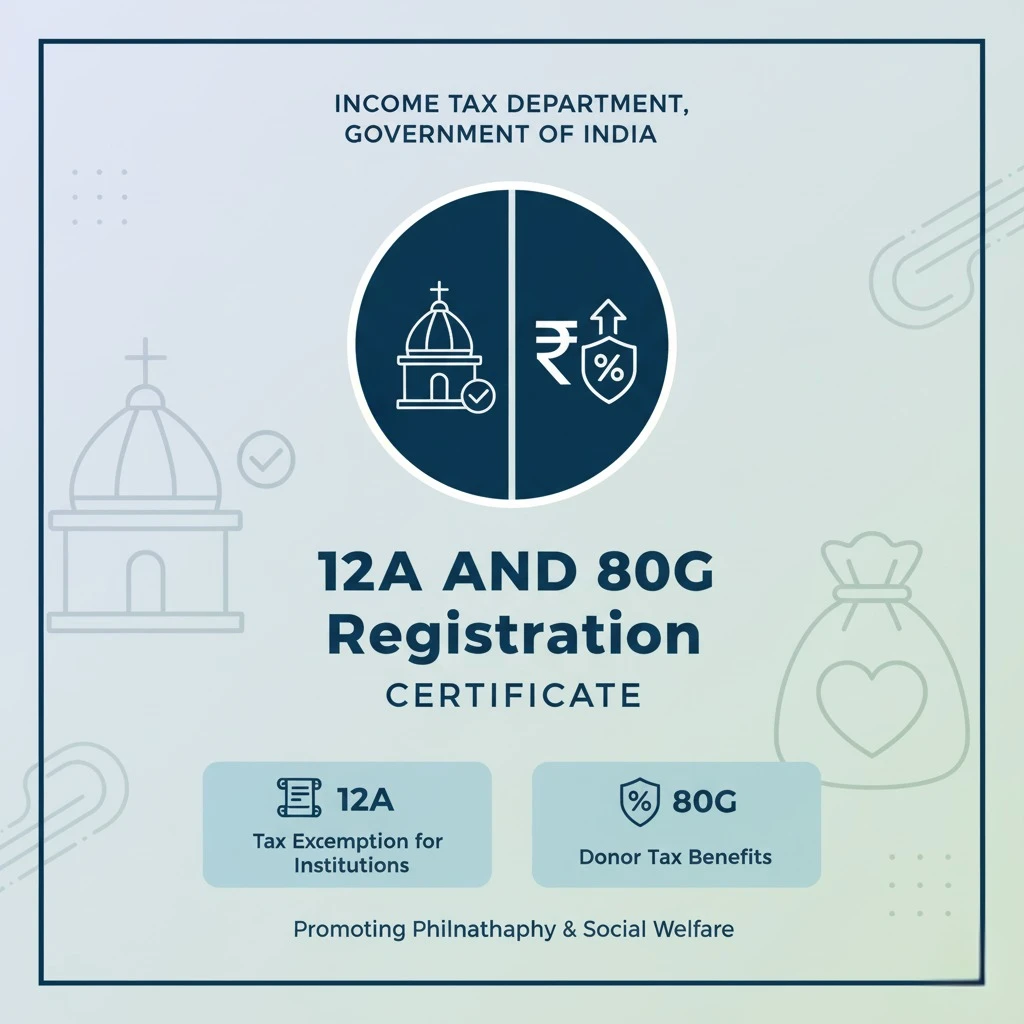
12A & 80G Registration in Thane
12A & 80G Registration in Thane should be approached according to the NGO’s actual compliance position, not as a standard two-certificate package. A newly created trust with no activity, an operating society already receiving donations and an established organisation with an older approval can all require different filing treatment.
Legal Papers India assists Thane organisations remotely from its Delhi and Noida offices. The project brief requires remote documentation and consultation where no city office has been verified, so the service should not be represented as a Thane branch, Income Tax centre or local government registration office.
Practical recommendation: before deciding what to file, identify whether activities have commenced, whether any old 12A/12AB or 80G approval exists, and whether the NGO wants organisational tax registration, donation approval, or both.
Thane’s NGO Ecosystem Makes Registration History and Activity Evidence Important
Thane has an active non-profit environment covering education, health, children’s welfare, women’s empowerment, livelihood, skill development and community support. For local organisations, this makes activity records and registration consistency especially important because many NGOs also maintain Charity Commissioner, CSR-1, NITI Aayog or other institutional credentials.
Publicly available Thane NGO profiles illustrate this layered compliance model. Aadharvad Charitable Trust lists Public Trust Registration, NITI Aayog Darpan, 12A, 80G and CSR-1 credentials, while LAHS Pratishthan similarly identifies Society, Public Charitable Trust, 12A, 80G and CSR-1 registrations.
This creates a practical distinction:
| Thane NGO Situation |
Main Tax Concern |
Other Records to Reconcile |
|
Educational NGO |
Tax exemption + donor approval |
Trust/society records |
|
Healthcare charity |
Fundraising and exemption |
Activity evidence |
|
CSR implementation NGO |
Donor credibility and tax status |
CSR-1, NGO records |
|
New trust |
Provisional route |
Whether activities started |
|
Existing society |
Renewal or regular filing |
Earlier approvals |
Common mistake: assuming that Charity Commissioner registration, CSR-1, NGO Darpan or society registration automatically gives the organisation 12A/80G-type Income Tax approval.
Decision guideline: treat entity registration, state-law charitable registration, CSR compliance and Income Tax registration as separate compliance layers.
Which Thane Organisations Should Evaluate 12A and 80G-Type Registration?
Public charitable trusts, registered societies and Section 8 companies are among the main organisation categories that may apply under the current NPO framework. The correct application depends on the organisation’s constitution, activity status, earlier approval history and fundraising model.
In Thane, likely applicants include:
- Public Charitable Trusts
- Education And Child-Welfare Ngos
- Healthcare Organisations
- Women’s Empowerment Groups
- Skill-Development Ngos
- Section 8 Companies
- Registered Societies
- Social-Welfare Organisations
- Public Religious And Charitable Institutions
- Newly Established Non-Profits Preparing For Structured Fundraising.
Local examples also show that many Thane NGOs operate across multiple welfare verticals. Samabhavana, for instance, describes work across education, health, skill development, vocational training and women’s empowerment while also holding 12A, 80G and CSR-1 credentials.
Overlooked requirement: actual activities should align with the governing objects. A broad trust deed does not automatically justify every activity the NGO later undertakes.
Expert tip: prepare a one-page summary listing legal entity type, formation date, charitable objects, current activities, prior tax approvals and fundraising channels before filing.
Form 104 or Form 105? The Activity Status Is the First Filter
A newly formed NGO that has not started activities can evaluate the provisional route under Form 104. Once activities have commenced, the regular registration/approval route under Form 105 becomes relevant in applicable cases.
A practical decision matrix is:
| NGO Position |
Route to Evaluate |
Main Risk |
|
Newly formed, no activities |
Form 104 |
Filing regular route too early |
|
Activities already underway |
Form 105 |
Using provisional route incorrectly |
|
Provisional approval expiring |
Form 105 |
Missing regular application |
|
Existing registration due for renewal |
Form 105 |
Ignoring validity |
|
Objects modified |
Form 105 |
Filing without revised documents |
|
Registration + donor approval |
Form 105 where applicable |
Wrong section selection |
This distinction creates a strong information-gain opportunity because some current Thane-focused service pages still foreground legacy 12A/80G advice, old validity claims or older application terminology. One Thane competitor, for example, still states that provisional 12A/80G validity is three years and presents older-style document/process guidance.
Compliance warning: do not follow a Form 10A/10AB checklist automatically for a fresh 2026 filing.
Expert recommendation: determine activity status, filing date and current approval history before choosing the form.
Documents Thane NGOs Should Review Before Filing
The document set differs by legal structure and by whether the case involves provisional registration, regular approval, renewal, changed objects or a previous rejection. For operating organisations, the Income Tax authority may examine constitutional records, management details, activities, prior recognition and financial information.
A practical preparation table is:
| Organisation |
Records to Review |
|
Charitable Trust |
Trust deed, PAN, trustee details, Charity Commissioner records, activity/financial evidence |
|
Registered Society |
Registration certificate, memorandum/rules, PAN, governing body |
|
Section 8 Company |
Incorporation documents, MOA/AOA, PAN, directors |
|
New NGO |
Constitution, PAN, authorised-person details |
|
Operating NGO |
Activity reports, accounts, previous tax orders |
|
NGO with changed objects |
Amended governing documents and old approvals |
For Maharashtra trusts, the state charitable-trust layer should be reviewed alongside Income Tax records. A practitioner source focused on public charitable trusts specifically notes that Maharashtra Charity Commissioner compliance is a separate regulatory layer and should not be treated as replaced by Income Tax registration.
Common mistake: keeping different organisation names, trustee lists or addresses across PAN, trust records and tax filings.
Checklist: reconcile PAN, governing document, Charity Commissioner information where applicable, e-Filing profile, office bearers, previous orders and current activities before submission.
Existing Approvals and Rejections Need a History Review Before Refiling
An NGO with an old approval should not automatically file again simply because the law changed. The correct approach is to review the existing order, expiry or validity, any earlier rejection and whether the present application is a fresh filing, renewal, regularisation or re-application.
This is particularly important in Thane because many established NGOs have long compliance histories. Public NGO disclosures commonly show combinations of trust registration, 12A, 80G, CSR-1 and NITI Aayog registrations accumulated over time.
Separate these cases:
Existing valid approval: review validity and the next compliance trigger.
Old or legacy registration: identify how it transitions into the current framework.
Previous rejection: examine the reason before filing again.
Changed objects: review whether the modified governing document affects the registration position.
Compliance warning: ignoring an old rejection or cancellation can lead to the wrong current filing category.
Expert recommendation: collect all earlier 12A/12AB/80G orders before preparing the new application.
Why Professional Assistance Can Be Useful in Thane’s Multi-Registration NGO Environment?
Professional assistance adds the most value where several compliance layers must be reconciled. Thane NGOs may simultaneously hold Maharashtra public-trust registration, society registration, CSR-1, NITI Aayog registration and tax approvals, so inconsistencies between these records can become a practical filing issue.
For example, a Thane NGO working on CSR-funded programmes may need its 12A/80G history, CSR-1 credentials, governing documents and office-bearer details to remain aligned. Samabhavana and Aadharvad both publicly demonstrate this multi-registration pattern.
Professional review can be useful where:
- Activities Have Already Started
- Provisional Approval Is Nearing Expiry
- Earlier Tax Approvals Exist
- Objects Have Changed
- Trustees Or Directors Changed
- Csr-1 Or Other Ngo Registrations Use Older Information
- An Earlier Application Was Rejected
- Both Organisational And Donor-Related Approval Are Being Considered.
Buyer hesitation point: professional assistance should be evaluated by scope, not by promises of “guaranteed approval.”
Compliance tip: ask whether the service includes document reconciliation, application classification, filing and response support. Read more About Us
Cost and Timeline for 12A & 80G Registration in Thane
There is no responsible single professional fee or guaranteed approval timeline for every Thane NGO. Complexity depends on the legal structure, activity status, earlier approvals, amended objects, prior rejection and whether both registration and donor approval are being pursued.
| Cost/Timeline Factor |
Why It Changes the Work |
|
Provisional vs regular filing |
Different form and evidence |
|
Registration vs approval vs both |
Different application scope |
|
Existing 12A/80G history |
Previous orders must be reviewed |
|
Charity Commissioner records |
State-law consistency may need checking |
|
Changed objects |
Governing document comparison required |
|
Previous rejection |
Re-application position must be assessed |
|
Departmental queries |
Additional response work |
A Thane competitor advertises fixed pricing and completion periods for broader NGO registration, illustrating why users often search for cost certainty. However, those numbers should not be copied into a tax-registration landing page because 12A/80G complexity varies by case.
Approval-delay reason: wrong application type, conflicting records or weak activity evidence can extend the process.
Pricing guideline: ask for a written scope covering application review, document preparation, filing and post-filing support rather than comparing only a headline fee.
Frequently Asked Questions
1. How can a new NGO apply for 12A Registration in Thane?
A new NGO should first determine whether charitable activities have started. If activities have not commenced, the provisional route under the current framework may apply. If the organisation is already operating, the regular route should be evaluated instead. The legal form, PAN, governing document and any prior approval history should be reviewed before the application is selected.
2. Can a Maharashtra public trust in Thane apply for 80G-type approval?
Yes, an eligible public charitable trust may evaluate donor-related approval, but Maharashtra public-trust registration and Income Tax approval are separate matters. The trust should keep its Charity Commissioner records, PAN, trust deed, trustee information and actual charitable activities consistent before filing.
3. Does Charity Commissioner registration replace 12A or 80G?
No. Maharashtra Charity Commissioner registration governs the public charitable trust under state law, while 12A/80G-type approval belongs to the Income Tax framework. A Thane trust may need both depending on its structure and activities. Treating one as a substitute for the other can create a compliance gap.
4. Can a Section 8 company in Thane seek both tax registration and donor approval?
Potentially yes, subject to the current statutory conditions. A Section 8 company should review its MOA, charitable objects, PAN, directors, actual programmes and previous tax-registration history before deciding whether to seek organisational registration, donation approval, or both.
5. How much does 12A and 80G Registration cost in Thane?
Professional fees depend on the case. A new inactive NGO generally requires a different level of review from an established trust with multiple registrations, amended objects or earlier rejection orders. Ask for a written scope showing what document review, filing and post-filing assistance are included rather than relying solely on a fixed advertised price.
6. Our Thane NGO already has CSR-1. Do we still need 12A or 80G?
CSR-1 and 12A/80G-type registrations serve different purposes. CSR-1 relates to eligibility within the CSR implementation framework, while Income Tax registration and donor-related approval deal with tax treatment and qualifying donation deductions. Thane NGOs commonly hold several credentials together rather than using one as a replacement for all others.
7. Can an education or healthcare NGO in Thane apply?
Yes, subject to eligibility and proper charitable objects. Thane has active organisations working in education, health, children’s welfare and community support, and public NGO disclosures show 12A/80G credentials alongside these activities. The important issue is whether the governing objects and actual programmes support the tax-registration application.
8. What if our previous 12A or 80G application was rejected?
Do not ignore the earlier order. Review the rejection reason, date, application type and any changes made since then before filing again. A fresh or re-application should be selected based on the actual history, not simply because the organisation wants another attempt.
9. Can a Thane NGO working across several causes use the same registration?
An NGO may work across several charitable programmes, but the governing objects and actual activities must remain consistent with the registration framework. Thane organisations often operate across education, health, livelihood and skill development, so activity expansion should be reviewed against the constitutional documents rather than treated casually.
10. Does Legal Papers India have a Thane office?
The supplied project brief identifies Delhi and Noida as Legal Papers India’s head-office locations and requires remote delivery where no physical city office has been verified. Thane organisations should therefore be offered online consultation and documentation assistance without implying an unverified local branch.
Review the Organisation’s Complete Compliance Stack Before Filing
For a Thane NGO, the strongest filing position comes from reviewing the full compliance stack rather than preparing the Income Tax application in isolation. That can include the trust or society registration, Charity Commissioner records, CSR-1, PAN, e-Filing profile, old approvals, governing objects and current programmes.
This matters particularly in Thane because local NGOs commonly operate with several registrations simultaneously, and publicly disclosed organisations show that 12A, 80G, Charity Commissioner, NITI Aayog and CSR credentials often sit side by side.
Legal Papers India can assist Thane-based trusts, societies, Section 8 companies, education NGOs, healthcare organisations and CSR-focused non-profits remotely with application classification, document review and filing guidance from Delhi and Noida.
Choose Legal Papers India for Expert Guidance. Contact Us
Legal Papers India Business Solution Private Limited, F 2, Sector 8, Noida, Uttar Pradesh, 201301
Monday to Saturday 10:00 AM to 06:30 PM





Please submit all general enquiries in the contact form below and we look forward to hearing from you soon.


Captcha:











Or sign in with:
LOGIN WITH GOOGLESign up for early Sale access plus tailored new arrivals, trends and promotions. To opt out, click unsubscribe in our emails.
Forgot your password? No worries! Enter your registered email to receive a link and securely reset it in just a few steps.