
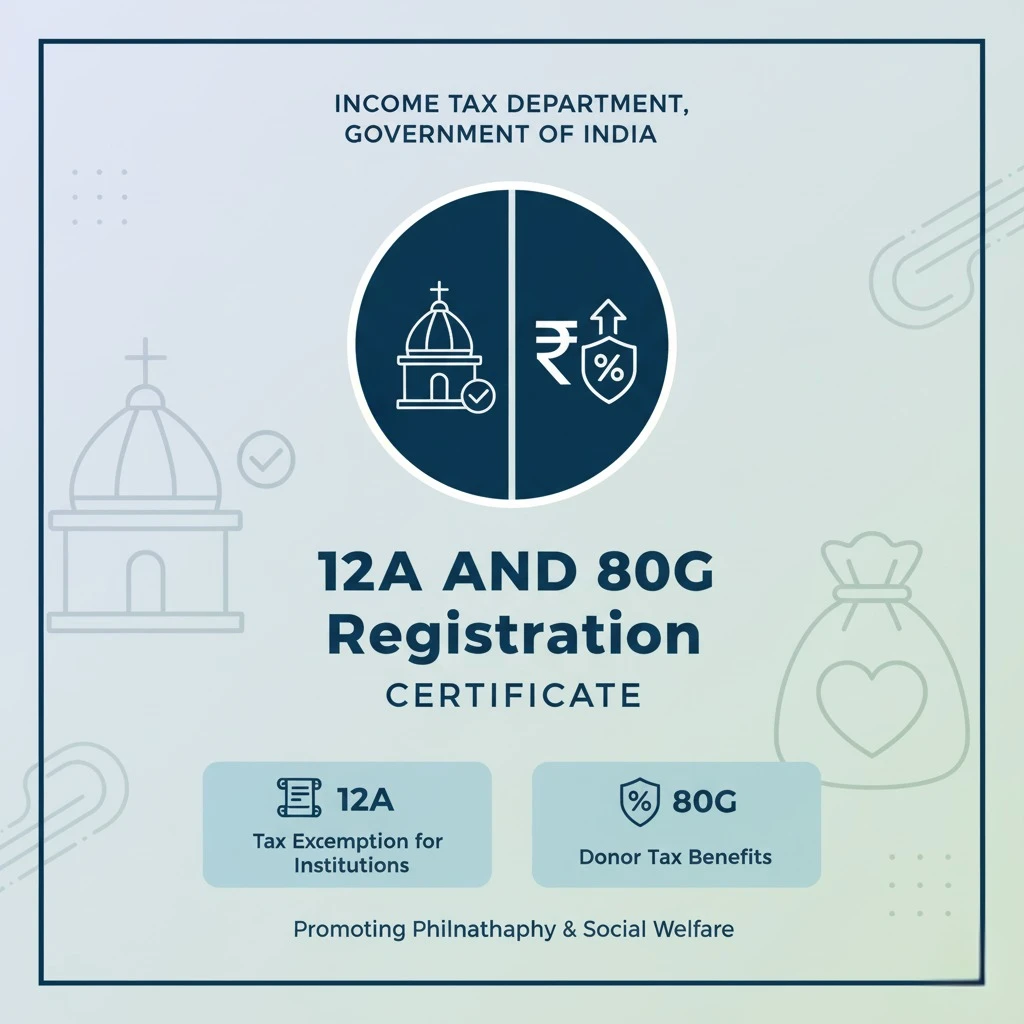
12A & 80G Registration in Vijayawada
For a Vijayawada NGO, the starting question in 2026 is not simply “How do I get a 12A or 80G certificate?” The organisation must first identify its present compliance status—new and inactive, already conducting charitable work, holding provisional registration, approaching renewal, or operating under modified objects. That classification determines the filing route.
The current framework has changed significantly. Regular registration under section 332(3) and donation-related approval under section 354(2) of the Income-tax Act, 2025 are handled through Form 105, filed electronically under Rule 181 of the Income-tax Rules, 2026.
Legal Papers India assists Vijayawada organisations remotely from its Delhi and Noida head-office locations. The supplied service model is Pan-India and specifically requires remote documentation and consultation unless a physical office is verified.
Practical recommendation: establish the NGO's activity commencement date, existing registration status and approval history before preparing the application.
Vijayawada NGOs Often Operate Across More Than One Compliance Environment
Vijayawada's non-profit ecosystem includes organisations working in child protection, women's empowerment, healthcare, social security, education and community welfare. For these organisations, 12A/80G is an Income Tax compliance matter and should be kept distinct from participation in government welfare schemes or other institutional recognition.
This distinction is particularly relevant locally. NTR District's Women & Child Welfare & Empowerment Office has programmes connected with the District Child Protection Unit, Specialised Adoption Agency and children's homes under Mission Vatsalya. The district's Rural Development Agency also administers social-security-related services from Gollapudi, Vijayawada.
That produces several practical scenarios:
| Vijayawada organisation |
Compliance question to resolve |
|
Child-welfare NGO |
Do constitutional objects match actual programmes? |
|
Educational organisation |
Is its tax-registration position current? |
|
Healthcare NGO |
Does it require registration, donor approval, or both? |
|
Charitable trust |
Have activities already commenced? |
|
Society |
Are governing-body and registration records current? |
|
Existing NPO |
Is renewal or transition from an earlier approval required? |
Common mistake: assuming government-programme participation, NGO incorporation or social-sector recognition automatically gives the organisation 12A/80G status.
Decision guideline: treat entity registration, programme eligibility and Income Tax approval as separate compliance layers.
Which Vijayawada Organisations Should Review 12A and 80G?
Charitable trusts, registered societies, Section 8 companies and other eligible non-profit organisations should review their Income Tax registration position when seeking tax-exemption treatment or approval relevant to eligible donations. The entity's legal form matters, but its objects, activities and previous compliance history matter just as much.
Form 105 itself reflects this approach. The Income Tax Department uses it to examine an NPO's particulars, recognition history, office bearers, operational details, assets and liabilities, income, religious activities and supporting attachments.
Potential Vijayawada applicants include:
- Newly Established Charitable Trusts
- Registered Social-Welfare Societies
- Section 8 Companies
- Education-Focused NGOs
- Healthcare And Community-Health Organisations
- Child And Women Welfare Organisations
- Religious And Charitable Institutions
- Rural-Development Organisations
- Existing NGOs Approaching Renewal Or Regular Registration.
Overlooked requirement: forming a trust, society or Section 8 company is not the same as obtaining Income Tax registration or donation-related approval.
Practical example: a society undertaking child-welfare activities in Vijayawada should reconcile its registered objects with its actual programme records before submission instead of treating its society certificate as sufficient evidence.
Choosing the Correct Registration Route After 1 April 2026
For applications under the new framework, an NGO's activity status and existing approval history determine what should be filed. Form 105 is relevant to regular registration or approval where activities have commenced, provisional registration is expiring, existing registration requires renewal, or organisational objects have changed.
| NGO status |
Filing position to examine |
Risk to avoid |
|
New NGO; activities not started |
Provisional-registration route |
Applying under outdated guidance |
|
Activities commenced |
Form 105 regular route |
Assuming every new applicant is provisional |
|
Provisional approval expiring |
Form 105 |
Missing conversion to regular status |
|
Existing approval due for renewal |
Form 105 |
Assuming approval continues indefinitely |
|
Objects modified |
Form 105 implications |
Failing to report material changes |
|
Registration + donor approval sought |
Sections 332 and 354 |
Selecting an incomplete application type |
For regular applications, Form 105 allows selection under section 332, 354, or both, depending on the circumstances. Importantly, an application for approval under section 354(2) is subject to registration-related conditions described by the Income Tax Department.
After successful examination, the Department issues the applicable order in Form 107 together with a 16-digit Unique Registration Number.
Compliance warning: do not rely on an older website simply because it ranks well for “12A registration.” Post-April-2026 applications should be checked against the current Income Tax framework.
Documents Vijayawada NGOs Should Reconcile Before Filing
The attachment list changes with the organisation's legal structure and history. However, a strong application should establish a consistent trail from the NGO's creation and registered objects to its management, activities, accounts and earlier Income Tax approvals.
The notified 2026 rules include supporting records such as the trust deed or other creation instrument, registration with the applicable Registrar, FCRA registration where relevant, previous 12A/12AA/12AB/80G orders, rejection or cancellation orders where applicable, and accounts for organisations already in existence.
| Applicant |
Records that commonly need review |
|
Charitable Trust |
Trust deed, PAN, trustee details, registration evidence |
|
Society |
Registration certificate, memorandum/rules, governing-body details |
|
Section 8 Company |
Incorporation records, MOA/AOA, PAN, director information |
|
Operating NGO |
Activity evidence and relevant annual accounts |
|
Previously Registered NGO |
Earlier approval/order and URN where applicable |
|
Organisation with Changed Objects |
Amended governing documents and existing approval |
A valid DSC registered on the e-Filing portal is also a prerequisite for verification through DSC mode, and the PAN status must be active.
Document-control tip: check that the legal name, PAN, address, governing persons and objects agree across records before uploading attachments.
Approval-delay risk: inconsistent management details or incomplete historical approval records can turn an otherwise straightforward filing into a clarification exercise.
When a Vijayawada NGO Should Seek Professional Review
Professional review becomes particularly useful when the organisation has a compliance history that cannot be resolved through a generic document checklist. Previous registration, rejection, changed objects, active programmes or simultaneous registration and donation-approval requirements can all change the filing strategy.
A notable feature of Form 105 is that an applicant can withdraw a mistakenly filed application within 7 days of filing. The form also contains specific treatment for re-applications and earlier rejection orders, making correct classification important before submission.
Review is especially worthwhile when:
- An Old 12A, 12AA, 12AB Or 80G Order Exists;
- Provisional Registration Is Approaching Expiry;
- Charitable Activities Have Already Begun;
- The Organisation Has Changed Its Objects;
- A Previous Application Was Rejected Or Cancelled;
- The NGO Wants Registration And Donation-Related Approval Together; Or
- Accounts And Activity Evidence Need Reconciliation.
Buyer hesitation point: before comparing consultant prices, ask what the quotation actually covers—classification, document review, portal filing, correction support, departmental response assistance, or only form submission.
Trust guideline: no consultant can responsibly guarantee Income Tax approval. Get to know About Us
Cost & Timeline for 12A & 80G Registration in Vijayawada
There is no single professional fee or approval timeline that applies to every Vijayawada NGO. A newly created trust with organised documents requires a different scope from an operational society with several years of accounts, an older registration order, modified objects or a previous rejection.
| Factor |
Why it affects scope |
|
Registration status |
Provisional, regular and renewal cases differ |
|
12A/registration + donor approval |
Both may require additional review |
|
Operating history |
Existing activities and accounts require examination |
|
Old approval |
Transition/history must be checked |
|
Modified objects |
Amended documents require comparison |
|
Previous rejection |
Earlier order can affect filing strategy |
|
Record inconsistency |
Corrections may be needed before submission |
The Income Tax Department, rather than the consultant, controls statutory examination and final approval. Form 105 requires the Department to examine the organisation before issuing Form 107 and the URN.
Pricing recommendation: request a scope-based quotation rather than choosing solely on an advertised low registration price.
Timeline recommendation: prepare complete records before filing; reducing preventable document discrepancies is more useful than relying on a promised approval date.
Frequently Asked Questions
1. Can I apply for 12A and 80G Registration Online in Vijayawada?
Yes. The relevant Income Tax application process is electronic, so the advisory provider does not need a physical Vijayawada office to coordinate the filing. For regular registration or approval, Form 105 is submitted electronically through the Income Tax e-Filing portal under Rule 181.
2. Does a newly registered Vijayawada NGO immediately need Form 105?
Not necessarily. The correct route depends partly on whether activities have commenced and the NGO's existing registration position. Form 105 is generally used where activities have commenced, provisional registration is expiring, registration requires renewal or objects have been modified. Verify the organisation's status before selecting a form.
3. Can a Vijayawada Section 8 company obtain 80G approval?
A Section 8 company may pursue the applicable registration/approval where it satisfies the statutory requirements. Incorporation under the Companies Act does not itself establish 80G eligibility. Its MOA, activities, financial position, existing Income Tax registration and other relevant records should be reviewed before filing.
4. What documents are required for NGO 80G Registration in Vijayawada?
Documents depend on the organisation and its history. Current rules contemplate creation documents, applicable Registrar registration, previous Income Tax approvals, relevant rejection/cancellation orders and accounts for organisations already in existence, among other records.
5. How much does 12A and 80G Registration cost in Vijayawada?
Professional charges vary according to the work involved. An operating NGO requiring historical approval review, financial document reconciliation or correction of inconsistencies may involve more work than a newly established organisation with properly maintained records. Obtain a written scope before comparing professional fees.
6. Can an NGO apply for 80G if its registration position is not clear?
This should be reviewed first. The Income Tax Department states that an application under section 354(2) is linked to the NPO's registration position under section 332 or corresponding provisions. Form 105 also permits an eligible applicant to select both sections where appropriate.
7. What happens after Form 105 is approved?
Following examination and successful approval, the Income Tax Department issues an order in Form 107 and a 16-digit Unique Registration Number (URN). The URN serves as confirmation of regular registration or approval and is relevant for future compliance.
8. Is government social-welfare recognition in Vijayawada the same as 12A/80G?
No. Vijayawada has government-administered welfare programmes through district authorities, including child-protection and social-security functions, but those programmes are distinct from Income Tax registration and donation approval.
9. Can a wrong Form 105 application be withdrawn?
The Income Tax Department's current Form 105 guidance states that an application containing a filing mistake can be withdrawn within seven days from the filing date. That safety mechanism should not replace careful pre-filing review, particularly where previous approvals or multiple application sections are involved.
10. Does Legal Papers India have a Vijayawada office?
The supplied brief lists Legal Papers India's head-office locations as Delhi and Noida and specifies a remote Pan-India service model unless another physical office is verified. Accordingly, Vijayawada should be presented as an online consultation and documentation service area, not as a local branch.
Get Your Vijayawada NGO’s Filing Position Reviewed Before Applying
For 12A & 80G Registration in Vijayawada, the most useful first step is to establish the organisation's actual position: when activities started, what approvals already exist, whether objects have changed, and whether registration, donation-related approval or both are required.
Legal Papers India can coordinate the assessment, document preparation and online filing process remotely for charitable trusts, societies, Section 8 companies and other eligible Vijayawada non-profit organisations.
You can therefore begin the compliance process without relying on an unverified local registration centre or branch.
Start Your Compliance Journey with Legal Papers India. Contact Us
Legal Papers India Business Solution Private Limited, F 2, Sector 8, Noida, Uttar Pradesh, 201301
Monday to Saturday 10:00 AM to 06:30 PM





Please submit all general enquiries in the contact form below and we look forward to hearing from you soon.


Captcha:







Or sign in with:
LOGIN WITH GOOGLESign up for early Sale access plus tailored new arrivals, trends and promotions. To opt out, click unsubscribe in our emails.
Forgot your password? No worries! Enter your registered email to receive a link and securely reset it in just a few steps.