
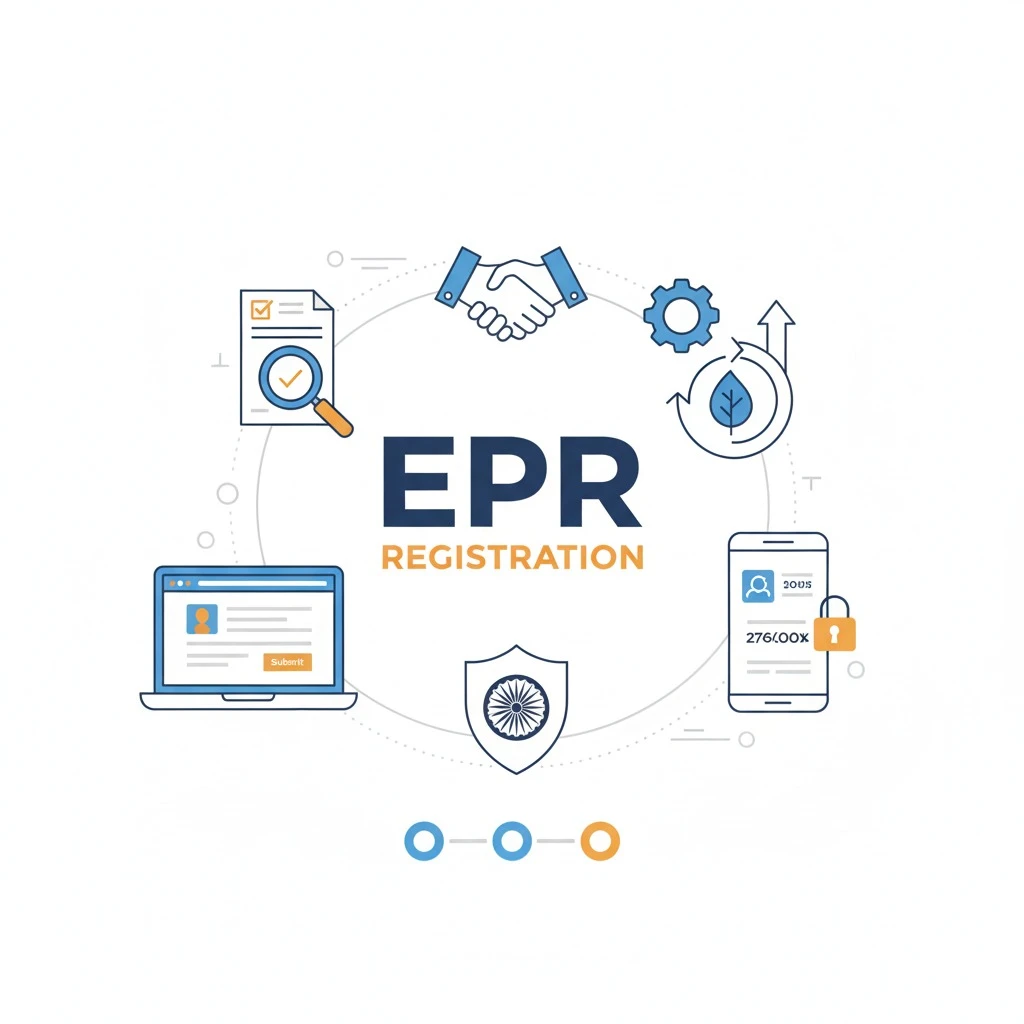
EPR Registration in Vijayawada
EPR Registration in Vijayawada requires businesses to first identify whether their role, products, batteries or packaging fall within an applicable Extended Producer Responsibility framework. Legal Papers India operates from Delhi and Noida and coordinates EPR documentation and consultation remotely for Vijayawada businesses, without representing an unverified physical office in the city.
The supplied service model specifically states that services are delivered remotely unless a physical office is specified and that no false local presence should be created.
For a Vijayawada business, the first compliance question should therefore not simply be, “How do I get an EPR certificate?”
It should be:
What exactly are we placing in the market, and in what regulatory capacity?
A business may potentially need assessment under:
- Plastic Waste EPR
- E-Waste EPR
- Battery Waste EPR
- Multiple EPR frameworks where products involve more than one regulated stream
For example, a company may import an electronic consumer product packed in plastic and containing a battery. Looking only at the finished product can miss separate compliance considerations.
Practical recommendation: Complete an applicability assessment before preparing the application. Incorrect classification at the beginning can create document changes and regulatory queries later.
Why Vijayawada Businesses Need Product-Level EPR Assessment
Vijayawada's role as a major commercial and distribution centre means EPR questions are relevant not only to manufacturers but also to importers, distributors, packaged-goods businesses, electronics sellers and growing consumer brands. The key issue is the business's regulatory role in introducing covered products, packaging or batteries into the market.
Vijayawada supports substantial trading, wholesale, retail, logistics and distribution activity alongside manufacturing and commercial businesses. Its connectivity also makes the city relevant to companies distributing products across Andhra Pradesh.
That creates some important EPR situations.
| Business Situation |
Compliance Question to Ask |
|
Distributor sourcing domestically |
Is it only distributing, or also operating as a brand owner? |
|
Company importing electronic goods |
Does importer responsibility apply? |
|
FMCG brand using plastic packaging |
Which packaging categories need assessment? |
|
Battery-powered product seller |
Does Battery Waste EPR apply? |
|
Electronics business |
Is the equipment covered by E-Waste EPR? |
|
Private-label business |
Which entity is the Brand Owner? |
|
Online consumer brand |
What packaging enters the market under its brand? |
One particularly important distinction is between distribution and importation.
A business purchasing goods from an Indian manufacturer and reselling them may occupy a different regulatory position from a business directly importing the same products.
Common mistake: Businesses sometimes describe themselves simply as “traders” even though their commercial activity includes direct imports or private-label branding. EPR assessment should follow actual activity, not the informal business description.
Who Should Evaluate EPR Registration in Vijayawada?
Manufacturers, producers, importers and brand owners dealing with regulated electronics, electrical equipment, batteries or plastic packaging should evaluate their EPR obligations. In Vijayawada's trading and distribution ecosystem, businesses should pay particular attention when they directly import goods, introduce private-label products or sell packaged products under their own brands.
Potentially relevant businesses include:
- Manufacturers
- Producers
- Direct importers
- Brand owners
- Electronics businesses
- Electrical-equipment businesses
- Battery manufacturers
- Battery importers
- Plastic-packaging businesses
- FMCG brands
- Consumer-goods companies
- E-commerce brands
- D2C companies
- Private-label sellers
- Distributors involved in imports
The Four-Question Applicability Check
Ask:
- Do we manufacture a covered product?
- Do we directly import a covered product or component?
- Do we sell products or packaging under our own brand?
- Does our product contain regulated electronics, batteries or plastic packaging?
A “yes” does not automatically establish every EPR obligation, but it is a strong reason to conduct a detailed applicability review.
Overlooked issue: A company can change its compliance position without changing its legal entity. Starting direct imports, launching a private label or changing packaging may be enough to require reassessment.
Choosing the Correct EPR Category Before Filing
An EPR License in Vijayawada is not a single universal environmental permission covering every waste stream. Plastic packaging, e-waste and batteries operate through distinct regulatory frameworks. Correctly mapping products and business roles before filing is therefore one of the most important steps in preparing an EPR application.
A useful classification matrix is:
| What the Business Places in the Market |
EPR Area to Evaluate |
Important Data |
|
Plastic packaging |
Plastic Waste EPR |
Packaging category and quantity |
|
Covered electrical/electronic equipment |
E-Waste EPR |
Product category and quantity |
|
Batteries |
Battery Waste EPR |
Battery type/category and quantity |
|
Product containing several regulated elements |
Multiple frameworks |
Component-level information |
Consider a Vijayawada-based consumer brand selling rechargeable electronic equipment through online marketplaces.
The business may need to evaluate:
- Electronic equipment
- Battery incorporated into the equipment
- Plastic packaging used for the product
Treating everything as one compliance category may leave gaps.
Decision guideline: Map the finished product first, then examine regulated components and packaging separately.
How EPR Registration Online in Vijayawada Is Prepared
EPR Registration Online in Vijayawada should begin with data preparation rather than immediately entering information on a regulatory portal. Applicants should first establish their regulatory role, classify relevant products or packaging, reconcile quantities and verify company records. This reduces the risk of inconsistent information appearing across the application and supporting documents.
A practical filing workflow can follow these stages:
1. Determine the Applicant's Role
Identify whether the applicant operates as a producer, importer, brand owner or another regulated entity under the applicable framework.
Common mistake: Selecting a category because it sounds closest to the company's trade description rather than checking the regulatory definition.
2. Map Products and Packaging
Create a list of relevant:
- Products
- SKUs
- Brands
- Packaging formats
- Electronic equipment
- Batteries
- Imported items
3. Establish the Relevant EPR Stream
Determine whether Plastic Waste, E-Waste, Battery Waste or multiple frameworks require assessment.
4. Reconcile Quantity Data
Compare applicable figures against internal sources such as:
- Purchase records
- Import records
- Production records
- Sales information
- ERP data
- Packaging procurement records
5. Review Entity Documents
Legal name, GST information, PAN and other organizational information should be consistent.
6. Prepare and Submit the Application
Application data and supporting documentation are organized according to the relevant EPR framework.
7. Handle Regulatory Observations
Where clarification is sought, the response should be supported by the same underlying product and business records used to prepare the application.
8. Plan Post-Registration Compliance
Registration should be followed by a compliance calendar for applicable reporting, targets, certificates, amendments and records.
Approval-delay reason: Quantity information collected independently by finance, sales and operations teams may not match. Resolve those differences before submission rather than explaining them after a query.
Documents Required for EPR Registration in Vijayawada
Documents for EPR Registration in Vijayawada vary according to the applicant's constitution, business role and applicable waste stream. Legal-entity records identify the applicant, while product, import, manufacturing, battery and packaging records establish the operational facts on which EPR classification and reporting depend.
| Applicant Type |
Typical Records to Organize |
|
Proprietorship |
PAN, GST and proprietor/business records |
|
Partnership |
PAN, GST, Partnership Deed and partner information |
|
LLP |
Incorporation documents, LLP Agreement, PAN and GST |
|
Private Limited Company |
Incorporation Certificate, PAN, GST and authorized-person details |
|
OPC |
Incorporation and authorized-signatory information |
|
Manufacturer |
Entity documents plus manufacturing/product data |
|
Importer |
Entity documents plus import and product information |
|
Brand Owner |
Entity information plus brand and packaging records |
Depending on the EPR stream, applicants may also need information relating to:
- Product categories
- Product descriptions
- Brand names
- Packaging material
- Packaging categories
- Battery categories
- Manufacturing quantities
- Import quantities
- Market-placement quantities
- Authorized signatory
- Existing environmental registrations
- Supporting declarations
A Better Way to Organize EPR Data
For companies handling many SKUs, maintain a working sheet containing:
SKU → Product → Brand → Manufacturer/Importer → Packaging → Electronics → Battery → Applicable EPR Stream → Quantity → Supporting Record
This provides a traceable connection between the number entered in the application and the company's underlying commercial records.
What Professional EPR Assistance Should Cover
Professional EPR assistance should reduce uncertainty around applicability, classification and data preparation—not merely perform portal entry. For Vijayawada manufacturers, importers and brands, useful assistance should identify the correct applicant role, examine product and packaging information, detect inconsistencies before submission and explain obligations that may continue after registration.
Operational Value
Structured assistance can establish:
- Clear responsibility within the organization
- Product-level compliance mapping
- Better quantity reconciliation
- Organized supporting records
- A future compliance calendar
Regulatory Value
A review can identify problems such as:
- Incorrect applicant classification
- Missing SKUs
- Wrong packaging categories
- Inconsistent company information
- Unsupported quantity figures
Commercial Value
Businesses supplying large buyers or expanding through marketplaces may increasingly encounter compliance-document requests during vendor onboarding and commercial due diligence.
Future Compliance Value
Depending on the applicable framework, responsibilities may continue through:
- Recycling targets
- EPR certificates
- Returns
- Record maintenance
- Modifications
- Other prescribed compliance actions
Buyer decision tip: When comparing consultants, ask whether the quotation covers only initial registration or also clarification queries and post-registration guidance.
Remote CPCB EPR Registration Support for Vijayawada
CPCB EPR Registration in Vijayawada can be coordinated remotely because much of the work involves regulatory classification, business records, product data and online submissions. Legal Papers India operates from Delhi and Noida and can coordinate consultation and documentation digitally for applicants based in Vijayawada without creating a false local-office representation.
Remote coordination is particularly practical where the applicant can share:
- Entity documents
- Product master
- Import information
- Packaging details
- Battery specifications
- Quantity data
- Existing registrations
For larger businesses, one person should ideally coordinate information internally.
However, that person may need inputs from:
Finance for quantities and transactions, operations for production information, procurement for packaging and components, and product teams for technical specifications.
Expert observation: Many compliance delays originate inside the applicant's organization rather than on the portal. Assigning clear internal data ownership before filing can prevent repeated revisions.
EPR Registration Cost and Expected Timeline in Vijayawada
The cost and timeline for EPR Registration in Vijayawada depend on the applicable regulatory category and complexity of the applicant's operations. Number of products, packaging formats, imports, regulated waste streams, quality of existing records and scope of professional support can all influence the work required before and after submission.
Factors That Influence Cost
| Factor |
Why It Matters |
|
EPR category |
Different frameworks require different assessments |
|
Number of SKUs |
Larger portfolios require more classification |
|
Import activity |
Import records need reconciliation |
|
Packaging complexity |
Multiple packaging categories require mapping |
|
Multiple waste streams |
Separate compliance assessments may apply |
|
Quality of records |
Missing data increases preparation work |
|
Regulatory queries |
Additional clarification may be required |
|
Ongoing support |
Post-registration work expands scope |
Rather than asking only:
“What is the cheapest EPR registration price?”
ask:
“What exactly is included in the quoted scope?”
The answer should clarify whether the engagement covers applicability assessment, documentation, application preparation, regulatory observations and continuing compliance guidance.
The same principle applies to timelines.
A business with two straightforward products and organized records cannot reasonably be compared with an importer managing hundreds of SKUs across several product categories.
Compliance warning: Avoid commercial promises of guaranteed approval within a fixed period where the outcome or processing time depends on regulatory review.
Why Vijayawada Businesses Work with Legal Papers India
Vijayawada businesses looking for EPR Authorization need clarity about what applies before they commit to a filing. Legal Papers India can coordinate product assessment, document preparation and regulatory filing remotely while keeping the service model transparent: the organization operates from Delhi and Noida rather than claiming an unverified Vijayawada office.
A useful engagement should provide clarity on:
- Applicable EPR category
- Applicant's regulatory role
- Documents and product information required
- Quantity-data preparation
- Application scope
- Query-handling scope
- Expected next steps
- Post-registration responsibilities
The purpose is not to make every business file an application.
The first purpose is to establish whether the business is covered and what exactly needs to be addressed.
That distinction matters particularly for traders and distributors, where importing, branding and sourcing arrangements can significantly affect the regulatory assessment.
Read more About Us
Frequently Asked Questions
1. Does a distributor in Vijayawada need EPR Registration?
A distributor's EPR position depends on what it actually does. Simply purchasing and reselling goods sourced from an Indian manufacturer may differ from directly importing products or selling them under a private brand. Businesses should therefore examine their supply chain, branding and import activities instead of deciding applicability only from the word “distributor.”
2. Do online sellers in Vijayawada need EPR compliance?
An online sales channel by itself does not determine EPR liability. The seller's role as producer, importer or brand owner and the products, batteries or packaging placed in the market are more important. D2C and marketplace sellers should particularly review private-label goods, imported products and plastic packaging used under their brands.
3. Can I obtain an EPR Certificate in Vijayawada through an online process?
Relevant EPR regulatory systems operate through online mechanisms, so documentation and professional coordination can be handled remotely. The applicant still needs to prepare accurate company, product, packaging and quantity information. Online filing should not be confused with automatic approval; classification and supporting records remain important parts of the application.
4. Does importing electronic equipment create an EPR obligation?
It can. Businesses directly importing covered electrical or electronic equipment should assess their position under the applicable E-Waste EPR framework. Importers should map the imported product categories and maintain consistent records because product descriptions used commercially or in import documentation may not always correspond neatly with regulatory classifications.
5. What if my product contains both electronics and a battery?
The product may require assessment under more than one EPR framework. The electronic equipment and battery should be reviewed separately, and the product's packaging may create another compliance consideration. Companies should therefore map the complete product rather than assuming that one EPR Registration automatically addresses every regulated component.
6. How much does EPR Registration cost in Vijayawada?
There is no responsible universal price for every applicant. Cost depends on the EPR category, business role, product portfolio, number of SKUs, import activity, packaging complexity, condition of existing records and whether the engagement includes regulatory queries and future compliance. Businesses should request a scope-based quotation rather than comparing headline registration prices.
7. How long does CPCB EPR Registration take?
Preparation time depends heavily on the applicant's readiness, while regulatory processing can depend on application completeness and subsequent observations. Companies with organized entity records, product classifications and quantity information can generally prepare more efficiently. A consultant should distinguish internal preparation time from regulatory processing rather than promising an unsupported guaranteed approval date.
8. What happens if our packaging changes after registration?
A significant packaging or product change should trigger a compliance review. Switching packaging materials, introducing new categories, launching additional SKUs or changing quantities can affect existing EPR information and future reporting. Businesses should therefore include compliance review in their product and packaging change-control procedures rather than waiting for the next filing deadline.
9. Is EPR Registration a permanent one-time compliance?
Businesses should not assume that obtaining registration completes all EPR responsibilities. Depending on the applicable framework, continuing requirements can involve targets, certificates, returns, records, amendments and other compliance actions. Before applying, establish who inside the organization will maintain the information needed for future obligations.
10. Can Legal Papers India assist Vijayawada companies remotely?
Yes. The supplied service brief identifies Delhi and Noida as the head-office locations and specifies a Pan-India remote service model. Product information, business records, documentation and consultation can therefore be coordinated digitally without claiming that Legal Papers India operates a physical Vijayawada branch.
Start with an EPR Applicability Review
EPR Registration should begin with understanding your products and business role, not with filling a portal form. Vijayawada manufacturers, importers, distributors and consumer brands can work with Legal Papers India remotely to identify the relevant EPR stream, organize documentation and establish what continuing compliance may follow registration.
Before requesting an assessment, keep these records ready:
- Legal entity details
- GST and PAN information
- Product/SKU list
- Brand information
- Manufacturing details
- Import details
- Packaging specifications
- Battery information
- Electronic-product details
- Quantity records
- Existing environmental registrations
A well-prepared first discussion should answer four commercial questions:
Does EPR apply? Which framework applies? What needs to be filed? What will need to be maintained afterward?
Simplify Compliance with Legal Papers India. Contact Us
Legal Papers India Business Solution Private Limited, F 2, Sector 8, Noida, Uttar Pradesh, 201301
Monday to Saturday 10:00 AM to 06:30 PM





Please submit all general enquiries in the contact form below and we look forward to hearing from you soon.


Captcha:



Or sign in with:
LOGIN WITH GOOGLESign up for early Sale access plus tailored new arrivals, trends and promotions. To opt out, click unsubscribe in our emails.
Forgot your password? No worries! Enter your registered email to receive a link and securely reset it in just a few steps.