
EPR Registration in Visakhapatnam
Businesses that manufacture, import or place regulated products and packaging into the market may need EPR Registration in Visakhapatnam under the applicable waste-management framework. Legal Papers India assists Visakhapatnam businesses through a remote documentation and consultation model from its Delhi and Noida operations, without representing an unverified local office or registration centre in the city.
Extended Producer Responsibility can apply differently depending on whether the business handles plastic packaging, electrical and electronic equipment, batteries or a combination of these. The practical starting point is therefore not simply applying for an EPR Certificate. The product, packaging, supply chain and regulatory role should first be mapped correctly.
For a port-oriented industrial city such as Visakhapatnam, this distinction matters particularly to importers, manufacturers, distributors and businesses introducing imported products into the Indian market.
Why EPR Compliance Matters to Visakhapatnam’s Port and Industrial Economy
Visakhapatnam businesses operate within an economy where port-linked trade, manufacturing, pharmaceuticals, food processing, electronics and industrial supply chains can create distinct EPR situations. Import-led companies in particular should determine responsibility before commercial distribution because regulatory obligations may arise from being the importer or brand owner even when manufacturing occurs elsewhere.
A manufacturer may need to evaluate waste generated by products it places in the market. An importer may become responsible for imported regulated products. A brand owner can have obligations connected with packaging carrying its brand.
Consider three practical situations:
| Business Situation |
EPR Issue to Examine |
|
Importing electrical equipment through Visakhapatnam |
E-Waste EPR applicability |
|
Selling packaged consumer products under own brand |
Plastic Waste EPR |
|
Importing battery-powered industrial equipment |
E-Waste and Battery Waste EPR |
|
Manufacturing packaged pharmaceutical products |
Plastic packaging responsibility |
|
Private-label consumer product business |
Brand Owner obligations |
|
Importing batteries for commercial distribution |
Battery Waste EPR |
The common mistake is to classify the company only by its main industry. A pharmaceutical company, for example, may have an EPR issue because of packaging rather than its pharmaceutical activity itself.
Decision guideline: Trace what enters the Indian market under your business's manufacturing, importing or branding activity and then classify the relevant waste stream.
Who Should Assess EPR Registration in Visakhapatnam?
Manufacturers, producers, importers and brand owners dealing with regulated products should assess whether Extended Producer Responsibility Registration in Visakhapatnam applies to their activities. The assessment should consider both the company's legal role and the actual products, batteries or packaging it introduces into the market rather than relying only on its GST business description.
Relevant businesses can include:
- Electronics manufacturers and importers
- Electrical-equipment businesses
- Battery manufacturers
- Battery importers
- Plastic-packaging businesses
- FMCG brands
- Pharmaceutical product companies
- Packaged-food businesses
- E-commerce companies
- D2C brands
- Private-label sellers
- Industrial-equipment importers
- Distributors importing products directly
- Consumer-product manufacturers
- Brand owners using plastic packaging
Manufacturer vs Importer vs Brand Owner
A company can occupy more than one role.
Suppose a Visakhapatnam company manufactures one product locally, imports a second product and sells a third product manufactured by another entity under its own brand. The regulatory assessment should distinguish these activities instead of assigning one classification to the entire company.
Overlooked requirement: Product portfolios change. New imports, packaging redesigns, batteries and additional models should trigger another EPR applicability review.
Choosing the Correct EPR Category Before Filing
EPR Registration in Visakhapatnam is not one universal authorization covering every type of regulated waste. Plastic packaging, e-waste and batteries operate under different regulatory frameworks. Businesses dealing with composite or battery-powered products should therefore perform a multi-stream assessment before selecting a registration route or preparing CPCB portal information.
Plastic Waste EPR
Relevant where the business falls within an applicable category associated with regulated plastic packaging or plastic products.
Typical examples can include:
- FMCG packaging
- Pharmaceutical packaging
- Food-product packaging
- D2C shipment packaging
- Private-label consumer products
E-Waste EPR
Relevant to producers dealing with covered electrical and electronic equipment.
Examples may include:
- Consumer electronics
- Electrical devices
- IT equipment
- Electronic industrial products
- Certain imported electronic equipment
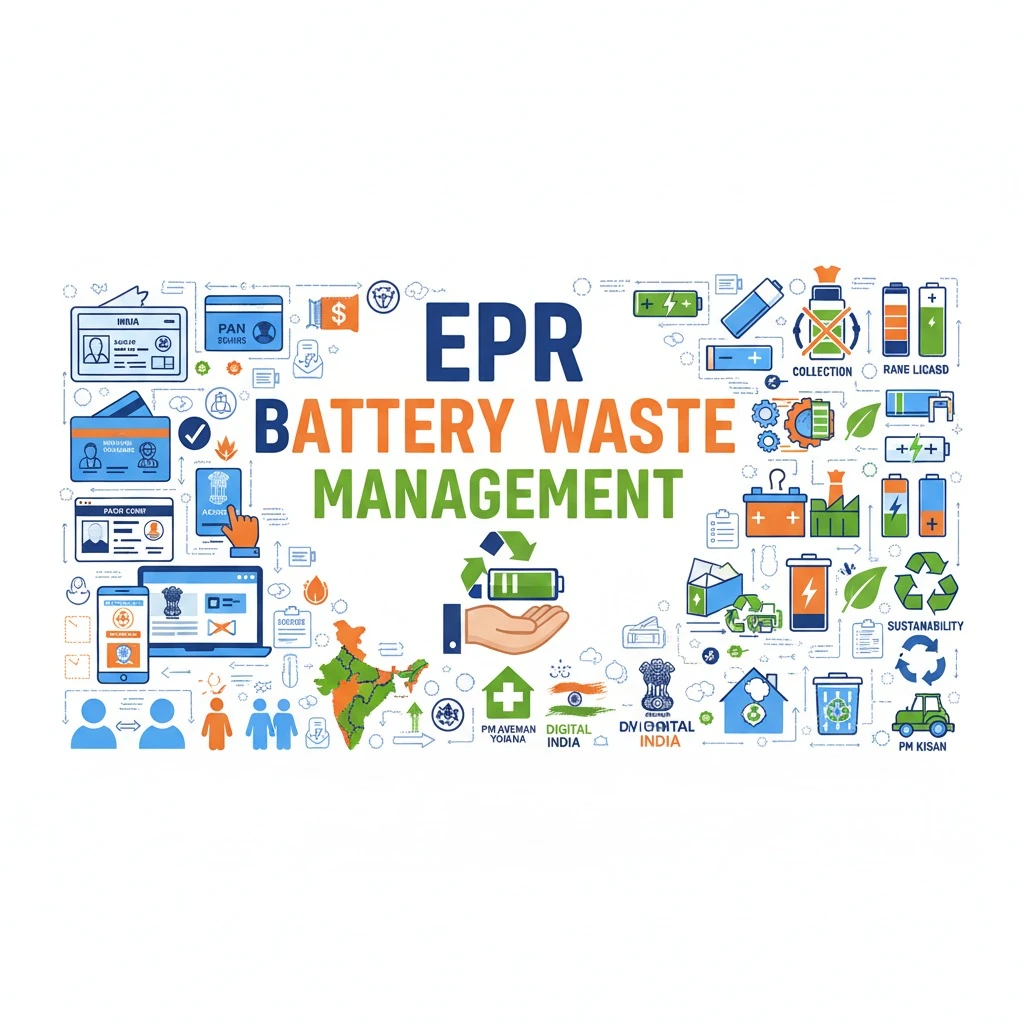
Battery Waste EPR
Relevant where the company manufactures, imports or places applicable batteries into the market.
Examples can include:
- Portable batteries
- Industrial batteries
- Automotive batteries
- Electric-vehicle batteries
- Batteries supplied with products
Multi-Stream Example
An imported electronic instrument could arrive with:
Electronic equipment + rechargeable battery + plastic packaging
That one commercial product can create separate questions under e-waste, battery-waste and plastic-waste requirements.
Compliance warning: Obtaining one EPR Registration does not automatically satisfy another applicable EPR framework.
EPR Registration Online in Visakhapatnam
EPR Registration Online in Visakhapatnam should begin with an internal compliance review rather than immediate portal submission. Product categories, business roles, historical quantities and supporting records should agree with each other before filing. This reduces the risk of discrepancies that later affect application clarification, EPR targets, certificates or periodic compliance.
A practical workflow is:
| Stage |
What Needs to Be Done |
Common Mistake |
|
Applicability Review |
Identify applicable waste stream |
Assuming every product needs the same EPR |
|
Role Mapping |
Determine producer/importer/brand-owner status |
Using only business registration description |
|
Product Classification |
Map relevant SKUs/categories |
Missing models or variants |
|
Quantity Review |
Reconcile relevant quantities |
Sales and import records do not match |
|
Document Preparation |
Organize entity and product records |
Using inconsistent company information |
|
Portal Filing |
Enter applicable information |
Selecting incorrect categories |
|
Query Handling |
Respond with supporting evidence |
Providing explanations without records |
|
Registration Review |
Verify approved information |
Not checking registration details |
|
Continuing Compliance |
Track future obligations |
Treating registration as one-time work |
For companies importing through a port-linked supply chain, purchase records, Bills of Entry, IEC information and product masters should be reconciled where relevant before quantity declarations are finalized.
Expert recommendation: Maintain one EPR working sheet linking every regulated SKU to its source, regulatory category, relevant quantity and documentary evidence.
Documents Required for EPR Registration in Visakhapatnam
The documents required for CPCB EPR Registration in Visakhapatnam depend on the applicant's constitution, EPR category and regulatory role. Legal-entity documents establish who the applicant is, while product, import, manufacturing, packaging and quantity records establish what responsibility the applicant may have under the relevant framework.
| Business Type |
Typical Documents/Data to Prepare |
|
Proprietorship |
PAN, GST and proprietor/business details |
|
Partnership |
PAN, GST, Partnership Deed and partner details |
|
LLP |
Incorporation records, PAN, GST and LLP information |
|
Private Limited Company |
Incorporation Certificate, PAN, GST and authorized-person details |
|
OPC |
Incorporation and authorized-signatory records |
|
Manufacturer |
Entity documents plus manufacturing/product data |
|
Importer |
Entity records, IEC and relevant import/product data |
|
Brand Owner |
Entity documents, brand information and packaging/product data |
Depending on the applicable EPR stream, additional information can include:
- Product catalogue
- Model/SKU details
- Brand details
- Packaging categories
- Plastic quantity data
- Battery specifications
- Electrical/electronic equipment information
- Import quantities
- Manufacturing quantities
- Market-placement information
- Authorized-person details
- Existing registrations
- Supporting declarations
For importers, IEC details and import records deserve particular attention because responsibility should be mapped against what is actually being brought into India.
Common mistake: Using different product descriptions in invoices, import documents and the EPR working sheet without creating a common product mapping.
What Professional EPR Assistance Should Actually Cover
Professional assistance is valuable when it resolves regulatory ambiguity before filing rather than simply transferring information into an online form. For Visakhapatnam businesses with imports, multiple product lines or mixed packaging, the important work often involves role classification, quantity reconciliation, product mapping and planning the obligations that continue after registration.
Operational Benefits
A structured process can establish:
- A clean SKU master
- Product-to-EPR mapping
- Packaging classification
- Import/manufacturing reconciliation
- Compliance ownership
Legal and Compliance Benefits
Professional review can reduce errors involving:
- Incorrect applicant category
- Wrong EPR stream
- Incomplete products
- Unsupported quantity information
- Inconsistent entity records
Commercial Benefits
A properly managed EPR Certificate in Visakhapatnam may be relevant where customers, marketplaces, distributors or procurement teams request environmental-compliance documentation before onboarding or continuing commercial relationships.
Future Compliance Benefits
Registration should also lead into:
- EPR target tracking
- Recycling-certificate management where applicable
- Return filing
- Registration modifications
- Product updates
- Record retention
Buyer guideline: Before engaging a consultant, ask whether the quoted scope covers only registration or also classification, regulator queries, modifications and post-registration obligations.
Why Visakhapatnam Companies Can Use Remote EPR Assistance
Businesses seeking an EPR License in Visakhapatnam do not necessarily require a consultant physically located in the city because the regulatory workflow largely depends on digital documentation, product data and centralized registration systems. Legal Papers India can coordinate the process remotely from Delhi and Noida while the applicant retains its actual Visakhapatnam business or operational address.
The uploaded requirements explicitly state that services are delivered remotely unless a physical city office exists and prohibit false local-presence signals.
A remote consultation can cover:
- Business and product assessment
- Regulatory-role identification
- Product/SKU classification
- Document checklist preparation
- Data verification
- Filing coordination
- Query-response preparation
- Post-registration compliance planning
For an importing company, the finance, import/logistics and compliance teams may all need to participate.
For a manufacturer, production and product teams may hold information the legal team does not.
Practical observation: The person filing the application should not estimate technical product details when engineering, procurement or import records can provide verifiable information.
EPR Registration Cost and Timeline in Visakhapatnam
EPR Registration cost in Visakhapatnam cannot responsibly be reduced to one fixed figure because scope changes with the EPR category, number of products, applicant role, historical quantities, imports, packaging complexity and quality of existing records. The timeline similarly depends on internal document readiness and the processing or clarification requirements of the relevant authority.
What Can Change the Cost?
| Factor |
Effect on Compliance Work |
|
Single vs multiple EPR streams |
Multiple streams require separate assessment |
|
Number of SKUs |
More classification and data work |
|
Import activity |
Additional import-data reconciliation |
|
Multiple brands |
More product/brand mapping |
|
Battery-powered equipment |
Additional regulatory assessment |
|
Packaging complexity |
More material/category analysis |
|
Historical data gaps |
Data reconstruction may be needed |
|
Authority queries |
Additional clarification/documentation |
|
Ongoing compliance support |
Separate recurring work |
An importer handling 50 electronic models with batteries should not expect the same work scope as a small packaged-goods brand with three products.
When requesting pricing, ask for separate clarity on:
- Professional registration fee
- Applicable statutory/portal fee
- Data or classification work
- Query-response support
- Modification assistance
- Post-registration compliance
Timeline warning: No consultant should guarantee an authority approval date that remains outside the consultant's control.
Common EPR Mistakes for Import-Led Businesses
Import-led businesses can create EPR exposure before realizing it because commercial teams often focus on customs, logistics and sales while environmental responsibility is reviewed later. A better approach is to integrate EPR screening into product onboarding so that new electronic equipment, batteries and packaging are assessed before regular imports and distribution begin.
Common errors include:
| Mistake |
Better Approach |
|
Checking EPR after imports begin |
Screen before product onboarding |
|
Assuming foreign manufacturer carries Indian responsibility |
Determine Indian applicant role |
|
Treating all SKUs as one category |
Classify SKU-by-SKU |
|
Ignoring battery inside equipment |
Conduct component-level review |
|
Ignoring outer plastic packaging |
Review packaging separately |
|
Estimating historical quantities |
Reconcile against records |
|
Forgetting new product launches |
Add EPR to change-control process |
A useful internal control is:
New SKU → Import/Manufacture? → Brand Owner? → Electronic? → Battery? → Plastic Packaging? → EPR Review
This turns environmental compliance into a repeatable business process rather than an annual correction exercise.
Get to know About Us
Frequently Asked Questions
1. Do importers in Visakhapatnam need EPR Registration?
An importer may require EPR registration where it imports products covered by an applicable EPR framework and falls within the relevant regulatory definition. Electronics, batteries and products supplied with plastic packaging should be reviewed separately. Importing through Visakhapatnam Port does not itself determine EPR liability; the product and applicant's regulatory role are the important factors.
2. Can I obtain an EPR Certificate in Visakhapatnam completely online?
Much of the registration workflow can be handled digitally because relevant information and applications are processed through centralized regulatory systems. However, “online” does not mean documentation can be skipped. Applicants still need accurate legal-entity, product, quantity, packaging, import or manufacturing information depending on the applicable EPR category.
3. Does a pharmaceutical company in Visakhapatnam need EPR?
A pharmaceutical company may need to assess Plastic Waste EPR where it introduces regulated plastic packaging into the market and falls within an applicable category. If the company also sells electronic healthcare equipment or battery-powered devices, those products should be screened separately for e-waste or battery-waste requirements rather than assuming pharmaceutical regulation covers them.
4. Is EPR Registration required before importing electronic products?
Importers should assess EPR applicability before beginning regular commercial imports of covered products. Waiting until a marketplace, customer or regulatory review requests documentation can create avoidable commercial and compliance problems. Product category, Indian importer role, brand arrangement and any battery or packaging components should be reviewed during product onboarding.
5. Does an EPR Authorization in Visakhapatnam require a local CPCB office visit?
The uploaded service model is based on remote documentation and consultation, and the page should not imply a local Legal Papers India registration centre. Whether any authority interaction is required depends on the applicable regulatory procedure, but professional document preparation and online filing coordination can generally be handled without claiming a physical consultant office in Visakhapatnam.
6. What happens when a company adds new electronic products after registration?
New products should be screened against the existing registration scope before commercial rollout. A new model may introduce a different equipment category, battery type, packaging format or quantity obligation. Keeping compliance linked to the company's SKU-creation process reduces the chance of discovering missing products only during later reporting.
7. How long does CPCB EPR Registration in Visakhapatnam take?
The overall period depends on document readiness, product complexity, applicable registration category and whether clarifications are raised during processing. Internal preparation should be separated from authority processing time. Companies with well-reconciled product and quantity records are generally better positioned to avoid applicant-side delays than those assembling information after filing begins.
8. Is EPR Registration a one-time compliance?
Registration should not be treated as the end of the compliance cycle. Depending on the applicable framework, continuing responsibilities can include EPR targets, recycling certificates, returns, record maintenance, product updates and registration modifications. Businesses should assign an internal compliance owner instead of storing the registration certificate and revisiting EPR only when a problem occurs.
9. Can one importer require both E-Waste and Battery Waste EPR?
Potentially, yes. An importer bringing covered battery-powered electronic equipment into India can create separate questions for the electrical/electronic product and the battery contained within it. Plastic packaging may introduce another assessment. Each waste stream should therefore be mapped separately using the actual product configuration and business role.
10. What is the biggest EPR mistake an industrial importer should avoid?
A major mistake is assuming EPR responsibility belongs entirely to the overseas manufacturer. Indian regulatory responsibility should be assessed according to the applicable rules and the Indian entity's role. Before importing a new product line, review the equipment, batteries, packaging, brand arrangement and importer records so the compliance position is understood before distribution begins.
Start EPR Compliance Before Your Next Product or Import Cycle
Businesses considering EPR Registration in Visakhapatnam can reduce avoidable filing problems by reviewing products, imports, packaging and applicant roles before submitting information. Legal Papers India provides Pan-India consultation and documentation support from Delhi and Noida, allowing Visakhapatnam companies to coordinate their EPR requirements remotely without relying on an artificial local-presence claim.
Before consultation, keep these records ready:
- PAN and GST details
- IEC, where applicable
- Product/SKU list
- Brand details
- Import or manufacturing information
- Electronic product specifications
- Battery details
- Plastic-packaging information
- Relevant quantity records
- Existing EPR documents
The objective should be to answer four questions clearly:
What is regulated? Who is responsible? What quantity is relevant? What must happen after registration?
Start Your Compliance Journey with Legal Papers India. Contact Us
Legal Papers India Business Solution Private Limited, F 2, Sector 8, Noida, Uttar Pradesh, 201301
Monday to Saturday 10:00 AM to 06:30 PM





Please submit all general enquiries in the contact form below and we look forward to hearing from you soon.


Captcha:







Or sign in with:
LOGIN WITH GOOGLESign up for early Sale access plus tailored new arrivals, trends and promotions. To opt out, click unsubscribe in our emails.
Forgot your password? No worries! Enter your registered email to receive a link and securely reset it in just a few steps.