
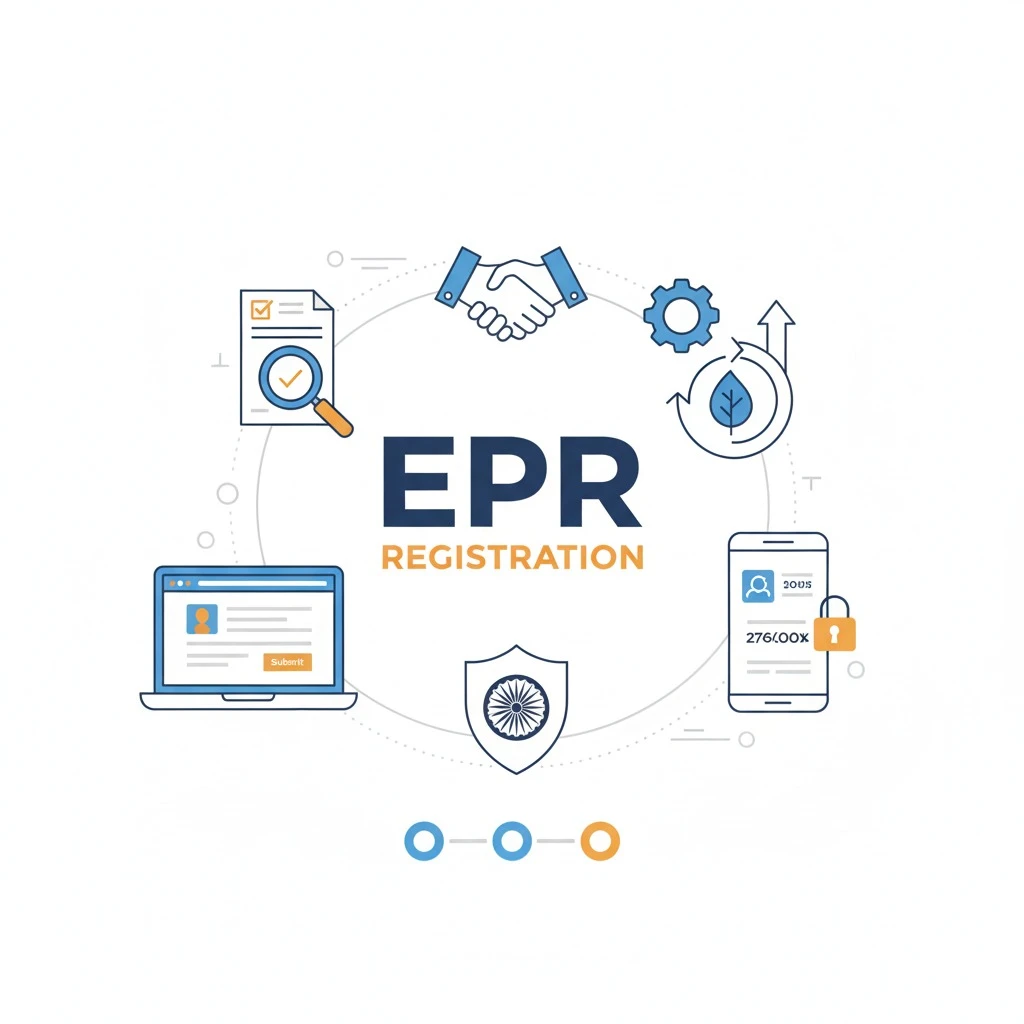
EPR Registration in Mysore
EPR Registration in Mysore depends on what the applicant manufactures, imports, brands or places into the Indian market. Legal Papers India assists Mysore businesses remotely from Delhi and Noida with applicability review, product classification, documentation and registration coordination without representing a physical Mysore branch or local EPR registration centre.
The brief expressly requires remote delivery unless a physical city office exists and prohibits false local-presence signals.
For most businesses, the first decision is not which application form to fill. It is which environmental responsibility framework applies.
The business may need to examine:
- Plastic Waste EPR
- E-Waste EPR
- Battery Waste EPR
- More than one EPR stream for the same commercial product
CPCB's current plastic EPR material defines Producers, Importers and Brand Owners separately, while its e-waste framework uses a distinct producer definition for covered electrical and electronic equipment.
Practical recommendation: Map the full commercial product before applying. A product with electronics, a battery and plastic packaging may require separate compliance assessment under more than one framework.
Why Mysore’s Industrial Profile Creates Distinct EPR Requirements
Mysore has a diversified industrial base covering general engineering, electrical and electronics, food, packaged drinking water, garments, wood products, automobile-related activity and industrial chemicals. For businesses in these sectors, EPR becomes particularly relevant when products include covered electronics, batteries or plastic packaging placed into the market.
Invest Karnataka identifies Mysuru's major industries as general engineering, electrical and electronics, food, packaged drinking water, garments, wood industry and other manufacturing sectors. It also lists key industrial areas including Hebbal, Metagalli, Hootagalli, Belavadi, Belagola, Kadakola and Nanjangud. The district administration similarly identifies established industrial areas around Hebbal, Metagalli, Hootagalli and Belavadi.
This produces locally relevant EPR situations:
| Mysore Business Situation |
Compliance Question |
|
Electrical-equipment manufacturer |
Is the finished equipment covered under e-waste rules? |
|
Packaged drinking-water brand |
Which plastic packaging categories enter the market? |
|
Food manufacturer |
Does branded plastic packaging create PIBO obligations? |
|
Engineering company importing electronic controls |
Does importer status trigger e-waste assessment? |
|
Battery-powered consumer product seller |
Are battery and e-waste frameworks both relevant? |
|
D2C garment/lifestyle brand |
Is plastic secondary or tertiary packaging covered? |
Expert observation: Traditional manufacturing businesses may acquire EPR obligations as their product lines evolve. Adding electronic controls, batteries or branded packaging can change the environmental compliance profile even when the company itself remains the same.
Common mistake: Reviewing EPR only when a regulator or marketplace asks for a certificate. Product-level compliance is easier to manage before launch.
Which Businesses in Mysore Should Check EPR Applicability?
Manufacturers, producers, importers and brand owners dealing with regulated packaging, batteries or covered electrical and electronic products should evaluate EPR requirements. Businesses in Mysore's engineering, food, electronics and packaged-goods sectors should focus on their actual supply-chain role rather than assuming industry type alone decides whether registration applies.
Businesses that commonly need an applicability review include:
- Engineering manufacturers
- Electrical and electronics companies
- Importers
- Producers
- Brand Owners
- Packaged food businesses
- Packaged drinking-water brands
- Battery manufacturers and importers
- Plastic packaging businesses
- FMCG companies
- Consumer-product brands
- E-commerce businesses
- D2C brands
- Private-label sellers
A Practical Role Test
Ask four questions:
- Do we manufacture the regulated product or packaging?
- Do we import it for commercial use?
- Do we sell it under our own registered brand or trademark?
- Does the finished product include electronics, batteries or plastic packaging?
CPCB's current guidance makes these distinctions material. Under plastic EPR, Producer, Importer and Brand Owner each have specific definitions; e-waste follows a separate producer framework.
Overlooked requirement: A company may simultaneously occupy more than one commercial role. For example, it may manufacture one product locally while importing another and selling both under its brand.
Selecting Between Plastic, E-Waste and Battery EPR
An EPR Certificate in Mysore should not be treated as one universal licence covering all waste streams. Plastic packaging, e-waste and batteries are regulated through separate frameworks. Businesses should identify which part of the product or packaging is regulated and maintain category-specific data before deciding which application route applies.
| Product or Packaging Element |
Potential EPR Stream |
Key Data to Prepare |
|
Plastic packaging |
Plastic Waste EPR |
Packaging category and quantity |
|
Covered electrical/electronic equipment |
E-Waste EPR |
EEE category and market quantity |
|
Battery |
Battery Waste EPR |
Battery category and quantity |
|
Composite product |
Multiple streams |
Component-level compliance mapping |
CPCB's plastic EPR guidelines expressly place Extended Producer Responsibility on Producers, Importers and Brand Owners for plastic packaging.
Example: Smart Engineering Product
Suppose a Mysore engineering company manufactures a branded industrial controller supplied with:
- Electronic circuitry
- Rechargeable battery
- Molded plastic packaging
The business should not assume that one registration automatically covers all three.
Decision guideline: Break the SKU into product, battery and packaging components, then test each against the relevant regulatory framework.
EPR Registration Online in Mysore
EPR Registration Online in Mysore works best when the applicant prepares reliable product and quantity data before portal submission. The process should begin with regulatory classification, followed by SKU mapping, quantity reconciliation, document review and application preparation. This reduces the risk of category errors and inconsistent information during scrutiny.
Step-by-Step Process
| Stage |
Purpose |
Common Mistake |
Expert Recommendation |
|
Applicability Review |
Identify the relevant EPR stream |
Assuming one framework covers everything |
Review product, battery and packaging separately |
|
Applicant Classification |
Determine producer/importer/brand-owner role |
Using trade labels instead of definitions |
Map actual supply-chain activity |
|
Product Mapping |
List regulated products/SKUs |
Missing variants or accessories |
Maintain a master product file |
|
Quantity Reconciliation |
Establish market/import/manufacturing quantities |
Different departments using different figures |
Reconcile before filing |
|
Document Validation |
Check legal-entity records |
PAN/GST/name mismatch |
Use one legal master dataset |
|
Application Filing |
Submit category-specific information |
Wrong product/category selection |
Review technical classification first |
|
Query Handling |
Respond to regulator observations |
Partial or unsupported response |
Retain supporting source records |
|
Registration Review |
Check approved particulars |
Certificate not verified |
Match against filed information |
|
Ongoing Compliance |
Track later obligations |
Treating registration as one-time work |
Maintain a compliance calendar |
A useful internal EPR master can contain:
Product Code → Brand → Manufactured/Imported → Electronic Component → Battery → Packaging Material → EPR Stream → Quantity → Evidence Source
Approval-delay reason: Starting portal filing before production, sales, import and packaging data are reconciled often leads to avoidable rework.
Documents Required for EPR Registration in Mysore
Documents required for EPR Registration in Mysore vary according to the applicant's legal structure, regulatory role and waste stream. Basic company records establish legal identity, while product, manufacturing, import, battery and packaging information establishes whether and how the applicant falls within the relevant EPR framework.
| Applicant Type |
Common Records to Organize |
|
Proprietorship |
PAN, GST/business records and proprietor details |
|
Partnership |
Partnership Deed, PAN, GST and partner information |
|
LLP |
Incorporation records, LLP Agreement, PAN and GST |
|
Private Limited Company |
Incorporation Certificate, PAN, GST and authorized-person information |
|
OPC |
Incorporation records and authorized-signatory details |
|
Manufacturer |
Entity records plus manufacturing/product data |
|
Importer |
Entity records plus import and product information |
|
Brand Owner |
Entity details plus brand and packaging information |
Additional category-specific data can involve:
- Product descriptions
- Product categories
- Brand names
- Plastic packaging categories
- Manufacturing quantities
- Import quantities
- Battery types
- Market-placement data
- Authorized signatory details
- Existing environmental registrations
- Supporting declarations
Compliance tip: Avoid creating numbers specifically for the EPR application without linking them to source records. Quantities should ideally be traceable to ERP data, invoices, import records, production registers or packaging procurement information.
Why Professional EPR Assistance Can Be Valuable
Professional EPR assistance is most useful when it resolves uncertainty about applicability, product classification and data preparation before an application is filed. For Mysore manufacturers and brands handling several products or packaging types, structured guidance can prevent incorrect category selection and create a more manageable post-registration compliance system.
Operational Benefits
Professional review can create:
- One product-compliance master
- Clear responsibility between departments
- Better SKU mapping
- Packaging-data consistency
- Reliable quantity records
Regulatory Benefits
It can reduce risks involving:
- Incorrect applicant category
- Missing SKUs
- Wrong packaging classification
- Mismatched entity information
- Weak query responses
Commercial Benefits
EPR documentation may become relevant during:
- Corporate procurement
- E-commerce onboarding
- Distributor due diligence
- Private-label arrangements
- Import expansion
- National sales growth
Future Compliance Benefits
Registration may be followed by:
- Recycling targets
- EPR certificate requirements
- Returns and reporting
- Amendments
- Product/category updates
- Other prescribed obligations
Buyer hesitation point: Ask whether the professional fee covers only registration or also regulator queries and later compliance. These are materially different scopes.
How Remote EPR Assistance Works for Mysore Applicants
Legal Papers India can coordinate CPCB EPR Registration in Mysore remotely because much of the work involves digital business records, product specifications, packaging information and online regulatory systems. The organization operates from Delhi and Noida, so Mysore should be represented as an area served rather than as a physical branch location.
The remote model can cover:
- Applicability assessment
- Producer/importer/brand-owner classification
- Plastic, e-waste and battery review
- Product master preparation
- Packaging-data review
- Document checklist
- Application preparation
- Query-response coordination
- Post-registration compliance discussion
For a manufacturer, involving more than one internal department is often necessary.
Engineering/Product Team: product components and technical categories
Finance: quantities and invoices
Procurement: packaging and component purchases
Imports/Logistics: import records
Compliance/Management: registration responsibility
Expert observation: Many filing delays arise because no one person owns the entire compliance dataset. Assigning an internal coordinator can significantly improve consistency.
Read more About Us
EPR Registration Cost and Timeline in Mysore
The cost and timeline for EPR Registration in Mysore depend on the waste stream, applicant role, number of products, manufacturing or import complexity, packaging formats, quality of available records and scope of professional support. A single universal fee or approval period is therefore not appropriate for every business.
Main Cost Drivers
| Factor |
Why It Changes the Work |
|
Number of EPR streams |
Multiple frameworks require separate assessment |
|
Number of SKUs |
Larger portfolios need more classification |
|
Product complexity |
Electronics and batteries require closer review |
|
Packaging variety |
More packaging categories increase data work |
|
Import activity |
Import data needs reconciliation |
|
Poor record quality |
Missing/inconsistent information increases preparation |
|
Regulatory queries |
Additional clarification may be required |
|
Continuing compliance |
Different from registration-only support |
A two-SKU packaged food brand and a manufacturer with 80 electronic products should not receive the same scope merely because both search for an “EPR License in Mysore.”
Expert recommendation: Compare quotations on four components:
Applicability review → registration preparation → query handling → ongoing compliance
For timelines, distinguish internal preparation from regulatory processing. The former can often be improved through better records; the latter should not be presented as a guaranteed approval date.
Frequently Asked Questions
1. Does a packaged drinking-water company in Mysore need EPR Registration?
A packaged drinking-water business should assess Plastic Waste EPR if it places regulated plastic packaging into the market and falls within the applicable Producer, Importer or Brand Owner definition. Mysuru's official industrial profile includes packaged drinking water among its major industries, making packaging classification especially relevant for such local businesses.
2. Can an electrical-equipment manufacturer in Mysore need E-Waste EPR?
It can, depending on whether the equipment is covered under the applicable electrical and electronic equipment categories and whether the company falls within the producer definition. Mysuru has established electrical and electronics activity, but industry type alone is not enough; the exact product and regulatory role should be assessed.
3. Can EPR Registration in Mysore be completed online?
Relevant EPR regulatory systems operate through online mechanisms, so application documentation and professional consultation can be coordinated remotely. However, applicants still need accurate legal, product, packaging and quantity information. Online submission simplifies the method of filing; it does not eliminate classification or continuing compliance responsibilities.
4. Can a Mysore manufacturer require more than one EPR registration?
Yes. A manufacturer selling a covered electronic product containing a battery and supplied with plastic packaging may need to assess e-waste, battery-waste and plastic-packaging obligations independently. A single commercial SKU can therefore create more than one environmental compliance stream depending on product construction and the applicant's role.
5. What affects EPR Registration cost in Mysore?
Cost depends on the applicable EPR framework, number of products, applicant role, manufacturing or import activity, packaging complexity, quality of internal data and scope of professional assistance. Businesses should request a scope-based quotation showing whether classification, application preparation, regulatory queries and continuing compliance are included.
6. How long does CPCB EPR Registration take?
There is no single reliable timeline for every EPR application. Preparation time depends on product complexity and the quality of the applicant's records, while regulatory processing can vary according to application completeness and observations. Businesses should distinguish internal preparation time from regulatory processing instead of relying on unsupported guaranteed approval claims.
7. Does changing plastic packaging require an EPR review?
Yes, a packaging change can affect category classification, quantities or future compliance information. Businesses should review changes to packaging material, packaging format or product presentation before commercial rollout. This is particularly relevant to food, packaged drinking-water, FMCG and D2C brands that frequently alter pack sizes or packaging formats.
8. Is EPR Authorization the same as KSPCB consent?
No. Extended Producer Responsibility addresses responsibility for regulated products or packaging placed into the market. Karnataka State Pollution Control Board consents or other operational environmental approvals can apply separately to manufacturing facilities or industrial activities. An EPR approval should not automatically be treated as replacing another environmental permission.
9. Does EPR compliance end after registration?
No. Registration may be followed by continuing responsibilities relating to recycling targets, certificates, reporting, record maintenance, amendments or other prescribed actions depending on the waste stream. A business should assign internal ownership of compliance data before registration so later reporting does not become an emergency exercise.
10. Can Legal Papers India assist Mysore businesses without a Mysore office?
Yes. The supplied brief identifies Delhi and Noida as the head-office locations and requires remote Pan-India service delivery unless a physical local office is expressly stated. Documentation, product review and consultation can therefore be coordinated digitally while clearly describing Mysore as an area served rather than an office location.
Make EPR Part of Your Product Compliance Process
EPR Registration in Mysore is easier to manage when it is built into product, packaging and import decisions instead of being treated as a certificate required after launch. Legal Papers India can remotely review your business role, products and available records so the applicable registration path is identified before unnecessary filing work begins.
For an initial review, prepare:
- Company constitution
- PAN and GST information
- Product/SKU master
- Brand details
- Manufacturing or import status
- Product specifications
- Packaging information
- Battery information
- Quantity records
- Existing EPR registrations
The practical decision sequence is:
Identify the regulated product → establish the company's role → map applicable EPR streams → reconcile data → prepare the filing → maintain future compliance
Get Trusted Compliance Support from Legal Papers India. Contact Us
Legal Papers India Business Solution Private Limited, F 2, Sector 8, Noida, Uttar Pradesh, 201301
Monday to Saturday 10:00 AM to 06:30 PM





Please submit all general enquiries in the contact form below and we look forward to hearing from you soon.


Captcha:







Or sign in with:
LOGIN WITH GOOGLESign up for early Sale access plus tailored new arrivals, trends and promotions. To opt out, click unsubscribe in our emails.
Forgot your password? No worries! Enter your registered email to receive a link and securely reset it in just a few steps.