
Sep 04, 2026
LLP Registration Process: What Businesses Should Know Before Getting Started
When a Growing Business Starts Feeling “Too Informal”
It usually begins quietly. Two friends start a consulting venture. A designer teams up with a marketer. Siblings launch an online trading business. In the beginning, everything works through trust, shared spreadsheets, and verbal understanding.
Then practical issues appear.
One partner signs a vendor agreement without discussing it. A client asks for a formal business structure before approving a contract. Someone worries about personal liability if the business runs into debt or legal trouble.
That is often the stage where people begin searching for the LLP Registration Process.
Not because they suddenly want a “corporate structure,” but because the business has grown beyond an informal arrangement.
For many small and mid-sized ventures in India, a Limited Liability Partnership (LLP) offers a middle ground between a traditional partnership and a private limited company. But understanding how the process works, who actually needs it, and what compliance follows afterward is equally important before applying.
What Is the LLP Registration Process?
A Simple Definition of LLP Registration
The LLP Registration Process is the legal procedure through which a business is incorporated as a Limited Liability Partnership under the LLP Act, 2008 through the Ministry of Corporate Affairs (MCA). It involves obtaining digital signatures, reserving a business name, filing incorporation documents, and receiving a Certificate of Incorporation.
An LLP becomes a separate legal entity after registration, meaning the business and its partners are treated separately in legal and financial matters.
LLP Registration Explained in Practical Terms
An LLP structure allows two or more partners to operate a business together while limiting personal liability for business obligations. Unlike a normal partnership firm, the liability of partners in an LLP is generally restricted to their agreed contribution.
In practical business situations, this matters more than many founders initially realize.
For example:
- If the LLP faces a contractual dispute, personal assets of partners are usually protected from business liabilities.
- If one partner makes an operational mistake, another partner may not automatically become personally liable for that action.
- The business can continue existing even if partners change over time.
This is one reason professional service firms, agencies, consultants, traders, and growing startups often explore LLP registration once operations become more structured.
Why LLP Registration Matters for Businesses
Many businesses continue operating informally for years. That may work temporarily, but certain growth stages usually create pressure for formal registration.
An LLP structure often becomes relevant when:
- Clients request formal agreements
- Vendors ask for registered entity details
- Multiple founders need clear operational roles
- Personal liability concerns increase
- Businesses begin handling larger transactions
- Banks or financial institutions seek organizational proof
Another overlooked factor is continuity.
In informal partnerships, disputes or exits can destabilize the business quickly. LLP agreements provide operational clarity regarding profit sharing, responsibilities, decision-making, and partner exits.
Businesses exploring expansion across different regions sometimes also review operational presence requirements through pages like business service availability across locations when assessing future compliance needs.
Who Should Consider LLP Registration — And Who May Not Need It
Businesses That Commonly Prefer LLP Structures
LLP registration is commonly suitable for:
- Professional service firms
- Marketing agencies
- Consulting businesses
- Architecture and design firms
- Import-export partnerships
- Family-run businesses with multiple active partners
- Small businesses wanting operational flexibility
It is particularly attractive for ventures that want limited liability protection without the heavier compliance framework associated with some corporate structures.
Situations Where LLP May Not Be Necessary
Not every business immediately needs LLP registration.
For example:
- Freelancers working independently may not require an LLP initially
- Very small side-income activities may function adequately as proprietorships
- Businesses planning rapid equity fundraising may sometimes prefer company structures instead
This is where many founders get confused online. People often search for “best business structure” expecting a universal answer, but suitability depends heavily on operational goals, risk exposure, and future plans.
LLP vs Traditional Partnership: A Neutral Comparison
One common search intent behind the LLP Registration Process is understanding how it differs from a standard partnership firm.
Here is the practical distinction:
| Aspect |
Traditional Partnership |
LLP |
|
Legal Identity |
Partners and firm treated closely |
Separate legal entity |
|
Liability |
Often unlimited |
Limited liability |
|
Registration |
Optional in many cases |
Mandatory |
|
Compliance |
Lower |
Moderate |
|
Continuity |
Can be unstable during exits |
More structured continuity |
|
Credibility |
Moderate |
Higher institutional acceptance |
This does not automatically make LLP “better” in every case. The right structure depends on operational complexity, future risk, and business scale.
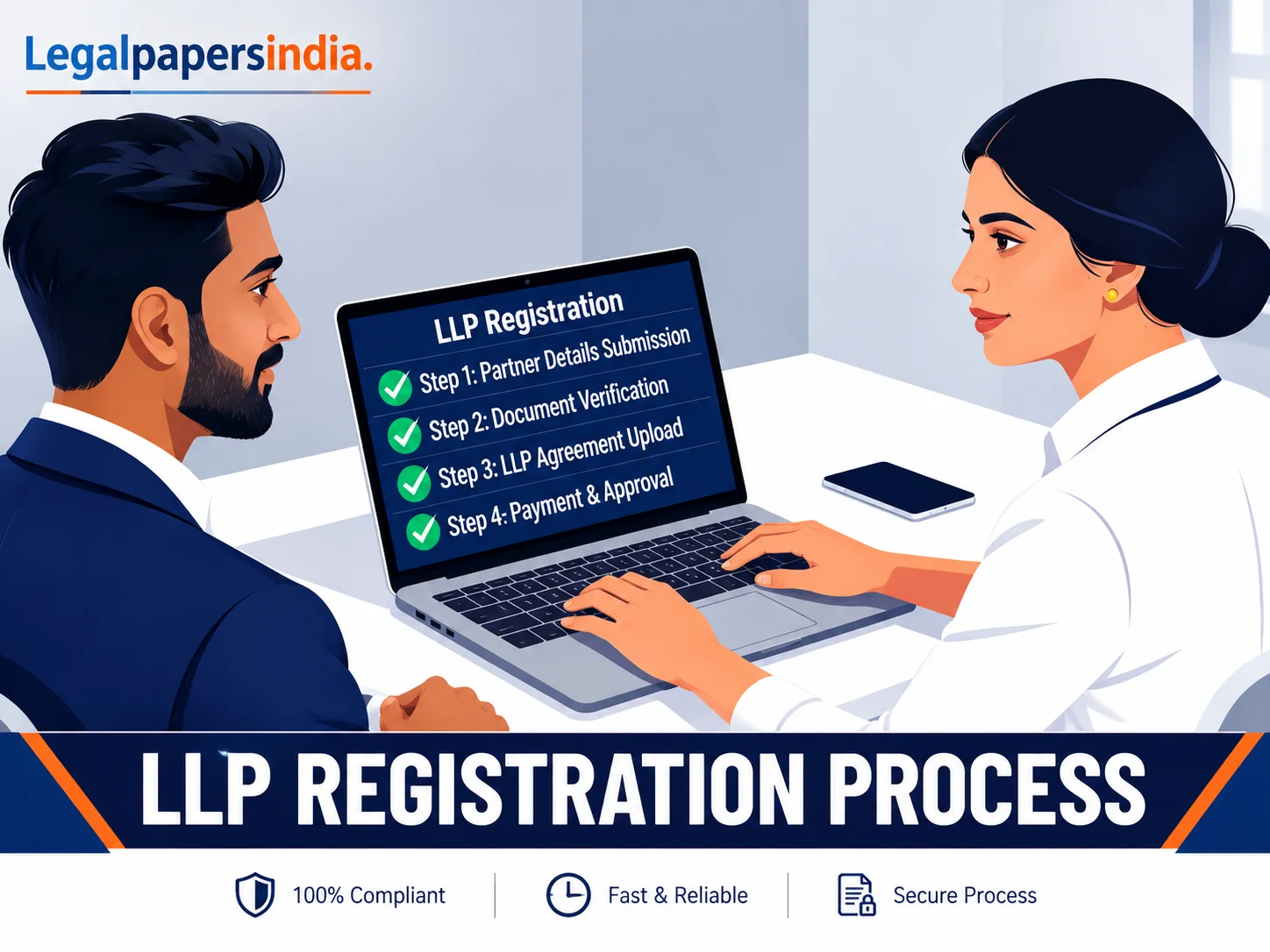
How the LLP Registration Process Works
Step 1: Obtain Digital Signature Certificates (DSC)
All designated partners need Digital Signature Certificates because LLP incorporation forms are filed electronically through the MCA portal.
Without DSCs, incorporation documents cannot be submitted.
Step 2: Apply for DPIN
Designated Partner Identification Number (DPIN) is required for individuals becoming designated partners in the LLP.
In many cases, it is allotted during incorporation itself.
Step 3: Reserve the LLP Name
The proposed business name is submitted for approval through the MCA system.
Names may be rejected if they:
- Closely resemble existing entities
- Include restricted words
- Violate naming guidelines
- Create trademark conflicts
This stage often takes longer than people expect because first-choice names are frequently unavailable.
Step 4: File Incorporation Documents
Once the name is approved, incorporation forms are filed with supporting documents.
These generally include:
- Identity proof
- Address proof
- Registered office details
- Partner consent
- Subscriber sheet
Step 5: Receive Certificate of Incorporation
After verification, MCA issues the Certificate of Incorporation.
At this point, the LLP legally comes into existence.
Step 6: Draft and File LLP Agreement
The LLP Agreement defines:
- Profit-sharing ratio
- Rights and responsibilities
- Decision-making process
- Partner obligations
- Exit terms
Many disputes later arise because businesses rush through this document without properly discussing operational realities.
Step 7: Post-Registration Compliance
Depending on business activity, additional registrations may become necessary, such as:
- GST registration
- Professional tax registration
- Import Export Code (IEC)
- Industry-specific licenses
Businesses seeking a broader understanding of formal incorporation procedures sometimes also review detailed guidance related to LLP registration and compliance requirements before finalizing the structure.
Documents Commonly Required for LLP Registration
The exact documentation may vary slightly depending on partner type and office setup, but commonly required documents include:
For Individual Partners
- PAN card
- Aadhaar card
- Passport-sized photograph
- Address proof
- Email and mobile number
For Registered Office
- Utility bill
- Rent agreement (if rented)
- No Objection Certificate from owner
For Foreign Nationals or NRIs
Additional notarization and apostille requirements may apply in certain situations.
One practical issue businesses face is mismatched documentation — especially address differences across PAN, Aadhaar, and bank records. Small inconsistencies often delay approvals.
Common Challenges During LLP Registration
Name Rejection
This is one of the most frequent delays.
Businesses often choose generic names already similar to existing entities or trademarks.
Poorly Drafted LLP Agreements
Some founders copy generic templates without tailoring operational terms. This becomes problematic later during profit disputes or partner exits.
Incorrect Documentation
Even minor spelling mismatches can trigger resubmission requests.
Ignoring Post-Incorporation Compliance
Many businesses believe registration alone completes the process. In reality, annual filing and ongoing compliance remain important.
What Compliance Risks Should Businesses Understand?
LLPs generally have simpler compliance than many corporate structures, but they are not compliance-free.
Failure to file mandatory annual returns or statements can result in:
- Additional government fees
- Penalties for delayed filing
- Compliance status issues
- Operational complications during future funding or closure
The risk is not usually dramatic overnight action — it is gradual administrative burden that becomes difficult to clean up later.
Businesses sometimes underestimate this because incorporation feels like the “main event,” while compliance quietly continues in the background every year.
How Long Does the LLP Registration Process Usually Take?
In many normal cases, LLP registration may take around 7–15 working days.
However, timelines vary depending on:
- Name approval delays
- Document accuracy
- MCA processing speed
- Resubmission requirements
- Partner verification issues
For foreign nationals or complex ownership structures, timelines can extend further.
Businesses planning contractual commitments or vendor onboarding should ideally avoid assuming instant approval.
Key Things to Consider Before Registering an LLP
Before proceeding, businesses should think beyond incorporation itself.
Consider questions such as:
- Will external investment be needed later?
- How will profits be shared?
- What happens if a partner exits?
- Will one partner manage operations more actively?
- Are industry-specific registrations also required?
- Is GST registration likely to become necessary soon?
These conversations are often more important than the filing process itself.
A carefully structured LLP usually performs better operationally than one created quickly without internal clarity.
Frequently Asked Questions About LLP Registration Process
1. Can a single person register an LLP?
No. An LLP requires at least two partners for incorporation and ongoing existence.
2. Is LLP registration mandatory for partnerships?
No. Traditional partnerships can still operate without LLP registration. LLP is a separate legal structure offering limited liability benefits.
3. Does LLP registration automatically include GST registration?
No. GST registration is separate and depends on turnover thresholds and business activities.
4. Can salaried individuals become LLP partners?
Yes, salaried individuals can become LLP partners unless restricted by employment agreements or organizational policies.
5. What happens if annual LLP compliance is ignored?
Delayed filings may attract additional fees and compliance complications over time. Repeated non-compliance can create operational and regulatory difficulties.
When Professional Assistance Often Becomes Useful
Many LLP registrations appear straightforward initially but become complicated due to:
- Name objections
- Agreement drafting confusion
- Incorrect filings
- Compliance misunderstandings
- Multi-partner structuring issues
This is especially true when partners have unequal investments, operational roles, or future expansion plans.
Reviewing professional guidance from firms such as Legal Papers India’s business compliance team can help businesses better understand documentation flow, filing expectations, and post-registration obligations before proceeding.
Conclusion
The LLP Registration Process is not just a formality for obtaining a registration certificate. It is often the point where a business shifts from an informal arrangement into a legally structured operation with defined responsibilities and protections.
For many businesses, that transition creates clarity, operational credibility, and reduced personal risk.
At the same time, LLP registration should not be approached casually or rushed purely because “everyone else is doing it.” The structure works best when partners understand how responsibilities, compliance, and future business goals align with the LLP model.
If you are uncertain whether LLP is the right structure for your situation, speaking with experienced professionals before filing can help avoid unnecessary restructuring later.
Legal Papers India provides professional LLP registration and business compliance services across India. We help startups, entrepreneurs, and businesses complete the LLP registration process with expert guidance and proper documentation.
Our goal is to offer fast, reliable, and hassle-free business registration solutions at affordable pricing.
Looking for reliable LLP Registration services in India? Connect with Legal Papers India for professional assistance with Limited Liability Partnership registration and compliance support.
Social Share: