
Sep 04, 2026
FSSAI License vs Basic Registration: Which One Do You Actually Need?
The Confusion Usually Starts After the Business Idea Is Ready
A lot of food business owners don’t struggle with the product. They struggle with the paperwork.
Someone tells you, “Just get FSSAI.” Then another person says, “No, basic registration is enough.” At that point, most people stop asking what the law technically says and start wondering something more practical:
“Am I applying for the wrong category without realizing it?”
That hesitation is valid.
Because choosing between FSSAI License vs Basic Registration is not really about forms. It affects compliance risk, marketplace approvals, business expansion, packaging legality, and even whether distributors or platforms take your business seriously later.
In many real cases, businesses either:
- Apply for a lower category and face issues during scaling, or
- Over-apply unnecessarily and end up managing compliance they didn’t actually need.
The right choice depends less on what you sell and more on how your food business operates, your turnover, your supply chain model, and where you plan to go next.
If you're still evaluating which category fits your situation, this guide will help you make that decision clearly and practically.
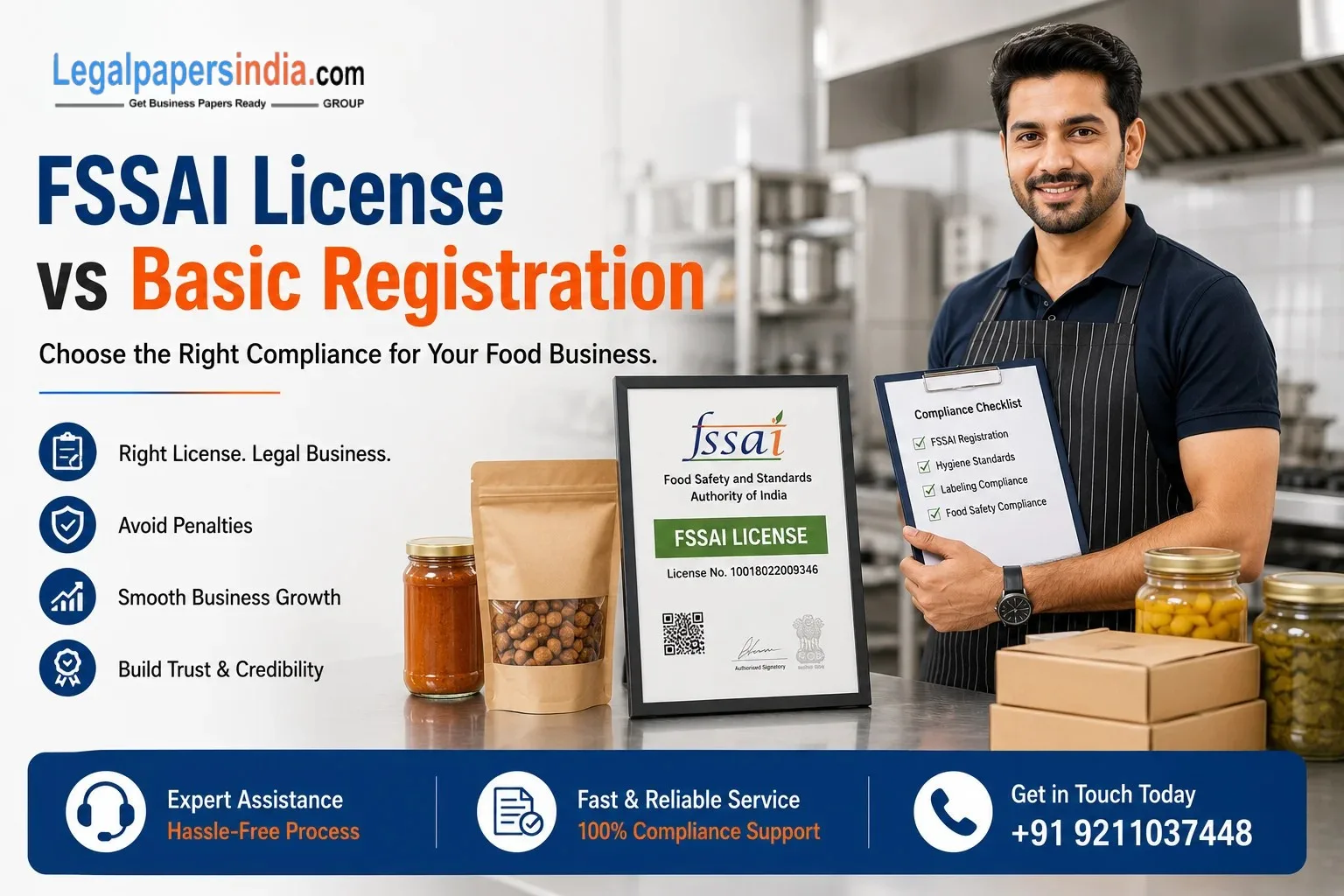
If your food business turnover is below ₹12 lakh annually and operations are small-scale, Basic FSSAI Registration is usually sufficient. Once turnover, production capacity, interstate operations, or distribution scale increases, an FSSAI State or Central License becomes necessary. The real decision should be based on future scalability and compliance exposure — not just current turnover.
When Basic Registration Usually Makes Sense
Basic Registration is often suitable for very small food operators who are still validating demand or operating locally.
This typically includes:
- Home kitchens
- Small snack sellers
- Local bakery startups
- Street food vendors
- Small-scale resellers
- Homemade pickle or spice businesses
- Early-stage cloud kitchens with limited volume
The biggest advantage here is operational simplicity.
You get legal recognition under the Food Safety and Standards Authority of India while avoiding unnecessary licensing layers too early.
But there’s an important nuance many businesses miss:
If your business model is expected to grow quickly, applying only for Basic Registration may create avoidable transition issues later.
For example:
- Onboarding delays with Zomato or Swiggy
- Distributor documentation problems
- Relabeling or packaging updates
- Reapplication during turnover growth
At this stage, many founders begin wondering whether it’s smarter to start slightly ahead of current requirements.
Sometimes, it is.
Who Should Consider a Full FSSAI License Instead
An FSSAI License becomes the safer choice when operations are already structured for growth.
You’ll likely need a State or Central License if you:
- Operate across multiple states
- Manufacture food products at scale
- Import or export food items
- Supply to retailers or supermarkets
- Run large cloud kitchen operations
- Work with institutional buyers
- Exceed turnover thresholds
- Want smoother marketplace onboarding
This is where the discussion around FSSAI registration and licensing requirements becomes more strategic than procedural.
Many businesses technically qualify for Basic Registration initially but still choose a higher category because they know expansion is coming within the next 6–12 months.
That decision often reduces future disruption.
A Practical Way to Decide
Instead of asking:
“What’s the minimum requirement?”
Ask:
“What will my business realistically look like within a year?”
That question usually leads to a better compliance decision.
Basic Registration may work if:
- You’re testing the market
- Operations are hyper-local
- Packaging and distribution are limited
- Turnover growth is uncertain
- Compliance costs need to stay minimal
A License may be smarter if:
- Branding investment is already happening
- You plan marketplace partnerships
- Interstate supply is expected
- Investors/distributors may review compliance
- Scaling is already part of the roadmap
This is where many small food brands unintentionally delay themselves — not because the product fails, but because compliance planning stayed too reactive.
Who Should Avoid Staying on Basic Registration for Too Long
Some businesses continue operating under Basic Registration long after their operational scale changes.
That becomes risky.
You should reconsider your registration category if:
- Revenue has increased substantially
- Order volume has become consistent
- Manufacturing has expanded
- Warehouses or multiple kitchens are involved
- You’ve started private labeling
- Retailers ask for upgraded licensing
- You’re moving into packaged food distribution
One common pattern seen in growing food startups is this:
They delay upgrading because “the existing registration still works.”
Until suddenly:
- A platform asks for higher compliance,
- A food inspector raises category concerns,
- Or packaging scrutiny increases.
At that point, upgrading becomes reactive instead of planned.
Key Decision Criteria Before Choosing
Use this checklist honestly before applying:
Choose Basic Registration if:
- Annual turnover is under ₹12 lakh
- Operations remain local
- Production capacity is limited
- No interstate operations exist
- You are still validating business viability
- Compliance management resources are limited
Consider a State/Central License if:
- Growth is already visible
- You expect rapid scaling
- You plan online marketplace selling
- Distribution networks are expanding
- Investors or institutional buyers are involved
- Your product category may attract stricter scrutiny
Cost & Compliance Considerations
This decision is not only about registration fees.
Most people focus on application cost and ignore operational compliance cost.
That’s where mistakes happen.
Basic Registration usually involves:
- Lower documentation burden
- Simpler renewal requirements
- Fewer operational compliance layers
Licensing may involve:
- Additional documentation
- Inspection readiness
- Stricter operational standards
- Higher accountability during scaling
But here’s the overlooked part:
A business planning serious growth may actually save time and operational friction by choosing the correct license category early.
Cheap compliance can become expensive later if rework is involved.
Risk Factors Most Businesses Underestimate
1. Marketplace Compliance Delays
Food delivery and ecommerce platforms increasingly verify licensing accuracy carefully.
Incorrect category selection can delay onboarding.
2. Packaging and Labeling Exposure
As packaged products scale, scrutiny around labeling and compliance increases.
3. Expansion Restrictions
Some businesses discover too late that their current registration doesn’t align with expanded operations.
4. Inspection Readiness
Growth naturally attracts more visibility. Weak compliance foundations become harder to fix retroactively.
5. Business Credibility
Suppliers, distributors, and institutional partners often evaluate compliance maturity before partnerships.
Step-by-Step Action Plan Before Applying
Step 1: Assess Current Turnover
Start with realistic annual revenue projections, not optimistic estimates.
Step 2: Evaluate Operational Scale
Consider:
- Kitchen size
- Manufacturing volume
- Storage setup
- Supply chain reach
Step 3: Map the Next 12 Months
This is where better decisions happen.
If expansion is highly likely, plan accordingly now.
Step 4: Review Platform or Retail Requirements
Some marketplaces and distributors may expect specific licensing categories.
Step 5: Verify Documentation Readiness
Before applying, organize:
- Identity proof
- Address proof
- Business structure documents
- Food activity details
Common Decision-Stage Mistakes
Applying Based Only on Turnover
Turnover matters, but operational nature matters too.
Ignoring Future Scaling
Many businesses choose the minimum category without considering near-term growth.
Assuming Upgrade Is Always Simple
Transitioning later may involve operational interruptions or documentation rework.
Copying Competitor Compliance Blindly
Another business’s category may not legally fit your structure.
Delaying Registration Entirely
Some founders wait until marketplaces or authorities force compliance.
That usually creates unnecessary stress.
Practical Scenarios That Make the Decision Easier
Scenario 1: Home Baker Selling Through Instagram
If operations are small and local with limited turnover, Basic Registration is usually enough initially.
Scenario 2: Cloud Kitchen Planning Multi-City Expansion
Even if turnover is currently modest, a higher license category may align better with growth plans.
Scenario 3: Packaged Snacks Entering Retail Stores
Retail distribution generally increases compliance expectations quickly.
Scenario 4: Small Café Opening a Second Outlet
Expansion changes operational scale. Remaining under Basic Registration may no longer fit.
Is Trademark Registration Also Needed?
This question comes up surprisingly often once food businesses start branding seriously.
The short answer:
No, trademark registration is not mandatory for obtaining FSSAI approval.
But practically speaking, it becomes important once:
- Your packaging carries a brand name,
- You sell online,
- Customers recognize your label,
- Or expansion is planned.
Without trademark protection, another business may use a confusingly similar brand identity later.
Many food startups first focus on FSSAI compliance and then gradually move toward brand protection once sales stabilize.
If your business is already investing in labels, marketing, or marketplace visibility, trademark planning should not be ignored for too long.
Final Decision Summary
If your operations are genuinely small, local, and experimental, Basic Registration is often the right starting point.
But if growth, packaging, online selling, or distribution expansion are already part of your business direction, choosing a higher FSSAI license category earlier may reduce future compliance friction.
The better decision usually comes from evaluating where your business is headed — not just where it stands today.
And if you're unsure whether your current setup technically fits Basic Registration or requires licensing, you're not alone. This is one of the most common decision-stage confusion points for growing food businesses.
Frequently Asked Questions
1. Does every food business need FSSAI registration?
Yes. Any business involved in food manufacturing, storage, distribution, sale, or handling generally requires FSSAI compliance in some form.
2. Can I start with Basic Registration and upgrade later?
Yes, upgrading is possible. However, businesses expecting quick growth often prefer choosing the appropriate license category earlier to avoid operational disruption.
3. Is Basic Registration valid for online food selling?
It can be, depending on turnover and operational structure. But many ecommerce and food delivery platforms may require stronger compliance documentation as operations scale.
4. What happens if I use the wrong FSSAI category?
Using an incorrect category may create issues during inspections, marketplace onboarding, renewals, or expansion. Businesses should periodically reassess compliance eligibility as operations grow.
5. Is trademark registration compulsory for food businesses?
No. Trademark registration is separate from FSSAI compliance. However, it becomes valuable once branding, packaging, and market visibility increase.
Trademark registration is not mandatory for obtaining FSSAI registration or license approval. However, food businesses planning long-term branding, packaged product sales, online visibility, or expansion often choose trademark protection to secure their brand identity and reduce future naming conflicts.
Conclusion
Choosing between FSSAI License vs Basic Registration is less about finding the cheapest option and more about aligning compliance with the reality of your business.
Some businesses genuinely only need a basic registration. Others outgrow it faster than expected.
A careful decision now can prevent avoidable compliance adjustments later — especially if your business is already moving toward branding, scaling, or structured distribution.
If you want professional guidance on evaluating the correct registration category for your food business, the team at Legal Papers India can help you assess the practical and compliance side before you proceed. You can also reach out through their contact page for clarification based on your business model.
Legal Papers India provides professional FSSAI License registration services for startups and businesses across India. We assist with company incorporation, documentation, and compliance support for a smooth registration process.
Contact Legal Papers India for fast and reliable FSSAI License registration assistance. Our experts help with online filing, legal documentation, and business registration support.
Social Share: