
Sep 04, 2026
GST Composition vs Regular Scheme: Which One Actually Fits Your Business?
A lot of business owners don’t struggle with GST registration itself. The real confusion starts one step later.
You register, and then someone asks: “Are you opting for the Composition Scheme or Regular GST?”
That’s usually the moment hesitation kicks in.
A small trader wants lower compliance. A service provider wants fewer filings. A growing business worries about losing clients if input tax credit isn’t available. And somewhere in the middle, most people start wondering whether choosing the wrong scheme now will create problems later.
If you're comparing GST Composition vs Regular Scheme, the decision is less about “which is better” and more about which structure matches your current business reality without limiting future growth.
The right choice depends on:
- Your turnover,
- Type of customers,
- Profit margins,
- Expansion plans,
- And how much compliance you can realistically handle.
Before proceeding with GST registration services, it’s worth understanding where each scheme practically works — and where it starts becoming restrictive.
The Composition Scheme suits small businesses that mainly sell to end consumers and want minimal GST compliance. The Regular Scheme is usually better for businesses planning to grow, claim input tax credit, work with B2B clients, or operate across multiple states. Most scaling businesses eventually move toward the Regular Scheme.
When the Composition Scheme Makes Practical Sense
The Composition Scheme tends to work well for businesses that prioritize simplicity over tax flexibility.
In real situations, it often suits:
- Local retail shops
- Small restaurants
- Traders with limited interstate business
- Businesses selling mostly to end consumers
- Owners who want predictable tax calculation
- Businesses with relatively low purchase tax credits
You may find it suitable if:
- Your annual turnover stays within prescribed GST limits,
- Your buyers rarely ask for GST invoices,
- And compliance management feels more burdensome than beneficial.
For example, a neighborhood grocery store selling directly to consumers may not gain much from complex GST credit structures. In that case, lower compliance under Composition can feel more manageable.
At this stage, many small business owners are mainly trying to stay compliant without increasing operational complexity unnecessarily.
Who Should Usually Avoid the Composition Scheme
This is where many businesses make costly assumptions.
The Composition Scheme looks attractive initially because of reduced filings and lower tax rates. But it becomes restrictive faster than people expect.
You should carefully reconsider Composition if you:
- Sell to businesses that expect input tax credit,
- Plan interstate expansion,
- Operate through eCommerce platforms,
- Deal with high purchase GST,
- Expect turnover growth soon,
- Or want stronger vendor credibility.
A common pattern seen in growing businesses:
They choose Composition to “save effort,” then switch to Regular GST within a year because vendors, distributors, or clients start demanding proper GST invoices.
That transition often creates avoidable operational confusion.
If growth is already visible, choosing Regular GST early may reduce future disruption.
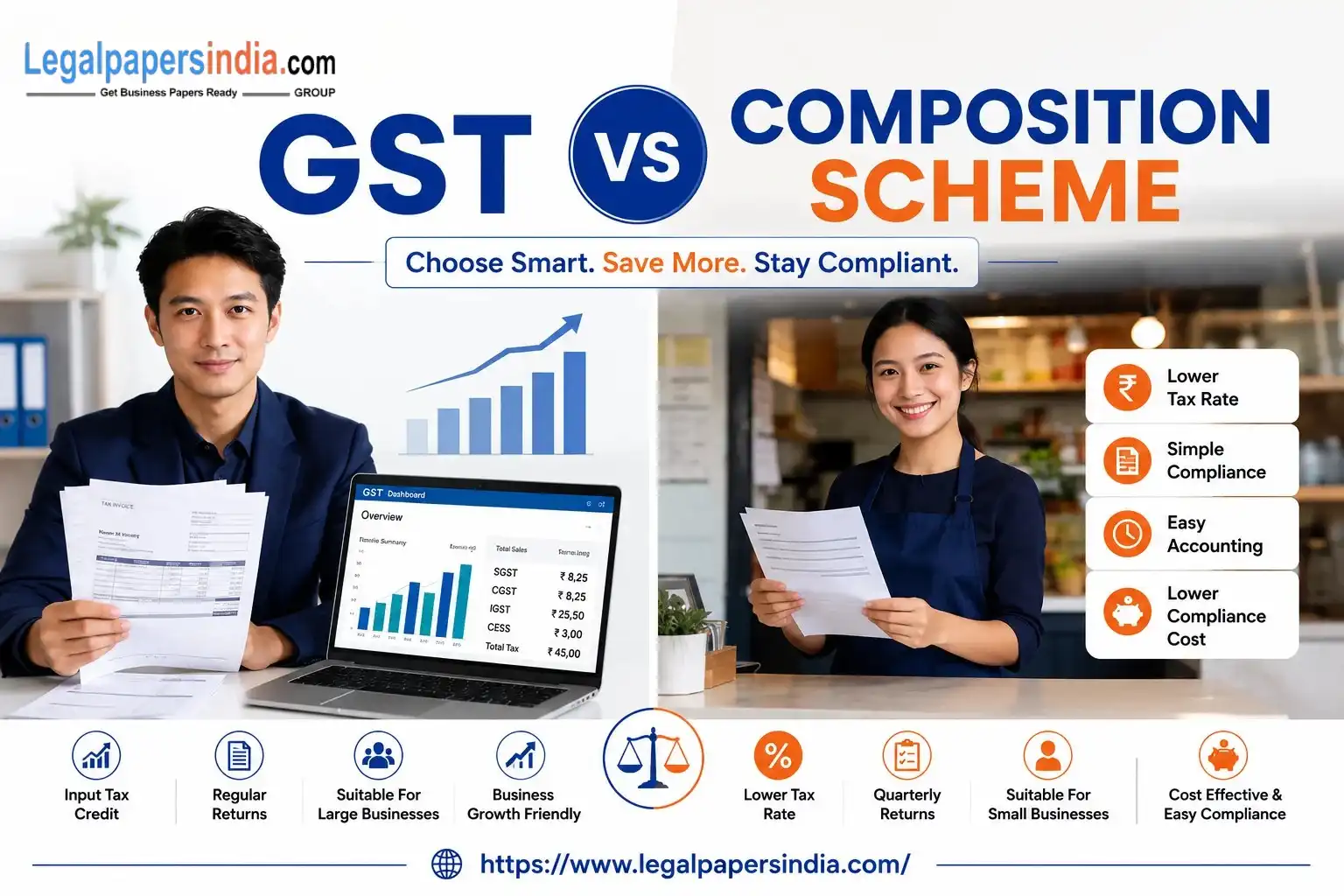
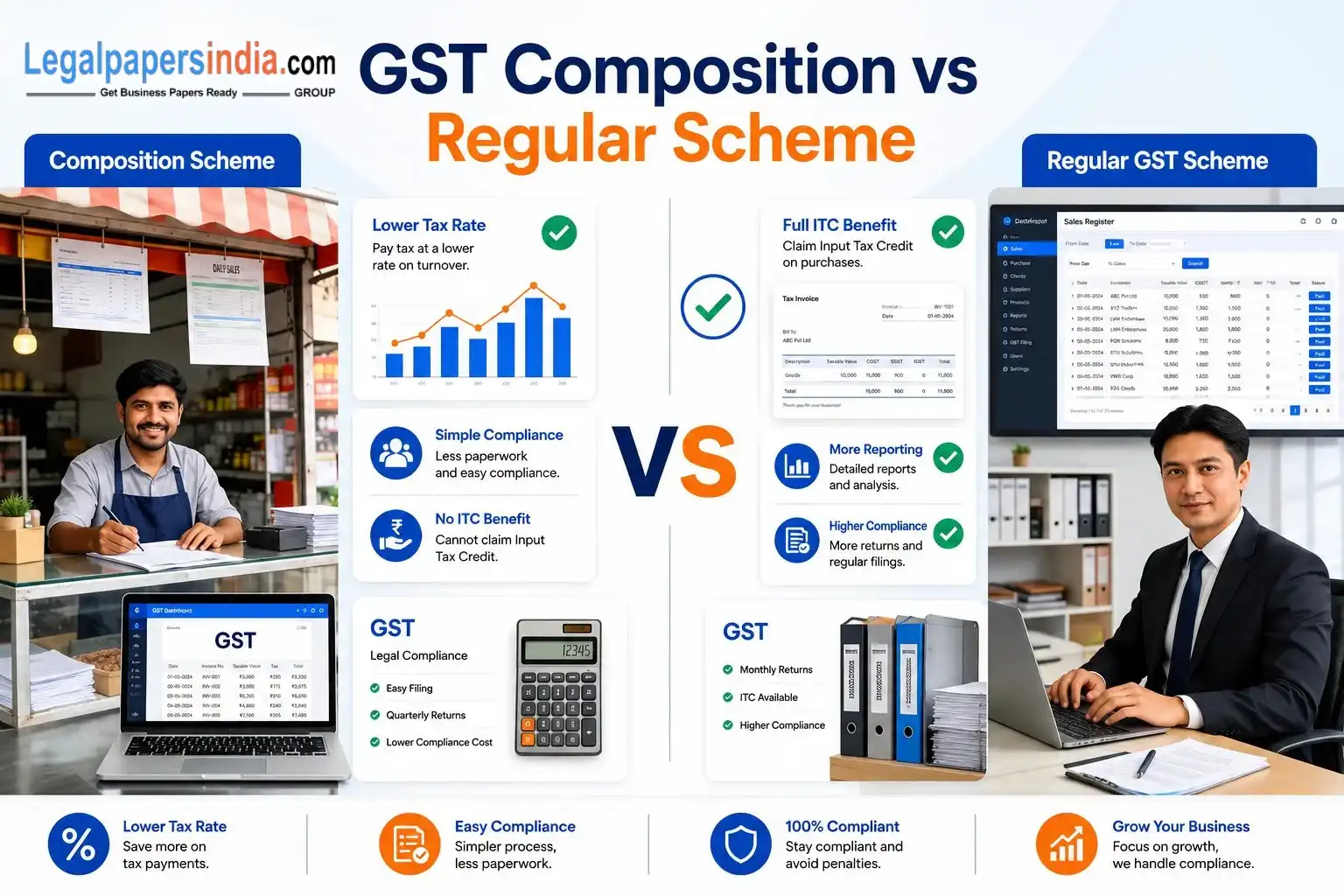
GST Composition vs Regular Scheme: The Core Decision Difference
Here’s the practical distinction most business owners actually care about:
| Factor |
Composition Scheme |
Regular Scheme |
|
Compliance Burden |
Lower |
Higher |
|
GST Rates |
Fixed lower rate |
Standard GST rates |
|
Input Tax Credit |
Not available |
Available |
|
Interstate Sales |
Restricted in many cases |
Allowed |
|
eCommerce Selling |
Limited restrictions apply |
Fully suitable |
|
B2B Suitability |
Often weaker |
Stronger |
|
Scalability |
Limited |
Better for growth |
|
Invoice Type |
Bill of supply |
Tax invoice |
The biggest real-world difference is input tax credit.
Under the Regular Scheme, businesses can claim GST paid on purchases. Under Composition, they generally cannot.
For businesses with significant procurement costs, this becomes financially important very quickly.
Key Decision Checklist Before Choosing
Before deciding, ask yourself these questions honestly.
Choose Composition If:
- Your turnover is comfortably within eligibility limits
- Most customers are end consumers
- You operate locally
- Your compliance capacity is limited
- Your input tax credits are relatively small
- You want straightforward quarterly compliance
Choose Regular GST If:
- You work with corporate clients
- Vendors or clients expect GST invoices
- You plan interstate expansion
- You want to claim input tax credit
- Your business margins depend on tax adjustments
- You expect rapid growth within 12–24 months
If you’re unsure which category you fall into, you’re not alone. Many businesses technically qualify for Composition but operationally function better under the Regular Scheme.
Eligibility alone should not drive the decision.
Cost & Compliance Considerations Most Businesses Overlook
People often focus only on GST rates while ignoring the broader operational impact.
That’s usually where decision mistakes happen.
Composition Scheme Compliance
Generally involves:
- Simplified returns,
- Lower accounting complexity,
- And easier monthly management.
But there’s a trade-off:
you cannot issue standard tax invoices for input tax credit purposes.
That can affect how seriously some B2B buyers view your business.
Regular Scheme Compliance
Requires:
- Regular return filing,
- Invoice reconciliation,
- Tax credit management,
- And more structured accounting.
Yes, compliance costs are higher.
But businesses with supplier networks, procurement-heavy operations, or scaling ambitions often recover far more through input tax credits than they spend on compliance management.
Sometimes lower GST burden does not actually mean lower overall business cost.
Risk Factors You Should Evaluate Before Opting In
This decision is not only about convenience. It also affects operational flexibility.
1. Future Growth Restrictions
Businesses expecting expansion often outgrow Composition faster than anticipated.
2. Client Perception
Certain corporate buyers avoid Composition dealers because they cannot claim tax credit.
3. Pricing Pressure
Without input tax credit benefits, your effective pricing competitiveness may weaken in some sectors.
4. Switching Complexity Later
Transitioning from Composition to Regular GST is possible, but businesses frequently underestimate the documentation and accounting adjustments involved.
5. Industry-Specific Limitations
Certain sectors naturally fit the Regular Scheme better due to supply chain structures and procurement patterns.
This is why practical suitability matters more than short-term simplicity.
Step-by-Step Action Plan Before You Decide
Step 1: Estimate Realistic Turnover
Don’t calculate based only on current sales. Consider projected growth over the next 12–18 months.
Step 2: Analyze Your Customer Type
Are your buyers mostly:
- Consumers,
- Retailers,
- Distributors,
- Or corporate businesses?
This changes everything.
Step 3: Calculate Input Tax Credit Impact
Review GST paid on:
- Inventory,
- Raw materials,
- Equipment,
- Software,
- And operational expenses.
Step 4: Evaluate Expansion Plans
Even tentative interstate selling or online expansion may shift the decision toward Regular GST.
Step 5: Discuss Compliance Readiness
A qualified GST consultant can often identify operational risks that aren’t obvious during self-assessment.
Businesses comparing registration structures across locations sometimes also review regional compliance support availability before proceeding.
Common Decision-Stage Mistakes
Choosing Composition Only Because “It’s Simpler”
Simplicity helps initially, but growth limitations appear later.
Ignoring Buyer Expectations
Many B2B customers specifically ask for Regular GST invoices.
Underestimating Future Turnover
Businesses often calculate eligibility based on today’s numbers instead of realistic projections.
Not Considering Vendor Ecosystems
Your suppliers and buyers influence whether Composition remains practical.
Delaying Professional Guidance
Incorrect selection can create restructuring work later that could have been avoided early.
Practical Scenarios That Make the Decision Clearer
Scenario 1: Local Retail Store
A single-location clothing store selling mainly to walk-in consumers may benefit from Composition due to simpler compliance and limited tax credit dependency.
Scenario 2: Digital Service Agency
A marketing agency working with businesses across states usually fits the Regular Scheme better because clients expect GST invoices and interstate service supply is common.
Scenario 3: Expanding Food Business
A restaurant operating locally today but planning franchise growth may initially qualify for Composition, yet Regular GST may support long-term expansion more effectively.
Scenario 4: Wholesale Trader
Wholesalers typically benefit more from input tax credit structures available under the Regular Scheme.
In practice, the more interconnected your business becomes with suppliers, vendors, logistics, and B2B customers, the stronger the case for Regular GST usually becomes.
Final Decision Summary
If your business is small, locally focused, consumer-driven, and unlikely to expand aggressively soon, the Composition Scheme can reduce compliance pressure and simplify operations.
But if your business depends on:
- Scalability,
- Supplier credits,
- B2B relationships,
- Interstate activity,
- Or long-term growth,
the Regular Scheme is generally the more sustainable option.
The key is not choosing the cheapest structure today. It’s choosing the one that still supports your business comfortably a year from now.
Frequently Asked Questions
1. Is the Composition Scheme better for small businesses?
It can be beneficial for small businesses with local consumer sales and limited compliance capacity. However, businesses planning growth, interstate sales, or B2B expansion often find the Regular Scheme more practical despite higher compliance requirements.
2. Can I switch from Composition to Regular GST later?
Yes. Businesses can migrate from the Composition Scheme to the Regular Scheme if eligibility changes or operational needs evolve. However, switching later may involve accounting adjustments, updated invoicing processes, and additional compliance responsibilities.
3. Does the Composition Scheme allow input tax credit?
No. Businesses under the Composition Scheme generally cannot claim input tax credit on purchases, which can affect overall cost efficiency in procurement-heavy operations.
4. Which GST scheme is better for service providers?
Most service providers prefer the Regular Scheme because interstate services, corporate invoicing, and input tax credit needs are common in service-based businesses.
5. Is Regular GST mandatory for interstate business?
In many practical cases, interstate supply activities align better with the Regular Scheme due to operational flexibility and compliance requirements.
Conclusion
Choosing between GST Composition vs Regular Scheme is ultimately a business-structure decision, not just a tax decision.
The right option depends on how your business operates today and where you realistically expect it to go next.
If you're still evaluating suitability, speaking with professionals who regularly handle GST structuring across different business models can help clarify the operational impact before registration. You can learn more about the experience and advisory approach of Legal Papers Indiabefore taking the next step.
Contact our team for fast and hassle-free GST registration support. We are here to help with documentation and online registration assistance.
Social Share: