
Sep 04, 2026
OPC vs LLP: Which Structure Makes More Sense for Your Business?
You’ve probably reached the stage where the business idea feels real enough to formalize — but now the confusion starts.
Should you register as an OPC because you’re starting alone? Or does an LLP give you more flexibility later?
And if you choose the wrong structure now, will it create unnecessary compliance, tax complications, or restructuring headaches later?
This is exactly where most founders hesitate.
The decision between OPC vs LLP is rarely about “which is better” in general. It’s about which structure aligns with how you plan to operate, earn, scale, and manage responsibility over the next few years.
Some people choose an OPC thinking it looks more credible, only to realize later that investor entry and operational flexibility become issues. Others register an LLP because it feels simpler, then discover that certain clients, lenders, or procurement platforms prefer a company structure.
If you're currently evaluating both options before proceeding, this guide will help you make a practical decision — not just a theoretical comparison.
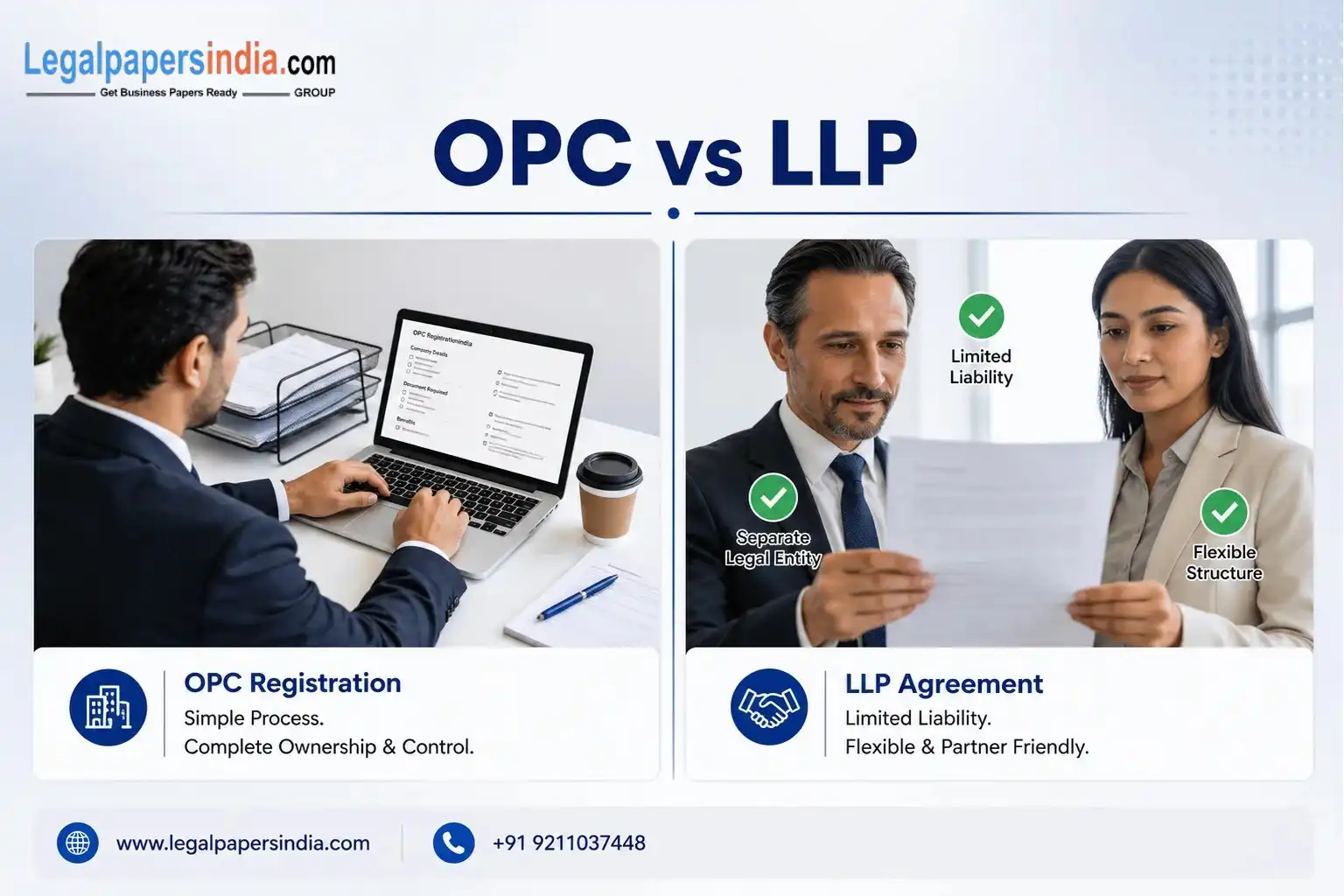
If you want a solo-controlled business with a separate legal identity and stronger corporate positioning, an OPC usually fits better. If you expect co-founders, flexible management, lower compliance burden, or professional partnership operations, LLP is often more practical. The right choice depends less on registration cost and more on future operational direction.
The Real Difference Most Founders Eventually Notice
On paper, both structures offer limited liability protection. But in practice, they operate very differently.
An OPC behaves more like a private company with structured governance under the Ministry of Corporate Affairs framework.
An LLP functions more like a flexible partnership with legal protection added to it.
That difference affects:
- compliance expectations
- taxation approach
- ownership flexibility
- funding readiness
- operational control
- long-term restructuring effort
This is why the decision should not be based only on “lower cost” or “easier registration.”
At this stage, what matters is how your business is likely to evolve.
Who Should Choose an OPC?
An OPC generally works well when the founder wants tighter ownership control and a more company-like structure from the beginning.
You may lean toward an OPC if:
- You are the sole founder and want complete decision authority
- You plan to build a brand with formal corporate positioning
- You expect banks, vendors, or enterprise clients to prefer a company entity
- You may eventually convert into a private limited company
- You want stronger distinction between personal and business identity
- You expect structured business growth over time
This often suits:
- solo consultants building agencies
- tech founders starting independently
- ecommerce brands
- service businesses seeking credibility with larger clients
- founders planning future expansion
In many real cases, founders choose OPC not because they immediately need it, but because they want to avoid appearing “informal” during early growth.
If you're evaluating whether an OPC setup aligns with your operational goals, reviewing the official One Person Company registration service can help clarify procedural expectations.
Who Should Avoid an OPC?
An OPC may create unnecessary rigidity if your business model depends on collaboration or flexible ownership.
You may want to avoid OPC if:
- You already have active co-founders
- You expect equity-sharing early
- You want simpler annual compliance
- Your business income may fluctuate unpredictably
- You prefer operational flexibility over corporate structure
- You’re starting a small professional practice with minimal scaling plans
One common mistake is choosing OPC purely because it “sounds more professional,” without considering whether the business actually needs a company-style framework.
That usually becomes visible during annual compliance cycles.
When LLP Usually Makes More Sense
An LLP tends to work better for businesses where flexibility matters more than corporate hierarchy.
It’s commonly suitable for:
- professional firms
- agencies with multiple partners
- family-run operational businesses
- consulting practices
- businesses sharing profit among active participants
- founders who want lower compliance complexity
In practice, LLPs are often preferred by businesses focused on operational stability rather than aggressive scaling.
If your priority is practical management rather than formal corporate structuring, the Limited Liability Partnership registration process may feel more aligned with your business model.
Key Decision Criteria Before Choosing
Use This Checklist Before Finalizing
Choose OPC if:
- You are starting alone
- You want stronger company positioning
- You expect structured growth
- You may seek funding later
- You want clear ownership separation
- You’re comfortable handling company compliance
Choose LLP if:
- Multiple people will actively operate the business
- Flexibility matters more than structure
- You want lower compliance pressure
- Profit-sharing arrangements are important
- You want easier operational management
- You prefer partnership-style governance
If you’re still stuck between both, ask yourself one practical question:
“How likely is it that ownership or management structure changes within the next 2–3 years?”
That answer usually reveals the better option.
Cost & Compliance Considerations
This is where many founders underestimate future obligations.
Initial registration cost is only one part of the decision.
OPC Compliance Reality
An OPC typically involves:
- annual ROC filings
- financial statement compliance
- statutory documentation
- board-related formalities
- accounting discipline
Even when operations remain small, the structure itself carries corporate obligations.
LLP Compliance Reality
LLPs generally offer:
- fewer governance formalities
- simpler operational compliance
- lower maintenance effort
- flexible internal agreements
However, lower compliance does not automatically mean “better.”
Some businesses later discover that clients, lenders, or marketplaces perceive company structures more favorably.
This becomes especially relevant when credibility affects business opportunities.
Risk Factors People Often Ignore
Choosing Based Only on Current Size
Many founders register according to today’s business stage, not tomorrow’s direction.
That’s understandable — but it creates avoidable restructuring later.
Ignoring Ownership Flexibility
An OPC is built around single ownership.
If partnerships or equity discussions are already likely, LLP may reduce friction.
Overvaluing “Professional Appearance”
Yes, OPC can create stronger corporate perception.
But perception alone should not drive legal structuring decisions.
Assuming LLP Means No Compliance
This assumption causes problems regularly.
LLPs still require regulatory filings and proper documentation under Registrar of Companies oversight.
Practical Scenarios That Make the Decision Easier
Scenario 1: Solo Digital Marketing Consultant
You operate independently, want complete control, and may expand into an agency later.
An OPC may fit better because the structure supports brand-building and future transition potential.
Scenario 2: Two Architects Starting a Design Practice
Both founders actively manage clients and revenue.
An LLP is usually more practical because partnership participation is central to operations.
Scenario 3: Ecommerce Founder Planning Investor Discussions Later
Even if starting solo, long-term scalability matters.
An OPC may provide a more structured growth pathway initially.
Scenario 4: Small Family Business with Shared Participation
Operations depend on multiple involved members rather than corporate expansion.
An LLP often creates less operational friction here.
Step-by-Step Action Plan Before Registration
1. Clarify Operational Structure
Decide whether the business will remain founder-centric or partnership-driven.
2. Estimate Future Ownership Changes
Think realistically about whether investors, co-founders, or partners may enter later.
3. Evaluate Compliance Comfort
Some founders prefer simplicity. Others prioritize structure and long-term positioning.
Both are valid.
4. Assess Market Expectations
In certain industries, company structures create stronger trust signals.
In others, clients care far more about execution than legal format.
5. Review Long-Term Scalability
The right structure today should still make sense after business growth begins.
Common Decision-Stage Mistakes
Registering Too Quickly
Many founders rush registration because operations are starting.
But restructuring later can become more expensive than spending extra evaluation time now.
Following Generic Advice
What worked for another founder may not suit your revenue model, growth strategy, or ownership plan.
Treating Compliance as a Minor Issue
At first, annual filings seem distant.
Later, missed compliance becomes stressful and expensive.
Choosing Structure for Branding Alone
Business structure should support operations first — branding second.
Final Decision Summary
If you want a solo-controlled, company-style structure with stronger corporate positioning and future scalability potential, OPC is often the better choice.
If your business depends on shared management, operational flexibility, simpler compliance, and partnership-driven functioning, LLP usually makes more practical sense.
Neither structure is universally superior.
The better decision comes from aligning the legal structure with how the business will realistically operate — not just how it looks during registration.
If you're unsure whether your situation fits either structure cleanly, you're not alone. This is one of the most common hesitation points founders face before formal registration.
Frequently Asked Questions
1. Is OPC better than LLP for a single founder?
Not always. OPC works well for solo founders seeking corporate structure and future scalability. But if simplicity and operational flexibility matter more, LLP may still be suitable depending on the business model.
2. Which has lower compliance: OPC or LLP?
LLPs generally involve lower compliance burden compared to OPCs because they operate with fewer corporate governance requirements.
3. Can an OPC later become a private limited company?
Yes. Many businesses initially register as OPC and later convert into a private limited company as ownership, investment, or operational needs evolve.
4. Is LLP suitable for startups planning funding?
In many cases, investors prefer company structures over LLPs. If external investment is a strong future goal, founders often evaluate OPC or private limited structures more seriously.
5. Which is cheaper to maintain: OPC or LLP?
LLPs are usually cheaper to maintain because compliance and governance obligations are comparatively lighter. However, lower maintenance cost should not be the only deciding factor.
Conclusion
The OPC vs LLP decision becomes easier once you stop asking, “Which structure is best?” and start asking, “Which structure fits the way this business will actually operate?”
That shift usually brings clarity.
Some businesses genuinely benefit from formal company structuring early. Others perform far better with flexible partnership-based operations.
If you want guidance based on your business model rather than generic recommendations, the team behind Legal Papers India can help you evaluate the practical implications before you proceed.
The goal isn’t simply registering a business. It’s choosing a structure you won’t regret six months later.
Legal Papers India provides professional OPC vs LLP registration services for startups and businesses across India. We assist with company incorporation, documentation, and compliance support for a smooth registration process.
Contact Legal Papers India for fast and reliable OPC vs LLP registration assistance. Our experts help with online filing, legal documentation, and business registration support.
Social Share: