

Sep 04, 2026
GST Registration Documents Guide: What You Really Need Before Applying
Why do so many GST applications get delayed over “simple documents”?
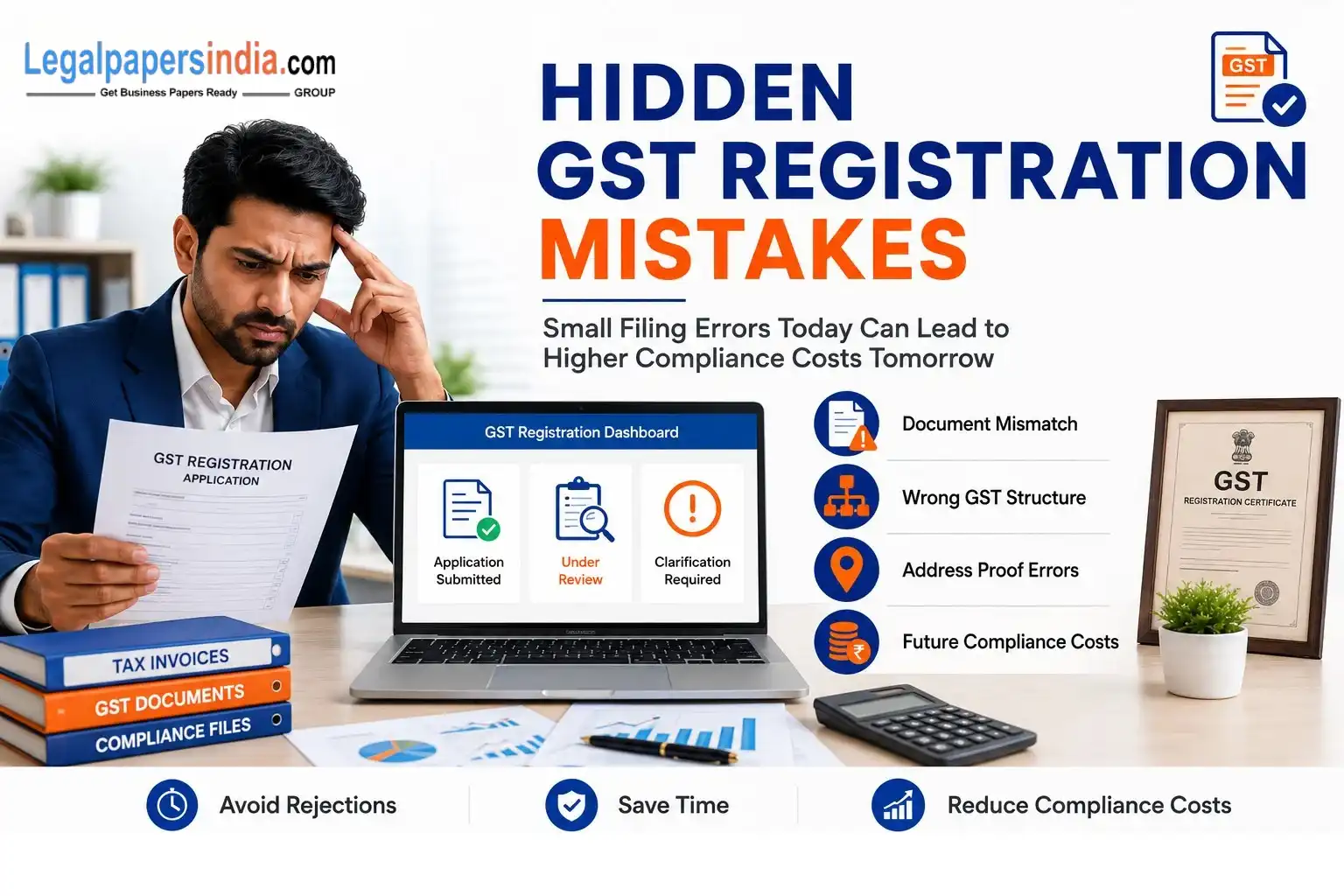
A lot of business owners assume GST registration is mostly a formality until the application gets marked for clarification or rejection because one document does not match another.
Sometimes the business address proof is outdated. Sometimes the PAN and Aadhaar details differ slightly. In other cases, people upload the wrong electricity bill, unclear rental agreement, or incomplete authorization letter.
The confusing part is that most websites oversimplify the process by saying “just submit basic documents.” In reality, the document requirement changes based on your business type, property status, and registration structure.
That is where many applicants lose time, face repeated notices, or end up paying extra for corrections later.
What Documents Are Required for GST Registration?
For most GST registration applications, the core documents include:
- PAN card of the business or applicant
- Aadhaar card
- Business address proof
- Bank account proof
- Photograph
- Business constitution documents
- Authorization proof (where applicable)
The exact documents depend on whether the applicant is a proprietorship, partnership, LLP, private limited company, freelancer, ecommerce seller, or home-based business.
Why GST Document Requirements Confuse Applicants
One reason people get confused is that GST documentation is not “one-size-fits-all.”
A freelancer working from home usually needs fewer documents than a private limited company operating from a rented office. Similarly, ecommerce sellers often face stricter scrutiny because address proof and bank details must align properly.
Another common misunderstanding is assuming that document submission alone guarantees approval. In practice, authorities also verify:
- Consistency across documents
- Business activity relevance
- Address authenticity
- Identity validation
- Digital verification readiness
That is why two businesses applying on the same day can experience very different approval timelines.
Documents Required for GST Registration Based on Business Type
Sole Proprietorship
Usually required:
- PAN card of proprietor
- Aadhaar card
- Passport-size photograph
- Bank statement or cancelled cheque
- Address proof of business place
If operating from home, residential utility bills may sometimes work as address proof depending on document consistency.
Partnership Firm
Additional documents generally include:
- Partnership deed
- PAN of partnership firm
- ID proofs of partners
- Authorization letter for authorized signatory
LLP Registration
Typically required:
- LLP incorporation certificate
- LLP agreement
- PAN of LLP
- Partner KYC documents
- Address proof of registered office
Businesses already handling compliance through services like GST registration assistance often organize these documents beforehand to avoid clarification notices.
Private Limited Company
Usually includes:
- Certificate of incorporation
- PAN of company
- MOA and AOA
- Director identity proof
- Board resolution or authorization letter
- Office address proof
Private companies often face additional verification if business activities appear high-risk or ecommerce-related.
What Determines Whether Your GST Documents Get Accepted Quickly
Many applicants think uploading “all documents” is enough. The bigger issue is document quality and consistency.
Address Match Matters More Than People Expect
A surprisingly common issue is mismatch between:
- Aadhaar address
- PAN details
- Electricity bill
- Rental agreement
- Bank account address
Even small spelling differences can trigger clarification requests.
Business Place Proof Creates Most Delays
This is where many applications slow down.
For example:
| Business Setup |
Commonly Accepted Proof |
|
Owned property |
Electricity bill/property tax receipt |
|
Rented office |
Rent agreement + utility bill |
|
Shared workspace |
NOC + utility proof |
|
Home-based business |
Residential utility bill |
People often underestimate how important the property ownership trail becomes during verification.
GST Registration Documents for Home-Based Businesses
Home-based businesses are becoming more common, especially for:
- Freelancers
- Online sellers
- Consultants
- Small service providers
- Digital agencies
In these cases, authorities may still require:
- Utility bill
- Owner consent or self-ownership proof
- Identity verification
- Business activity details
One practical issue here is that many applicants use temporary addresses or incomplete rent agreements, which can delay approval.
If your business operates across multiple locations, checking regional compliance support through the Legal Papers India service locations page can help clarify local documentation practices.
Common Document Mistakes That Trigger GST Notices
Uploading Blurry Scans
This sounds minor, but unclear PDFs remain one of the biggest causes of resubmission requests.
Using Expired Utility Bills
Many applicants upload very old electricity bills or internet bills that no longer meet recency requirements.
Wrong Bank Proof
A cancelled cheque without printed business name may not always work.
Inconsistent Business Names
This happens frequently with:
- Trade names
- Brand names
- Partnership names
- Informal business naming
Consistency across PAN, bank account, and registration details is critical.
Missing Authorization Documents
Partnerships and companies often forget board resolutions or authorization letters.
That usually leads to avoidable clarification rounds.
What Documents Are Needed for GST Registration on Rented Property?
This is one of the most searched GST questions because rented properties create extra verification layers.
Generally required:
- Rent agreement
- Utility bill of premises
- NOC from owner (in some cases)
Many businesses assume the rental agreement alone is sufficient. Often, it is not.
Authorities usually want evidence that the property is actively valid and usable for business purposes.
Do Ecommerce Sellers Need Additional GST Documents?
Often, yes.
Ecommerce sellers on marketplaces may need stronger verification because authorities closely review:
- Business activity
- Inventory location
- Address legitimacy
- Bank linkage
In practice, sellers using warehouse addresses, virtual offices, or third-party fulfillment setups should ensure documentation is extremely clear.
This is where many sellers unknowingly overspend later on corrections and compliance adjustments.
How Long Does GST Verification Take After Document Submission?
If documents are clear and properly matched, approval may happen relatively quickly.
But timelines often increase when:
- Clarification notices are issued
- Address proof mismatches appear
- Aadhaar authentication fails
- Business activity seems unclear
- Uploaded documents are incomplete
A major misconception is believing that faster filing services automatically guarantee faster approval. Actual approval depends heavily on documentation accuracy.
Hidden Problems Applicants Usually Discover Too Late
Using Personal Instead of Business Bank Details
This becomes problematic when turnover grows later.
Not Preparing Multi-State Documentation
Businesses expanding into multiple states often realize each registration may require separate address proof.
Ignoring Future Compliance Needs
Some businesses rush registration without organizing:
- Digital records
- Tax invoices
- Bank segregation
- Authorization paperwork
That creates operational confusion later.
How to Reduce GST Registration Delays and Extra Costs
A few practical steps genuinely help:
- Keep all document names identical
- Use recent utility bills
- Scan documents clearly
- Verify address consistency beforehand
- Maintain separate business banking where possible
- Avoid temporary or unverifiable addresses
One of the biggest ways businesses overspend is repeated correction handling after filing errors. Prevention is usually cheaper than post-submission fixes.
Practical GST Document Scenarios Most Businesses Face
Scenario 1: Freelancer Working From Home
Usually simpler documentation, but address consistency matters heavily.
Scenario 2: Startup Using Co-Working Space
NOC and workspace agreement become important.
Scenario 3: Ecommerce Seller Using Warehouse
Warehouse proof and operational linkage often require careful documentation.
Scenario 4: Partnership Firm Expanding States
Separate registrations may require fresh location proof in each state.
These situations explain why GST registration complexity varies widely despite many websites presenting it as a uniform process.
Decision Clarity: What Actually Matters Before Filing
Before applying, it helps to think less about “how many documents” and more about “how verifiable and consistent” those documents are.
In many cases, approval delays are not caused by missing paperwork alone. They happen because:
- The business setup is unclear
- The address trail is weak
- Supporting documents contradict each other
A well-prepared application usually saves more time than rushing submission.
Frequently Asked Questions
1. How much documentation is required for GST registration?
Most businesses need identity proof, PAN, address proof, bank proof, and business constitution documents. Additional paperwork depends on business structure, rented property status, and authorization requirements.
2. Can I use my home address for GST registration?
Yes, many freelancers and small businesses use home addresses. However, you still need valid address proof and document consistency for verification.
3. Is a rent agreement mandatory for GST registration?
If the business operates from rented premises, a rent agreement is commonly required along with utility proof and, in some situations, owner authorization.
4.What is the biggest reason GST applications get rejected?
Document mismatch is one of the most common reasons. Differences in names, addresses, unclear scans, or missing authorization documents frequently trigger clarification notices.
5. Do online sellers need different GST documents?
Ecommerce sellers may face additional scrutiny regarding warehouse details, operational address proof, and business verification consistency.
When Professional Help Makes Sense
Not every GST application requires professional assistance.
But businesses with:
- Multiple partners
- Rented commercial premises
- Ecommerce operations
- Multi-state expansion
- Complex ownership structures
often benefit from document review before submission.
This is especially true when future compliance planning matters more than just getting an application number quickly.
Businesses exploring structured compliance support can also learn more about Legal Papers India before deciding how to proceed.
Conclusion
GST registration looks straightforward on the surface, but documentation mistakes are where most delays and confusion begin.
The real challenge is rarely collecting documents. It is making sure everything aligns properly, verifies smoothly, and reflects the actual business setup.
A careful approach usually prevents unnecessary notices, repeated filings, and avoidable expenses later. If you are unsure about document suitability or business structure requirements, taking guidance before submission can save significant time and frustration.
Legal Papers India provides professional GST Registration Documents guide for Business registration services for startups and businesses across India. We assist with company incorporation, documentation, and compliance support for a smooth registration process.
Contact Legal Papers India for fast and reliable GST Registration Documents guide for business registration assistance. Our experts help with online filing, legal documentation, and business registration support.
Social Share: