
Sep 04, 2026
GST vs Composition Scheme: Which Option Actually Fits Your Business?
A lot of business owners don’t struggle with GST registration itself. The real confusion starts right after that.
You begin hearing conflicting advice:
“Take regular GST if you want to grow.”
“Composition Scheme saves tax and compliance.”
“You’ll regret choosing the wrong one later.”
And suddenly, what looked like a simple registration decision starts affecting pricing, invoices, clients, margins, and even future expansion.
If you're currently comparing GST vs Composition Scheme, you’re probably not looking for textbook definitions anymore. You want to know which option makes practical sense for your business today — without creating compliance problems six months later.
The truth is, neither option is universally “better.” The right choice depends on how your business earns, sells, scales, and operates.
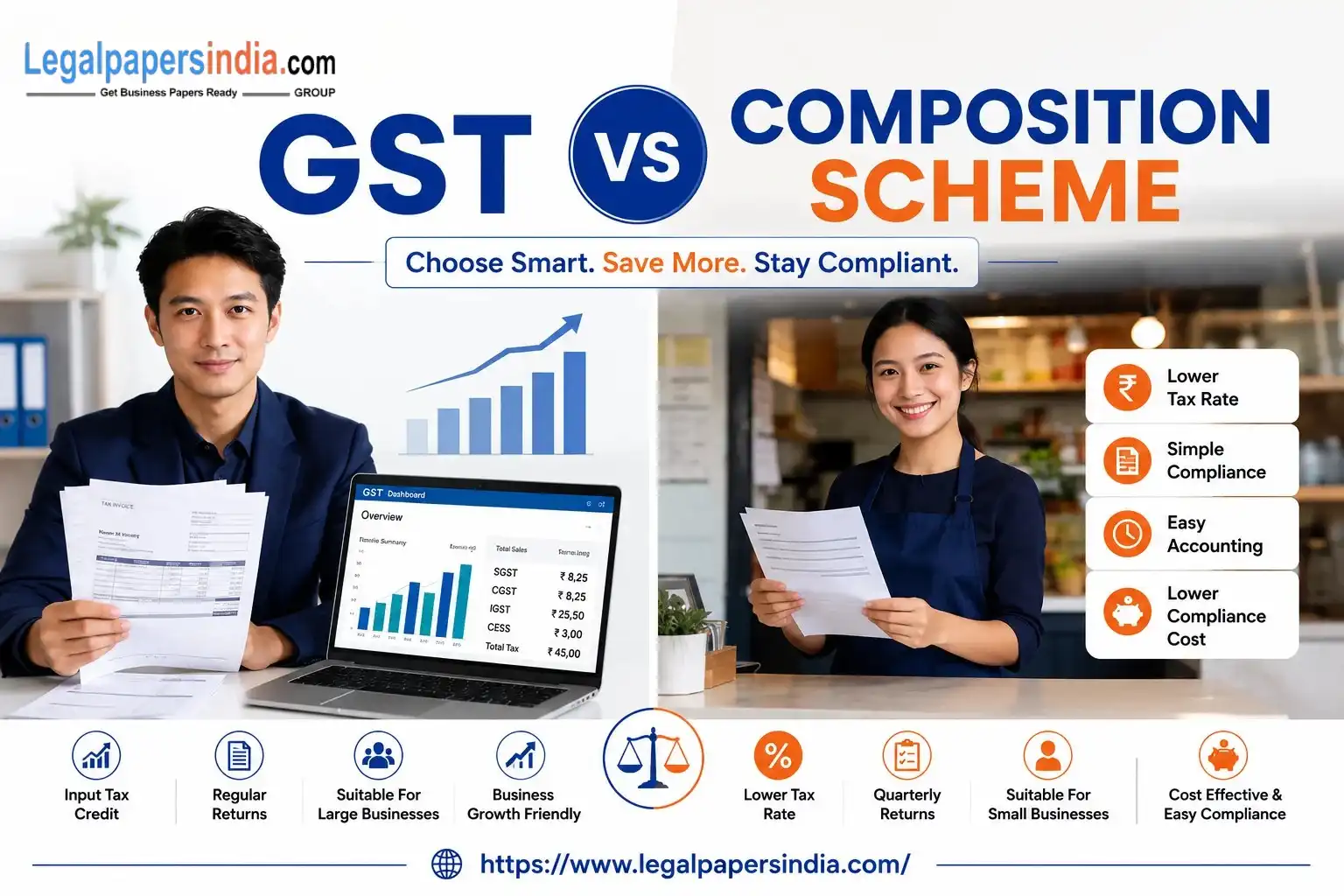
If your business mainly sells to end consumers locally, has lower turnover, and wants minimal compliance, the Composition Scheme may work well. But if you deal with B2B clients, interstate sales, e-commerce platforms, or plan to scale aggressively, regular GST registration is usually the safer long-term decision.
Who Should Choose the Composition Scheme?
The Composition Scheme tends to work best for small businesses that prioritize simplicity over input tax benefits.
You may find it suitable if:
- Your turnover falls within the prescribed eligibility limits under the Goods and Services Tax Network framework
- Most of your customers are end consumers rather than businesses
- You mainly operate within one state
- Your invoicing requirements are simple
- You want lower compliance workload
- You don’t depend heavily on claiming input tax credit
In real situations, this often suits:
- Small retail shops
- Local restaurants
- Traders with limited operational complexity
- Neighborhood manufacturers
- Small service providers qualifying under the scheme
Many first-time entrepreneurs choose Composition because monthly GST filing feels overwhelming initially. That hesitation is understandable. In the early stages, operational simplicity matters.
But simplicity only helps if it aligns with how your business actually functions.
When Regular GST Registration Makes More Sense
This is where many businesses underestimate future impact.
Regular GST registration is usually the better fit when:
- You sell interstate
- Your customers ask for tax invoices
- You work with corporate clients
- You plan to sell through e-commerce marketplaces
- Your business has significant input costs
- You want to claim input tax credit
- Expansion is likely within the next 12–24 months
A common pattern seen with growing businesses is this:
They initially choose Composition to save compliance effort, then later realize clients prefer vendors who provide full GST invoices with input tax credit benefits.
At that point, switching becomes an additional administrative step.
If your business model already leans toward scalability, regular GST registration often avoids future restructuring.
You can review the broader registration process and compliance requirements through the GST Registration Services by Legal Papers India page for additional procedural clarity.
The Real Decision Usually Comes Down to These Factors
1. Who Are Your Customers?
This single factor changes the recommendation entirely.
If your customers are mostly consumers:
Composition may help keep pricing simpler.
If your customers are businesses:
Regular GST usually becomes more practical because B2B buyers often prefer vendors who allow input tax credit claims.
Many small suppliers ignore this initially and later struggle during vendor onboarding with larger companies.
2. Are You Planning to Scale Soon?
At this stage, most business owners start wondering:
“Should I optimize for today or prepare for future growth?”
If expansion is already part of your roadmap, regular GST often creates fewer barriers later.
The Composition Scheme works best when:
- Business size remains relatively stable
- Operations stay locally focused
- Compliance simplicity matters more than tax credit flexibility
3. How Important Is Input Tax Credit to Your Margins?
This is frequently overlooked.
Under the Composition Scheme:
- You generally cannot claim input tax credit
- Customers typically cannot claim credit from your invoices
If your purchases involve substantial GST payments, regular registration may financially offset compliance costs through credit utilization.
This becomes especially important in:
- Manufacturing
- Wholesale trading
- Businesses with recurring vendor expenses
4. Will You Sell Online?
Many people realize this too late.
Businesses operating through major e-commerce platforms usually require regular GST registration. Composition taxpayers often face restrictions here.
So if online selling is even a medium-term possibility, it deserves consideration before choosing.
Decision Checklist Before You Choose
Use this as a practical evaluation filter:
Composition Scheme May Fit You If:
- You mainly sell within one state
- Your buyers are mostly consumers
- Compliance simplicity is a priority
- Your input costs are relatively low
- You don’t require complex GST invoicing
- Growth expectations are moderate
Regular GST May Be Better If:
- You work with B2B clients
- You expect turnover growth
- You want input tax credit benefits
- You plan interstate transactions
- You may enter e-commerce
- Vendor credibility matters in your industry
If you're unsure where your business falls, you're not alone. Most confusion happens because people compare tax rates without evaluating operational impact.
Cost & Compliance Considerations
Many businesses initially focus only on “lower tax.”
But the smarter question is:
“What will this cost me operationally over time?”
Composition Scheme Advantages
- Lower compliance burden
- Simplified returns
- Easier bookkeeping for smaller operations
- Reduced accounting dependency initially
Regular GST Considerations
- More detailed return filing
- Stronger documentation requirements
- Ongoing reconciliation responsibilities
However, regular GST may improve:
- Vendor acceptance
- Business credibility
- Tax credit recovery
- Expansion readiness
So the real comparison isn’t “cheap vs expensive.”
It’s:
“Simplified operations today” versus “greater flexibility later.”
Risk Factors Businesses Often Ignore
Choosing Composition Only for Lower Tax
This is one of the most common mistakes.
Businesses sometimes select the scheme assuming lower rates automatically mean higher profitability. But if customers prefer GST-credit-enabled invoices, the pricing advantage can disappear quickly.
Underestimating Future Growth
A business that starts locally may expand faster than expected.
Switching structures later is possible — but restructuring invoices, accounting processes, and vendor expectations takes effort.
Ignoring Industry Expectations
Certain sectors practically operate on regular GST norms even when small businesses technically qualify for Composition.
For example:
- B2B supply chains
- Industrial procurement
- Contract-based vendor ecosystems
In these cases, market expectations matter as much as legal eligibility.
A Practical Step-by-Step Way to Decide
Instead of rushing into registration, evaluate in this order:
Step 1: Map Your Revenue Model
Ask:
- B2B or B2C?
- Local or interstate?
- Offline or online?
Step 2: Estimate Input Expenses
Check whether losing input tax credit meaningfully affects margins.
Step 3: Assess Growth Timeline
Will your current setup still work after 12–18 months?
Step 4: Understand Industry Norms
Sometimes your market already dictates the practical answer.
Step 5: Evaluate Compliance Capacity
Can your business realistically manage regular GST filing consistently?
Common Decision-Stage Mistakes
Assuming “small business” automatically means Composition
Not always true. A fast-growing small business may benefit more from regular GST early on.
Taking advice without understanding business model fit
What worked for another business owner may not suit your operational structure.
A retailer and a B2B wholesaler face very different GST realities.
Delaying the decision entirely
Some businesses postpone registration strategy discussions until clients or vendors start demanding changes.
That usually creates unnecessary urgency later.
Real-World Scenarios That Clarify the Choice
Scenario 1: Local Retail Store
A neighborhood clothing shop selling mostly to walk-in consumers with stable local turnover may genuinely benefit from Composition due to simpler compliance.
Scenario 2: Growing Digital Electronics Supplier
A trader supplying products across multiple states and dealing with corporate buyers will usually benefit more from regular GST registration because invoice credit expectations become important.
Scenario 3: Small Manufacturer Planning Marketplace Sales
Even if current turnover is modest, future e-commerce expansion may make regular GST the smarter long-term option.
Final Decision Summary
If your business values operational simplicity, limited compliance, and mainly serves local end consumers, the Composition Scheme can work efficiently.
But if your business depends on scalability, B2B relationships, interstate operations, or tax credit optimization, regular GST registration is usually the more sustainable decision.
The important part is not choosing the “lowest tax” option.
It’s choosing the structure your business won’t outgrow too quickly.
Frequently Asked Questions
1. Is the Composition Scheme better than regular GST?
Not necessarily. The Composition Scheme works well for smaller, locally focused businesses with simpler operations. Regular GST is generally more suitable for businesses planning growth, interstate sales, or B2B transactions where input tax credit matters.
2. Can I switch from Composition Scheme to regular GST later?
Yes. Businesses can move from Composition to regular GST registration if eligibility changes or operational needs evolve. However, transitioning later may require invoice restructuring, updated compliance processes, and accounting adjustments.
3. Do B2B clients prefer regular GST registration?
In many industries, yes. Businesses often prefer suppliers who issue standard GST invoices because they can claim input tax credit. This becomes especially important in wholesale, manufacturing, and corporate procurement environments.
4. Is compliance significantly easier under the Composition Scheme?
Generally, yes. The Composition Scheme involves simpler filing and reduced compliance obligations compared to regular GST. That said, operational suitability should still outweigh compliance convenience when making the decision.
5. Who should avoid the Composition Scheme?
Businesses planning interstate trade, e-commerce selling, rapid expansion, or heavy input tax utilization should evaluate regular GST carefully before opting for Composition. In such cases, long-term operational flexibility often becomes more valuable than simplified compliance.
Conclusion
Choosing between GST and the Composition Scheme is less about tax slabs and more about business direction.
A structure that feels easier today can sometimes limit operational flexibility tomorrow. On the other hand, choosing regular GST too early without practical need may increase unnecessary compliance pressure.
The best decisions usually come from understanding how your business actually operates — not from generic advice circulating online.
If you want professional guidance tailored to your business model, you can learn more about Legal Papers India and their advisory approach or reach out through their contact page for clarity before proceeding.
Legal Papers India provides professional GST vs Composition Scheme registration services for startups and businesses across India. We assist with company incorporation, documentation, and compliance support for a smooth registration process.
Contact Legal Papers India for fast and reliable GST vs Composition Scheme registration assistance. Our experts help with online filing, legal documentation, and business registration support.
Social Share: