
Sep 04, 2026
Hidden GST Registration Mistakes That Often Lead to Extra Costs and Delays
When GST Registration Looks “Cheap” — But Ends Up Costing More Later
A lot of businesses assume GST registration is a one-time, low-cost formality. Then the unexpected starts.
Applications get rejected because of a small document mismatch. A business owner applies under the wrong category. Someone chooses a quick low-fee provider, only to discover additional charges for corrections, DSC support, or notice handling later.
The confusion usually isn’t about government fees alone. It’s about the hidden mistakes that quietly increase the real cost of GST registration.
For startups, freelancers, agencies, ecommerce sellers, and growing businesses, the bigger issue is not “How much does GST registration cost?” but “What mistakes increase compliance expenses after registration?”
Understanding those hidden errors early can prevent delays, duplicate filings, penalties, and unnecessary professional costs later.
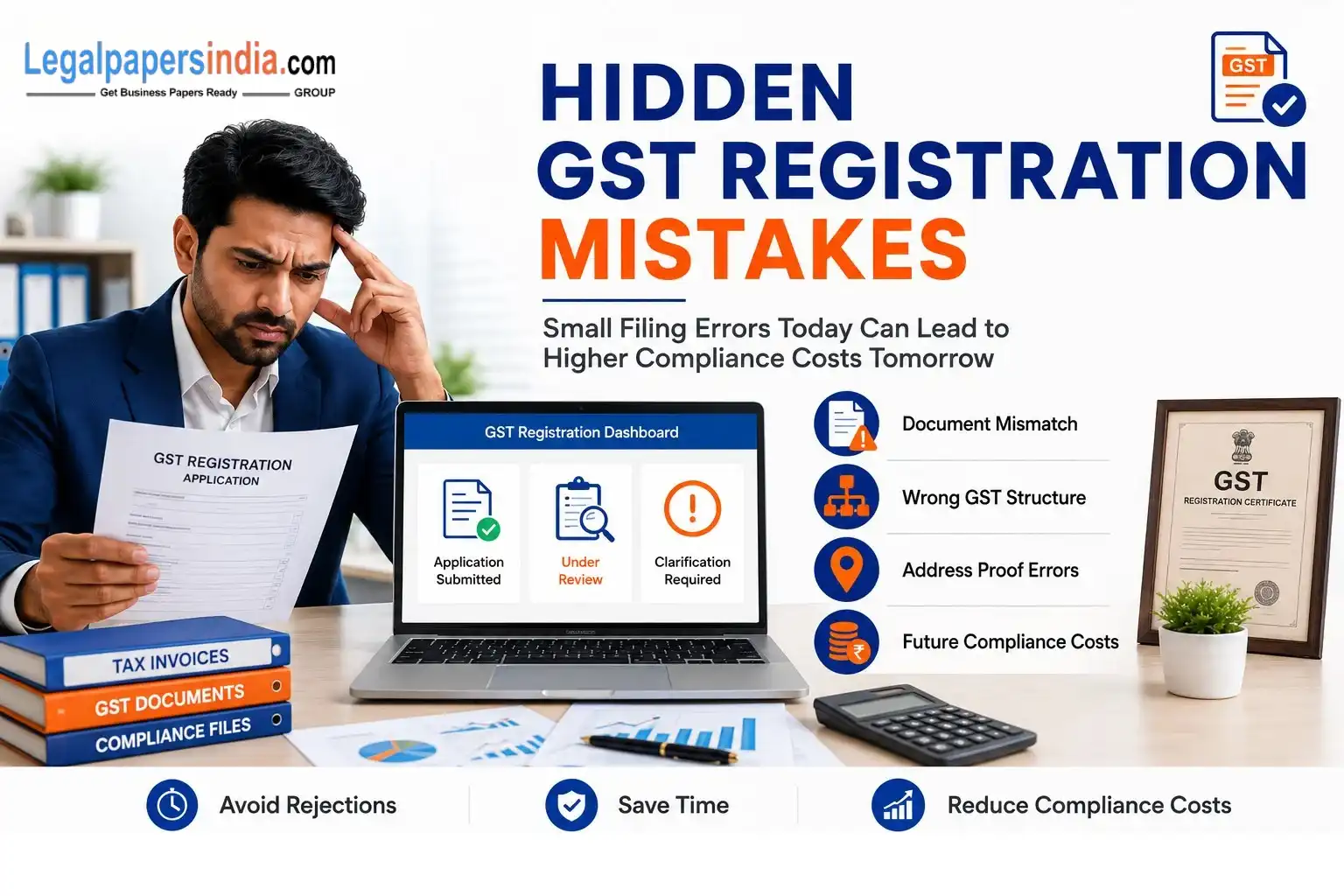
The most common GST registration mistakes include selecting the wrong business category, uploading mismatched documents, using incorrect business addresses, choosing unsuitable GST schemes, and ignoring post-registration compliance requirements.
While GST registration itself may involve minimal or no government fees in many cases, errors during filing or setup often create indirect costs through delays, correction filings, penalties, professional revisions, or compliance complications.
Why Some Businesses Face Higher GST-Related Costs Than Others
Two businesses can apply for GST registration in the same month and still experience completely different costs.
Usually, the difference comes down to preparation and registration accuracy.
Businesses that typically face higher GST-related expenses include:
- Ecommerce sellers registering without understanding interstate supply rules
- Partnership firms with incomplete documentation
- Businesses using rented premises without proper proof
- Companies applying urgently after receiving compliance notices
- Applicants selecting the wrong GST category or turnover classification
On the other hand, businesses with organized documentation and clear tax planning generally avoid repeated filing expenses and correction work.
This is one reason many applicants review provider experience and process clarity before proceeding with services like GST registration support.
What Actually Determines the Cost Impact of GST Registration Mistakes?
The “cost” of GST registration mistakes is often indirect.
Many people only calculate the initial filing expense. But in practice, the real financial impact usually comes from:
1. Application Rejections
Incorrect or unclear submissions may require:
- Refiling
- Additional documentation
- Professional revision support
- Delayed business onboarding
This becomes especially expensive for businesses waiting for:
- Vendor approvals
- Marketplace activation
- Tax invoices
- Corporate contracts
2. Wrong GST Structure Selection
One of the most overlooked issues is choosing the wrong registration type.
Examples include:
- Opting for composition scheme when interstate supply exists
- Registering as proprietorship instead of LLP/company alignment
- Using incorrect HSN/SAC categorization
Fixing structural errors later can involve:
- Amendment filings
- Professional consultation
- Compliance restructuring
3. Compliance Misunderstanding
Many businesses underestimate ongoing obligations after GST registration.
The registration itself may not be the expensive part. Monthly filings, NIL returns, invoice matching, and notice responses often create recurring costs when ignored initially.
Cost Breakdown: Where Hidden Expenses Usually Appear
Here’s where businesses commonly experience avoidable GST-related spending.
| Cost Area |
How Hidden Mistakes Increase Expense |
|
Documentation |
Incorrect address proof or ID mismatch causes rejection |
|
Digital Signature |
Last-minute DSC setup charges during urgent filing |
|
Professional Corrections |
Amendments after incorrect registration |
|
Delayed Approval |
Lost business opportunities during waiting period |
|
Compliance Penalties |
Missing post-registration filing obligations |
|
Notice Handling |
Professional fees for GST clarification responses |
|
Wrong Tax Structure |
Additional advisory and restructuring costs |
One practical observation: businesses often focus heavily on the lowest filing price while ignoring future correction costs. In many cases, cheap filing becomes expensive rectification later.
Typical GST Registration Cost Expectations
GST registration costs vary depending on:
- Business structure
- Documentation readiness
- State requirements
- Professional assistance level
- Urgency
- Additional compliance support
Some businesses only need basic filing assistance.
Others may require:
- DSC setup
- Multi-state guidance
- Ecommerce GST consultation
- Amendment handling
- Compliance advisory
This is why pricing differences between service providers can appear significant.
A very low-cost offer may exclude:
- Follow-up notices
- ARN tracking
- Re-submission handling
- Consultation
- Post-registration guidance
Meanwhile, more comprehensive assistance may include documentation review and compliance clarity that reduces future correction expenses.
Different Business Situations Create Different Cost Scenarios
Small Freelancers or Consultants
Usually simpler registrations if:
- Single location
- Clear ID proof
- Basic service billing
Costs may increase if:
- Home address documentation is incomplete
- Bank details mismatch
- Multiple service categories exist
Ecommerce Sellers
This category commonly faces hidden complications.
Additional costs may arise from:
- Interstate supply confusion
- Marketplace GST requirements
- Product classification errors
- Multiple warehouse registrations
Partnership Firms and LLPs
These structures often require:
- Partnership deeds
- Authorization letters
- PAN alignment
- Proper business proof
Minor inconsistencies here frequently delay approval.
Businesses Applying Urgently
Urgent GST applications often cost more because:
- Documentation preparation becomes rushed
- Corrections are more likely
- Professional intervention increases
Many businesses apply only after clients request GST invoices, which creates unnecessary pressure.
Hidden or Additional Costs Businesses Often Miss
GST Amendments Later
Businesses sometimes:
- Change addresses
- Update mobile numbers
- Modify trade names
- Add business activities
These changes may involve additional professional support if the original setup was inaccurate.
NIL Return Penalties
One of the biggest misconceptions:
“Unused GST numbers don’t require filing.”
Even inactive GST registrations can trigger filing obligations.
Missed returns may lead to:
- Late fees
- Compliance notices
- Registration suspension
Improper Vendor Advice
Some applicants rely entirely on unverified agents offering unusually low pricing without explaining compliance responsibilities.
This often results in:
- Incomplete registrations
- Incorrect filings
- Poor notice management
That’s why businesses increasingly compare process transparency instead of only comparing upfront pricing.
How Businesses Can Reduce Unnecessary GST-Related Costs
A few practical steps can significantly reduce future expenses.
Verify Documents Before Filing
Double-check:
- PAN spelling
- Address consistency
- Electricity bills
- Rent agreements
- Bank proof
Most delays start with small mismatches.
Understand Your Business Model Properly
Before registration, clarify:
- Interstate sales
- Ecommerce involvement
- Service categories
- Estimated turnover
This helps avoid incorrect GST structure selection.
Ask What the Service Actually Includes
Before choosing a provider, ask:
- Are corrections included?
- Is notice support available?
- Is consultation included?
- Are post-registration filings explained?
This prevents pricing misunderstandings later.
Businesses exploring state-wise operational support sometimes also review service accessibility through pages like regional service coverage when multi-location assistance becomes relevant.
Common Hidden GST Registration Mistakes That Increase Overall Expense
Choosing the Wrong Business Address
Using an address without proper proof is one of the most frequent rejection causes.
Especially common with:
- Shared offices
- Residential premises
- Virtual offices
Ignoring Future Compliance While Registering
Some applicants only focus on obtaining the GST number quickly.
But registration creates ongoing responsibilities.
Ignoring this leads to:
- Filing penalties
- Compliance confusion
- Professional correction costs
Applying Without Turnover Planning
Businesses close to threshold limits sometimes register without understanding:
- Tax collection implications
- Pricing impact
- Input credit handling
This can affect cash flow later.
Selecting Providers Only on Lowest Price
This is extremely common.
Low-cost filing services may not include:
- Clarification handling
- Follow-up support
- Compliance guidance
- Amendment assistance
The result is often fragmented support and additional spending later.
Practical Examples That Reflect Real-World Cost Problems
Example 1: Ecommerce Seller Delay
A new seller registered quickly using incomplete warehouse documentation.
Result:
- GST application clarification notice
- Marketplace onboarding delay
- Additional professional correction fees
The initial “cheap registration” ended up delaying business launch by weeks.
Example 2: Freelancer with Wrong Service Category
A consultant selected an incorrect service classification during application.
Later consequences included:
- Invoice confusion
- Advisory costs
- Amendment filing support
Example 3: Dormant GST Registration
A small business stopped operations temporarily but ignored NIL return filing.
Months later:
- Late fees accumulated
- GST status complications emerged
- Professional reactivation support became necessary
Decision Clarity: What Matters More Than the Lowest GST Filing Price?
The smartest GST-related decisions usually come from asking:
- Will this registration structure still work six months later?
- Is the documentation accurate enough to avoid rejection?
- Does the provider explain compliance responsibilities clearly?
- Are future correction costs likely?
A slightly more careful registration process often costs less overall than repeated amendments, notices, and compliance confusion later.
That balance between initial affordability and long-term clarity matters more than promotional “lowest price” claims.
Frequently Asked Questions
1. How much does GST registration usually cost?
GST registration costs vary based on business structure, professional support level, documentation complexity, and additional services. While government fees may be minimal in many standard cases, businesses often incur indirect costs through corrections, amendments, compliance support, or delayed approvals if mistakes occur during filing.
2. What is the most common GST registration mistake?
Document mismatch is one of the most common problems. Differences in address proof, PAN details, business names, or bank information frequently trigger clarification notices or application rejection.
3. Can wrong GST registration increase future compliance costs?
Yes. Selecting the wrong GST structure, scheme, or business classification can create future filing complications, amendment expenses, tax confusion, and additional professional advisory costs.
4. Do inactive GST registrations still require filing?
In many situations, yes. Even if business activity is low or temporarily inactive, required GST returns may still need to be filed. Ignoring this can result in penalties and notices.
5. Is the cheapest GST registration service always better?
Not necessarily. Very low-cost services sometimes exclude correction handling, consultation, notice response support, or compliance guidance. Businesses should compare both pricing and support scope before deciding.
When Professional Guidance Makes Sense
Professional GST assistance becomes more valuable when:
- Ecommerce operations are involved
- Multiple states are relevant
- Business structures are complex
- Documentation inconsistencies exist
- Urgent approvals are needed
The goal should not simply be “getting GST registered.”
It should be getting registered correctly, with fewer future complications.
Businesses evaluating experienced compliance-oriented support often prefer reviewing the background and process approach of firms like Legal Papers India before making decisions.
Conclusion
GST registration itself may appear straightforward, but the hidden mistakes around documentation, structure selection, compliance planning, and rushed applications are what usually increase the real cost later.
Most businesses don’t overspend because GST is expensive. They overspend because small registration errors create avoidable corrections, delays, and compliance problems afterward.
A clearer understanding of the process — along with realistic expectations about pricing, support, and ongoing obligations — helps businesses make more confident and cost-efficient decisions from the beginning.
If you’re evaluating GST registration options, it’s worth comparing not just pricing, but also process transparency, support quality, and long-term compliance clarity before proceeding.
Legal Papers India provides professional Hidden GST Registration Mistake registration services for startups and businesses across India. We assist with company incorporation, documentation, and compliance support for a smooth registration process.
Contact Legal Papers India for fast and reliable Hidden GST Registration Mistake registration assistance. Our experts help with online filing, legal documentation, and business registration support.
Social Share: