
Sep 04, 2026
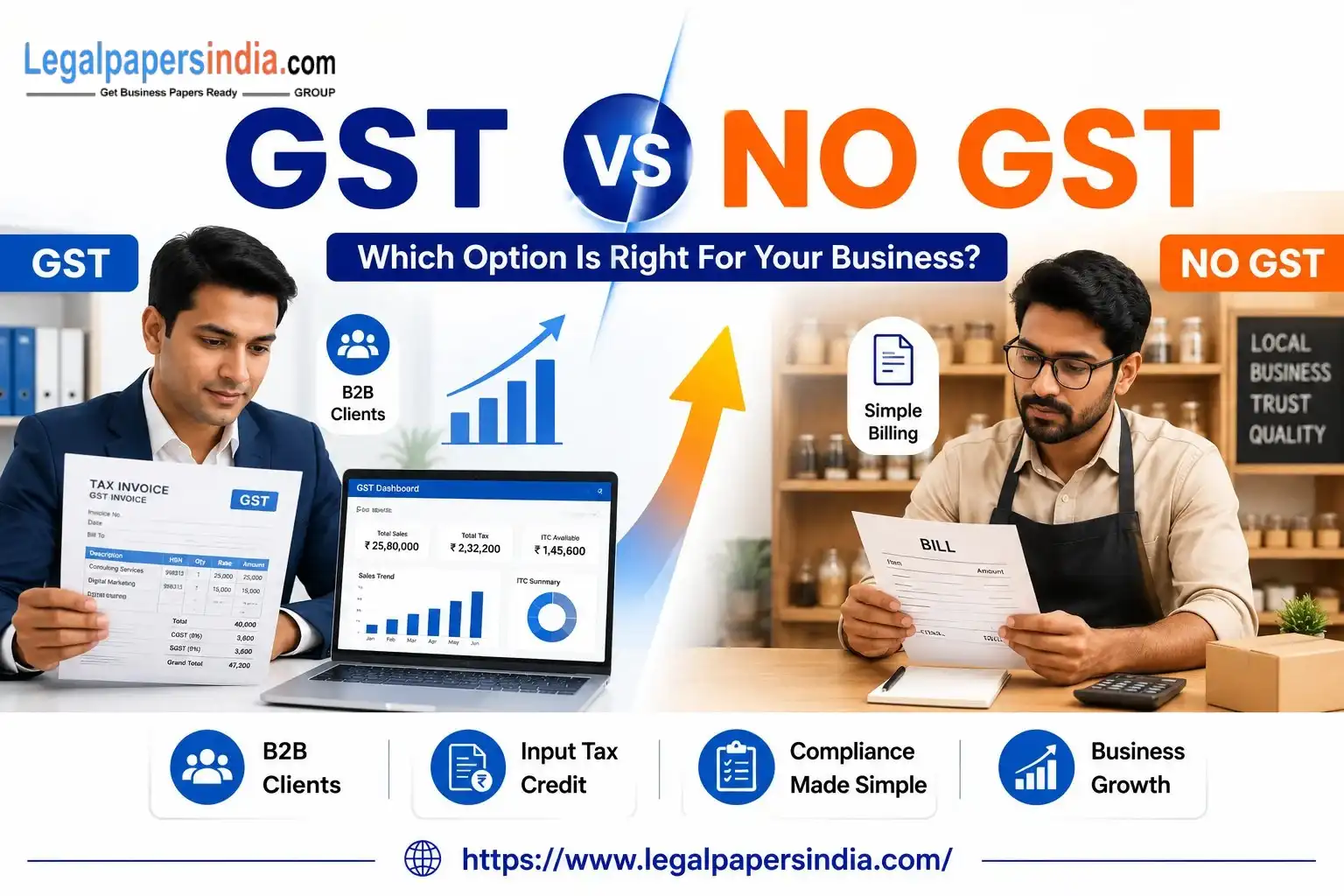
GST vs No GST ? What to Choose
You’ve probably reached the stage where the confusion stops being theoretical and starts affecting actual business decisions.
A freelancer crosses a certain income mark and suddenly wonders whether clients will start asking for GST invoices. A small seller on marketplaces gets told GST is “mandatory.” A local service provider hears that staying outside GST saves compliance headaches — but then worries about losing larger clients.
That’s usually where the real question begins:
Is GST registration actually beneficial for your situation, or will it create unnecessary compliance and cost?
The answer is not the same for everyone. In practice, the right decision depends less on “business size” and more on how your business operates, who your customers are, how you plan to grow, and whether compliance flexibility matters more than input tax advantages.
If you're unsure whether GST registration is genuinely necessary or just something people recommend by default, you're not alone. Many businesses delay the decision because they don’t fully understand the trade-offs involved.
This guide breaks down the practical side of choosing GST vs no GST — not just the legal threshold conversation.
If your business deals with B2B clients, interstate sales, e-commerce platforms, or long-term scaling plans, GST registration usually becomes strategically useful even before it becomes legally mandatory. On the other hand, small local businesses with limited turnover and minimal compliance capacity may benefit from staying outside GST until registration becomes commercially necessary.
When Choosing GST Usually Makes Sense
There’s a common pattern seen in growing businesses:
They initially avoid GST to reduce compliance work, but later realize the absence of GST starts creating operational limitations.
You should seriously consider GST registration if:
- Your clients ask for GST invoices
- You work with companies rather than individual consumers
- You sell through Amazon, Flipkart, or similar marketplaces
- You operate across multiple states
- You want to claim input tax credit
- You expect turnover growth soon
- Your industry already functions within GST billing norms
- You want better vendor credibility during procurement discussions
For example:
A graphic designer earning below the mandatory threshold may still choose GST registration because corporate clients prefer working with registered vendors. Without GST invoices, payment approvals sometimes get delayed internally within client organizations.
Similarly, many startups register early simply because future compliance transitions become smoother.
At this stage, most businesses are not choosing GST because of tax alone. They are choosing operational compatibility.
If you are evaluating registration eligibility or process requirements, the GST Registration service page explains the procedural side in more detail.
When Staying Without GST May Be Better
Not every business benefits from early GST registration.
In fact, some businesses create avoidable compliance pressure by registering too early without operational need.
You may prefer staying outside GST if:
- Your turnover is comfortably below threshold limits
- Your customers are mostly local end consumers
- You do not require input tax credits
- You operate with very low margins
- Your business activity is occasional or experimental
- You want minimal filing responsibilities initially
- Your sector does not heavily depend on tax invoice chains
A local home bakery selling directly within one city is a good example.
If most customers are individual consumers rather than businesses, GST registration may not significantly improve revenue opportunities immediately.
Another practical factor people underestimate:
Once registered, even low-activity businesses must continue periodic compliance filings. That ongoing responsibility matters more than many first-time business owners expect.
Who Usually Regrets Delaying GST Registration
Interestingly, the businesses that struggle most are not always the smallest ones.
The more difficult situations usually involve businesses that:
- Cross turnover limits suddenly
- Begin interstate transactions without realizing implications
- Join e-commerce platforms late
- Lose contracts because they cannot issue GST invoices
- Miss claiming substantial input tax credits
One recurring issue appears in service businesses.
A consultant may initially avoid GST because turnover is below threshold. Later, a large corporate client requires GST-compliant invoicing, and the business scrambles to register quickly while fixing earlier billing structures.
That transition becomes messy when growth arrives unexpectedly.
Key Decision Criteria Before You Choose
Instead of asking “Should I take GST?” ask yourself these questions first:
Business Structure Checklist
- Are your customers businesses or consumers?
- Will clients expect GST invoices?
- Are you planning interstate sales?
- Do vendors charge you GST regularly?
- Will input tax credit materially help profitability?
- Are you joining online marketplaces?
- Is growth expected within 6–12 months?
- Can you handle ongoing filing compliance?
- Does your industry commonly operate with GST registration?
If most answers lean toward “yes,” GST registration is usually the practical choice.
If most answers lean toward “no,” waiting may still be reasonable.
Cost & Compliance Considerations Most People Ignore
People often compare GST only from a taxation perspective.
But operational compliance is the real consideration.
With GST Registration
You may need:
- Monthly or quarterly return filing
- Invoice standardization
- Proper bookkeeping
- Vendor reconciliation
- Timely compliance tracking
- Possible professional assistance
Without GST Registration
You avoid:
- Routine filing obligations
- Compliance maintenance costs
- Input tax reporting complexity
But you may also face:
- Reduced business credibility in B2B sectors
- Inability to claim input tax credit
- Limited marketplace participation
- Procurement disadvantages
This is where decision-stage hesitation becomes valid.
Some businesses save short-term compliance effort by avoiding GST, but unintentionally limit commercial scalability.
Others register too early and struggle with unnecessary compliance before stable revenue arrives.
The right decision usually balances operational maturity with future growth plans.
Do You Need Trademark Along With GST?
This question comes up surprisingly often.
The short answer:
No, trademark registration is not mandatory for GST registration.
GST and trademark serve completely different purposes.
- GST registration handles tax compliance.
- Trademark registration protects your brand identity, business name, logo, or slogan.
However, businesses planning long-term branding often apply for trademark protection early — especially if:
- They sell online
- They are building a recognizable brand
- Packaging or advertising is involved
- Expansion is planned
For example, a local reseller may not urgently need trademark protection. But a growing skincare brand, food label, coaching brand, or apparel company usually should not delay trademark filing for too long.
A common mistake is assuming GST ownership automatically protects a brand name. It does not.
Risk Factors to Evaluate Before Deciding
1. Sudden Turnover Growth
Many businesses underestimate growth speed.
Crossing GST thresholds without preparation can create retrospective compliance complications.
2. Client Restrictions
Some companies avoid onboarding unregistered vendors entirely.
This especially affects consultants, agencies, contractors, and suppliers.
3. Marketplace Dependency
Most e-commerce ecosystems heavily favor GST-registered sellers operationally.
4. Documentation Gaps
Businesses avoiding GST often become less disciplined with accounting initially, which later creates tax and reconciliation difficulties.
A Practical Action Plan
If you are still undecided, this phased approach works well for many businesses.
Step 1: Evaluate Current Turnover
Check whether you are nearing mandatory registration thresholds.
Step 2: Review Customer Type
B2B-heavy businesses generally benefit earlier from GST registration.
Step 3: Estimate Compliance Comfort
Can you realistically maintain filing discipline?
Step 4: Assess Future Growth
Will your business likely scale within the next year?
Step 5: Review Vendor Tax Exposure
If you already pay substantial GST on purchases, input credit may justify registration.
Step 6: Take Professional Guidance Before Structuring
Many businesses make structural mistakes early that later affect compliance efficiency.
The team behind Legal Papers India regularly assists businesses in evaluating whether GST registration is commercially practical or legally necessary based on actual operational models rather than generic assumptions.
Common Decision-Stage Mistakes
Registering Just Because “Everyone Else Has GST”
Business suitability matters more than trends.
Avoiding GST Purely Out of Fear
Compliance feels intimidating initially, but manageable systems reduce long-term difficulty.
Ignoring Interstate Supply Rules
Many service providers unintentionally trigger GST applicability through interstate transactions.
Delaying Registration Until Clients Pressure You
Reactive compliance often creates rushed documentation issues.
Confusing GST With Brand Protection
GST does not secure business name ownership. Trademark protection is separate.
Practical Scenarios That Clarify the Decision
Scenario 1: Freelance Digital Marketer
- Works with startups across India
- Clients request GST invoices
- Plans agency expansion
GST registration is usually beneficial here.
Scenario 2: Small Local Boutique
- Operates within one locality
- Limited turnover
- Mostly walk-in retail customers
Remaining outside GST may still work initially.
Scenario 3: Amazon Seller Launching New Brand
- Sells interstate
- Pays GST on inventory purchases
- Building a long-term product brand
GST registration becomes strategically important early.
Trademark filing may also become relevant.
Scenario 4: Consultant Testing a Side Business
- Inconsistent income
- No fixed commercial structure yet
- Minimal business expenses
Waiting before registration may be reasonable unless threshold or client requirements apply.
Final Decision Summary
Choosing between GST vs no GST is rarely just a legal threshold decision.
It’s really a question of:
- business maturity,
- operational readiness,
- customer expectations,
- and future scalability.
If your business interacts with corporate clients, interstate transactions, online marketplaces, or growth-oriented operations, GST registration usually becomes beneficial earlier than expected.
If your business remains small, local, low-compliance, and consumer-focused, delaying registration may still be practical — at least temporarily.
The key is avoiding emotional or trend-driven decisions.
A thoughtful decision now usually prevents unnecessary restructuring later.
Frequently Asked Questions
1. Is GST registration compulsory for small businesses?
Not always. Businesses below prescribed turnover thresholds may not require GST registration unless specific conditions apply, such as interstate supply, e-commerce selling, or category-based mandatory registration requirements.
2. Is it better to take GST voluntarily?
Voluntary GST registration can help businesses working with B2B clients, marketplaces, or growth-focused operations. It improves invoice compatibility and allows input tax credit claims, but also increases compliance responsibilities.
3. Can I run a business legally without GST?
Yes, if your business falls below mandatory registration thresholds and does not trigger compulsory registration conditions. Many small local businesses legally operate without GST initially.
4. Do I need trademark registration before GST registration?
No. Trademark registration is not required for GST registration. Trademark protects your brand identity, while GST handles tax compliance and invoicing obligations.
5. Which is better for freelancers: GST or no GST?
For freelancers working with companies or interstate clients, GST registration often becomes commercially useful even before mandatory thresholds apply. For occasional or low-revenue freelance work, staying outside GST may still be practical initially.
Conclusion
If you're currently stuck between “Should I register now?” and “Can I wait a little longer?”, that hesitation is actually reasonable.
GST registration should support the way your business operates — not complicate it unnecessarily.
The smartest approach is usually not the earliest registration or the latest possible delay. It’s choosing the point where compliance aligns naturally with business growth, client expectations, and operational stability.
If you want clearer guidance based on your specific business model, transaction type, or future expansion plans, reviewing your situation with professionals before making the decision can save considerable restructuring effort later.
Legal Papers India provides professional GST vs No GST registration services for startups and businesses across India. We assist with company incorporation, documentation, and compliance support for a smooth registration process.
Contact Legal Papers India for fast and reliable GST vs No GST registration assistance. Our experts help with online filing, legal documentation, and business registration support.
Social Share: