
Sep 04, 2026
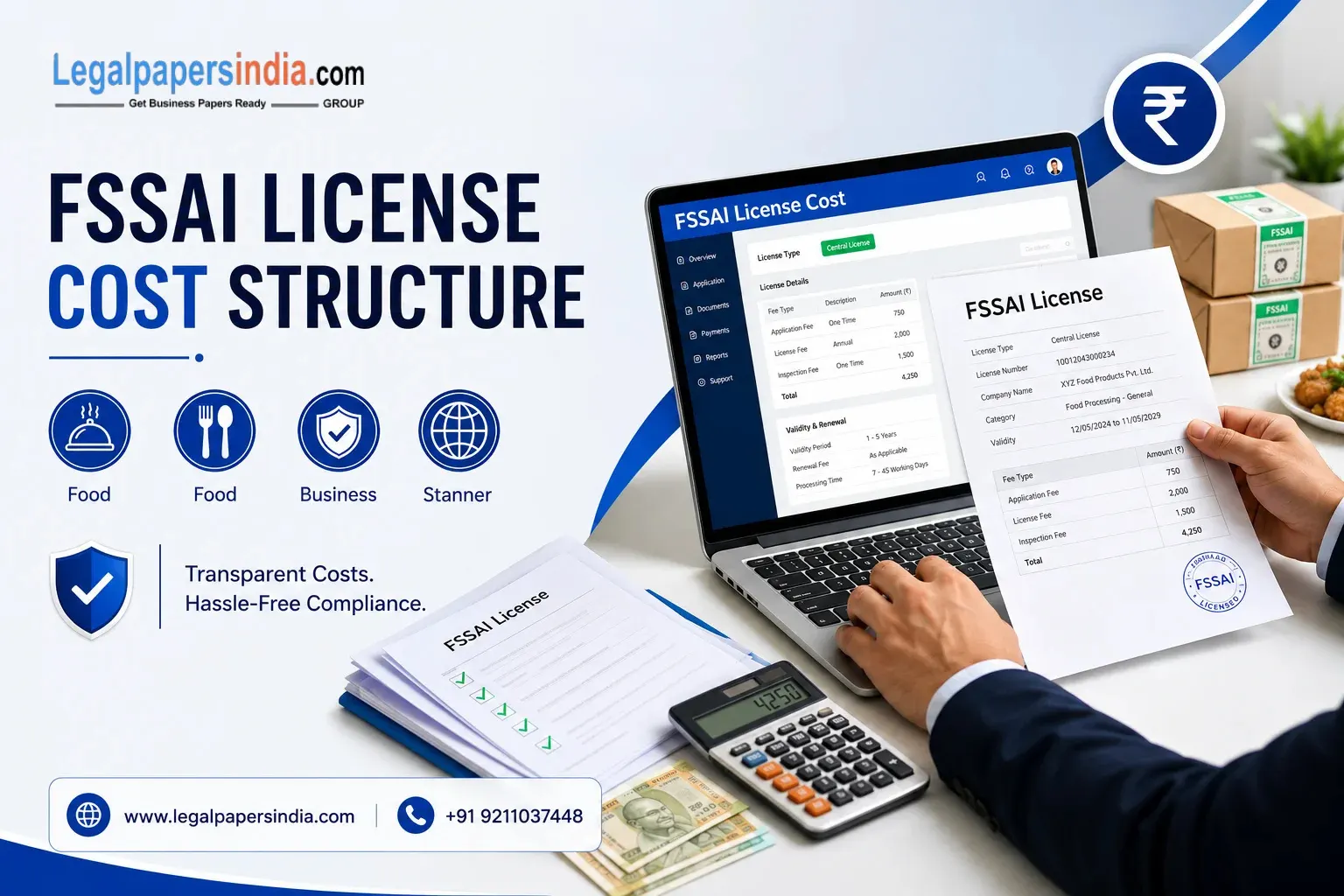
FSSAI License Cost Structure
Why Do FSSAI License Costs Vary So Much?
Many food business owners start searching for FSSAI registration expecting a fixed government fee, only to discover wildly different price quotes from consultants, agents, and online platforms.
One provider says the process is “almost free,” while another shares a package costing several thousand rupees. That confusion usually comes from mixing up government fees, professional assistance charges, documentation support, and license category requirements.
The reality is that FSSAI license cost depends less on a “standard price” and more on your business type, turnover, operational scale, and whether mistakes during filing create delays or reapplications.
For small home kitchens or startups, costs can stay relatively low. But for manufacturers, cloud kitchens, importers, or multi-state operators, compliance complexity increases quickly. Many businesses also underestimate indirect expenses like documentation corrections, product category classification, or renewal-related penalties.
Understanding the actual cost structure helps avoid both overpaying and under-budgeting.
What Is the FSSAI License Cost Structure?
FSSAI license cost generally includes government fees, documentation preparation, professional assistance charges, and renewal expenses. Small businesses applying for Basic Registration usually pay significantly less than manufacturers, importers, or large food brands requiring State or Central Licenses. Final cost depends on turnover, business category, operational scale, and filing complexity.
Who Should Consider Different FSSAI Cost Ranges?
Not every business needs the same type of registration, and this is where many businesses overspend unnecessarily.
Businesses Usually Eligible for Lower-Cost Registration
These businesses often qualify for Basic Registration:
- Home bakers
- Small food stalls
- Local snack vendors
- Home-based pickle businesses
- Small café startups
- Tiny cloud kitchens with limited turnover
For these businesses, costs remain relatively manageable because compliance requirements are simpler.
Businesses That Should Expect Higher Compliance Costs
Higher licensing and compliance costs are more common for:
- Food manufacturers
- Exporters and importers
- Multi-city food chains
- Large restaurants
- Warehousing businesses
- Packaged food brands
- Businesses selling across states
In such cases, documentation scrutiny and operational verification become more detailed.
What Determines the Cost of FSSAI Registration?
Several factors influence pricing, and many are operational rather than purely administrative.
1. Type of FSSAI License
FSSAI registration falls into three major categories:
- Basic Registration
- State License
- Central License
The higher the operational scale, the higher the compliance burden and associated cost.
2. Annual Turnover
Turnover directly affects license category eligibility. Businesses crossing prescribed turnover thresholds often move from Basic Registration to State or Central licensing.
This transition increases documentation requirements and professional compliance support.
3. Nature of Food Activity
A food reseller may face lower complexity than:
- Manufacturers
- Repackagers
- Meat processors
- Dairy businesses
- Importers
Some categories require additional declarations, layout details, or technical documentation.
4. Number of Business Locations
Single-location businesses are easier to process compared to:
- Franchise models
- Multiple outlets
- Central kitchens
- Warehousing networks
Each operational location can add documentation and coordination effort.
5. Urgency of Filing
Urgent filings often increase professional service costs because consultants prioritize documentation review and rapid corrections.
This is one area where businesses sometimes unknowingly overpay.
Understanding the Cost Breakdown
When people hear “FSSAI registration fees,” they often assume it means only government charges. In reality, the total expense may include several layers.
Government Fees
Government fees vary depending on:
- License category
- Validity period
- Business scale
Basic registrations generally involve lower statutory fees compared to Central Licenses.
Professional or Consultant Charges
Professional support may include:
- Application drafting
- Documentation verification
- Business category selection
- Follow-up responses
- Correction handling
Consultant fees differ significantly based on experience and service scope.
Documentation Preparation Costs
Some businesses need:
- NOC drafting
- Rent agreement updates
- Food safety declarations
- Layout plan preparation
These indirect expenses are often overlooked initially.
Renewal Costs
FSSAI licenses are not one-time approvals forever.
Renewals may involve:
- Updated documentation
- Compliance review
- Additional filings
- Delayed renewal penalties
Businesses that ignore renewal timelines often spend more later.
Typical FSSAI License Price Range Explained Safely
There is no universal fixed price applicable to every food business.
However, generally speaking:
- Basic Registration usually remains at the lower end of the pricing spectrum
- State License applications involve moderate compliance and documentation expenses
- Central Licenses often cost more due to complexity and operational scrutiny
The difference between a low-cost and high-cost filing is rarely just the government fee. It usually comes from:
- Incorrect filing corrections
- Business category confusion
- Multiple revisions
- Delayed approvals
- Additional compliance assistance
This is why two businesses can receive very different quotations for seemingly similar registrations.
Cost Based on Different Business Scenarios
Small Home-Based Food Business
A home baker operating locally may only need Basic Registration with limited documentation.
Costs typically remain lower because:
- Operational risk is limited
- Inspection requirements are minimal
- Compliance structure is simpler
Cloud Kitchen Startup
Cloud kitchens often face moderate compliance costs because:
- Kitchen setup verification matters
- Food handling standards apply
- Commercial documentation may be required
Many first-time founders underestimate these compliance requirements.
Restaurant Expanding Across Cities
A growing restaurant brand may need:
- Multiple licenses
- Centralized compliance coordination
- State-specific operational filings
This naturally increases overall registration and management costs.
Food Manufacturing Unit
Manufacturers generally face higher costs due to:
- Production-related scrutiny
- Technical compliance
- Safety documentation
- Infrastructure verification
These businesses should prioritize accuracy over “lowest-cost filing.”
Hidden or Additional Costs Businesses Often Miss
This is where confusion usually starts.
Many advertisements promote “cheap FSSAI registration,” but businesses later discover additional charges.
Common overlooked expenses include:
- Application correction fees
- Renewal delays
- Document rework
- Digital signature support
- Address proof mismatch corrections
- Professional response drafting during objections
Some businesses also spend extra because they apply under the wrong category initially.
A surprisingly common mistake is choosing Basic Registration simply to reduce cost, even when turnover or operations require a higher license category.
That short-term saving often creates bigger compliance costs later.
How to Reduce FSSAI Registration Costs Without Taking Risks
Trying to minimize costs is reasonable. But choosing the cheapest option blindly often creates more problems.
Keep Documentation Accurate
Incorrect business names, mismatched addresses, or missing declarations frequently delay approvals.
Correction cycles increase both time and cost.
Apply Under the Correct License Category
Over-licensing increases unnecessary compliance expenses.
Under-licensing can create regulatory issues later.
Avoid Last-Minute Renewals
Delayed renewals may attract penalties or operational interruptions.
Clarify Scope Before Hiring Consultants
Ask providers:
- What is included?
- Are revisions covered?
- Does pricing include government fees?
- Are renewal reminders provided?
Many businesses assume everything is bundled when it is not.
If you're evaluating different registration pathways, understanding the compliance process through the FSSAI Basic Registration service page can help clarify which category may apply to your business structure.
Common Mistakes That Increase FSSAI Licensing Costs
Choosing Providers Only Based on Lowest Price
Very low pricing often excludes:
- Documentation assistance
- Objection handling
- Follow-up support
Businesses later end up paying separately for corrections.
Ignoring Future Scalability
A business expecting rapid expansion should plan licensing accordingly.
Repeated upgrades can create avoidable administrative expenses.
Misclassifying Food Category
Incorrect classification delays approvals and sometimes triggers reapplication.
Waiting Until Operations Start
Some businesses begin operations before compliance completion, leading to rushed processing and avoidable urgency costs.
Practical Cost Examples for Better Understanding
Example 1: Home Snack Seller
A local homemade snacks business with limited turnover may only require Basic Registration and simple documentation.
Costs remain relatively controlled if documents are already organized.
Example 2: Packaged Food Startup
A startup launching packaged products online may require:
- Product category mapping
- Label compliance review
- State License documentation
Here, compliance assistance becomes more important than just filing.
Example 3: Import-Based Food Brand
Importers usually face higher compliance complexity because import documentation, operational scope, and food category scrutiny are stricter.
In these cases, businesses paying slightly more for experienced assistance often avoid expensive future corrections.
Frequently Asked Questions
1. How much does it cost to get an FSSAI license?
The total cost depends on your license category, turnover, business activity, and whether you use professional assistance. Small businesses usually pay less than manufacturers, importers, or multi-location food operators.
2. Why do consultant charges for FSSAI registration vary so much?
Pricing differences usually come from service scope. Some providers only file applications, while others handle documentation review, corrections, follow-ups, and compliance guidance.
3. Is FSSAI Basic Registration cheaper than a State License?
Yes. Basic Registration generally involves lower government fees and simpler documentation requirements compared to State or Central Licenses.
4. Can incorrect filing increase FSSAI registration cost?
Yes. Incorrect business category selection, documentation mismatches, or application errors can lead to rework, delays, or fresh filings.
5. Do I need professional help for FSSAI registration?
Not always. Very small businesses with straightforward documentation may handle the process independently. However, businesses with manufacturing, import, or multi-location operations often benefit from professional compliance support.
Turning Cost Understanding Into a Better Decision
The goal is not simply finding the cheapest FSSAI registration option.
The better approach is understanding:
- Which license category actually applies
- What support is included
- Whether the filing will remain compliant as your business grows
- What risks come from incomplete or incorrect registration
A lower upfront price sometimes becomes more expensive when corrections, delays, or renewals are handled poorly.
On the other hand, not every business needs premium compliance packages either.
The right balance depends on operational complexity, not marketing claims.
When Professional Assistance Starts Making Sense
Professional support becomes more valuable when:
- Your business has multiple food categories
- Manufacturing is involved
- Import/export operations exist
- Documentation is incomplete
- Expansion across states is planned
In such situations, the cost of avoiding compliance mistakes can outweigh the cost of professional guidance itself.
Businesses also tend to feel more confident when documentation, category selection, and renewal tracking are handled systematically rather than reactively.
If you want to understand how compliance requirements may apply to your business model or operational scale, exploring the guidance shared by Legal Papers India can help you evaluate options more clearly.
Conclusion
FSSAI license cost is rarely a single flat number. It is a combination of government fees, operational complexity, documentation quality, compliance category, and professional support requirements.
Small businesses often need only limited registration support, while manufacturers, growing food brands, and multi-location businesses usually require more structured compliance handling.
The most important thing is not chasing the lowest quote blindly. It is understanding what the pricing actually includes and whether it aligns with your business needs.
A clear understanding of cost structure helps avoid unnecessary spending, delays, and compliance issues later. If you're uncertain about which registration path fits your business, taking professional guidance before filing can often save both time and future correction costs.
Legal Papers India provides professional FSSAI License Cost Structure registration services for startups and businesses across India. We assist with company incorporation, documentation, and compliance support for a smooth registration process.
Contact Legal Papers India for fast and reliable FSSAI License Cost Structure registration assistance. Our experts help with online filing, legal documentation, and business registration support.
Social Share: