
Sep 04, 2026
GST Registration Complete Guide
When a Simple Business Decision Suddenly Turns Into a Compliance Question
A freelancer sends their first invoice to a corporate client and gets asked for a GST number.
An online seller lists products on an e-commerce platform and receives a notification about mandatory GST compliance.
A small business owner crosses a turnover threshold without realizing registration obligations have changed.
These situations are more common than most businesses expect.
For many entrepreneurs, GST registration becomes relevant not because they planned for it, but because business growth, vendor requirements, interstate transactions, or platform policies suddenly make it necessary. The confusion usually starts with practical questions:
- Is GST registration compulsory for my business?
- What documents are actually needed?
- How long does approval take?
- What happens if I delay registration?
- Do small businesses always need GST registration?
This guide explains GST registration from a practical and compliance-focused perspective, including eligibility, process flow, documentation, common mistakes, and post-registration responsibilities.
Understanding GST Registration in Simple Terms
What Is GST Registration?
GST registration is the process through which a business obtains a unique Goods and Services Tax Identification Number (GSTIN) from the Government of India for collecting and remitting GST on taxable supplies of goods or services.
It officially recognizes a business under the GST system and enables lawful tax collection, input tax credit claims, and GST return filing obligations.
Alternate Explanation: Why Businesses Actually Register for GST
In practical terms, GST registration connects a business to India’s indirect tax framework. Once registered, the business can issue GST-compliant invoices, work with larger vendors, participate in interstate trade more smoothly, and maintain tax compliance under the GST regime.
For many businesses, registration becomes necessary not only because of turnover limits but also due to operational requirements such as marketplace selling, B2B transactions, or vendor onboarding.
Why GST Registration Matters
GST registration affects more than taxation alone. It often influences how a business operates commercially.
Here’s where it becomes important:
Businesses can legally collect GST from customers
Registered entities may claim input tax credit on eligible purchases
Many companies prefer working with GST-registered vendors
E-commerce platforms often require GST compliance
Interstate supply obligations may trigger registration requirements
Proper GST compliance helps reduce future tax disputes
In real business scenarios, GST registration frequently becomes a credibility and operational requirement rather than just a tax formality.
A growing consultancy, for example, may initially operate without registration. But once larger corporate clients request GST invoices for accounting purposes, registration often becomes unavoidable.
Who Needs GST Registration — And Who May Not
Eligibility depends on multiple factors, including turnover, business activity, location, and transaction type.
Businesses That Commonly Require GST Registration
GST registration may be mandatory for:
- Businesses crossing prescribed turnover thresholds
- Interstate suppliers of taxable goods or services
- E-commerce sellers
- Casual taxable persons
- Input service distributors
- Certain agents and aggregators
- Businesses liable under reverse charge provisions
- Non-resident taxable persons
Threshold limits can vary depending on:
- Nature of business
- Type of supply
- State category
- Applicable GST notifications
Because rules evolve periodically, businesses should verify current applicability carefully.
Who May Not Need GST Registration
Some individuals and entities may not require GST registration, including:
- Businesses exclusively dealing in exempt goods or services
- Small businesses below applicable turnover thresholds
- Certain agriculturists supplying produce from cultivation
- Individuals making non-taxable supplies only
However, exemption from mandatory registration does not always mean remaining unregistered is strategically beneficial. Some businesses voluntarily register to improve vendor acceptance or claim input tax credit benefits.
If you are evaluating broader compliance requirements for your business structure or operational presence, reviewing the services available through the presence network of Legal Papers India may provide additional context.
How GST Registration Works in Practice
The registration journey is relatively digital, but practical issues usually arise from incorrect documentation, business classification confusion, or verification mismatches.
Step 1: Determine Registration Applicability
The first step is understanding whether registration is:
- Mandatory
- Voluntary
- State-specific
- Activity-specific
This assessment is important because incorrect assumptions often lead to delayed compliance.
Step 2: Gather Supporting Documents
Documents generally depend on:
- Business constitution
- Ownership structure
- Nature of premises
- Authorized signatory details
Incomplete documentation is one of the most common reasons for application clarification notices.
Step 3: Application Filing on GST Portal
The application is submitted online through the GST system with:
- PAN verification
- Aadhaar authentication (where applicable)
- Business activity details
- Bank account information
- Principal place of business details
Step 4: Verification by Authorities
Authorities may:
- Approve the application directly
- Request clarification
- Seek additional documents
- Initiate physical verification in certain cases
Minor inconsistencies in address proof or business activity descriptions often trigger clarification notices.
Step 5: GSTIN Allotment
Once approved:
- GSTIN is issued
- Registration certificate becomes downloadable
- Tax invoice compliance obligations begin
Step 6: Post-Registration Compliance Begins
Many businesses assume the process ends after approval. In reality, ongoing responsibilities begin immediately, including:
- GST return filing
- Invoice compliance
- Record maintenance
- Tax payment obligations
Businesses looking for a broader understanding of registration procedures and compliance support can review the detailed GST Registration service information for additional reference.
Documents Commonly Required for GST Registration
Documentation varies based on business type, but these are commonly requested:
Identity and Constitution Documents
- PAN card of business/entity
- Aadhaar details
- Partnership deed (for partnership firms)
- Certificate of incorporation (for companies)
- LLP agreement (for LLPs)
Business Address Proof
Depending on the premises type:
- Electricity bill
- Property tax receipt
- Rent agreement
- NOC from owner
Bank Account Proof
- Cancelled cheque
- Bank statement
- Passbook copy
Authorized Signatory Documents
- Photograph
- Identity proof
- Authorization letter or board resolution
One practical issue businesses face is mismatch across documents. Even slight differences in trade name spelling, address formatting, or ownership details can slow approval timelines.
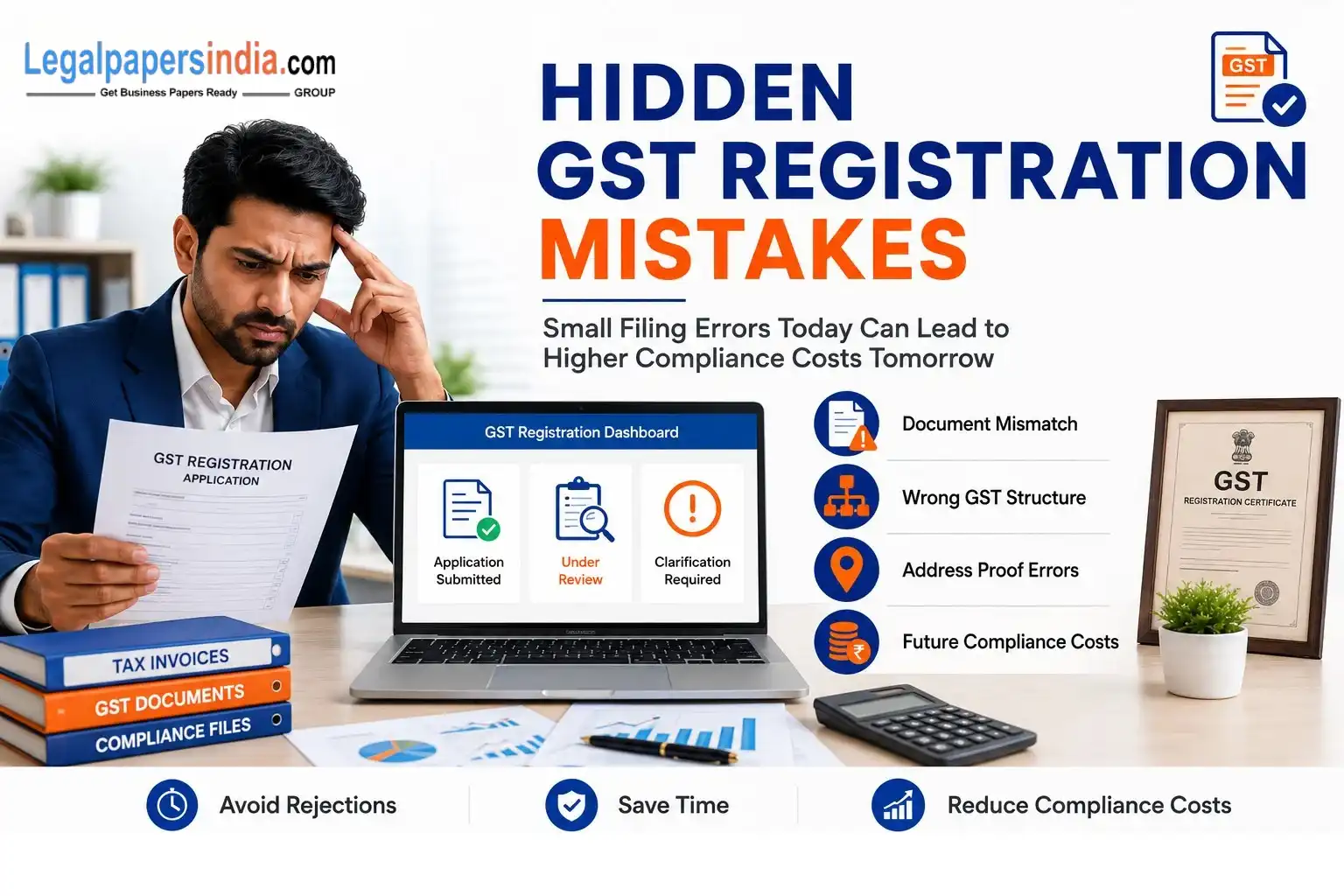
Common GST Registration Mistakes Businesses Make
Applying Too Late
Some businesses delay registration until receiving notices or vendor escalations. This can create compliance complications for earlier transactions.
Selecting Incorrect Business Category
Choosing the wrong taxpayer type or business activity classification may affect future compliance and filing obligations.
Using Weak Address Documentation
Improper rent agreements, missing NOCs, or outdated utility bills frequently trigger objections.
Ignoring Post-Registration Responsibilities
Registration approval is only the beginning. Failure to file returns after obtaining GSTIN can lead to penalties, notices, or suspension risks.
Assuming Small Businesses Are Automatically Exempt
Turnover is not the only deciding factor. Interstate transactions, online selling, and service categories may independently trigger registration requirements.
Important Considerations Before Applying
Before proceeding with GST registration, businesses should evaluate a few operational realities.
Will You Need GST-Compliant Invoicing?
Corporate clients and larger vendors often insist on GST invoices for accounting and input tax credit purposes.
Are You Selling Across States?
Interstate transactions can change registration applicability even when turnover remains modest.
Will You Operate Through E-Commerce Platforms?
Many marketplaces impose GST-related onboarding conditions regardless of business size.
Can You Handle Ongoing Compliance?
Registration creates continuing obligations:
- Monthly or quarterly returns
- Invoice accuracy
- Record retention
- Reconciliation requirements
This is where businesses sometimes underestimate the administrative side of GST compliance.
GST Registration Timeline: What Businesses Typically Experience
The actual timeline depends on:
- Accuracy of documentation
- Aadhaar authentication status
- Clarification notices
- Verification requirements
- Department workload
Typical Expectations
In straightforward cases:
- Application submission: Same day
- Basic processing: Few working days
- Clarification cases: Additional time may apply
However, delays are common when:
- Address proof is insufficient
- Business activity lacks clarity
- PAN and Aadhaar details mismatch
- Supporting documents are incomplete
Businesses operating from shared spaces or rented premises often experience additional scrutiny during verification.
GST Registration vs Voluntary Registration
Not every registration happens because of mandatory turnover rules.
| Aspect |
Mandatory Registration |
Voluntary Registration |
|
Trigger |
Legal applicability |
Strategic business decision |
|
Compliance Obligation |
Required by law |
Chosen voluntarily |
|
Input Tax Credit |
Generally available |
Generally available |
|
Client Perception |
Compliance necessity |
May improve business credibility |
|
Filing Requirements |
Applicable |
Applicable after registration |
Voluntary registration can make sense for businesses dealing with corporate clients or planning expansion, but it also introduces ongoing compliance responsibilities.
Frequently Asked Questions
1. Is GST registration compulsory for freelancers?
It depends on turnover, client location, and nature of services. Freelancers providing interstate taxable services or working with larger corporate clients may eventually require GST registration based on applicability conditions.
2. Can a small business operate without GST registration?
Yes, if it falls below applicable thresholds and does not fall under mandatory registration categories. However, operational realities such as vendor expectations or marketplace requirements may still influence the decision.
3. What happens if GST registration is delayed?
Delayed registration can lead to compliance complications, penalties, interest exposure, and difficulty issuing valid GST invoices for taxable transactions already undertaken.
4. How long does GST registration approval usually take?
Straightforward applications may be processed within a few working days, while clarification notices or verification issues can extend timelines.
5. Can GST registration be cancelled later?
Yes. Businesses may apply for cancellation under eligible circumstances such as closure, turnover changes, restructuring, or discontinuation of taxable activities.
When Professional Assistance Becomes Helpful
Some GST applications are relatively straightforward. Others become more complex due to:
- Multiple business locations
- Interstate transactions
- Partnership or company structures
- Shared premises
- E-commerce operations
- Prior compliance gaps
Professional guidance can help businesses avoid classification errors, documentation mismatches, and post-registration compliance confusion.
If you want to understand the background and compliance-focused approach of the team handling such matters, you can learn more through the About Us section of Legal Papers India.
Final Thoughts
GST registration is often treated as a one-time formality, but in reality, it affects invoicing, vendor relationships, tax compliance, and operational flexibility.
For some businesses, registration is legally mandatory. For others, it becomes commercially practical much earlier than expected.
The important thing is not just obtaining a GSTIN, but understanding the responsibilities that follow. A carefully handled registration process reduces future compliance friction and helps businesses operate more confidently within the GST framework.
If you are unsure whether GST registration applies to your situation, seeking professional guidance before filing can help prevent avoidable mistakes later.
Legal Papers India provides professional GST Registration Complete Guide registration services for startups and businesses across India. We assist with company incorporation, documentation, and compliance support for a smooth registration process.
Contact Legal Papers India for fast and reliable GST Registration Complete Guide registration assistance. Our experts help with online filing, legal documentation, and business registration support.
Social Share: