
Sep 04, 2026
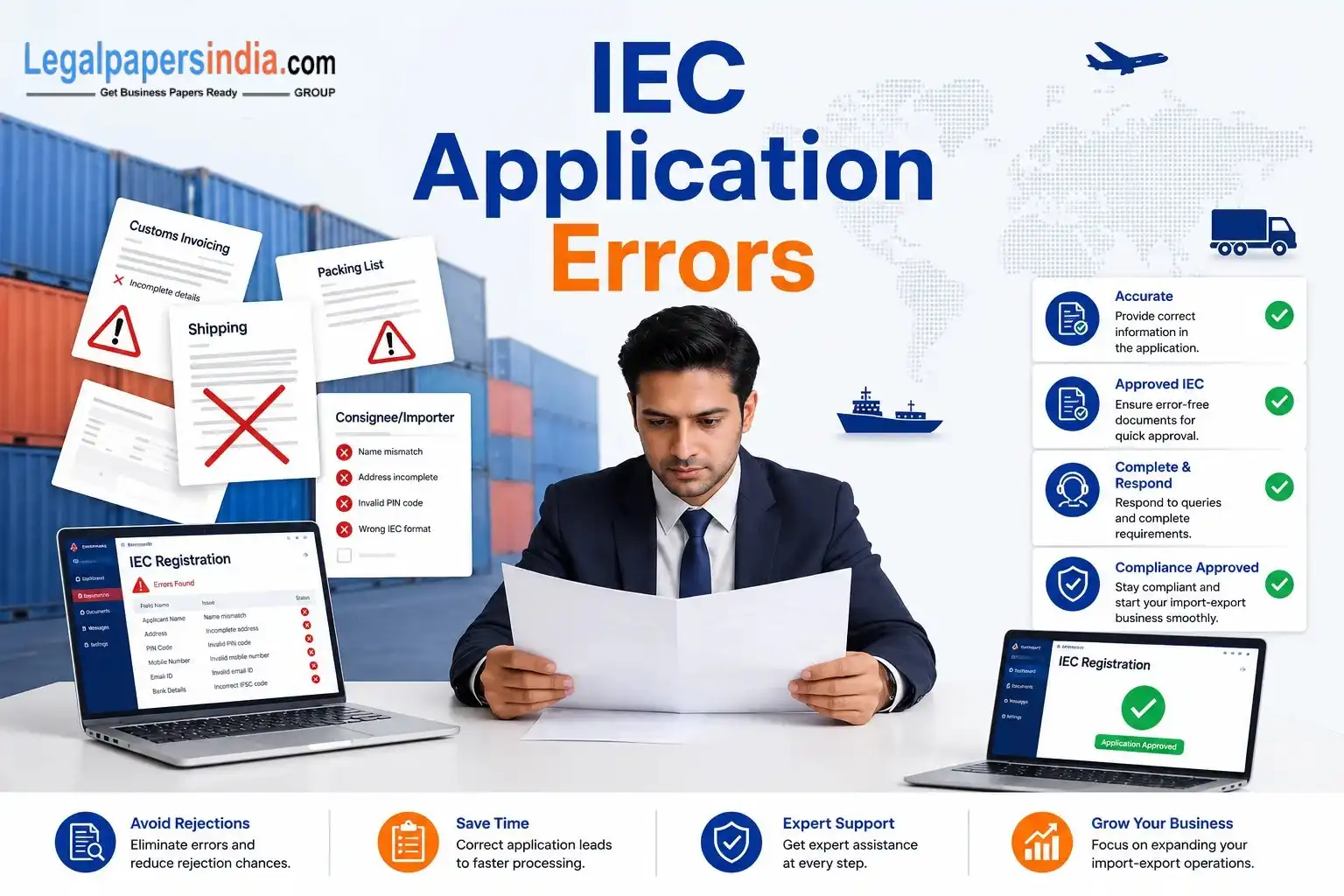
IEC Application Errors: Costly Mistakes That Delay Import Export Approval
Why do some IEC applications get approved quickly while others end up costing far more than expected?
A lot of businesses assume IEC registration is just a low-cost compliance formality until the application gets rejected, marked for clarification, or delayed due to avoidable mistakes.
In reality, the biggest expense in IEC registration is often not the government fee. It is the indirect cost of wrong documentation, correction filings, delayed import timelines, banking issues, or mismatched business details.
Many applicants also misunderstand pricing. They compare only the filing charge while ignoring:
- Document Correction Costs,
- Consultant Revision Fees,
- Delayed Shipment Losses,
- Dsc Or Compliance Expenses,
- And Time Spent Fixing Errors After Submission.
That is where most businesses end up overpaying.
If you are evaluating IEC registration costs or trying to avoid application rejection, understanding the common IEC application errors can help you make a far more informed decision before filing.
What Do IEC Application Errors Usually Cost Businesses?
IEC application mistakes rarely create huge direct government penalties, but they often increase the overall registration cost through delays, corrections, document revisions, and compliance rework. Small errors such as PAN mismatch, address inconsistency, or wrong bank details can lead to resubmission expenses, consultant charges, shipment delays, or operational interruptions.
Who Should Pay Attention to IEC Application Errors?
IEC mistakes are especially costly for businesses that:
- Plan To Start Importing Quickly,
- Need Customs Clearance Without Delays,
- Are Onboarding With International Suppliers,
- Require Bank Ad Code Processing,
- Or Are Applying Alongside Gst And Other Registrations.
These businesses usually face higher indirect costs if the IEC application is incorrect.
On the other hand, businesses with flexible timelines and low operational urgency may not feel immediate financial impact, though repeated corrections can still create unnecessary compliance expenses later.
This becomes even more relevant for businesses operating across multiple locations listed on the service presence network of Legal Papers India, where documentation consistency across states matters more than many applicants initially realize.
What Actually Determines the Cost Impact of IEC Application Errors?
Many people think IEC registration pricing depends only on who files the application. That is only partially true.
The real cost impact usually depends on how complex the business profile and documentation are.
1. Accuracy of PAN and Business Details
The IEC system is tightly linked with PAN-based verification.
Even small mismatches in:
- Proprietor Name,
- Company Spelling,
- Date Formats,
- Or Constitution Type
can trigger clarification requests or rejection.
Correcting these later often increases overall filing costs.
2. Bank Verification Problems
Incorrect bank account details are one of the most common reasons applications get held.
Issues often include:
- Mismatched IFSC Codes,
- Non-Business Bank Accounts,
- Unreadable Cancelled Cheques,
- Old Account Details.
Businesses sometimes end up paying again for revised filing support because of these avoidable mistakes.
3. Incorrect Business Address Proof
Many applicants underestimate address proof scrutiny.
Shared office setups, coworking spaces, rented premises, or utility bills in another person’s name frequently create verification complications.
4. Urgency of Import Timeline
If imports are already planned, every day of IEC delay can indirectly increase costs through:
- Warehousing Delays,
- Supplier Coordination Issues,
- Customs Scheduling Changes,
- Or Postponed Export Payments.
This is where even a “small” application mistake becomes financially significant.
The Most Common IEC Application Errors That Increase Cost
Wrong PAN Mapping
IEC registration is PAN-based. If the PAN details do not exactly match official records, the application can fail immediately.
This is surprisingly common with:
- Newly Incorporated Companies,
- LLPs,
- And Proprietorship Conversions.
Businesses often spend additional money correcting linked compliance records before reapplying.
Using Personal Instead of Business Banking Documents
A frequent mistake among first-time importers is submitting personal account documents instead of operational business banking proof.
This creates issues later during:
- Customs Procedures,
- Payment Settlements,
- And Ad Code Registration.
The correction process may require additional consultant assistance and fresh submissions.
Poor Document Quality
Blurred PDFs, cropped scans, password-protected documents, and unreadable signatures regularly delay approval.
This sounds minor, but it creates avoidable back-and-forth communication that increases processing time and professional support costs.
Incorrect Constitution Selection
Some applicants accidentally choose the wrong entity type while filing:
- Proprietorship Instead Of Partnership,
- LLP Instead Of Private Limited Company,
- Or Individual Exporter Instead Of Business Entity.
This can create downstream compliance mismatches with GST, customs, and banking records.
Ignoring Future Business Expansion
Businesses sometimes apply using temporary addresses or unstable documentation to “save time.”
Later updates often require modification requests and additional professional charges.
A slightly more careful filing initially usually costs less overall.
Typical IEC Registration Cost Expectations
IEC registration itself generally involves a relatively modest government fee structure. However, the total practical cost can vary depending on:
- Documentation Readiness
- Filing Support
- Urgency
- Correction Requirements
- And Post-Application Assistance.
In practical terms:
| Scenario |
Cost Impact |
|
Clean documentation with accurate filing |
Lower overall expense |
|
Incorrect documents requiring refiling |
Moderate increase |
|
Urgent import timelines with errors |
Higher indirect cost |
|
Multi-location or complex business setup |
Additional compliance coordination |
|
Repeated corrections after submission |
Often the most expensive overall |
One common misconception is that the “cheapest filing service” automatically saves money. In reality, poor filing quality often creates higher correction and operational costs later.
For businesses comparing filing support, reviewing a detailed IEC registration process and documentation structure can provide better clarity than comparing only upfront pricing.
Cost Differences Based on Business Situation
First-Time Small Importers
Small traders and first-time importers usually spend less initially, but they are more vulnerable to costly filing mistakes because they may not understand document alignment requirements.
Common issues:
- Incorrect Bank Proof,
- Gst Mismatch,
- Incomplete Address Documents.
Established Businesses Expanding Internationally
Existing companies expanding into imports or exports typically have better documentation, but complexity increases because:
- Multiple Directors May Be Involved,
- Registered Offices Differ From Operational Locations,
- Banking Structures Are More Layered.
These businesses often require more verification coordination.
Businesses With Urgent Shipment Timelines
This category usually faces the highest indirect costs when errors happen.
A delayed IEC approval can affect:
- Customs Processing,
- Supplier Commitments,
- Product Launch Timelines,
- And Working Capital Cycles.
In such situations, even minor application corrections become expensive from an operational standpoint.
Hidden or Additional Costs Businesses Often Ignore
Modification Costs Later
Many applicants assume IEC registration is “one-time forever.”
But changes in:
- Address,
- Mobile number,
- Email,
- Bank account,
- Or constitution
may require updates later.
Incorrect initial filing increases future maintenance effort.
Delay-Related Business Losses
This is the least discussed cost factor.
A rejected IEC application may delay:
- Import orders,
- Export invoices,
- International payment settlements,
- Or customs documentation.
The operational impact can easily exceed the original registration expense.
Third-Party Correction Charges
Businesses that initially choose extremely low-cost filing services sometimes discover that:
- Revisions cost extra,
- Clarification handling is separate,
- Or post-submission support is limited.
This creates a misleading perception of “cheap registration.”
How to Reduce IEC Registration Costs Without Taking Risk
Keep Documentation Consistent
Ensure:
- PAN,
- GST,
- Bank account,
- And address proof
all reflect matching business details.
Most avoidable IEC issues begin with inconsistent records.
Avoid Last-Minute Filing
Urgent applications usually increase the risk of rushed documentation mistakes.
A calm review process often reduces both direct and indirect cost.
Verify Bank Details Carefully
This single step prevents a surprisingly high number of clarification requests.
Choose Clarity Over Lowest Pricing
Many businesses focus only on the lowest filing charge and ignore:
- Response Support,
- Correction Assistance,
- Document Review Quality,
- And Long-Term Compliance Guidance.
That often becomes expensive later.
Common Misunderstandings About IEC Costs
“IEC Registration Is Always Instant”
Not necessarily.
Simple applications may move quickly, but document mismatches can create delays.
“Low Filing Price Means Lower Overall Cost”
This is one of the biggest misconceptions.
The real expense usually comes from corrections, delays, or missing support after submission.
“Small Businesses Don’t Need Proper Documentation”
Even small importers are subject to verification checks.
Incorrect filings affect businesses of every size.
Practical Real-World Examples
Example 1: New Ecommerce Importer
A small ecommerce seller submitted a personal savings account instead of a business current account.
The IEC required correction later during banking procedures, creating additional compliance work and delayed imports.
Example 2: Partnership Firm With Address Mismatch
A partnership used an old electricity bill that did not match updated GST records.
The clarification process delayed approval and required revised documentation support.
Example 3: Urgent Industrial Import Requirement
A manufacturing company needed IEC approval quickly for incoming machinery imports.
A minor director-name mismatch caused unexpected delays, increasing logistics coordination costs significantly.
A Simple Way to Decide What Matters Most
When evaluating IEC registration cost, the better question is usually not:
“How cheap is the filing?”
Instead, ask:
- Will the documentation pass smoothly?
- Is post-submission support available?
- Are corrections included if needed?
- Will delays affect business operations?
- Are future updates easier to handle?
That shift in thinking helps businesses avoid short-term savings that create larger long-term costs.
Frequently Asked Questions
1. How much does it cost to correct an IEC application error?
The correction cost depends on the type of issue, whether professional assistance is needed, and whether operational delays are involved. Simple updates may be manageable, while repeated clarification handling can increase the overall expense.
2. Can IEC application mistakes delay imports?
Yes. Incorrect IEC details can delay customs processing, AD code activation, banking procedures, and supplier coordination, especially when import timelines are urgent.
3. What is the most common IEC registration mistake?
PAN mismatch, incorrect bank details, and inconsistent business address documents are among the most common IEC filing errors.
4. Is professional help necessary for IEC registration?
Not always. Businesses with clean documentation and straightforward structures may handle filing independently. However, businesses with complex setups or urgent timelines often prefer professional guidance to reduce error-related risks.
5. Can IEC details be modified later?
Yes. IEC details can usually be updated when business information changes, though modifications may involve additional compliance steps and professional support costs.
When Professional Assistance Starts Making Sense
Professional help becomes more useful when:
- The Business Structure Is Complex,
- Imports Are Time-Sensitive,
- Multiple Registrations Are Interconnected,
- Or Documentation Consistency Is Uncertain.
The goal should not simply be faster filing. It should be reducing avoidable compliance friction and preventing cost escalation later.
Businesses evaluating filing support often review the experience and compliance approach shared on the About Legal Papers India page before making a decision.
Conclusion
IEC registration itself is not usually an expensive process. What increases cost is avoidable mistakes, rushed filing, inconsistent documents, and delayed corrections.
Businesses that understand the real cost drivers early generally make better decisions and avoid unnecessary operational disruptions later.
A careful, well-reviewed application often saves more money than choosing the lowest visible filing price.
If you are planning to apply for IEC registration, it helps to compare not just pricing, but also documentation guidance, correction support, and long-term compliance clarity before proceeding.
Contact our team for fast and hassle-free IEC Registration support. We are here to help with documentation and online registration assistance.
Social Share: