
Sep 04, 2026
LLP Annual Compliance Cost: What Businesses Often Miss Before Registering
A lot of founders reach the same point after deciding on an LLP:
“The registration cost seems manageable… but what happens after that?”
That’s usually where hesitation begins.
Because the real decision isn’t only about forming a Limited Liability Partnership. It’s about whether you can comfortably manage the recurring compliance responsibilities year after year without unnecessary penalties, filing stress, or professional dependency.
Some businesses barely notice the annual compliance burden. Others end up spending more on missed deadlines and corrective filings than they expected during registration.
If you're evaluating LLP formation seriously, understanding the actual LLP annual compliance cost — including professional fees, ROC filings, tax compliance, and practical management effort — helps you decide whether this structure truly fits your business stage.
Before proceeding, it’s worth understanding how LLP registration and long-term compliance obligations work together rather than viewing registration as a one-time setup.
For most small and mid-sized LLPs in India, annual compliance costs generally range between ₹6,000 and ₹25,000+ depending on turnover, GST applicability, accounting complexity, and professional support requirements. Businesses with inactive operations may still need mandatory ROC filings, while growing LLPs usually face higher bookkeeping, tax filing, and audit-related expenses.
When an LLP Makes Financial Sense — And When It Doesn’t
Not every business benefits equally from an LLP structure.
In practice, LLPs work best when there’s a balance between operational flexibility and manageable compliance.
You may find LLP compliance cost reasonable if:
- You run a service-based business
- You have 2 or more active partners
- Your revenue flow is relatively stable
- You want limited liability protection without private limited company formalities
- You expect moderate business growth without heavy investor involvement
- You prefer lower compliance compared to companies
Consultants, agencies, freelancers scaling into partnerships, trading firms, and professional service businesses often fit well here.
An LLP may become inefficient if:
- You expect venture capital funding
- Your business will remain inactive for long periods
- You are uncomfortable with annual filing discipline
- Partners frequently change
- Your accounting records are poorly maintained
- You want minimal ongoing professional involvement
At this stage, many founders realize the issue isn’t “high cost” — it’s recurring administrative responsibility.
That distinction matters.
Key Decision Criteria Before You Proceed
Use this checklist before deciding whether LLP compliance costs are acceptable for your business model.
Decision Checklist
- Can you maintain basic accounting records throughout the year?
- Are you prepared for annual ROC filing deadlines?
- Will GST registration apply to your operations?
- Do you have a CA or compliance professional available?
- Is your expected annual revenue sufficient to justify recurring costs?
- Will there be regular financial transactions between partners?
- Can partners coordinate documentation on time?
- Are you comfortable with penalties for delayed compliance?
If you answered “no” to several points, the issue may not be affordability — it may be operational readiness.
What Actually Contributes to LLP Annual Compliance Cost?
This is where most online explanations stay too generic.
Founders often assume there’s a single “government renewal fee.” In reality, LLP annual compliance cost is usually a combination of multiple recurring obligations.
1. ROC Filing Costs
Every LLP must generally file:
- Form 11 (Annual Return)
- Form 8 (Statement of Accounts and Solvency)
These are filed with the Ministry of Corporate Affairs under the oversight of the Ministry of Corporate Affairs.
Even LLPs with little or no business activity are usually expected to file mandatory returns.
2. Accounting and Bookkeeping
This varies significantly.
A low-transaction consulting LLP may spend very little annually, while trading or GST-heavy businesses usually require monthly bookkeeping support.
This is where compliance cost becomes operational rather than regulatory.
3. Income Tax Filing
LLPs must file income tax returns annually through the Income Tax Department.
Professional fees increase when:
- Multiple revenue streams exist
- Partner remuneration calculations become complex
- Foreign transactions are involved
- TDS compliance applies
4. GST Compliance
Once GST registration enters the picture, compliance costs often increase noticeably.
Monthly or quarterly returns, reconciliations, invoicing discipline, and record maintenance create ongoing professional involvement.
For some small LLPs, GST-related work becomes the largest recurring compliance expense.
5. Audit Requirements
Not every LLP requires an audit.
However, audit applicability may arise based on turnover or contribution thresholds under LLP regulations.
Many founders underestimate how much accounting quality affects audit readiness later.
Hidden Cost Areas People Rarely Factor In
This is where real-world experience differs from theoretical compliance guides.
Late Filing Penalties
One missed filing can quickly increase overall annual cost.
Many LLPs delay filings because:
- Partners are traveling
- Financial records are incomplete
- GST reconciliation is pending
- Digital signatures expire
- Professional coordination happens too late
The problem is rarely ignorance. It’s delay.
Partner Coordination Issues
Multi-partner LLPs often struggle with:
- Approval delays
- Capital contribution disputes
- Missing documentation
- Profit-sharing clarification
Operational friction increases compliance effort.
Frequent Business Changes
Each structural modification can trigger additional filing costs:
- Partner addition/removal
- Registered office change
- Agreement amendments
- Capital changes
Businesses expecting frequent restructuring should factor this in early.
Who Usually Handles LLP Compliance Smoothly?
In practice, these businesses adapt well:
Businesses with Predictable Operations
For example:
- Marketing agencies
- IT consulting firms
- Architecture partnerships
- Legal or accounting practices
Their transaction flow remains easier to document consistently.
Founders Who Separate Personal and Business Finances
This sounds basic, but it changes compliance difficulty dramatically.
Mixed transactions create bookkeeping confusion, delayed filings, and avoidable professional costs.
Businesses That Build Compliance Into Routine Operations
The smoothest LLPs usually:
- Maintain monthly accounting
- Track invoices properly
- Keep partner communication documented
- Review filing deadlines quarterly
They don’t treat compliance as a year-end emergency.
Common Decision-Stage Mistakes
Choosing LLP Only Because Registration Seems Cheap
- Registration cost is temporary.
- Compliance discipline is ongoing.
- This mismatch creates frustration later.
Ignoring Dormant LLP Obligations
- Many people assume inactive LLPs have no filing burden.
- That assumption often leads to accumulated penalties.
Waiting Until Deadline Month
- At this stage, most businesses start wondering whether compliance professionals are “expensive.”
- Usually, the problem is delayed preparation rather than professional pricing.
Underestimating GST Impact
- An LLP with GST registration almost always requires stronger bookkeeping consistency.
- This becomes especially important once vendor reconciliations and input tax credit tracking increase.
Practical Scenarios That Help Clarify the Decision
Scenario 1: Small Consulting Partnership
Two partners running a digital consultancy with moderate invoicing and limited expenses.
Typical outcome:
- Manageable annual compliance
- Low operational complexity
- LLP structure usually remains cost-efficient
Scenario 2: Trading LLP With Heavy GST Activity
High invoice volume, multiple vendors, interstate supply.
Typical outcome:
- Compliance cost rises substantially
- Monthly accounting becomes essential
- Professional involvement increases
Scenario 3: Inactive or Side-Hustle LLP
Business operations remain inconsistent for long periods.
Typical outcome:
- Mandatory filings still continue
- Penalties become common if ignored
- LLP may feel burdensome relative to activity level
If you're unsure whether this applies to you, you're not alone. Many founders evaluate LLPs assuming future growth will automatically justify compliance effort. Sometimes it does. Sometimes the structure becomes unnecessarily administrative for the business size.
Step-by-Step Approach Before Registering an LLP
Step 1: Estimate Your Real Annual Transactions
Don’t evaluate compliance cost abstractly.
Estimate:
- Number of invoices
- GST applicability
- Vendor payments
- Partner withdrawals
- Banking activity
Step 2: Check Long-Term Operational Intent
Ask yourself:
Will this business actively operate for the next 2–3 years?
That answer affects whether recurring compliance feels justified.
Step 3: Speak With a Compliance Professional Early
Understanding recurring obligations before registration prevents later surprises.
Step 4: Build a Compliance Calendar
Even basic tracking prevents most penalty situations.
Step 5: Keep Documentation Centralized
Businesses with scattered invoices and financial records usually face higher compliance costs later.
Final Decision Summary
LLP annual compliance cost is usually reasonable for businesses that maintain operational discipline, basic accounting structure, and consistent partner coordination.
The challenge is rarely the filing fee itself.
What increases cost over time is:
- irregular bookkeeping,
- missed deadlines,
- GST complexity,
- inactive operations,
- and reactive compliance management.
If your business has stable activity, multiple partners, and long-term operational intent, LLP compliance often remains practical and financially manageable.
If your business is uncertain, irregular, or likely to remain dormant, the recurring obligations may feel heavier than expected.
The better decision usually comes from matching the structure to your actual business behavior — not just the registration budget.
Frequently Asked Questions
1. What is the average LLP annual compliance cost in India?
For many small businesses, LLP annual compliance costs typically range from ₹6,000 to ₹25,000 or more annually depending on accounting complexity, GST filing requirements, turnover, and professional fees. Businesses with higher transaction volume usually incur higher compliance expenses.
2. Is LLP compliance mandatory even if there is no business activity?
Yes. Even inactive LLPs are generally required to complete mandatory ROC filings and income tax compliance. Ignoring dormant LLP compliance often leads to additional penalties and filing complications later.
3. Does GST registration increase LLP compliance cost?
Yes, significantly in many cases. GST registration often increases bookkeeping, return filing, reconciliation, and professional involvement requirements, especially for businesses with regular invoice activity.
4. Is LLP compliance cheaper than private limited company compliance?
In many situations, yes. LLPs usually involve comparatively lower compliance formalities than private limited companies, particularly for small service-based businesses with limited operational complexity.
5. Can partners handle LLP compliance without professionals?
Technically possible for some low-complexity LLPs, but most businesses eventually rely on accountants or compliance professionals to avoid filing errors, missed deadlines, and tax-related complications.
Conclusion
Choosing an LLP shouldn’t depend only on registration affordability. The better question is whether the structure remains sustainable for your business operations over time.
A well-managed LLP can offer flexibility, liability protection, and manageable compliance for the right type of business. But the experience changes considerably when bookkeeping, GST, or filing discipline is inconsistent.
If you want clarity on how LLP compliance would apply to your specific business situation, you can review the guidance shared by Legal Papers India and evaluate the next step with practical expectations rather than assumptions.
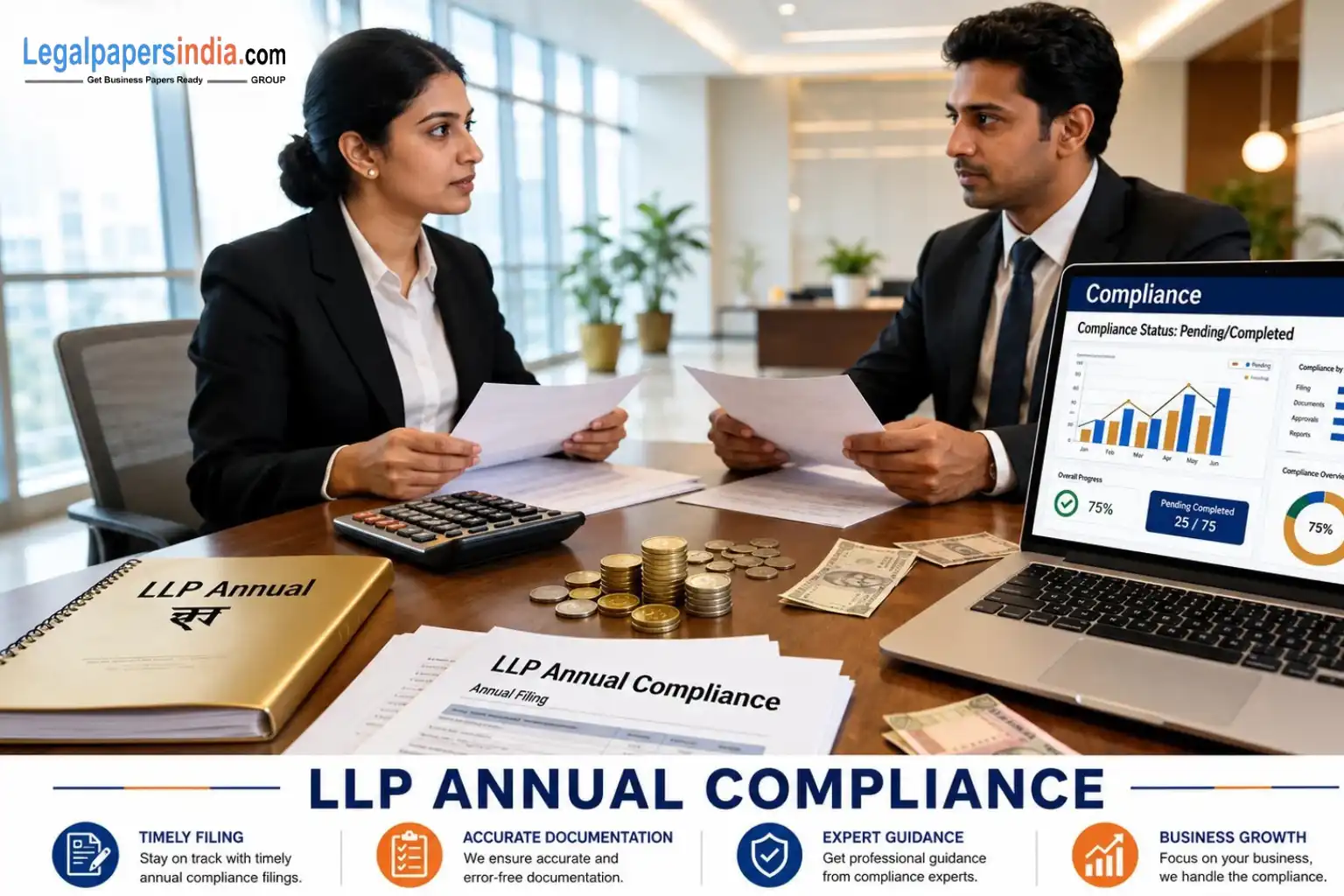
Legal Papers India (about us) provides reliable LLP Annual Compliance services to help businesses stay legally compliant with MCA regulations. We assist with annual filing, documentation, and timely compliance support for LLP firms.
Contact our team for quick and hassle-free LLP Annual Compliance filing services. We provide professional support for Form 8, Form 11, and yearly compliance requirements for LLP businesses.
Social Share: