
Sep 04, 2026
FSSAI Mistakes: What Usually Goes Wrong (and How to Avoid It)
What are FSSAI Mistakes?
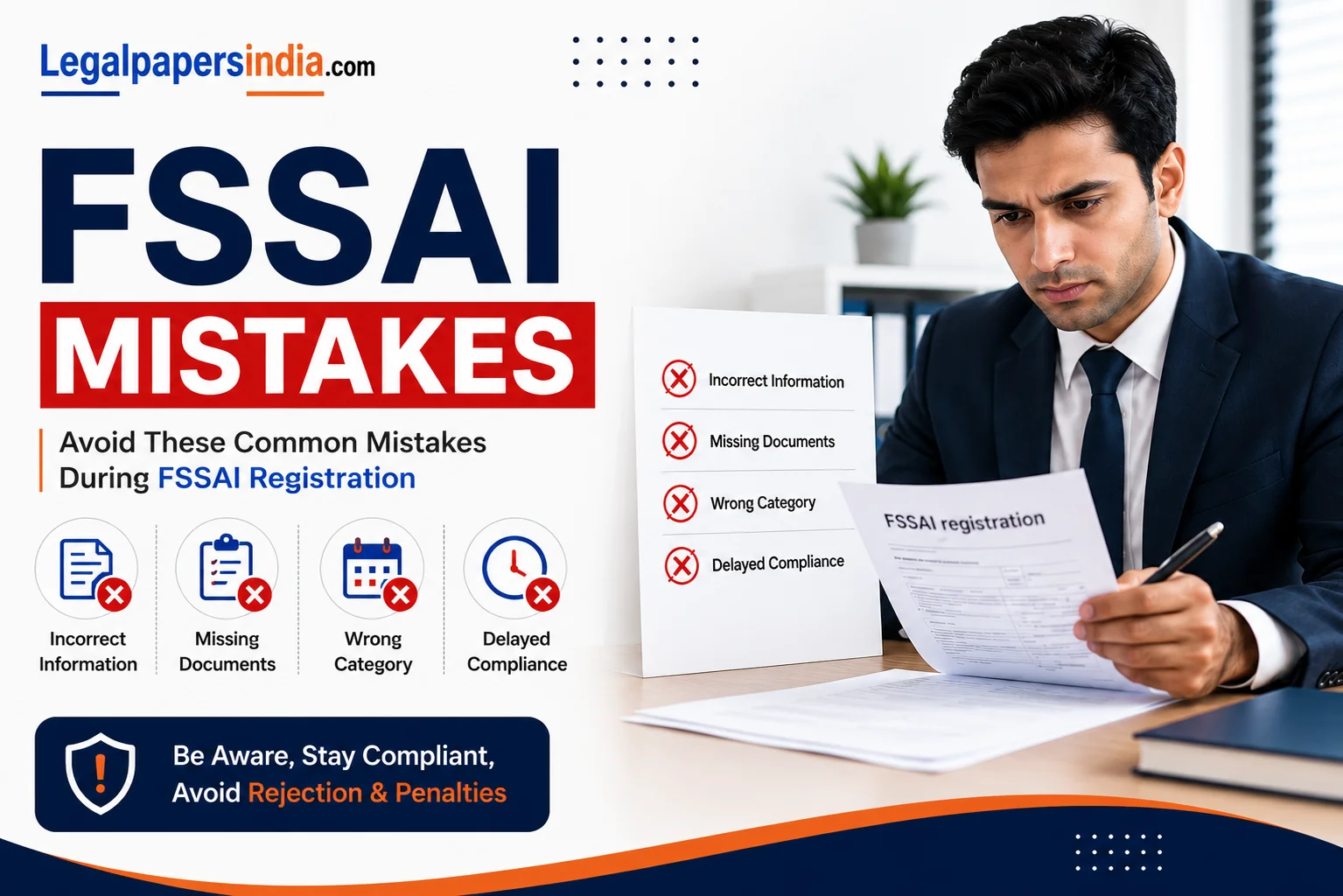
FSSAI mistakes refer to errors made while applying for, maintaining, or renewing food business registration or licensing under the Food Safety and Standards Authority of India. These mistakes often arise from misunderstanding eligibility, incorrect documentation, or overlooking compliance requirements—leading to delays, rejections, or regulatory complications.
Where Most People Slip Without Realizing
It often starts with a simple assumption—“It’s just a basic registration.”
But somewhere between selecting the right category and uploading documents, things begin to go off track.
Not because the process is complicated, but because it’s easy to misinterpret small details.
And with something like FSSAI registration, small missteps don’t stay small for long.
Why These Mistakes Commonly Happen
If you look closely, most errors aren’t careless—they’re predictable.
- The guidelines feel straightforward at first glance
- Many rely on incomplete or second-hand information
- Categories and requirements seem similar but aren’t
- There’s a tendency to rush the application just to “get it done”
This combination creates a situation where people feel confident—but not fully informed.
Most Common FSSAI Mistakes to Avoid
1. Choosing the Wrong Registration Category
What This Mistake Actually Means
Applying under Basic Registration when your business actually requires a State or Central License.
Why People Make This Mistake
Turnover thresholds and business scale definitions are often misunderstood or underestimated.
What Happens If Ignored
- Application rejection
- Legal non-compliance
- Future penalties if operating under incorrect license
How to Avoid It
- Evaluate turnover and operational scale carefully
- Consider business expansion plans—not just current status
- Cross-check eligibility before submitting
2. Uploading Incorrect or Incomplete Documents
What This Mistake Actually Means
Submitting unclear, mismatched, or missing documents like ID proof, address proof, or business details.
Why People Make This Mistake
Many assume “basic documents” are enough without checking exact requirements.
What Happens If Ignored
- Delayed approval
- Repeated clarification requests
- Possible rejection
How to Avoid It
- Verify document checklist thoroughly
- Ensure consistency across all submitted details
- Double-check file clarity and format
3. Mismatch Between Business Activities and Application Details
What This Mistake Actually Means
Declaring incorrect business activity—like selecting “retailer” instead of “manufacturer” or “cloud kitchen.”
Why People Make This Mistake
Terminology confusion or assumption that categories are interchangeable.
What Happens If Ignored
- Compliance issues during inspection
- License misuse concerns
- Risk of cancellation
How to Avoid It
- Clearly define your business model
- Understand activity-specific classifications
- Avoid generic selections
4. Ignoring Hygiene and Safety Declarations
What This Mistake Actually Means
Submitting declarations without actually understanding or implementing basic food safety standards.
Why People Make This Mistake
They treat it as a formality rather than a compliance commitment.
What Happens If Ignored
- Inspection failures
- Warning notices or penalties
- Business reputation damage
How to Avoid It
- Understand basic food safety guidelines
- Align operations with declared standards
- Maintain records where applicable
5. Delaying Renewal or Updates
What This Mistake Actually Means
Forgetting to renew registration or update details like address, ownership, or product category.
Why People Make This Mistake
Out of sight, out of mind—until an issue arises.
What Happens If Ignored
- Expired license status
- Penalties or operational disruptions
- Need to reapply from scratch
How to Avoid It
- Track renewal dates
- Update changes proactively
- Maintain compliance calendar reminders
6. Assuming “One License Covers Everything”
What This Mistake Actually Means
Using a single FSSAI registration for multiple locations or different business verticals.
Why People Make This Mistake
Misunderstanding scope and applicability.
What Happens If Ignored
- Non-compliance during inspections
- Legal exposure
- Forced corrective filings
How to Avoid It
- Treat each location/activity separately
- Understand multi-location requirements
- Apply accordingly
Legal, Financial, or Compliance Consequences
FSSAI errors rarely create immediate problems—but they surface later.
- During inspections
- When expanding operations
- While partnering with vendors or platforms
- During audits or renewals
The issue isn’t always penalties—it’s disruption.
And disruptions are what most businesses underestimate.
Preventive Checklist Before You Apply
- Confirm your correct license category
- Match documents with business details
- Clearly define your business activity
- Review all uploaded files for accuracy
- Understand basic food safety compliance
- Set reminders for renewal timelines
- Avoid assumptions—verify everything once
Real-World Scenarios Where Mistakes Happen
- A home-based food seller selects “manufacturer” instead of “petty food business”
- A cloud kitchen applies under restaurant category
- A growing business continues using Basic Registration beyond eligibility
- A renewal is missed because “no one followed up”
These are not rare situations—they happen more often than people realize.
When Professional Guidance Becomes Necessary
There’s a point where self-filing stops being efficient.
For example:
- When your business has multiple activities
- When scaling beyond initial registration
- When dealing with classification confusion
- When past applications were rejected
At that stage, clarity matters more than speed.
You can explore structured guidance through the FSSAI Basic Registration page to better understand compliance expectations.
Frequently Asked Questions
1. What is the most common FSSAI mistake?
The most common mistake is selecting the wrong registration category. Many businesses underestimate their turnover or misclassify their activity, leading to rejection or compliance issues later.
2. Can FSSAI applications be corrected after submission?
Minor corrections may be allowed through clarification requests, but major errors often require reapplication. It’s better to verify details thoroughly before submission.
3. Is FSSAI mandatory for small home-based food businesses?
Yes, even small-scale or home-based food businesses must obtain at least Basic FSSAI Registration to operate legally.
4. What happens if FSSAI registration expires?
Expired registration can lead to penalties and operational disruption. Businesses may need to reapply, which can delay continuity.
Final Protective Guidance
Most FSSAI mistakes don’t come from negligence—they come from assumptions.
And the tricky part is, everything feels “correct” until it’s reviewed.
If you’re unsure at any stage, it helps to step back and reassess rather than push forward with incomplete clarity.
If you want to better understand how compliance is typically handled or how businesses navigate these requirements, you can review how
Legal Papers India approaches regulatory processes.
Because in compliance, avoiding mistakes is often more valuable than fixing them later.
Contact Legal Papers India for hassle-free FSSAI Basic Registration assistance. Our team helps with fast application filing and complete registration support for food businesses.
Social Share: