
Sep 04, 2026
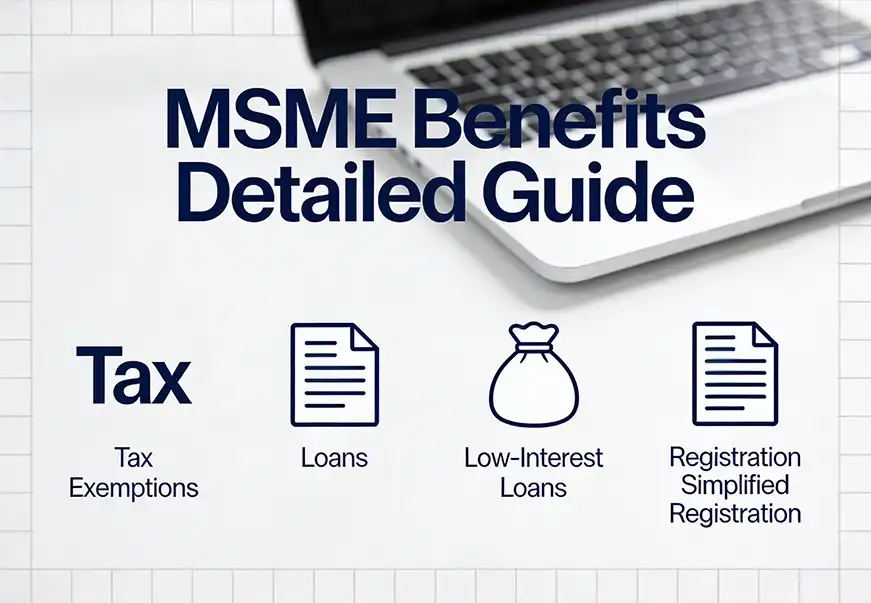
MSME Benefits Detailed Guide
Why So Many Small Businesses Delay MSME Registration — Until They Need It
A textile trader loses a large supply contract because the buyer prefers working with MSME-registered vendors. A freelance design agency struggles to access business credit during a slow season. A small manufacturer discovers too late that certain government tenders were open only to registered micro and small enterprises.
These situations are more common than most business owners realize.
Many entrepreneurs hear about MSME registration only when applying for loans, bidding for projects, or facing delayed payments from clients. Until then, it often feels like “just another registration.” The confusion usually starts with basic questions:
- Is MSME registration mandatory?
- What benefits actually matter in real business situations?
- Does it help service businesses or only manufacturers?
- Can freelancers, startups, and online businesses apply?
Understanding the practical value of MSME registration becomes important long before a business faces funding pressure or compliance hurdles. That is exactly where clarity matters.
What Is MSME Registration?
MSME registration is a government-recognized classification for Micro, Small, and Medium Enterprises under the Ministry of Micro, Small and Medium Enterprises. Businesses can register through the Udyam Registration portal to access benefits such as easier credit access, government scheme eligibility, delayed payment protection, and certain regulatory support measures.
MSME Benefits Explained in Simple Terms
MSME benefits are financial, operational, and regulatory advantages provided to eligible small businesses after Udyam Registration. These benefits may include priority sector lending, lower interest support under specific schemes, tender participation advantages, protection against delayed payments, and access to government-backed business development programs.
Why MSME Registration Matters More Than Many Businesses Expect
The biggest misconception is that MSME registration only helps businesses seeking loans.
In reality, the registration often becomes relevant during everyday business situations:
- When suppliers delay payments
- While applying for working capital
- During participation in tenders
- While expanding operations
- When seeking government incentives
- During business credibility checks
For newer businesses, MSME recognition can also improve formal identity. Many banks, marketplaces, and procurement systems treat registered enterprises differently because the business already falls within a recognized government framework.
There is also a practical psychological aspect. Once a business formalizes itself through registrations like GST, MSME, or incorporation, owners often become more structured in accounting, compliance, and long-term planning.
Understanding the Different Types of MSMEs
Businesses are classified based on investment and annual turnover limits.
Micro Enterprise
Typically smaller businesses with limited investment and lower turnover.
Examples:
- Freelancers
- Small retail shops
- Home-based businesses
- Local service providers
Small Enterprise
Businesses with growing operational scale.
Examples:
- Small manufacturers
- Regional distributors
- Digital agencies
- Food processing units
Medium Enterprise
Larger structured businesses that still qualify under MSME thresholds.
Examples:
- Expanding industrial units
- Export-oriented businesses
- Established service firms
The classification affects eligibility for certain schemes and financial assistance programs.
Who Should Consider MSME Registration?
MSME registration is often useful for:
- Startups
- Proprietorship businesses
- Partnership firms
- LLPs
- Private limited companies
- Online sellers
- Manufacturers
- Service providers
- Consultants and agencies
- Export businesses
- Home-based commercial operations
Even businesses operating digitally without a physical storefront may qualify if they meet eligibility conditions.
Businesses exploring expansion opportunities through formal financing or vendor onboarding may particularly benefit from registration.
You can also explore the broader business registration ecosystem through the business support network across different locations if your operations extend beyond a single region.
Who May Not Need MSME Registration?
Not every business immediately requires MSME registration.
It may not be essential for:
- Individuals without commercial activity
- Hobby-based non-commercial work
- Businesses operating temporarily without revenue intent
- Large enterprises exceeding MSME thresholds
- Entities that do not plan to access formal business ecosystems
However, many businesses initially assume they do not need MSME registration until a bank, buyer, or tender authority specifically requests it.
That shift usually happens during growth stages.
Key MSME Benefits Businesses Commonly Use
Easier Access to Business Loans
Banks and NBFCs often treat MSME-recognized businesses under priority sector lending frameworks.
This may help with:
- Working capital loans
- Machinery financing
- Expansion funding
- Cash flow management
Approval still depends on financial eligibility, but registration can strengthen the business profile.
Protection Against Delayed Payments
One of the most practical advantages involves payment recovery protections under MSME-related provisions.
When registered MSMEs face unusually delayed payments from buyers, legal remedies and interest provisions may become available under applicable laws.
For many small businesses, this becomes relevant far more often than subsidies or grants.
Better Eligibility for Government Schemes
Various central and state-level schemes may prioritize or specifically support MSMEs.
These may include:
- Technology upgrades
- Export support
- Skill development
- Subsidy-linked programs
- Energy efficiency incentives
Availability changes over time depending on policy updates.
Advantages in Government Tenders
Certain public procurement opportunities reserve participation benefits for MSMEs.
This can include:
- Relaxation in earnest money deposits
- Tender participation support
- Procurement preferences
For manufacturing and supply-based businesses, this can open new revenue channels.
Improved Business Credibility
Vendors, institutions, and financing partners often view registered businesses as more structured and reliable.
While MSME registration alone does not guarantee trust, it contributes to a stronger formal business profile.
How MSME Registration Works in Practice
The actual registration process is relatively straightforward, but mistakes in business classification or documentation can create complications later.
Step 1: Business Eligibility Assessment
The applicant first determines whether the business qualifies as:
- Micro
- Small
- Medium enterprise
Turnover and investment details become relevant here.
Step 2: Aadhaar and Business Validation
The registration system generally requires:
- Aadhaar authentication
- PAN validation
- Business activity details
Step 3: Filing Udyam Registration
Business information is submitted through the Udyam Registration system.
Typical details include:
- Nature of business
- NIC activity codes
- Bank details
- Business structure
Step 4: Verification and Certificate Generation
After successful validation, the system generates the Udyam Registration certificate.
Step 5: Post-Registration Usage
Businesses may then use the registration while:
- Applying for loans
- Vendor onboarding
- Tender participation
- Scheme applications
Many businesses overlook this final stage. Registration itself is only useful when actively integrated into operations.
For businesses seeking procedural clarity, the MSME registration guidance section provides additional context around the process and applicability.
Documents and Information Commonly Required
The exact requirements can vary depending on business structure.
Typically required details include:
- Aadhaar card of proprietor or authorized signatory
- PAN card
- Business address details
- Bank account information
- Business activity classification
- GST details (where applicable)
When GST Becomes Relevant
Some businesses assume GST registration is mandatory before MSME registration. That is not always the case.
However:
- GST-linked businesses may need validation integration
- Turnover classification may connect with GST records
This creates confusion for many growing businesses.
Common MSME Registration Mistakes Businesses Make
Incorrect Business Classification
Choosing the wrong activity type or classification may affect future eligibility.
Ignoring NIC Code Accuracy
The selected business activity codes should correctly reflect actual operations.
Assuming Registration Automatically Gives Subsidies
Many benefits depend on separate scheme eligibility. MSME registration is often the starting point, not the final approval.
Delaying Registration Until Funding Is Needed
Businesses sometimes wait until financial urgency arises, which can delay loan or tender processes.
Treating MSME Registration as “One-Time and Done
Business information may require updates if turnover, structure, or operational details significantly change.
Important Things to Consider Before Applying
Before proceeding, businesses should evaluate:
- Current turnover and investment position
- Whether GST linkage applies
- Nature of future funding requirements
- Tender participation plans
- Whether the business operates in manufacturing or services
- Accuracy of operational classification
It is also worth considering how MSME registration fits into broader compliance planning alongside GST, company registration, accounting, and tax filings.
A practical approach usually works better than rushing into registration without understanding long-term implications.
Typical MSME Registration Timeline
In straightforward cases, MSME registration can often be completed quickly once documentation and Aadhaar validation are properly aligned.
However, timelines may vary because of:
- PAN verification delays
- GST linkage issues
- Incorrect data entry
- Classification mismatches
- Technical portal validation problems
For businesses with multiple activities or changing structures, additional clarification may sometimes become necessary.
MSME Registration vs Startup Recognition: Are They the Same?
No. MSME registration and Startup India recognition serve different purposes.
| Aspect |
MSME Registration |
Startup Recognition |
|
Primary Focus |
Business classification |
Innovation/startup ecosystem |
|
Applicable To |
Wide range of businesses |
Eligible startups meeting DPIIT conditions |
|
Key Benefits |
Credit support, compliance benefits |
Startup incentives, tax-related support |
|
Regulatory Authority |
Ministry of MSME |
DPIIT |
Some businesses may qualify for both, depending on their structure and activities.
Frequently Asked Questions
1.Is MSME registration compulsory for small businesses?
No. MSME registration is generally optional. However, many businesses voluntarily register to access financing support, payment protection provisions, government schemes, and procurement-related opportunities.
2. Can service-based businesses apply for MSME registration?
Yes. Service providers such as consultants, agencies, IT firms, freelancers, and digital businesses may qualify if they meet MSME eligibility conditions.
3. How long does MSME registration usually take?
Simple registrations may be completed relatively quickly if Aadhaar, PAN, and business details are correctly validated. Delays typically happen because of mismatched information or verification issues.
4. What happens if a business operates without MSME registration?
There is usually no direct penalty for not registering. However, businesses may miss out on certain benefits, protections, financing opportunities, or procurement advantages available to registered enterprises.
5. Can an existing business apply for MSME registration later?
Yes. Existing businesses can apply if they meet the applicable eligibility criteria and provide the required operational and financial details.
When Professional Assistance May Be Helpful
Some businesses complete MSME registration independently without difficulty.
However, professional guidance can become useful when:
- Business activities are complex
- Multiple registrations are already linked
- Classification confusion exists
- Turnover calculations are unclear
- Tender eligibility matters
- Compliance alignment is important
This is especially true for growing businesses trying to avoid inconsistencies across GST, incorporation, tax, and MSME records.
You can learn more about the background and working approach of Legal Papers India if you are evaluating structured compliance assistance.
Conclusion
MSME registration is often underestimated because the immediate benefits are not always visible on day one.
But over time, it can influence financing access, procurement opportunities, payment protection, and overall business credibility. For many businesses, the value becomes clear only when growth challenges or operational hurdles appear.
The key is understanding where MSME registration genuinely fits into your business journey rather than treating it as just another formality.
If you are uncertain about eligibility, classification, or documentation requirements, seeking professional guidance before applying can help avoid avoidable compliance issues later.
Legal Papers India provides easy and professional MSME Registration services for startups and small businesses across India. We assist businesses with quick registration, proper documentation, and compliance support.
Contact Legal Papers India for smooth MSME Registration assistance. Our experts help businesses with fast online registration and complete documentation support.
Social Share: