
Sep 04, 2026
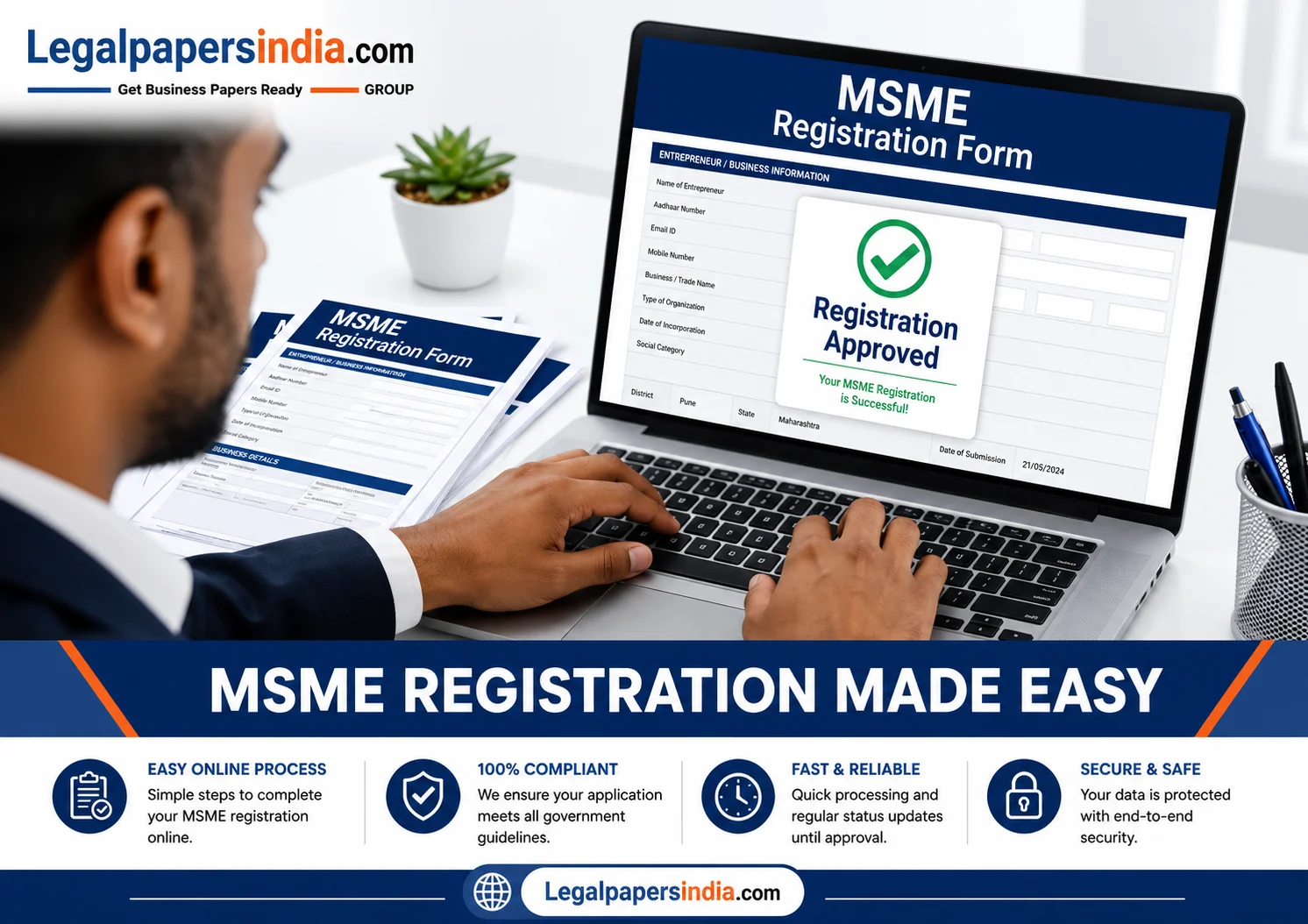
MSME Registration Guide: What Small Businesses Should Know Before Applying
When a Small Business Starts Growing, This Question Usually Comes Up
A freelancer lands a bigger client and suddenly needs formal invoices.
A local manufacturer wants to apply for a government tender but notices MSME registration is listed as a requirement.
A startup founder hears that banks offer better financing support to MSMEs but isn’t sure whether the business even qualifies.
This is usually the point where confusion begins.
Many business owners assume MSME registration is only for factories or established companies. Others think GST registration automatically covers MSME compliance. In reality, the process is simpler than many expect, but understanding eligibility, documentation, and practical usage matters before applying.
That’s why a proper MSME Registration Guide is useful — not just to explain the process, but to help business owners understand when it actually benefits them and when it may not be necessary.
What Is MSME Registration?
MSME registration is the process through which eligible micro, small, and medium enterprises are officially recognized under the Government of India’s MSME framework through the Udyam Registration system.
The registration helps businesses access certain government-backed benefits such as easier credit access, participation in specific tenders, delayed payment protection, and certain scheme-based incentives. It is administered through the Ministry of Micro, Small and Medium Enterprises.
MSME Registration Explained in Simple Terms
Think of MSME registration as an official business classification rather than a business license.
It does not create your business entity.
Instead, it categorizes an existing business based on investment and turnover criteria.
For example:
- A sole proprietor running a small trading business
- A startup offering software services
- A manufacturing unit producing industrial goods
- A partnership firm operating locally
…may all qualify under different MSME categories if they meet the prescribed thresholds.
This distinction matters because many entrepreneurs mistakenly assume MSME registration replaces registrations like GST, PAN, or company incorporation. It does not.
Why MSME Registration Matters for Growing Businesses
Not every small business immediately sees the value of MSME registration. But as operations expand, practical situations often make it relevant.
Here are some common reasons businesses apply:
Easier Access to Business Loans
Many banks and NBFCs consider MSME classification while evaluating certain lending schemes or collateral-free financing options.
Government Tender Eligibility
Some government procurement opportunities are specifically designed for MSMEs or provide relaxed participation conditions.
Delayed Payment Protection
Under MSME provisions, registered businesses may receive legal protection against delayed payments from buyers in certain cases.
Scheme-Based Benefits
Depending on policy updates and industry type, MSMEs may become eligible for subsidies, technology support programs, or sector-specific incentives.
Improved Business Credibility
In practice, vendors, buyers, and institutions sometimes view formally registered businesses as more reliable compared to entirely unregistered operations.
A business owner usually notices the importance of MSME registration only when an opportunity requires it unexpectedly.
Who Should Consider MSME Registration — And Who May Not Need It
Businesses That Commonly Benefit
MSME registration is often relevant for:
- Proprietorship businesses
- Partnership firms
- Private limited companies
- LLPs
- Manufacturers
- Service providers
- Traders
- Startups
- Home-based businesses with commercial activity
- Export-oriented small businesses
Businesses planning to scale, apply for financing, or work with institutional clients often benefit the most.
Businesses That May Not Immediately Need It
In some situations, MSME registration may not be a priority:
- Hobby-based non-commercial activity
- Businesses with no formal revenue structure
- Temporary side projects without operational continuity
- Activities outside MSME eligibility norms
For example, someone occasionally selling handmade products informally may not require immediate MSME registration unless the activity becomes a structured business.
How MSME Registration Works in Real-World Practice
A lot of online content explains the process theoretically. In reality, most applications follow a fairly predictable flow.
Step 1: Business Structure Is Established
Before MSME registration, the business usually already has:
- PAN
- Aadhaar
- Business name
- Basic operational activity
Depending on the setup, GST registration or incorporation documents may also exist.
Step 2: Eligibility Is Evaluated
The business is categorized based on:
- Annual turnover
- Investment in plant, machinery, or equipment
The classification determines whether the enterprise falls under Micro, Small, or Medium category.
Step 3: Udyam Registration Application Is Filed
The application is submitted through the official Udyam Registration framework using Aadhaar-linked verification.
Information generally includes:
- Business details
- Nature of activity
- PAN and GST details (where applicable)
- Bank details
- Classification information
Step 4: Verification and Registration Generation
If details match government records properly, the registration certificate is usually generated digitally.
Step 5: Post-Registration Usage
After approval, businesses commonly use the registration for:
- Loan applications
- Tender participation
- Vendor onboarding
- MSME compliance documentation
- Institutional partnerships
Businesses looking for procedural clarity often review professional guidance related to MSME registration services before filing to avoid classification or documentation mistakes.
Documents Commonly Required for MSME Registration
The exact requirement can vary depending on the business structure, but these are commonly needed:
Basic Identification Documents
- Aadhaar card
- PAN card
Business Information
- Business address
- Nature of activity
- Bank account details
Additional Documents
- GST registration
- Partnership deed
- Certificate of incorporation
- LLP agreement
When GST Becomes Relevant
Businesses crossing GST thresholds or operating in GST-mandated sectors may need GST registration linked during MSME application.
One practical issue many applicants face is inconsistency between PAN, GST, and Aadhaar details. Even small mismatches can slow the process.
Common Mistakes Businesses Make During MSME Registration
Assuming MSME Registration Creates a Business Entity
MSME registration is not incorporation.
You still need the appropriate legal structure separately.
Choosing Incorrect Business Classification
Applicants sometimes incorrectly classify trading, manufacturing, or service activities, which may later create confusion.
Using Inconsistent Financial Information
Turnover and investment details should align with actual records and tax filings where applicable.
Ignoring Future Scalability
Some businesses register casually without considering future compliance or financing requirements. Later corrections can become time-consuming.
Depending Entirely on Informal Advice
A surprising number of registration problems start with incomplete guidance from unofficial online sources.
Key Things to Consider Before Applying
Before starting MSME registration, it helps to think beyond just obtaining the certificate.
Understand Why You Need It
Ask practical questions:
- Are you applying for financing soon?
- Will you participate in tenders?
- Are institutional clients asking for MSME details?
Your actual business goals influence how important the registration becomes.
Ensure Other Registrations Are Aligned
Business details across:
- PAN
- GST
- Incorporation documents
- Bank records
…should ideally match.
Consider Future Growth
A business that currently qualifies as micro enterprise may eventually move into another category as turnover grows.
Planning with scalability in mind avoids future confusion.
MSME Registration vs GST Registration: What’s the Difference?
This is one of the most searched questions among small business owners.
| MSME Registration |
GST Registration |
|
Classifies eligible businesses under MSME framework |
Registers businesses for indirect taxation |
|
Focused on enterprise recognition and benefits |
Focused on tax compliance |
|
Not always mandatory |
Mandatory beyond specified thresholds |
|
Linked with Udyam system |
Linked with GST portal |
|
Useful for schemes, tenders, financing |
Required for GST invoicing and tax collection |
Many businesses eventually require both, but they serve entirely different purposes.
How Long Does MSME Registration Usually Take?
In straightforward cases, MSME registration can often be completed relatively quickly once documents and business details are accurate.
However, timelines vary due to:
- Aadhaar verification issues
- PAN mismatches
- GST inconsistencies
- Incorrect activity classification
- Technical portal issues
For businesses with proper documentation already in place, the process is usually smoother.
Frequently Asked Questions About MSME Registration
1. Is MSME registration mandatory for all small businesses?
No. MSME registration is generally optional unless a specific scheme, lender, tender, or institutional requirement makes it necessary for your business operations.
2. Can traders apply for MSME registration?
Yes. Traders may qualify under applicable MSME provisions, though eligibility and benefits can vary depending on policy interpretation and business activity.
3. Is MSME registration valid for lifetime?
The registration itself generally does not require periodic renewal in the traditional sense, but business information should remain updated and compliant with government records.
4. What happens if turnover increases later?
The enterprise category may change automatically based on updated turnover and investment data linked through government systems.
5. Can a business apply without GST registration?
In some cases, yes — especially if GST registration is not legally required for that business category or turnover level.
When Professional Assistance Becomes Useful
Some businesses complete MSME registration independently without difficulty.
But professional guidance may help when:
- Business structures are complex
- GST and PAN records differ
- Multiple activities exist
- Classification uncertainty arises
- Additional compliance planning is involved
Businesses operating across multiple regions sometimes also review broader operational guidance through pages like business service coverage locations to understand region-specific procedural support.
Toward the later stages of compliance planning, many entrepreneurs prefer working with teams experienced in business registrations and documentation workflows. You can learn more about Legal Papers Indiaand its background if you want additional context before seeking assistance.
Conclusion
MSME registration is often less about paperwork and more about business readiness.
For some businesses, it becomes useful during financing discussions. For others, it matters when entering government procurement, formal vendor ecosystems, or scaling operations beyond informal trade.
The important part is understanding where your business currently stands and whether MSME classification supports your next stage of growth.
If you are unsure about eligibility, classification, or documentation requirements, consulting experienced professionals before applying can help avoid unnecessary corrections later.
Need help with MSME Registration? Contact our experts for simple and fast registration support. We assist businesses with hassle-free documentation and online application services.
Social Share: