
Sep 04, 2026
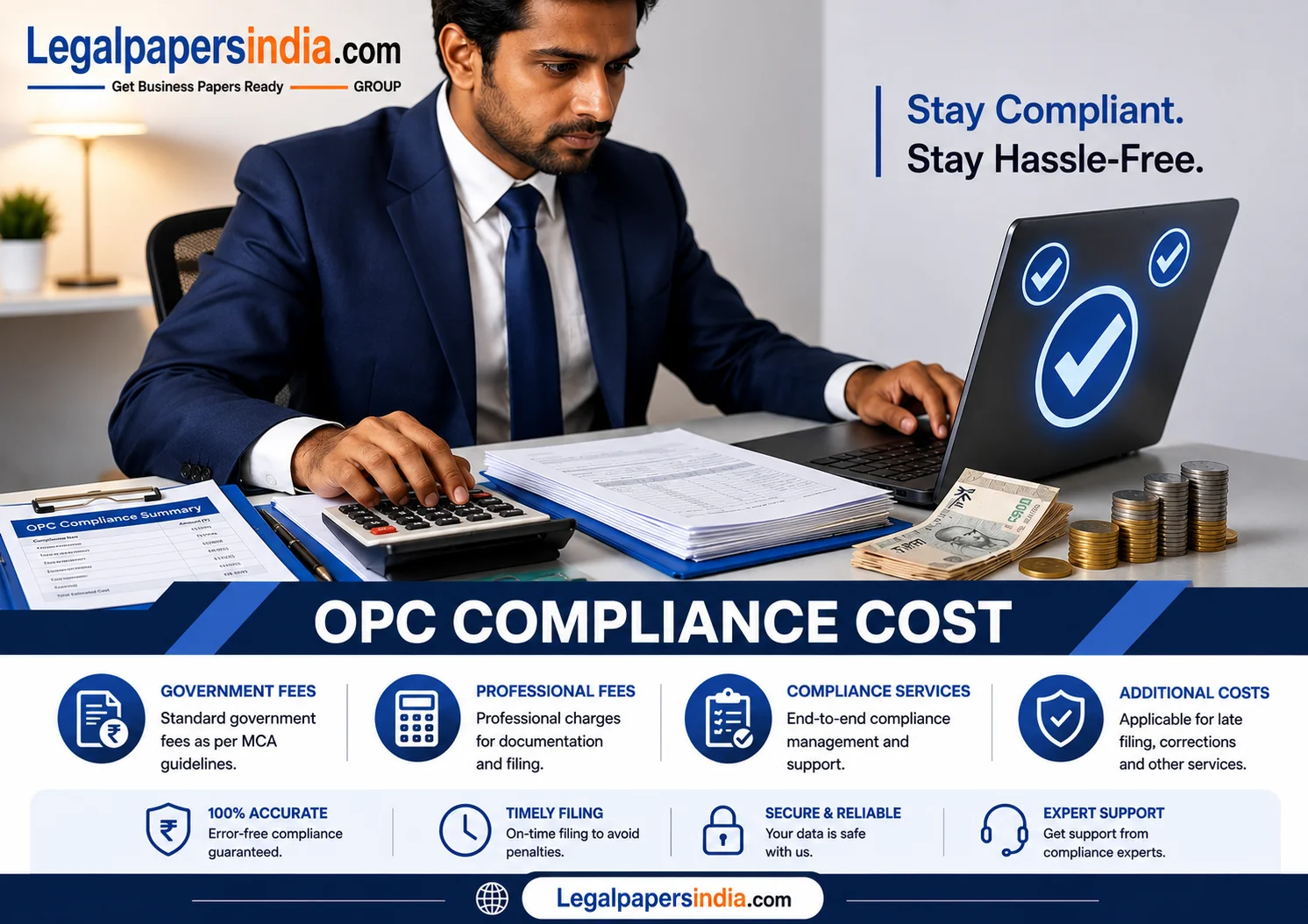
OPC Compliance Cost: What You Should Evaluate Before Registering
A lot of founders reach the same point before registering an OPC.
They like the idea of limited liability, cleaner business credibility, and a separate legal identity — but then another question starts bothering them:
“Will the ongoing compliance cost become a burden later?”
That hesitation is reasonable. An OPC (One Person Company) looks simple at the registration stage, but the real decision usually happens when people understand the yearly filing responsibilities, accounting expectations, and compliance overhead that follows after incorporation.
Some businesses benefit greatly from the OPC structure. Others end up paying for a compliance framework they never actually needed.
If you're currently evaluating OPC registration, the smarter approach is not just asking “How much does OPC compliance cost?” but also:
- Is the structure financially practical for your current stage?
- Can you maintain annual compliance comfortably?
- Will the legal and accounting obligations support your long-term plans?
Those are the questions that actually determine whether an OPC becomes useful or unnecessarily expensive later.
OPC compliance cost is usually manageable for solo founders who want structured business operations, legal separation, and better professional credibility. However, if your business has irregular income, minimal transactions, or no near-term growth plans, the annual filing, accounting, and regulatory responsibilities may feel heavier than expected.
When Choosing an OPC Usually Makes Sense
An OPC tends to work well when the business owner already sees the venture as a long-term professional setup rather than a temporary side activity.
You should seriously consider an OPC if you:
- Want limited liability protection
- Need a separate legal identity for contracts or clients
- Plan to build formal business credibility
- Intend to work with vendors, agencies, or corporate clients
- Want cleaner financial separation between personal and business income
- Expect business scaling over time
- Need structured compliance for funding readiness later
This becomes especially relevant for:
- Consultants and professionals
- Digital agencies
- Freelancers with stable revenue
- E-commerce sellers
- SaaS founders
- Solo service providers handling larger contracts
At this stage, many founders realize the compliance cost is not just an expense — it is part of operating within a recognized corporate structure.
If you are already evaluating whether an OPC aligns with your business model, reviewing the broader structure and registration process on the OPC registration service page can help clarify the operational expectations.
Situations Where an OPC May Not Be the Right Fit
This is the part many websites avoid discussing clearly.
An OPC is not automatically the best option for every solo entrepreneur.
You may want to avoid it if:
- Your revenue is still unpredictable
- You only need a basic invoicing structure
- You are testing a temporary business idea
- Your operations are extremely small-scale
- You are uncomfortable with recurring compliance deadlines
- You prefer minimal bookkeeping responsibilities
In real situations, some founders register an OPC too early because it “sounds professional,” then later struggle with:
- Annual filings
- Maintaining proper accounting records
- Auditor coordination
- Compliance tracking
- Additional professional fees
If your business is still experimental, a simpler structure may reduce unnecessary administrative pressure during the early phase.
Key Decision Criteria Before Proceeding
Before registering an OPC, evaluate these factors honestly.
Decision Checklist
Financial Readiness
- Can you comfortably manage annual compliance and professional fees?
- Will the business generate consistent income?
Operational Intent
- Is this a serious long-term venture or a trial project?
- Will you operate professionally with clients or vendors?
Compliance Comfort
- Are you prepared for annual ROC filings and accounting maintenance?
- Can you maintain proper invoices and financial records?
Growth Expectations
- Do you expect business expansion in the next 1–3 years?
- Could investor participation become relevant later?
Administrative Discipline
- Can you manage recurring deadlines?
- Will you maintain separation between personal and business finances?
People often underestimate the discipline part.
The actual challenge with OPC compliance is usually not complexity — it is consistency.
Understanding OPC Compliance Cost Beyond Filing Fees
One of the biggest misconceptions is assuming compliance cost only means government filing charges.
In practice, OPC compliance expenses usually include multiple layers.
Common OPC Compliance Components
- ROC annual filing
- Financial statement preparation
- Accounting/bookkeeping
- Auditor appointment and audit support
- Income tax return filing
- Director-related documentation
- Professional consultation fees
Depending on business activity, costs may also increase because of:
- GST compliance
- Payroll processing
- TDS filings
- Vendor documentation
- Multi-state operations
This is where many first-time founders get surprised.
The structure itself is manageable, but operational complexity gradually increases the compliance effort.
Practical Cost Reality
For a low-transaction OPC(One Person Company) with organized records, compliance management is usually straightforward.
But businesses with:
- Scattered transactions,
- Poor bookkeeping,
- Delayed invoicing,
- Or missing documentation
often end up paying higher professional charges later simply because rectification work becomes time-consuming.
What Actually Increases OPC Compliance Burden?
Interestingly, the company structure is rarely the main problem.
The burden usually increases because founders delay systems.
Common Patterns Seen in Real Cases
Mixing Personal and Business Expenses
This creates accounting confusion very quickly.
Ignoring Monthly Record Maintenance
People postpone bookkeeping for months, then face year-end panic during filings.
Assuming “No Business Activity” Means “No Compliance”
Even dormant companies can have filing obligations.
Choosing OPC Only for Branding
Some founders pick OPC purely because it sounds corporate, even when their operations do not justify the structure yet.
That mismatch often creates avoidable cost pressure.
Risk Factors You Should Evaluate Carefully
Before proceeding, think about the following risks realistically.
Compliance Delay Risk
Late filings may attract penalties and additional professional charges.
Scalability Transition
If the business grows significantly, structural changes may eventually become necessary.
Cost-to-Revenue Imbalance
For very small businesses, annual compliance cost may consume a noticeable percentage of profits.
Documentation Dependency
Corporate structures require organized records. If you dislike administrative work entirely, maintaining compliance can become frustrating.
At this stage, many people start asking themselves:
“Do I actually want a structured company right now — or just the appearance of one?”
That question matters more than most comparison charts online.
A Practical Action Plan Before Registering
Instead of rushing into registration, follow a more practical evaluation sequence.
Step 1 — Estimate Real Annual Revenue
Avoid optimistic projections. Use conservative estimates.
Step 2 — Calculate Compliance Sustainability
Assess whether yearly compliance expenses remain comfortable even during slower months.
Step 3 — Clarify Business Intent
Are you building:
- A professional long-term venture,
- Or simply validating a market idea?
Step 4 — Organize Financial Systems Early
Create:
- Separate bank usage,
- Invoice discipline,
- Expense tracking,
- Document storage habits.
Step 5 — Understand Your Filing Responsibilities
Before incorporation, know what recurring obligations will continue afterward.
This reduces future frustration significantly.
Common Decision-Stage Mistakes
Registering Too Early
Many founders formalize before validating consistent business activity.
Underestimating Accounting Needs
Even small OPCs require organized financial management.
Ignoring Professional Guidance
Trying to manage everything without compliance support often creates filing errors later.
Thinking Registration Is the Main Cost
The operational maintenance matters far more over time.
Delaying Compliance Until Deadline Season
This usually increases stress, mistakes, and professional correction costs.
Practical Scenarios That Help Clarify the Decision
Scenario 1: Freelance Consultant With Stable Clients
An OPC often makes sense here because:
- Contracts become more professional,
- Liability protection improves,
- And compliance cost is easier to justify through predictable revenue.
Scenario 2: Early-Stage Side Hustle
If revenue is inconsistent and operations are experimental, an OPC may feel unnecessarily heavy initially.
Scenario 3: Solo Founder Planning Long-Term Growth
If scaling, credibility, and structured operations matter, OPC compliance becomes part of building operational maturity.
Scenario 4: Small Seller With Minimal Transactions
In some cases, simpler structures remain more practical until operational volume increases.
Final Decision Summary
OPC compliance cost is reasonable when the business itself is serious, structured, and financially active.
It becomes difficult mainly when:
- The business is premature,
- Records are poorly maintained,
- Or the founder chooses the structure without understanding ongoing obligations.
An OPC is usually a good fit for founders who value:
- Professionalism,
- Liability separation,
- Operational credibility,
- And long-term business structuring.
But if your business is still uncertain or extremely small, waiting before formal incorporation can sometimes be the smarter financial decision.
Frequently Asked Questions
1. Is OPC compliance costly for small businesses?
OPC compliance is generally manageable for businesses with stable income and organized records. However, for very small or irregular businesses, recurring filing, accounting, and professional costs may feel disproportionate compared to actual revenue.
2. Does an OPC require annual filing even with low business activity?
Yes. An OPC typically continues to have statutory compliance obligations even if business activity is limited. Ignoring filings because operations are inactive can create penalties later.
3. Can I manage OPC compliance myself?
Some basic record management can be handled independently, but most founders still rely on professionals for ROC filings, accounting finalization, and regulatory compliance to reduce errors and missed deadlines.
4. Is OPC suitable for freelancers and consultants?
Yes, especially for professionals handling long-term clients, contracts, or higher-value projects. The structure can improve credibility and provide liability separation when operations become more formal.
5. When does OPC become financially practical?
OPC usually becomes practical when business revenue is consistent enough to comfortably absorb annual compliance, accounting, and regulatory costs without affecting operational stability.
Conclusion
The real decision around OPC compliance cost is not whether the structure is “cheap” or “expensive.”
It is whether the structure matches the seriousness, stability, and direction of your business.
If you're still evaluating, take time to assess operational readiness — not just registration enthusiasm.
And if you need structured guidance before making that decision, learning more about Legal Papers India and their approach may help you understand how compliance planning fits into the bigger picture of running a legally sustainable business.
Connect with our team for quick and reliable OPC Compliance assistance. We provide easy support for OPC Compliance Cost.
Social Share: