
Sep 04, 2026
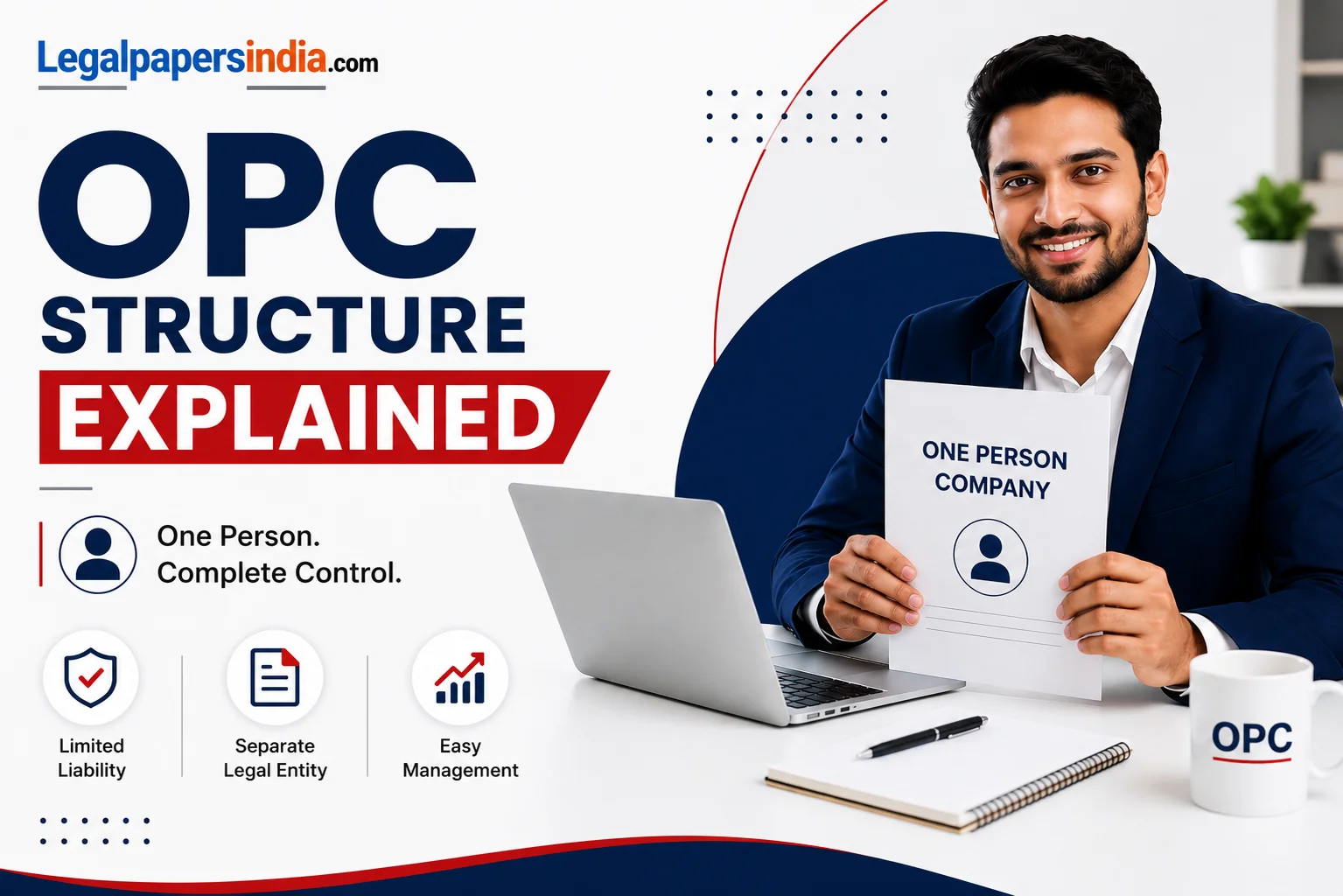
OPC Structure Explained: How a One Person Company Actually Works in India
When a Solo Founder Wants Limited Liability Without Building a Full Private Limited Company
A lot of businesses in India begin the same way — one person handling everything. The founder manages clients, invoices, compliance, banking, and growth decisions alone. At some point, though, operating as an individual starts creating friction.
Banks ask for structured business documentation. Vendors prefer dealing with registered entities. Liability concerns become real. And many founders realize that continuing as a sole proprietor may not offer enough legal separation between personal and business assets.
That is usually when the term “OPC” starts appearing during searches.
But the confusion is understandable. Many people assume a One Person Company is simply a renamed sole proprietorship. Others believe it works exactly like a Private Limited Company. In reality, it sits somewhere between flexibility and corporate structure.
Understanding how an OPC is structured — legally, operationally, and compliantly — helps founders decide whether it genuinely fits their business stage or whether another entity model would be more practical.
What Is an OPC Structure?
An OPC (One Person Company) is a legally recognized business structure under the Companies Act, 2013 that allows a single individual to own and operate a company with limited liability protection. It combines the control of sole ownership with the legal identity and compliance framework of a registered company.
OPC Structure Explained in Simpler Terms
A One Person Company works like a company run by a single owner. The business becomes a separate legal entity from the individual, meaning the company can own assets, sign contracts, and carry liabilities independently while still being controlled by one shareholder-director.
Why the OPC Structure Matters for Small Businesses
The structure matters because it changes how the business is legally viewed.
As a sole proprietor, the individual and the business are treated as the same entity. In an OPC, the company becomes separate from the owner. That distinction affects:
- Liability exposure
- Business credibility
- Tax and compliance handling
- Banking relationships
- Contract execution
- Long-term scalability
For example, a freelance consultant handling larger retainers may eventually prefer contracts under a company name rather than a personal identity. Similarly, an e-commerce seller expanding operations may want clearer separation between personal finances and business obligations.
An OPC creates that formal separation without requiring multiple shareholders.
It is also commonly considered by:
- Independent professionals
- Digital service providers
- IT consultants
- Small manufacturers
- Designers and agency founders
- Online sellers
- Early-stage entrepreneurs testing business models
In several cases, founders first explore business structures through regional compliance resources or location-specific guidance available on the service presence page before deciding which registration model fits their operations.
Core Features of an OPC Structure
Understanding the structure becomes easier when you break down its main components.
1. Single Shareholder Ownership
An OPC can have only one shareholder.
That person owns 100% of the company shares and retains complete control over major decisions.
2. Separate Legal Entity
The company exists independently from the owner.
This means:
- The company can enter contracts
- Own intellectual property
- Open bank accounts
- Sue or be sued separately
3. Limited Liability Protection
The owner’s personal liability is generally limited to the capital invested in the company.
This is one of the biggest differences from sole proprietorships.
4. Nominee Requirement
Every OPC must appoint a nominee during incorporation.
If the owner becomes incapacitated or dies, the nominee can take over ownership continuity. This requirement is often misunderstood but is legally important for succession purposes.
5. Corporate Compliance Applicability
Even though there is only one owner, the business still falls under the Ministry of Corporate Affairs (MCA) compliance framework.
That includes:
- Annual filings
- Financial statements
- ROC compliance
- Statutory record maintenance
Who Should Consider an OPC — And Who Usually Should Not
Businesses That Commonly Benefit from an OPC
An OPC may make sense if:
- You are the sole founder
- You want limited liability protection
- Your operations are relatively small but formal
- You need better business credibility
- You plan to work with corporate clients
- You want a structured business identity
Practical examples include:
- A solo architect handling commercial projects
- A YouTube creator building a media business
- A software developer offering SaaS tools independently
- A consultant signing enterprise agreements
Who May Not Need an OPC
An OPC may not be ideal if:
- You already have co-founders
- You plan immediate investor onboarding
- Your business requires equity distribution
- You want minimal compliance responsibilities
- Your operations are extremely small and informal
In those situations, either a partnership model or a Private Limited Company may fit better.
OPC vs Sole Proprietorship: What Actually Changes?
Many searches around OPC structures are really attempts to understand whether incorporation changes day-to-day business functioning.
Here is the practical distinction.
| Aspect | ||
|
Legal Identity |
Separate company entity |
Owner and business are same |
|
Liability |
Limited |
Unlimited personal liability |
|
Compliance |
MCA compliance required |
Lower formal compliance |
|
Ownership |
One shareholder |
One owner |
|
Credibility |
Higher corporate recognition |
Often informal |
|
Continuity |
Structured succession through nominee |
Depends on individual |
An OPC introduces more compliance responsibilities, but it also creates stronger institutional recognition.
How the OPC Registration Process Typically Works
The process is usually smoother when documentation is prepared properly from the beginning.
Step 1: Obtain Digital Signatures
The proposed director needs:
- DSC (Digital Signature Certificate)
- PAN and Aadhaar linkage
Step 2: Director Identification Number (DIN)
The director receives a DIN through the incorporation process.
Step 3: Reserve the Company Name
The proposed business name is submitted through MCA systems for approval.
Certain naming restrictions apply, especially where trademarks or regulated terms are involved.
Step 4: Prepare Incorporation Documents
This typically includes:
- MOA
- AOA
- Identity proof
- Address proof
- Registered office documentation
- Nominee consent
Step 5: Filing with MCA
The incorporation application is filed with the Ministry of Corporate Affairs.
Step 6: Certificate of Incorporation Issued
Once approved:
- CIN is generated
- PAN/TAN integration is processed
- The OPC becomes a legally recognized company
Businesses exploring the incorporation journey often review detailed guidance around One Person Company registration to better understand filing requirements and compliance obligations before proceeding.
Documents Usually Required for OPC Registration
The exact documentation may vary slightly depending on the applicant’s circumstances, but the common requirements include:
Personal Documents
- PAN card
- Aadhaar card
- Passport-sized photograph
- Mobile number and email ID
Address Proof
- Bank statement
- Utility bill
- Driving licence or voter ID
Registered Office Proof
- Rent agreement (if rented)
- NOC from property owner
- Utility bill of premises
Nominee Documentation
- PAN and Aadhaar of nominee
- Consent form
One common delay occurs when address proofs contain mismatched names or outdated addresses. Even small inconsistencies can slow approval timelines.
Common Mistakes People Make While Choosing an OPC
Assuming Compliance Is Minimal
Many founders hear “single owner company” and assume reporting obligations are negligible.
In reality, MCA filings still apply.
Choosing OPC Despite Planned Co-Founder Expansion
Some startups incorporate as OPCs despite already planning equity partnerships within months. That often leads to unnecessary restructuring later.
Ignoring Nominee Selection
The nominee requirement is not just procedural paperwork. The nominee should be someone trustworthy and informed about the role.
Using Residential Addresses Without Documentation Readiness
Incorporation delays often happen because registered office proofs are incomplete or improperly formatted.
Important Compliance Responsibilities After Incorporation
Registration is only the starting point.
- Post-incorporation obligations may include:
- Annual ROC filings
- Income tax return filing
- Financial statement preparation
- Auditor appointment
- Maintaining statutory registers
- GST registration if turnover thresholds apply
Ignoring post-registration compliance can lead to:
- Penalties
- Additional filing fees
- Director disqualification risks in severe cases
- Operational complications during banking or funding
The penalties are usually financial rather than immediate legal action, but prolonged non-compliance can create significant administrative issues.
How Long Does OPC Registration Usually Take?
Under normal conditions, incorporation may take anywhere between 7 to 15 working days.
However, timelines vary depending on:
- Name approval issues
- Documentation accuracy
- MCA processing timelines
- Digital signature readiness
- Registered office verification
In practice, the biggest delays often come from avoidable documentation mismatches rather than government processing itself.
Key Things to Consider Before Choosing an OPC
Before registering, it helps to evaluate the business realistically rather than choosing a structure simply because it sounds formal.
Ask yourself:
- Will you remain a solo owner for the foreseeable future?
- Do you need limited liability protection?
- Are you prepared for annual compliance?
- Will clients benefit from dealing with a registered company?
- Do you expect investor participation later?
An OPC works well for certain stages of business growth, but it is not automatically the best option for every founder.
Frequently Asked Questions About OPC Structure
1. Can one person fully own and manage an OPC?
Yes. An OPC is specifically designed for single ownership. One individual can act as both shareholder and director while operating the company independently.
2. Is an OPC better than a sole proprietorship?
It depends on business goals. An OPC offers limited liability and stronger legal recognition, while a sole proprietorship generally involves fewer compliance requirements.
3. Does an OPC require annual compliance filing?
Yes. Even though ownership is limited to one person, the company must comply with MCA filing and reporting obligations annually.
4. Can an OPC later convert into a Private Limited Company?
Yes. Conversion is possible if the business expands, adds shareholders, or requires external investment participation.
5. What happens if OPC compliance is ignored?
Non-compliance can lead to penalties, additional filing fees, and regulatory complications. Over time, unresolved defaults may affect the company’s operational standing.
When Professional Guidance Becomes Usefull
Many OPC applications are straightforward on paper but become complicated because of:
- Incorrect document formatting
- Naming conflicts
- Compliance misunderstandings
- Structural confusion between OPC and other entities
Professional assistance is usually more useful when:
- The business has regulatory overlap
- GST applicability is unclear
- Trademark considerations exist
- Future restructuring is expected
- The founder wants cleaner compliance handling from the beginning
You can also learn more about the background and operational approach of Legal Papers India if you want to understand how professional compliance support is typically structured.
Conclusion
The OPC structure was introduced to bridge a practical gap in Indian business registration — giving solo entrepreneurs access to a corporate framework without forcing multi-owner participation.
For many small businesses, consultants, creators, and independent professionals, that balance can be useful. But an OPC is not simply a “better proprietorship.” It brings formal responsibilities along with legal advantages.
The right decision usually depends less on trend and more on how your business actually operates today — and how you expect it to evolve over the next few years.
If you are uncertain about eligibility, compliance applicability, or whether an OPC genuinely fits your situation, consulting experienced professionals before incorporation can help avoid restructuring complications later.
Contact Legal Papers India for quick and hassle-free One Person Company (OPC) registration support. Our team assists with documentation, online filing, and company registration services across India.
Social Share: