
Sep 04, 2026
ISO Certification Types: Understanding the Different Standards and Their Purpose
Why So Many Businesses Get Confused About ISO Certifications
A manufacturer wants to export products and is suddenly asked for ISO 9001.
A food startup hears distributors mention ISO 22000.
An IT company applying for enterprise contracts is told to consider ISO 27001.
At that point, most business owners ask the same question: Are all ISO certifications the same, or does each one serve a different purpose?
The confusion is understandable. ISO certifications are often discussed as a single concept, but in practice, there are multiple ISO standards designed for completely different operational areas — quality management, food safety, environmental responsibility, information security, medical devices, and more.
Understanding the different ISO certification types helps businesses avoid applying for the wrong standard, overcomplying unnecessarily, or missing certifications that clients and regulators increasingly expect in certain industries.
What Are ISO Certification Types?
ISO certification types refer to different international standards developed by the International Organization for Standardization (ISO) for specific business functions such as quality management, information security, food safety, environmental management, and operational processes. Each ISO standard addresses a distinct area of compliance, consistency, and risk control within an organization.
A Simpler Way to Understand ISO Certification Types
Think of ISO standards as operational frameworks rather than business licenses.
One ISO certification may help a company improve product quality. Another may focus on securing customer data. A different standard may apply only to food manufacturers or healthcare businesses.
The certification itself does not mean “government approval.” Instead, it demonstrates that a business follows internationally recognized systems and processes for a particular operational area.
That distinction matters because many businesses assume one ISO certificate covers everything — it does not.
Why ISO Certification Types Matter for Businesses
Different industries face different operational risks.
A logistics company may need process consistency.
A cloud software provider may need data protection controls.
A food processing unit may need contamination prevention systems.
ISO standards exist because operational risks vary across sectors.
In real-world business situations, ISO certifications often influence:
- Vendor approvals
- Corporate partnerships
- Tender eligibility
- Export opportunities
- Client confidence
- Internal process discipline
- Compliance readiness
Many larger organizations now include ISO-related requirements in procurement or onboarding checklists. Even when certification is not legally mandatory, it can become practically necessary for growth.
Businesses exploring operational compliance frameworks often review broader ISO certification requirements and applicability before deciding which standard fits their industry.
Common ISO Certification Types Explained
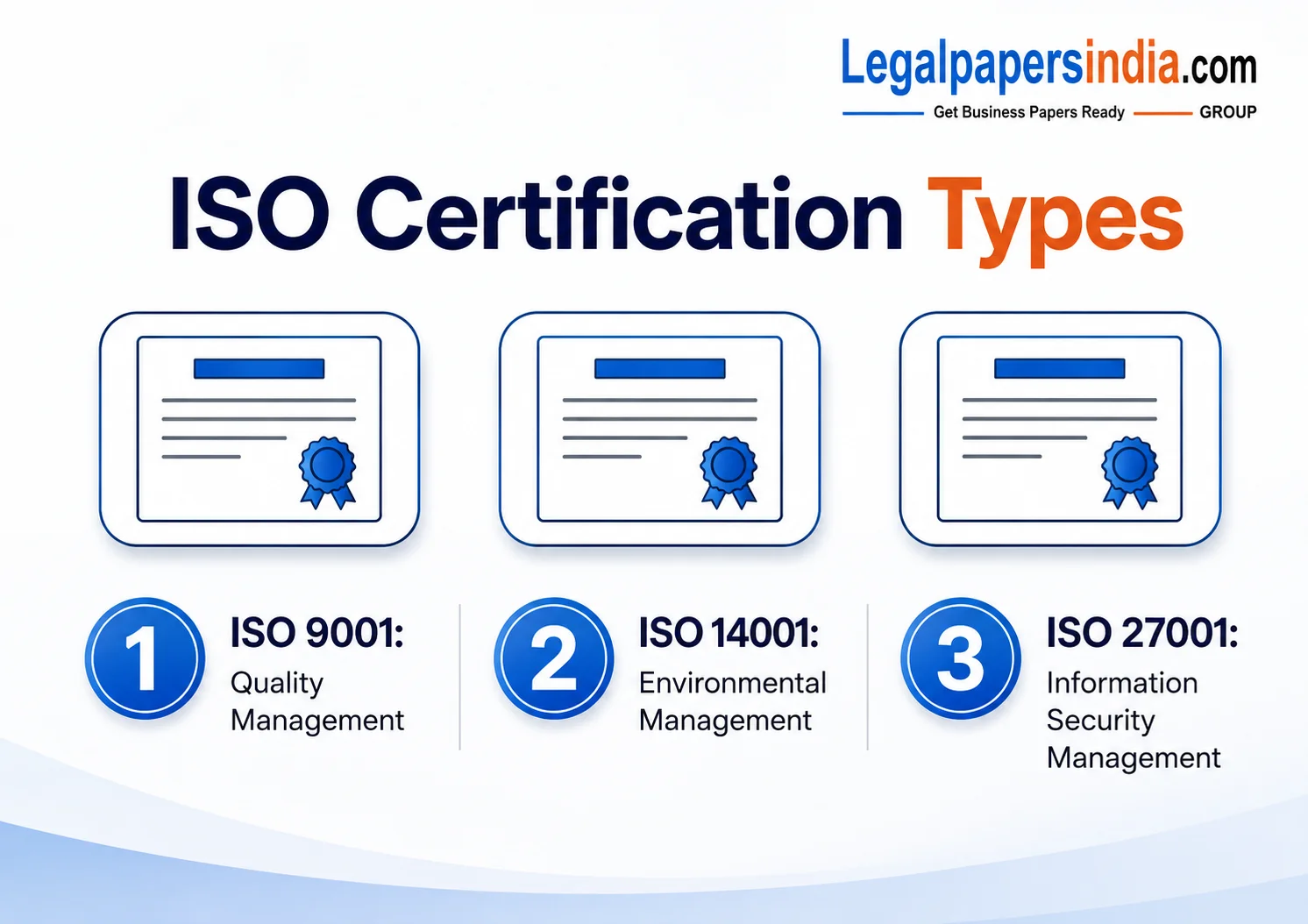
ISO 9001 – Quality Management System (QMS)
ISO 9001 is among the most widely recognized ISO standards globally.
It focuses on:
- Process consistency
- Customer satisfaction
- Quality control
- Documentation systems
- Continuous improvement
This certification is commonly used by:
- Manufacturers
- Service providers
- Consultants
- Educational institutions
- Logistics companies
In practice, businesses often pursue ISO 9001 when clients want assurance that operations follow structured quality procedures.
ISO 27001 – Information Security Management (ISM)
ISO 27001 focuses on protecting sensitive information and managing cybersecurity risks.
It is especially relevant for:
- IT companies
- SaaS businesses
- Data processors
- Fintech platforms
- BPO operations
- Cloud service providers
The certification framework includes:
- Access control policies
- Data handling procedures
- Incident response systems
- Risk assessment mechanisms
With growing concern around data breaches, ISO 27001 is increasingly requested during enterprise onboarding and international partnerships.
ISO 22000 – Food Safety Management (FSM)
ISO 22000 applies to food-related businesses and emphasizes food safety controls throughout the supply chain.
It is commonly considered by:
- Food manufacturers
- Restaurants
- Packaging units
- Food exporters
- Cold storage businesses
The standard integrates preventive food safety principles and operational hygiene management.
Businesses already dealing with food compliance frameworks often combine this with FSSAI-related obligations.
ISO 14001 – Environmental Management System (EMS)
ISO 14001 focuses on environmental responsibility and sustainability practices.
This standard helps businesses manage:
- Waste handling
- Resource usage
- Pollution control
- Environmental impact assessment
It is particularly relevant for:
- Factories
- Industrial units
- Construction businesses
- Chemical processing companies
For some export-oriented businesses, environmental management standards are becoming commercially important rather than purely voluntary.
ISO 45001 – Occupational Health and Safety (OHS)
ISO 45001 deals with workplace safety and employee risk management.
It is commonly adopted in:
- Construction
- Manufacturing
- Warehousing
- Engineering sectors
The standard encourages structured systems for:
- Hazard identification
- Safety training
- Incident reporting
- Workplace risk reduction
In industries with physical operational risks, this certification often strengthens contractor credibility.
Which ISO Certification Does a Business Actually Need?
This is where many businesses make assumptions that create unnecessary expense or compliance gaps.
The right ISO standard depends on factors such as:
- Industry type
- Operational risks
- Client expectations
- Regulatory environment
- Export goals
- Data handling responsibilities
For example:
| Business Type |
Commonly Relevant ISO Standard |
|
Software company |
ISO 27001 |
|
Manufacturing unit |
ISO 9001 |
|
Food processing business |
ISO 22000 |
|
Construction contractor |
ISO 45001 |
|
Industrial plant |
ISO 14001 |
In some situations, businesses adopt multiple ISO standards together to build integrated compliance systems.
Who Should Consider ISO Certifications?
ISO certifications are commonly considered by:
- Businesses bidding for government or corporate tenders
- Export-oriented companies
- Startups entering enterprise partnerships
- Manufacturers scaling operations
- Companies handling sensitive customer data
- Businesses seeking process standardization
- Organizations expanding internationally
Even smaller businesses sometimes pursue ISO certifications because larger clients increasingly prefer structured compliance ecosystems.
If your business is growing beyond informal operations, ISO standards often become part of operational maturity discussions.
Who May Not Need ISO Certification Immediately?
Not every business requires ISO certification at an early stage.
A small local business with:
- Limited operational complexity
- No enterprise clients
- No export activity
- Minimal compliance dependency
may not need certification immediately.
Similarly, some businesses pursue ISO certification too early without having stable internal systems. That usually creates documentation-heavy processes that teams struggle to maintain.
The better approach is to align certification timing with actual operational or commercial need.
How the ISO Certification Process Typically Works
Although exact procedures vary by certification body and standard type, the process generally follows a structured sequence.
1. Scope Identification
The business determines:
- Which ISO standard applies
- Which departments or operations are covered
- What compliance objectives exist
2. Gap Assessment
Current business processes are reviewed against ISO requirements.
This stage often reveals:
- Missing documentation
- Process inconsistencies
- Lack of monitoring systems
- Policy gaps
3. Documentation and Implementation
The organization develops:
- SOPs
- Policies
- Internal controls
- Compliance records
- Monitoring frameworks
This stage usually takes the most operational effort.
4. Internal Audit
Before external certification, businesses typically conduct internal reviews to identify unresolved compliance gaps.
5. Certification Audit
An accredited certification body evaluates whether the organization complies with the applicable ISO standard.
If requirements are met, certification is issued.
6. Ongoing Surveillance and Renewal
ISO certification is not a one-time event.
Periodic audits and renewals are generally required to maintain certification validity.
That ongoing compliance aspect is something businesses often underestimate initially.
Documents Commonly Required During ISO Certification
Documentation requirements vary depending on the ISO standard and business model.
However, businesses commonly prepare:
- Business registration documents
- GST registration
- Organizational structure details
- Process manuals
- SOPs and policy documents
- Employee records
- Risk assessment records
- Operational logs
- Compliance monitoring documents
For technical standards like ISO 27001 or ISO 22000, evidence of operational controls becomes especially important.
Common Mistakes Businesses Make During ISO Certification
Choosing the Wrong ISO Standard
Some businesses apply for certifications simply because competitors have them, without checking actual relevance.
Treating Certification as a One-Time Exercise
ISO systems require ongoing implementation. Businesses that only prepare for audit day often struggle during surveillance reviews.
Overcomplicating Documentation
Another common issue is excessive paperwork that employees cannot realistically follow.
Practical implementation matters more than creating bulky manuals.
Ignoring Employee Training
Even well-designed systems fail when teams do not understand operational procedures.
ISO compliance is operational, not just administrative.
Key Considerations Before Applying
Before pursuing ISO certification, businesses should evaluate:
- Whether clients or regulators actually require it
- Internal operational readiness
- Available compliance resources
- Long-term maintenance capability
- Certification body credibility
- Scope clarity
A rushed certification approach often creates process fatigue internally.
Businesses that benefit most usually treat ISO implementation as an operational improvement exercise rather than merely a certificate acquisition task.
Typical Timeline for ISO Certification
The timeline depends on:
- Business size
- Operational complexity
- Existing documentation maturity
- Type of ISO standard
Typical ranges may look like:
- Small businesses: 1–3 months
- Mid-sized organizations: 3–6 months
- Complex enterprises: longer depending on multi-location operations
ISO 27001 and ISO 22000 implementations often take more time because of control testing and operational evidence requirements.
Frequently Asked Questions
1. Is ISO certification legally mandatory in India?
Most ISO certifications are voluntary. However, certain industries, contracts, or procurement requirements may effectively make certification commercially necessary.
2. Can a startup apply for ISO certification?
Yes. Startups can apply if they have defined operational systems and processes relevant to the chosen ISO standard.
3. Does one ISO certification cover all business compliance requirements?
No. Each ISO standard addresses a specific operational area. A business may require different ISO certifications for quality, security, safety, or environmental management.
4. How long does ISO certification remain valid?
ISO certifications generally require periodic surveillance audits and renewal cycles to remain active.
5. What happens if a business fails to maintain ISO standards?
Non-compliance during audits may lead to observations, corrective action requirements, suspension, or cancellation of certification.
When Professional Assistance Becomes Useful
Many businesses initially try to manage ISO implementation internally. That can work for simpler operational environments.
However, professional guidance often becomes valuable when:
- Multiple departments are involved
- Technical standards apply
- Documentation systems are incomplete
- Internal compliance expertise is limited
- Client deadlines are tight
A structured approach usually reduces rework and helps align certification efforts with actual operational practices rather than creating impractical documentation systems.
Businesses wanting to understand organizational compliance support structures sometimes review the background and expertise of Legal Papers India professional advisory team before proceeding further.
Conclusion
ISO certification types exist because businesses face different operational challenges, risks, and compliance expectations.
A software company handling customer data does not face the same compliance priorities as a food manufacturer or construction contractor. That is why selecting the right ISO standard matters far more than simply obtaining “an ISO certificate.”
The most effective ISO implementations are usually the ones aligned with real operational needs — not just external pressure.
If you are unsure which ISO certification applies to your business model, industry expectations, or compliance obligations, seeking professional guidance before starting the process can help avoid unnecessary complexity and long-term compliance issues.
Legal Papers India helps businesses obtain ISO Certification with professional and hassle-free support. We assist companies with documentation, certification guidance, and compliance services to improve business credibility and standards.
Get in touch with Legal Papers India for reliable ISO Certification services. Our experts provide quick assistance with documentation, application processing, and certification support for businesses across India.
Social Share: