
Sep 04, 2026
OPC vs Pvt Ltd Basics: Which Business Structure Fits Different Entrepreneurial Goals?
When a Solo Founder Starts Growing, the Confusion Usually Begins
A freelance consultant starts getting repeat clients and wants legal credibility.
A startup founder plans to raise investment later but currently runs the business alone.
A family business wants limited liability but does not know whether one director is enough.
This is where many entrepreneurs get stuck between two common business structures — One Person Company (OPC) and Private Limited Company (Pvt Ltd).
At first glance, both seem similar because both are registered under the Companies Act and offer limited liability protection. But once you look at ownership rules, compliance obligations, scalability, and long-term business flexibility, the difference becomes much more practical than technical.
Understanding these basics early can prevent restructuring challenges later, especially when your business begins expanding faster than expected.
What Is an OPC?
An OPC (One Person Company) is a business structure registered under the Companies Act, 2013 that allows a single individual to operate a company with limited liability protection. It combines the advantages of sole ownership with the legal identity of a corporate entity, making it suitable for solo entrepreneurs and professionals.
What Is a Private Limited Company?
A Private Limited Company is a legally registered business entity owned by two or more shareholders and managed by directors. It offers separate legal identity, limited liability, structured ownership, and greater flexibility for investment, expansion, and team-based business operations.
Why the Difference Between OPC and Pvt Ltd Matters
Choosing between OPC and Pvt Ltd is not just about registration paperwork. The decision affects:
- Future funding possibilities
- Ownership flexibility
- Compliance responsibilities
- Tax planning structure
- Business continuity
- Investor confidence
- Scalability
In practice, many founders initially choose OPC because they are starting alone. But once they add co-founders, seek funding, or expand operations, they often convert into a Private Limited Company later.
On the other hand, businesses that already anticipate partnerships, hiring leadership teams, or attracting investors usually prefer Pvt Ltd registration from the beginning.
That is why the right choice depends less on “which is better” and more on “what the business is expected to become.”
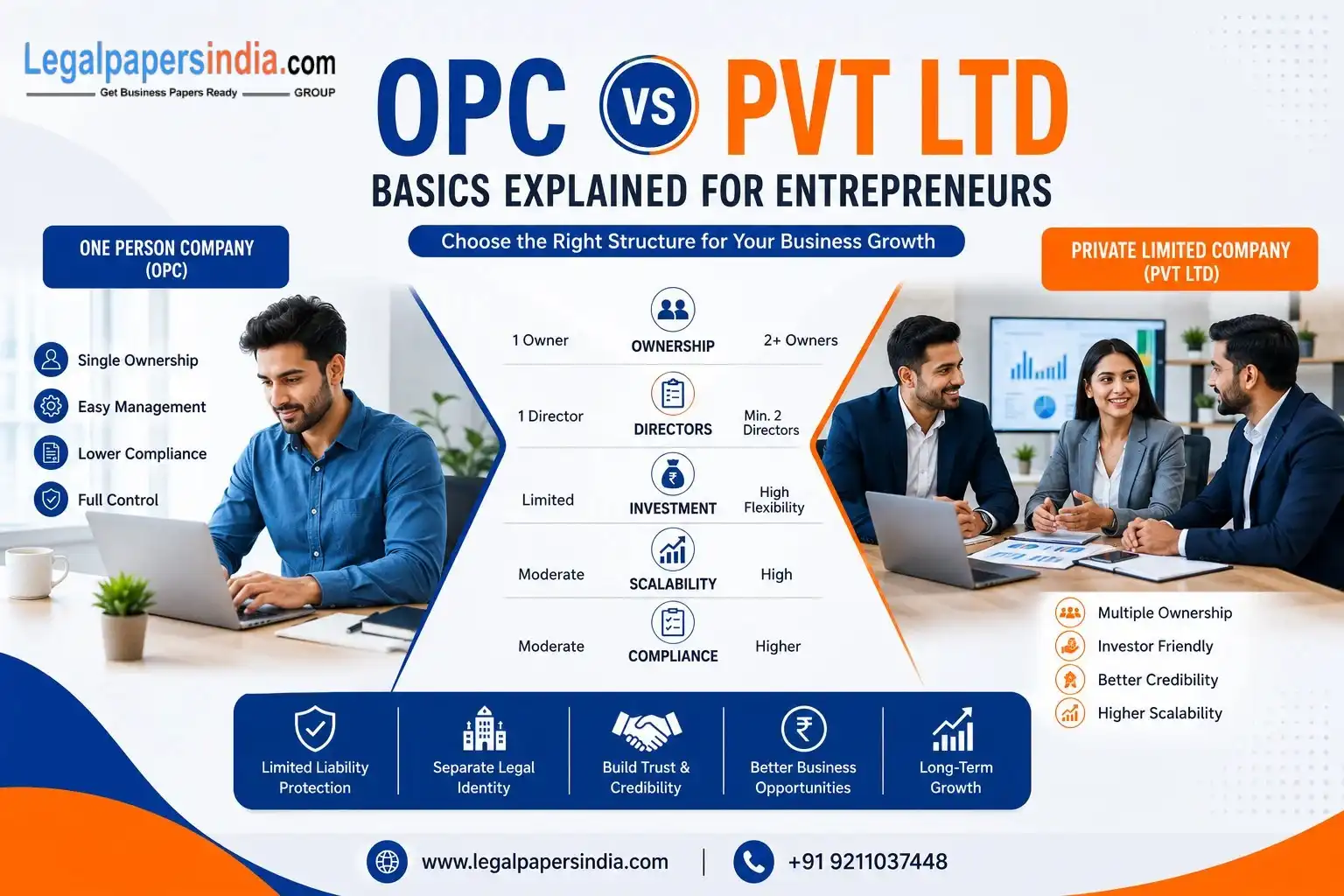
OPC vs Pvt Ltd Basics: Core Differences Explained
|
Aspect |
OPC |
Private Limited Company |
|
Number of Owners |
One shareholder |
Minimum two shareholders |
|
Directors Required |
One director |
Minimum two directors |
|
Liability |
Limited |
Limited |
|
Separate Legal Identity |
Yes |
Yes |
|
Investment Flexibility |
Limited |
Better suited for investment |
|
Ownership Transfer |
Restricted |
Easier comparatively |
|
Compliance Level |
Moderate |
Higher |
|
Scalability |
Suitable for smaller operations |
Better for scaling |
|
Suitable For |
Solo founders |
Startups and growth-focused businesses |
A practical observation: businesses expecting rapid growth rarely remain single-owner operations for long. That makes future planning an important part of the decision.
Who Should Consider OPC Registration?
OPC can make sense in situations where one individual wants legal protection without immediately building a partnership structure.
Common Examples
- Independent consultants
- Freelancers with growing revenue
- Solo e-commerce sellers
- Small service providers
- Individual digital entrepreneurs
- Professionals building personal brands
OPC Works Well When:
- You want complete ownership control
- External investment is not an immediate goal
- Business operations are relatively straightforward
- You want a corporate identity instead of operating as a sole proprietorship
If you are exploring different business registration structures across regions, the operational presence information available on the service coverage page can help understand broader applicability.
Who Should Consider a Private Limited Company?
Private Limited Companies are generally preferred where business growth, team ownership, or external investment may become important.
Common Situations
- Startup founders with co-founders
- Technology startups
- Agencies with multiple partners
- Businesses planning fundraising
- Companies expecting equity distribution
- Businesses with long-term expansion goals
Pvt Ltd Usually Makes More Sense When:
- More than one founder is involved
- Investors may enter later
- Ownership flexibility is important
- The business plans to scale operations aggressively
In real-world startup ecosystems, investors and institutional partners often feel more comfortable dealing with Private Limited entities because of structured shareholding and governance mechanisms.
Who Does NOT Necessarily Need OPC or Pvt Ltd Registration?
Not every small business immediately requires a company structure.
You may not need OPC or Pvt Ltd registration if:
- You are testing a temporary business idea
- Revenue activity is minimal or irregular
- You operate casually without commercial scale
- Regulatory licensing is not yet required
- A sole proprietorship currently meets operational needs
However, once liability risks, contracts, vendor agreements, or structured growth become part of the picture, formal incorporation usually becomes more relevant.
How the Registration Process Typically Works
Although OPC and Pvt Ltd registrations differ slightly, the broad MCA registration flow remains similar.
Step 1: Digital Signature Certificate (DSC)
Directors must obtain a Digital Signature Certificate for filing incorporation documents electronically.
Step 2: Director Identification Number (DIN)
DIN is allotted for proposed directors through the incorporation process.
Step 3: Company Name Approval
The proposed business name is checked for uniqueness and regulatory compliance through the Ministry of Corporate Affairs (MCA).
Step 4: Drafting Incorporation Documents
This includes:
- Memorandum of Association (MOA)
- Articles of Association (AOA)
- Identity proofs
- Address documents
- Consent declarations
Step 5: Filing Incorporation Application
The incorporation form is submitted to the Registrar of Companies (ROC).
Step 6: Certificate of Incorporation
Once approved, the company receives:
- Certificate of Incorporation
- Corporate Identification Number (CIN)
- PAN and TAN allocation
Step 7: Post-Registration Compliance
After incorporation, businesses may need:
- Bank account opening
- GST registration (if applicable)
- Accounting setup
- Annual ROC filings
- Statutory record maintenance
Businesses seeking detailed incorporation guidance often review the process information available for OPC Registration or Private Limited Company Registration before proceeding.
Documents Commonly Required
The documentation usually depends on the business structure and director/shareholder profile.
Basic Documents Include:
- PAN card
- Aadhaar card or identity proof
- Passport-size photographs
- Address proof
- Email ID and mobile number
- Registered office proof
- Utility bill for office address
Additional Situational Documents
Sometimes additional documentation becomes necessary when:
- Foreign nationals are involved
- Commercial rented property is used
- Multiple shareholders participate
- NRI ownership exists
A common delay happens when address proofs do not match current records or when business names closely resemble existing registered entities.
Compliance Responsibilities After Registration
Many founders focus heavily on incorporation but underestimate post-registration obligations.
Typical Compliance Areas
- Annual ROC filings
- Financial statement preparation
- Income tax filings
- Board resolutions
- Statutory registers
- Auditor appointment
Private Limited Companies usually face comparatively higher governance and documentation expectations than OPCs.
Ignoring compliance can lead to:
- Additional filing fees
- Penalties for delayed filings
- Director disqualification risks in serious cases
- Difficulty during funding or due diligence
The issue is rarely immediate punishment. More often, neglected compliance creates operational friction later when the business grows.
Common Mistakes Entrepreneurs Make
Choosing Based Only on Current Size
A solo founder expecting future co-founders may unnecessarily register an OPC and later require conversion.
Ignoring Long-Term Investment Plans
Investors usually prefer structured shareholding frameworks available in Pvt Ltd entities.
Underestimating Compliance
Even small companies carry ongoing legal and filing responsibilities.
Treating Incorporation as the Final Step
Registration is only the beginning. Proper bookkeeping, taxation, and governance matter afterward.
Selecting Business Structure Emotionally
Sometimes founders choose OPC simply because they want complete control, even when operational reality suggests collaborative growth.
Key Considerations Before Deciding
Before selecting either structure, think beyond registration speed.
Consider These Questions
- Will you add co-founders later?
- Do you expect external investment?
- Is ownership flexibility important?
- Will the business scale nationally?
- Do you need stronger corporate credibility?
- Can you manage ongoing compliance?
A practical approach is to choose the structure that aligns with your expected business model over the next 3–5 years rather than your current stage alone.
How Long Does the Registration Process Usually Take?
The timeline depends on:
- Document accuracy
- Name approval availability
- MCA processing timelines
- Director KYC completion
- Regulatory clarification requirements
Typical Expectations
- OPC Registration: Around 7–15 working days
- Pvt Ltd Registration: Around 7–20 working days
Timelines may extend if corrections, resubmissions, or additional approvals become necessary.
Frequently Asked Questions
1. Can an OPC later become a Private Limited Company?
Yes. An OPC can be converted into a Private Limited Company when business requirements change, such as adding shareholders, raising investment, or expanding operations.
2. Is OPC suitable for startups seeking funding?
Usually not ideal for aggressive fundraising scenarios. Investors often prefer Private Limited Companies due to structured equity participation and governance flexibility.
3. Does a Private Limited Company always require two directors?
Yes. Under current legal requirements, a Private Limited Company generally requires at least two directors.
4. Are compliance requirements different for OPC and Pvt Ltd?
Yes. Both require compliance, but Private Limited Companies usually involve comparatively broader governance and filing obligations.
5. What happens if annual company compliance is ignored?
Delayed filings can attract additional fees, compliance notices, and operational complications during audits, funding discussions, or business expansion activities.
When Professional Assistance Becomes Useful
Business registration decisions often look simple online until documentation, compliance interpretation, and future structuring questions appear.
Professional guidance can help when:
- The ownership structure is unclear
- Future investment planning exists
- Multiple directors are involved
- Regulatory applicability is uncertain
- Cross-border participation exists
- Conversion planning may be needed later
Many businesses also prefer professional support to reduce rejection risks during incorporation filing and ensure post-registration compliance setup is handled correctly.
You can also learn more about the background and operational approach of Legal Papers India before evaluating professional assistance options.
Conclusion
The debate around OPC vs Pvt Ltd basics is rarely about one structure being universally better. It is usually about matching the legal framework with the business’s realistic future.
If you are building independently and want operational simplicity with limited liability, OPC may fit comfortably. But if your plans involve partnerships, investors, scaling teams, or structured growth, a Private Limited Company often provides more flexibility from the beginning.
The important thing is not rushing the decision based only on present circumstances. A business structure should support where your business is heading, not just where it currently stands.
If you are uncertain which structure aligns better with your goals, speaking with incorporation professionals before filing can help avoid restructuring challenges later.
Legal Papers India provides professional OPC vs Pvt Ltd Basics Explained for Entrepreneurs registration services for startups and businesses across India. We assist with company incorporation, documentation, and compliance support for a smooth registration process.
Contact Legal Papers India for fast and reliable registration assistance. Our experts help with online filing, legal documentation, and business registration support.
Social Share: