
Sep 04, 2026
OPC vs Pvt Ltd Final Choice: Which Structure Actually Fits Your Business Plans?
You’ve probably already compared the basics. Limited liability, compliance, directors, ownership structure — that part is easy to find.
The real confusion starts later.
You begin wondering whether choosing an OPC today might create problems when investors come in later. Or whether forming a Private Limited Company now will burden a small business with unnecessary compliance before revenue even stabilizes.
This is where most founders hesitate.
Not because they don’t understand the terms, but because they’re trying to predict what their business will realistically look like 12–24 months from now.
The final decision between OPC and Pvt Ltd usually comes down to one thing: how you expect the business to operate, grow, and raise credibility over time.
And surprisingly, many businesses choose the wrong structure not because of legal misunderstanding — but because they optimize only for lower starting costs.
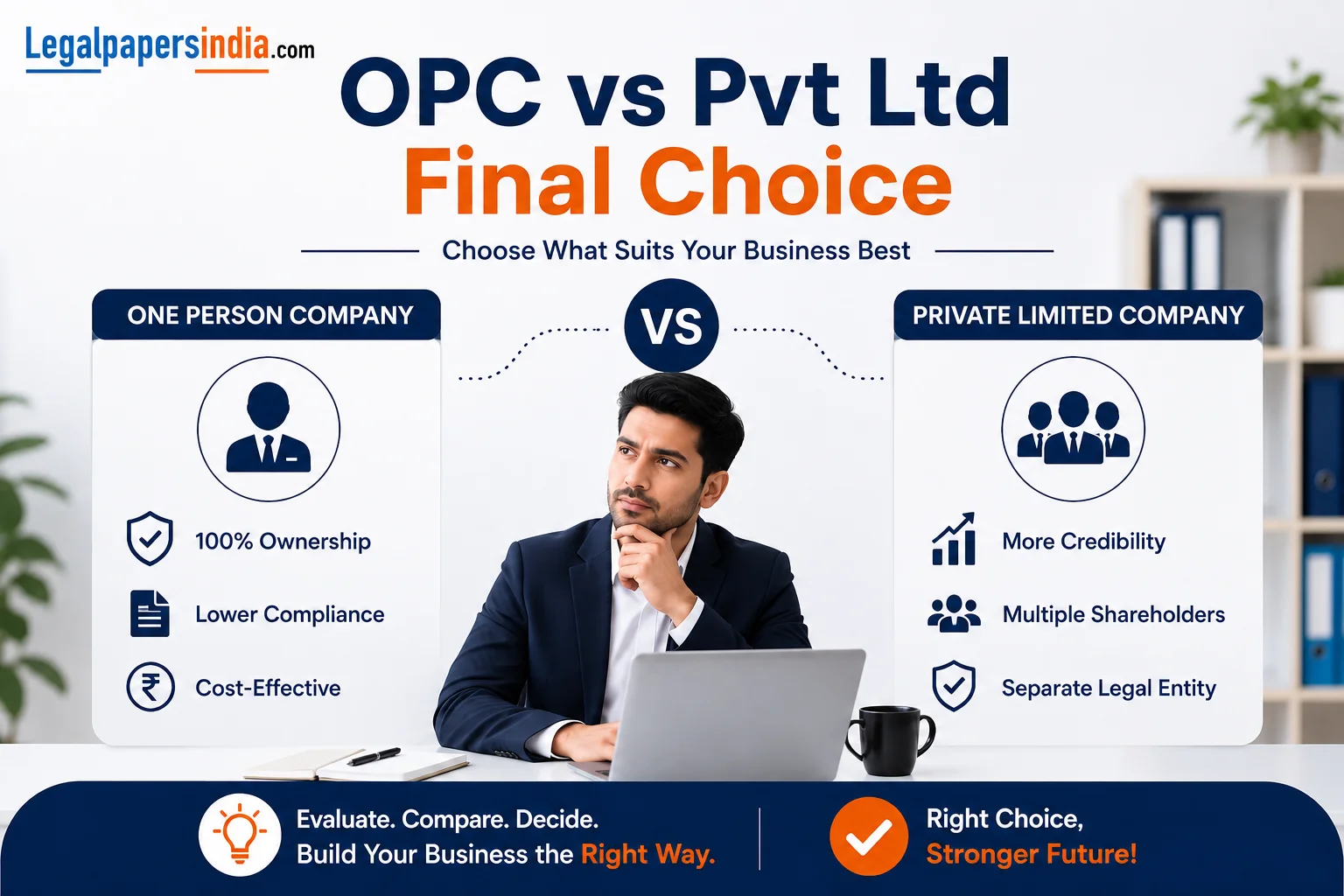
If you plan to run the business independently with limited external funding needs, an OPC is often the more manageable option in the early stage. But if you expect co-founders, investors, equity sharing, or aggressive scaling, a Private Limited Company generally becomes the more practical long-term structure despite higher compliance obligations.
What Most Founders Are Actually Deciding Between
Very few people are truly deciding between “OPC vs Pvt Ltd” in a legal sense.
They’re usually deciding between:
- Simplicity vs scalability
- Lower compliance vs stronger market perception
- Solo control vs shared ownership flexibility
- Short-term convenience vs long-term structure
That distinction matters.
A structure that feels easy today can become restrictive later. On the other hand, setting up a Pvt Ltd too early sometimes creates administrative pressure that small operators were never prepared for.
The decision becomes clearer once you stop asking:
“Which company type is better?”
…and start asking:
“What kind of business am I realistically building?”
Who Should Choose an OPC?
An OPC generally works best for people who want operational control without immediate expansion complexity.
You may lean toward an OPC if:
- You are the sole decision-maker
- The business is service-based or consulting-led
- External funding is not an immediate goal
- You want limited liability protection without adding partners
- You prefer relatively lower compliance management initially
- Revenue expectations are stable but moderate
This structure often suits:
- Freelance professionals scaling into formal businesses
- Solo agency owners
- Independent consultants
- E-commerce operators testing market viability
- Technical professionals starting niche ventures
One pattern seen repeatedly: many first-time founders overestimate how quickly they’ll need investors. In reality, several businesses operate comfortably as OPCs for years before restructuring becomes necessary.
If your current priority is operational clarity and manageable compliance, an OPC can be a practical first step.
For founders still evaluating incorporation requirements, understanding the official process behind an OPC registration structure can help clarify whether the format aligns with your growth expectations.
Who Should Avoid an OPC?
An OPC may become limiting if your business model already depends on collaboration, equity sharing, or rapid scaling.
You should think carefully before choosing OPC if:
- You already have a co-founder
- You expect angel or VC investment
- You plan to issue equity shares later
- You intend to onboard institutional clients quickly
- Your business requires stronger corporate perception
- Expansion plans involve multiple stakeholders
At this stage, many founders start wondering whether converting later is “simple enough.”
Technically, conversion is possible.
Practically, restructuring during growth phases can create operational interruptions, documentation burdens, and avoidable legal adjustments.
If your business roadmap already points toward partnerships or funding discussions, a Private Limited structure usually creates fewer future obstacles.
Businesses preparing for structured scaling often review the compliance and governance expectations linked to a Private Limited Company setup before making the final call.
Key Decision Criteria Before You Finalize
Here’s a practical checklist founders should evaluate before choosing either structure.
Choose OPC if most of these are true:
- You want complete ownership control
- Initial turnover expectations are modest
- Funding is not a near-term priority
- Compliance simplicity matters to you
- You are validating a business idea first
- You prefer fewer stakeholder management issues
Choose Pvt Ltd if most of these apply:
- You have or expect co-founders
- Investor readiness matters
- Equity distribution may happen later
- Long-term scalability is important
- Vendor and enterprise credibility matter
- You plan structured hiring and expansion
One useful observation:
Businesses rarely regret choosing Pvt Ltd too early when scaling is genuine. But many businesses regret choosing OPC when expansion starts sooner than expected.
Cost & Compliance Considerations
Cost should matter — but not in isolation.
This is where decision-making often becomes shortsighted.
OPC Compliance Reality
An OPC generally involves:
- Fewer governance formalities
- Simpler ownership structure
- Relatively manageable annual filings
- Lower administrative coordination
However, “simpler” does not mean “maintenance-free.”
You still deal with:
- ROC filings
- Financial statements
- Tax compliance
- Audit applicability under certain conditions
Pvt Ltd Compliance Reality
Private Limited Companies usually involve:
- Board-related procedural requirements
- More structured recordkeeping
- Additional annual compliance obligations
- Multi-director coordination
But those same structures also increase:
- Investor confidence
- Banking credibility
- Vendor trust perception
- Corporate legitimacy in larger deals
A common mistake is comparing only incorporation cost while ignoring future operational suitability.
A cheaper structure becomes expensive when it slows business flexibility later.
Risk Factors You Should Evaluate Carefully
1. Future Funding Restrictions
If external capital becomes necessary earlier than expected, OPC limitations can create friction.
This is especially relevant for:
- SaaS businesses
- Tech startups
- Scalable D2C brands
- Platform-based ventures
2. Ownership Dependency
An OPC depends heavily on one individual.
If business continuity becomes uncertain due to operational or personal circumstances, management flexibility may reduce compared to multi-director structures.
3. Compliance Misunderstanding
Some founders assume Pvt Ltd compliance is “too complicated” without understanding that professional compliance support usually standardizes much of the process.
Fear of compliance alone should not drive the decision.
4. Perception Gaps
In some industries, enterprise clients still perceive Pvt Ltd entities as more stable or expansion-ready.
This doesn’t mean OPC lacks legitimacy. But perception can influence negotiations.
A Practical Action Plan Before You Decide
Instead of rushing toward registration, work through this sequence first.
Step 1: Define the next 24 months realistically
Not the ideal version. The probable version.
Step 2: Assess whether ownership will stay individual
If even one strategic partner may join later, reconsider OPC carefully.
Step 3: Evaluate funding probability honestly
Many businesses never seek funding. Others need it within a year.
Step 4: Compare compliance tolerance
Would ongoing governance feel manageable or distracting?
Step 5: Think about client perception
Will your customers care about corporate structure credibility?
This process usually clarifies the answer faster than endless feature comparisons.
Common Decision-Stage Mistakes
Choosing only based on lower setup cost
This is probably the biggest mistake.
Incorporation cost is temporary. Structural suitability affects years of operations.
Assuming conversion later is “easy enough”
Possible? Yes.
Convenient during growth? Not always.
Copying what other startups did
A funded tech startup and a solo consulting practice should not follow identical incorporation logic.
Ignoring compliance readiness
Some founders choose Pvt Ltd for prestige but underestimate governance discipline.
Over-planning for hypothetical funding
If there’s no realistic funding pathway yet, complexity may not be necessary immediately.
Practical Scenarios That Make the Decision Easier
Scenario 1: Independent Marketing Consultant
You run client projects personally, don’t plan external investment, and want liability protection.
An OPC likely fits well.
Scenario 2: Two Founders Launching SaaS Product
Even if revenue is early-stage, shared ownership and future funding expectations make Pvt Ltd the stronger choice.
Scenario 3: Small E-commerce Brand Testing Growth
If the business is still validating market demand, OPC may reduce operational burden initially.
Scenario 4: Manufacturing Business Seeking Institutional Contracts
A Pvt Ltd structure often supports credibility and partnership expectations more effectively here.
If you're unsure whether your situation fits one of these patterns, you're not alone. Many founders sit somewhere in the middle — operationally small today but planning larger ambitions later.
That’s exactly why this decision deserves strategic thinking instead of default selection.
Final Decision Summary
If your business is currently founder-led, independently operated, and unlikely to seek immediate funding, an OPC is often the cleaner and more manageable route.
But if scalability, shared ownership, investor readiness, or stronger institutional positioning already matter, a Private Limited Company usually creates a more future-ready foundation.
The better choice is rarely about which structure is “best.”
It’s about which structure creates fewer operational compromises for the business you realistically expect to build.
Frequently Asked Questions
1. Is OPC better than Pvt Ltd for small businesses?
For solo-operated businesses with limited funding requirements, OPC can be more manageable initially. However, businesses expecting rapid growth, partnerships, or investor involvement often benefit more from a Pvt Ltd structure because of better scalability and ownership flexibility.
2. Can an OPC later become a Private Limited Company?
Yes, an OPC can be converted into a Private Limited Company. However, founders should understand that restructuring during expansion phases may involve additional documentation, procedural adjustments, and operational coordination.
3. Which structure has lower compliance burden?
An OPC generally has fewer governance formalities compared to a Private Limited Company. Still, both structures require statutory filings, tax compliance, and regulatory adherence under the Ministry of Corporate Affairs framework.
4. Do investors prefer Pvt Ltd over OPC?
In most cases, yes. Investors usually prefer Private Limited Companies because they support equity participation, multiple shareholders, and scalable ownership structures more efficiently.
5. Is Pvt Ltd always the better long-term option?
Not necessarily. If the business remains independently operated without expansion pressure, an OPC may continue working effectively. The right decision depends more on business trajectory than company size alone.
Conclusion
The final choice between OPC and Pvt Ltd should come from operational reality — not assumptions, trends, or fear of future compliance.
A structure that supports your actual business model will almost always outperform one chosen purely for convenience or perception.
If you still feel uncertain after evaluating scalability, ownership plans, and compliance readiness, reviewing guidance from the team behind Legal Papers India or reaching out through their contact page can help you assess the practical implications before proceeding.
Social Share: