

Sep 04, 2026
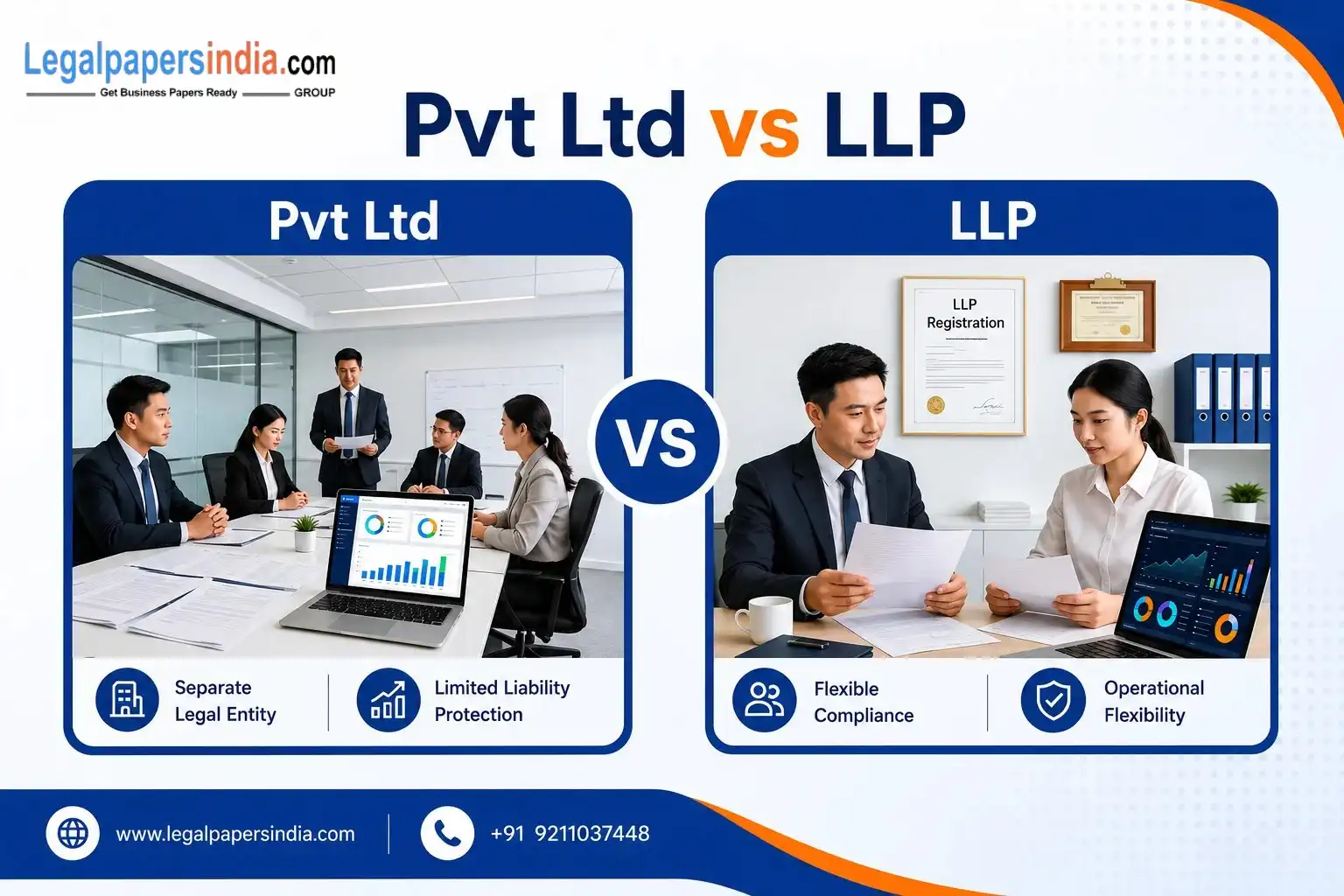
Pvt Ltd vs LLP: Which Structure Actually Fits Your Situation?
The Real Decision Most People Get Stuck On
You’re not confused about what a business is—you’re stuck on what structure won’t come back to bite you later.
Should you go with a Private Limited Company because it “looks more professional”?
Or choose an LLP because it seems simpler and cheaper to manage?
At this stage, most people aren’t looking for definitions—they’re trying to avoid making the wrong call.
Here’s the direct truth:
The right choice between Pvt Ltd vs LLP depends less on features, and more on how you plan to operate, scale, and handle compliance over the next 2–3 years.
Let’s walk through this like a real decision—not a textbook comparison.
If you plan to raise funding, scale aggressively, or build a structured company—Private Limited is usually the better fit.
If you want flexibility, lower compliance, and a partnership-style setup—LLP is more practical.
The decision largely depends on growth expectations, ownership structure, and how much compliance you’re willing to manage.
Who Should Choose Private Limited Company
A Private Limited Company isn’t just a legal structure—it’s a commitment to structured growth.
You should seriously consider it if:
- You plan to raise funds from investors or VCs
- You want clear ownership through shares
- You’re building a scalable or tech-driven business
- You expect to onboard co-founders or employees with equity
- You want higher credibility with clients, vendors, or institutions
In practice, most startups that aim for expansion regret not choosing Pvt Ltd early. Converting later is possible—but not always smooth.
Who Should Choose LLP
An LLP works best when your priority is operational ease rather than aggressive expansion.
It makes more sense if:
- You’re running a service-based or consulting business
- Partners are actively involved (not passive shareholders)
- You want fewer compliance headaches
- You’re not planning external funding
- Profit-sharing flexibility matters more than equity structure
A lot of professionals—CA firms, legal firms, agencies—lean toward LLP because it aligns with how they operate day-to-day.
Who Should Avoid Each Structure
This is where most blogs fall short—but this is where real clarity comes in.
Avoid Private Limited if:
- You’re not ready for ongoing compliance under the Companies Act, 2013
- You want minimal paperwork and annual filings
- You don’t need structured equity ownership
Avoid LLP if:
- You plan to raise venture capital
- You want to issue shares or ESOPs
- You need a strong “corporate image” for enterprise clients
Many people pick LLP thinking it’s “simpler”—but later hit limitations when scaling.
Key Decision Criteria
Before you finalize anything, run through this honestly:
- Do I plan to raise funding in the next 2–3 years?
- Will ownership change frequently or stay fixed?
- Am I okay handling annual compliance filings?
- Is my business more partnership-driven or growth-driven?
- Do I need structured equity (shares) or flexible profit sharing?
- How important is brand perception in my industry?
If most answers lean toward growth, structure, and scalability → Pvt Ltd
If they lean toward flexibility and simplicity → LLP
Cost & Compliance Considerations
This is where hesitation usually kicks in.
Private Limited Company:
- Mandatory filings with Ministry of Corporate Affairs
- Annual compliance (board meetings, ROC filings, etc.)
- Higher professional and maintenance cost
LLP:
- Fewer compliance requirements under Limited Liability Partnership Act, 2008
- Lower annual maintenance cost
- Simpler reporting structure
But here’s the catch:
Lower compliance doesn’t always mean better.
If your business grows, LLP limitations can create friction—especially in funding and ownership structuring.
Risk Factors You Shouldn’t Ignore
Most decisions go wrong because people ignore future risks.
With Pvt Ltd:
- Higher compliance burden → penalties if ignored
- More structured governance → less flexibility
With LLP:
- Limited fundraising options
- Perceived lower credibility in some industries
- Partner disputes can become operational risks
At this point, many founders start thinking:
“Am I optimizing for today—or for what this business might become?”
That question usually leads to the right answer.
Step-by-Step Action Plan (Decision to Execution)
Once you’re leaning toward a structure, don’t delay too much.
- Validate your decision based on future plans, not current stage
- Check name availability and business activity classification
- Prepare required documents (ID, address, business details)
- File incorporation with MCA portal
- Apply for PAN, TAN, and bank account
- Ensure post-registration compliance setup is in place
If you’ve decided on LLP, you can explore the complete LLP registration process here.
If Pvt Ltd feels right, the private limited company registration process will guide your next steps.
Common Decision-Stage Mistakes
These show up again and again:
- Choosing LLP just to save cost (then struggling to scale)
- Choosing Pvt Ltd without understanding compliance load
- Ignoring long-term ownership structure
- Delaying decision because both “seem fine”
One pattern stands out:
People often optimize for ease today and regret it when growth starts.
Practical Scenarios (Real-World Clarity)
Scenario 1: Two founders starting a tech startup
They plan to raise funding in a year.
→ Pvt Ltd makes sense from day one.
Scenario 2: A CA and a lawyer starting a joint practice
They want profit sharing and flexibility.
→ LLP fits better.
Scenario 3: Freelancer turning into an agency
Initially LLP feels right—but if scaling is expected, Pvt Ltd may be smarter early.
Scenario 4: Family-run business
If ownership is stable and funding isn’t needed → LLP works fine.
Final Decision Summary
There’s no “better” option universally—only what aligns with your direction.
- Choose Private Limited Company if growth, funding, and structured ownership matter
- Choose LLP if simplicity, flexibility, and low compliance are your priority
If you’re still unsure, that’s normal.
Most founders reach clarity only after mapping where they want the business to go—not just where it is today.
Frequently Asked Questions
1. Which is better: Pvt Ltd or LLP for startups?
If you plan to raise funds or scale quickly, Pvt Ltd is usually better. LLP works well for small, service-based businesses without external investment plans.
2. Can an LLP be converted into a Private Limited Company later?
Yes, but the process involves regulatory steps, documentation, and potential tax implications. It’s often smoother to choose the right structure early.
3. Is compliance really higher in Pvt Ltd?
Yes. Pvt Ltd companies must follow stricter rules under the Companies Act, including annual filings and governance requirements.
4. Do investors prefer Pvt Ltd over LLP?
Almost always. Investors prefer Pvt Ltd due to shareholding structure and legal clarity.
5. Which is cheaper to maintain?
LLP is generally cheaper due to fewer compliance requirements and filings.
Conclusion
Choosing between Pvt Ltd vs LLP isn’t about ticking boxes—it’s about aligning your structure with your intent.
If you’re still weighing your options, take a moment to map your next 2–3 years realistically. That clarity often makes the decision obvious.
If you want a clearer understanding of how your situation fits, you can explore more about who we are and how we guide businesses or reach out through the contact page for a practical discussion.
No pressure—just make sure the decision you take today doesn’t limit you tomorrow.
Social Share: