
Sep 04, 2026
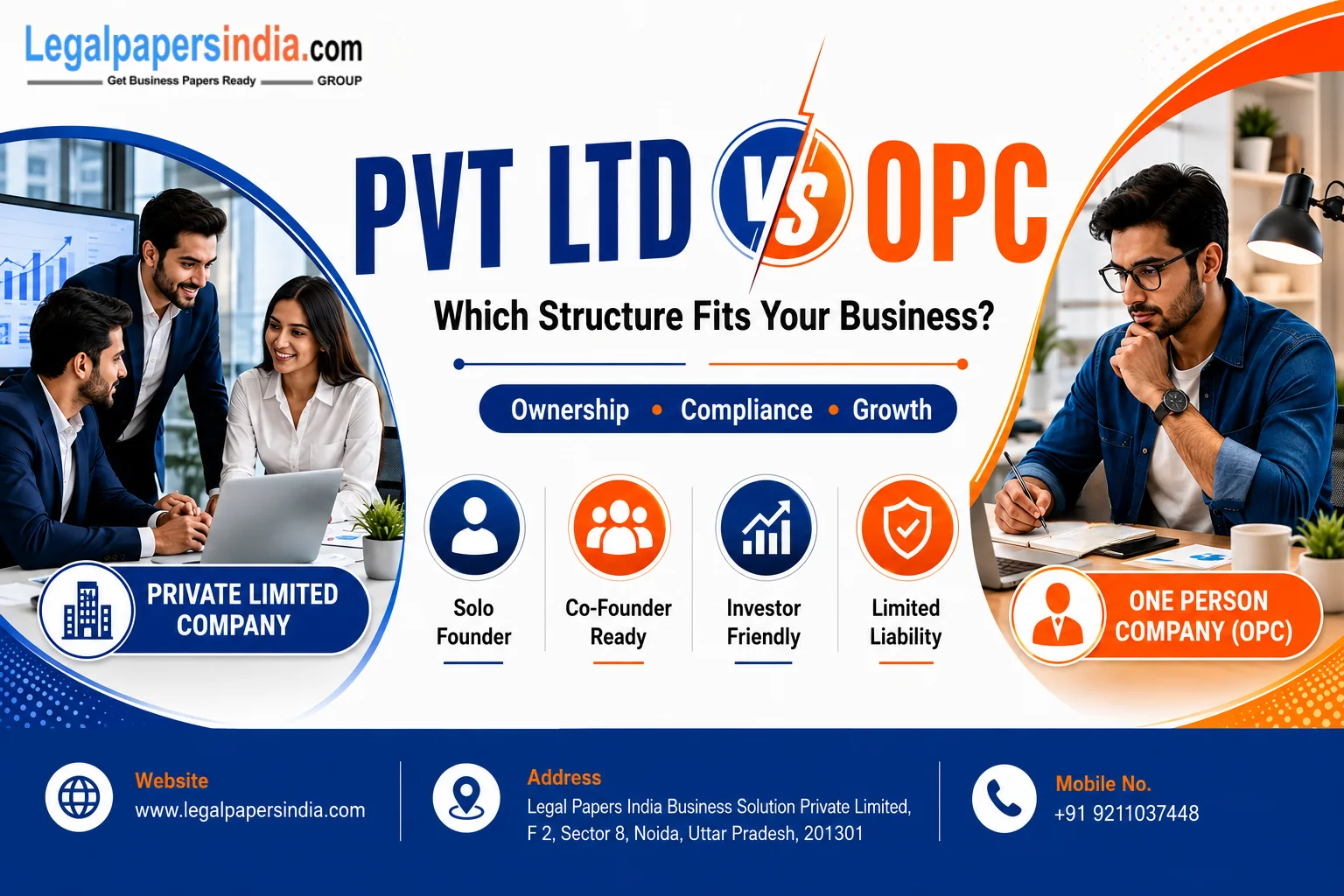
Pvt Ltd vs OPC: Which Structure Makes More Sense for Your Business?
A lot of founders reach the same point of confusion surprisingly late.
The business has started getting traction, clients are asking for invoices in a company name, maybe a co-founder is entering the picture, or investors have started asking what structure the business operates under. That is usually when the “Pvt Ltd vs OPC” question becomes serious.
And honestly, this is where many people overcomplicate things.
Some register a Private Limited Company too early and struggle with unnecessary compliance. Others choose an OPC because it feels simpler, only to realize later that growth becomes restrictive.
If you're currently stuck between these two structures, you're probably not looking for textbook definitions anymore. You're trying to figure out which option fits your actual business plans, risk level, ownership situation, and future growth expectations.
That decision matters more than most people realize.
If you are starting alone, expect moderate business activity, and want lower operational complexity, an OPC often works better initially. If you plan to raise investment, add co-founders, issue equity, or scale aggressively, a Private Limited Company is usually the safer long-term structure.
The Real Difference Most Founders Care About
At surface level, both structures offer limited liability and separate legal identity under the Companies Act, 2013.
But decision-stage users rarely care about legal terminology alone.
The practical difference is this:
- OPC is designed for solo ownership simplicity
- Private Limited Company is designed for scalability and shared ownership
That changes everything from compliance handling to fundraising capability.
At this stage, most people start wondering whether future growth should influence today’s registration choice. In many cases, it should.
Because restructuring later is possible — but rarely convenient.
Who Should Choose an OPC?
An OPC generally makes sense when business control matters more than rapid expansion.
You may lean toward OPC if:
- You are the sole founder
- You do not plan to onboard investors soon
- Your business operates with manageable financial exposure
- You want corporate credibility without multi-director complexity
- You prefer simpler operational management in early stages
Typical examples include:
- Independent consultants
- Freelance professionals
- Solo digital agencies
- Small service businesses
- Early-stage online sellers
- Technical specialists starting independently
One pattern seen frequently: many solo founders assume a Private Limited Company automatically looks “more professional.” In reality, for many small owner-driven businesses, OPC already provides enough legal structure initially.
The problem begins when founders register based on image rather than actual business requirements.
If your immediate focus is stable operations rather than fundraising, an OPC can reduce unnecessary pressure.
You can explore the official service process for an OPC registration structure if that model aligns with your current stage.
Who Should Avoid an OPC?
OPC becomes limiting faster than many founders expect.
You should probably avoid OPC if:
- You expect co-founders soon
- Equity sharing is part of the plan
- Investors may enter within 1–2 years
- You want easier business scalability
- Your industry requires stronger institutional credibility
- You expect high turnover growth
This becomes especially relevant for:
- SaaS startups
- Tech ventures
- Fundraising-oriented businesses
- Agencies planning partnerships
- Manufacturing businesses
- Multi-founder ventures
A common mistake is choosing OPC simply because “it’s easier.”
Ease during registration should not outweigh suitability after growth begins.
Once external stakeholders enter the picture, OPC restrictions start becoming operational friction rather than convenience.
For businesses expecting expansion, a Private Limited Company structure usually creates fewer future limitations.
Key Decision Criteria Before You Proceed
Instead of asking “Which is better?”, ask yourself these questions.
Decision Checklist
Choose OPC if most answers are “Yes”
- Are you the only owner?
- Do you want full decision control?
- Is funding not an immediate priority?
- Are you testing a business model first?
- Do you want comparatively lighter management requirements?
Choose Private Limited if most answers are “Yes”
- Will ownership be shared?
- Do you expect rapid scaling?
- Is external investment likely?
- Will ESOPs or equity allocation matter later?
- Do you want stronger institutional positioning?
This is usually where clarity starts appearing naturally.
Not because one structure is universally superior — but because business intent becomes clearer.
Cost & Compliance Considerations
This section often influences decisions more than founders admit.
Not just registration cost — ongoing responsibility.
OPC Compliance Reality
An OPC generally involves:
- Fewer governance complexities
- Lower procedural burden
- Simpler ownership handling
- Easier internal decision-making
However, compliance is not “optional.”
You still deal with:
- ROC filings
- Annual compliance
- Financial statement obligations
- Income tax requirements
Some people wrongly assume OPC means “minimal compliance business.” That misunderstanding creates problems later.
Private Limited Compliance Reality
A Private Limited Company carries:
- Higher compliance involvement
- Board-related procedural requirements
- More structured governance
- Greater documentation responsibility
But that added structure also increases:
- Investor comfort
- Banking credibility
- Partnership flexibility
- Scalability readiness
In practice, many founders tolerate higher compliance because future growth flexibility outweighs administrative effort.
Trademark Needed or Not?
This is one of the most misunderstood areas during company registration.
Technically, trademark registration is not mandatory for either OPC or Private Limited incorporation.
You can legally register the company without a trademark.
But practically, many businesses regret delaying it.
Here’s why:
Your company name approval from the Ministry of Corporate Affairs (MCA) does not automatically protect your brand identity in the market. Another business may still apply for similar branding under different categories if trademark protection is absent.
Trademark becomes more important when:
- You are building a brand-led business
- Marketing spend is increasing
- You operate online
- You sell across multiple states
- Brand imitation risk exists
- You expect long-term business continuity
For example:
- A solo consultant operating locally may delay trademark filing initially
- A D2C brand, software company, or ecommerce business usually should not
One practical observation: founders often spend heavily on websites, packaging, and advertising before securing brand protection. That sequence creates avoidable risk.
So the better question is usually not “Is trademark mandatory?” but “How expensive would brand conflict become later?”
Risk Factors People Often Ignore
Choosing OPC Only to Convert Later
This happens frequently.
Founders start alone, then:
- add partners,
- seek investment,
- expand operations,
- or restructure ownership.
Conversion is possible, but additional procedural work follows.
If growth visibility already exists, starting with Private Limited may reduce friction.
Choosing Private Limited Too Early
This is the opposite problem.
Some businesses register Pvt Ltd structures because competitors did.
But if:
- revenue is uncertain,
- operations remain small,
- or ownership stays solo,
the compliance burden may feel excessive compared to actual business needs.
Structure should match operational reality — not social perception.
Step-by-Step Action Plan Before Deciding
Step 1: Assess Ownership Intent
Will this remain founder-controlled or become multi-owner?
Step 2: Evaluate Growth Expectations
Are you building stable income or scalable enterprise value?
Step 3: Estimate Compliance Comfort
Can you realistically manage recurring corporate compliance?
Step 4: Think About Funding
Will investors, banks, or institutional clients matter later?
Step 5: Review Brand Protection Needs
Should trademark protection begin early?
This sequence prevents emotionally rushed registration decisions.
Practical Scenarios That Make the Decision Easier
Scenario 1: Solo Marketing Consultant
A freelance strategist earning independently with no co-founder plans may find OPC sufficient initially.
Why?
Because operational simplicity matters more than fundraising flexibility.
Scenario 2: SaaS Startup with Future Funding Plans
Even if one founder starts initially, investor discussions may happen quickly.
Private Limited generally fits better because equity allocation and investment handling become smoother.
Scenario 3: Ecommerce Brand Launch
If branding, advertising, and scale are core goals, many founders choose Private Limited early and secure trademark protection alongside growth.
Scenario 4: Small Family-Owned Service Business
An OPC may work temporarily if ownership remains centralized and expansion expectations are moderate.
Common Decision-Stage Mistakes
Registering Based on Trends
What works for startups on LinkedIn may not suit your business model.
Ignoring Future Ownership Changes
A solo structure can become restrictive surprisingly fast.
Underestimating Compliance
Both structures require ongoing responsibility.
Delaying Brand Protection Excessively
Especially risky for online-first businesses.
Assuming “Cheaper” Means “Better”
Lower initial cost sometimes creates higher restructuring effort later.
Final Decision Summary
If your business is founder-led, relatively controlled, and not immediately investment-focused, OPC can be a practical starting structure.
If scalability, co-founders, investment readiness, or long-term expansion already seem likely, Private Limited usually provides better flexibility from the beginning.
There is no universally correct answer in the Pvt Ltd vs OPC debate.
The right choice depends on:
- ownership goals,
- scalability expectations,
- compliance comfort,
- and how serious the business is expected to become over the next few years.
If you're unsure whether your situation fits one structure better, you're not alone. Most founders only gain clarity after evaluating where the business is realistically headed — not just where they hope it goes.
Frequently Asked Questions
1. Is OPC better than Private Limited for a solo founder?
For many solo founders, OPC offers easier management and simplified ownership control. But if growth, funding, or partnerships are expected soon, Private Limited may prevent future restructuring complications.
2. Can OPC receive investment funding?
OPCs face limitations compared to Private Limited Companies when it comes to equity participation and investor flexibility. Most institutional investors prefer Private Limited structures for scalability and ownership distribution.
3. Is trademark compulsory for OPC or Pvt Ltd registration?
No, trademark registration is not legally mandatory during incorporation. However, businesses planning branding, digital marketing, or long-term expansion should seriously consider protecting their brand identity early.
4. Which has lower compliance: OPC or Private Limited?
OPC generally involves comparatively simpler compliance management. Private Limited Companies carry more governance and filing responsibilities due to their multi-member corporate structure.
5. Can an OPC later become a Private Limited Company?
Yes. An OPC can be converted into a Private Limited Company when business requirements change. However, many founders prefer starting directly as Pvt Ltd if expansion plans are already visible.
Conclusion
The Pvt Ltd vs OPC decision becomes easier once you stop looking for the “best” structure and start focusing on the most suitable one for your actual business stage.
A structure should support the way you plan to operate — not create unnecessary complexity or future restrictions.
If you want guidance tailored to your business model, growth plans, or compliance concerns, the team at Legal Papers India can help you evaluate the practical implications before you proceed. You can also reach out directly through their contact page for structure-specific clarification.
Legal Papers India provides professional Pvt Ltd vs OPC registration services for startups and businesses across India. We assist with company incorporation, documentation, and compliance support for a smooth registration process.
Contact Legal Papers India for fast and reliable Pvt Ltd vs OPC registration assistance. Our experts help with online filing, legal documentation, and business registration support.
Social Share: