
Sep 04, 2026
FSSAI License Types: Understanding Which One Your Business Needs
When You’re About to Start a Food Business… and Hit a Wall
You’ve finalized your menu, maybe even shortlisted suppliers, and then someone casually asks “Have you got your FSSAI license yet?”
That’s usually when confusion starts. You search online and suddenly see multiple terms Basic Registration, State License, Central License without a clear answer to which one actually applies to your situation.
If you’re unsure which category your business falls into, you’re not alone. The classification depends on turnover, scale, and operations and getting it wrong can delay approvals or even attract penalties later.
What Are FSSAI License Types?
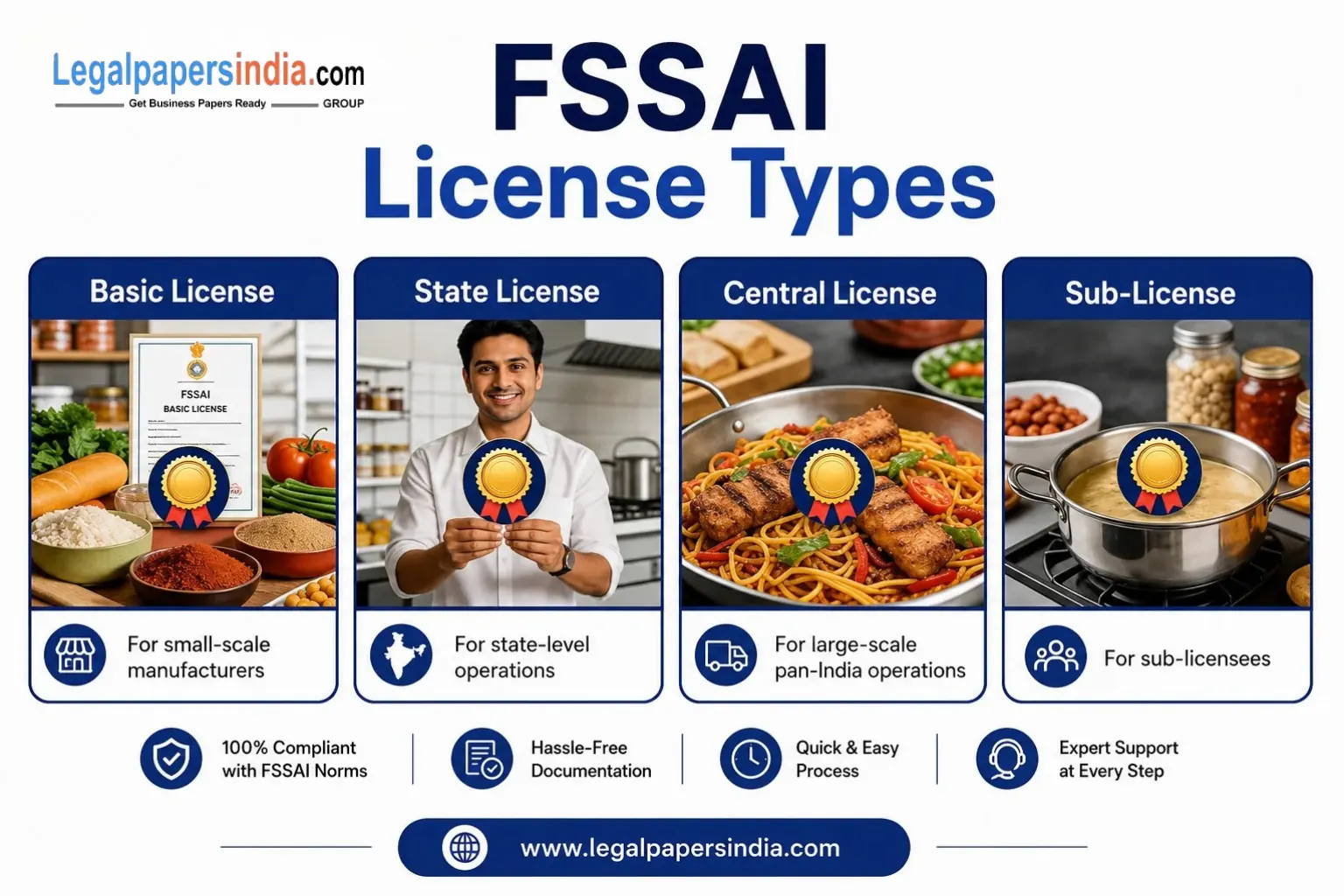
FSSAI license types are classifications defined by the Food Safety and Standards Authority of India based on a food business’s size, turnover, and operational scale. These categories determine whether a business needs basic registration, a state license, or a central license to legally operate in India.
Another Way to Understand FSSAI License Types
Instead of thinking of it as “licenses,” consider them as compliance levels.
- Small, local food operators → minimal compliance (Basic Registration)
- Growing businesses within a state → moderate compliance (State License)
- Large-scale or multi-state operators → highest compliance (Central License)
The idea is simple: the bigger your impact on food distribution, the stricter the regulatory oversight.
Why These License Types Exist in the First Place
Food safety isn’t just about hygiene—it’s about traceability, accountability, and consumer protection.
FSSAI categorizes businesses to ensure:
- Proper monitoring based on scale
- Structured compliance requirements
- Reduced risk of food contamination at larger levels
- Clear responsibility tracking across supply chains
For example, a home-based pickle seller and a nationwide packaged food brand cannot be regulated the same way and that’s exactly why these classifications exist.
Types of FSSAI Licenses Explained
1. Basic FSSAI Registration
Designed for small-scale food businesses.
Applicable when:
- Annual turnover is up to ₹12 lakh
- Small vendors, home kitchens, petty retailers
Typical examples:
- Street food vendors
- Home-based food sellers
- Small-scale storage units
2. FSSAI State License
Meant for medium-sized operations within a single state.
Applicable when:
- Turnover between ₹12 lakh and ₹20 crore
- Operations limited within one state
Typical examples:
- Restaurants
- Medium-sized manufacturers
- Local distributors
3. FSSAI Central License
Required for large-scale or multi-state businesses.
Applicable when:
- Turnover exceeds ₹20 crore
- Import/export operations
- Supply across multiple states
Typical examples:
- Large food manufacturers
- E-commerce food brands
- Importers/exporters
For detailed eligibility and application insights, you can refer to the official guidance pages for
Central License and State License, which explain scope and applicability more deeply.
Who Should Consider Getting an FSSAI License
You should evaluate your license type if you are:
- Starting any food-related business (even from home)
- Manufacturing, processing, or packaging food
- Running a restaurant, café, or cloud kitchen
- Distributing or storing food products
- Selling food through online platforms
Even small operations are not exempt most need at least Basic Registration.
Who Does NOT Need an FSSAI License
There are limited exceptions:
- Individuals cooking strictly for personal consumption
- Non-commercial food sharing (no sales involved)
- Certain small-scale agricultural producers (without processing or selling packaged food)
However, the moment you sell or distribute food commercially, FSSAI compliance becomes necessary.
How the FSSAI Licensing Process Works (Step-by-Step)
Understanding the process helps avoid delays:
Step 1: Determine Eligibility
Identify your turnover and business scale to select the correct license type.
Step 2: Prepare Documentation
Gather identity proof, business details, and operational information.
Step 3: Submit Application
Apply through the official FSSAI portal with accurate details.
Step 4: Inspection (if applicable)
Authorities may inspect premises, especially for state or central licenses.
Step 5: Approval or Clarification
You may receive approval or be asked for additional information.
Step 6: License Issuance
Once approved, your license number becomes your compliance identity.
Step 7: Post-Compliance
- Display license number on packaging/menu
- Maintain hygiene standards
- Renew before expiry
Documents You’ll Typically Need
While requirements vary slightly by license type, commonly required documents include:
- Identity and address proof of owner
- Business registration certificate (if applicable)
- Food safety management plan
- Proof of premises (rent agreement or ownership)
- Product details or list of food items
- NOC from municipality (in some cases)
The complexity increases as you move from Basic → State → Central.
Common Mistakes That Delay Approval
Many applications get stuck due to avoidable issues:
- Choosing the wrong license category
- Incomplete documentation
- Mismatch in business address details
- Incorrect product classification
- Ignoring follow-up queries from authorities
A practical insight: businesses often underestimate how strictly documentation is verified, especially at the state and central levels.
Key Considerations Before You Apply
Before you proceed, it helps to think through:
- Future growth plans → Will your turnover increase soon?
- Geographic expansion → Will you operate in multiple states?
- Product category → Certain foods have stricter compliance rules
- Operational model → Manufacturing vs distribution vs retail
Choosing a slightly higher license category early can sometimes prevent reapplication later.
Timeline: How Long Does It Take?
Typical timelines vary:
- Basic Registration → 7–10 working days
- State License → 15–30 days
- Central License → 30–60 days
Delays usually happen due to:
- Inspection scheduling
- Document corrections
- Clarification requests
Frequently Asked Questions
1. How do I know which FSSAI license type applies to me?
It depends on your annual turnover, business scale, and operational reach. Small businesses need basic registration, mid-sized businesses need a state license, and large or multi-state operations require a central license.
2. Can I upgrade my FSSAI license later?
Yes, businesses can upgrade their license when turnover or operations expand. However, the process involves fresh documentation and verification, so planning ahead can reduce future effort.
3. Is FSSAI mandatory for home-based food businesses?
Yes, even home-based food sellers need at least basic registration if they are selling food commercially.
4. What happens if I operate without an FSSAI license?
Operating without a valid license can lead to penalties, fines, or business closure under food safety regulations enforced by FSSAI.
5. Do I need separate licenses for multiple locations?
Yes, each business location typically requires a separate license or registration, depending on operational structure.
When Professional Assistance Makes Sense
While the process may seem straightforward, things can get complex when:
- Your business model doesn’t fit neatly into one category
- You operate across states
- Documentation requirements are unclear
- You receive objections or clarification notices
In such situations, guidance from experienced professionals can help avoid repeated delays.
If you want to understand how compliance applies to your specific business structure, reviewing resources from Legal Papers India can provide additional clarity on how businesses typically navigate these requirements.
Conclusion
Understanding FSSAI license types isn’t just about compliance—it’s about setting your food business on the right foundation from day one.
Choosing the correct category early saves time, reduces regulatory friction, and ensures smoother growth as your business expands.
If you’re unsure which license applies to your situation, it’s worth taking a step back and evaluating your business scale, future plans, and operational model—or consulting someone who deals with these cases regularly.
Legal Papers India provides professional FSSAI License Types registration services for startups and businesses across India. We assist with company incorporation, documentation, and compliance support for a smooth registration process.
Contact Legal Papers India for fast and reliable FSSAI License Types registration assistance. Our experts help with online filing, legal documentation, and business registration support.
Social Share: