
Sep 04, 2026
ISO Certification Process: A Practical Step-by-Step Guide for Businesses
When Compliance Starts Becoming a Question, Not a Choice
You might have noticed this already—clients asking for ISO certificates before finalizing deals, vendors mentioning “ISO standards” in negotiations, or tender documents quietly making it a requirement.
At that point, ISO certification stops being a vague term and turns into a real business question: What exactly is the ISO certification process, and how do you actually get it done without confusion?
This guide breaks it down in a way that reflects how it happens in real businesses—not just theory.
What Is the ISO Certification Process?
The ISO certification process is a structured procedure through which a business implements international standards, undergoes audits by an accredited certification body, and receives certification confirming compliance with specific ISO standards such as quality, safety, or environmental management.
ISO Certification Process Explained Simply
In practical terms, the ISO certification process is a combination of internal system setup and external verification, where a company aligns its operations with globally recognized standards and gets independently audited to prove it meets those requirements consistently.
Why ISO Certification Actually Matters in Real Scenarios
ISO certification is often misunderstood as a “badge.” In reality, it affects how businesses operate and how they are perceived.
Here’s where it becomes important:
- Vendor approval: Many corporates shortlist only ISO-certified vendors
- Tender eligibility: Government and large contracts often require it
- Process consistency: Helps standardize internal operations
- Customer trust: Signals reliability without needing constant justification
- Risk reduction: Especially relevant for manufacturing and service delivery
For example, a manufacturing unit struggling with quality complaints often uses ISO 9001 not just for certification—but to fix internal inefficiencies.
Who Should Consider ISO Certification—and Who Should Not
Businesses That Typically Benefit
- Manufacturing units scaling operations
- Service providers working with corporate clients
- Export-oriented businesses
- Startups entering structured industries (healthcare, logistics, IT services)
- Companies bidding for tenders
Businesses That May Not Need It Immediately
- Very small local businesses with no external compliance pressure
- Freelancers or solo consultants
- Businesses not dealing with standardized processes or audits
That said, many small businesses still pursue ISO early to build credibility faster.
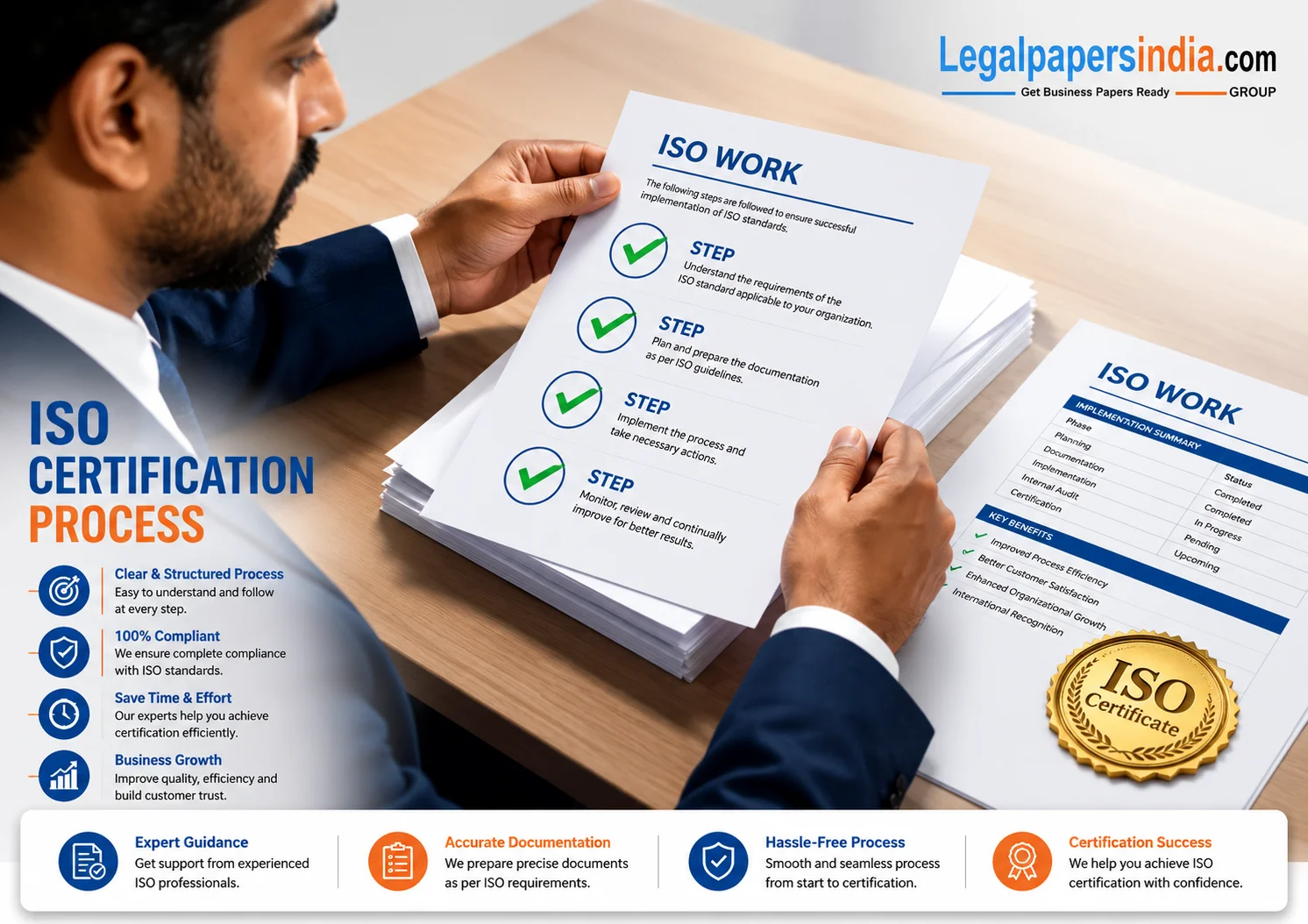
ISO Certification Process: Step-by-Step Breakdown
This is where most confusion happens, so let’s walk through how it actually unfolds.
1. Identify the Relevant ISO Standard
Different standards apply based on business type:
- ISO 9001 → Quality Management
- ISO 14001 → Environmental Management
- ISO 45001 → Occupational Health & Safety
Choosing the wrong one can delay the process.
2. Gap Analysis
Before applying, businesses assess:
- Current processes vs ISO requirements
- Missing documentation
- Operational gaps
This is often where companies realize the process is more about systems than paperwork.
3. Documentation and System Development
This involves creating:
- Policies and procedures
- Standard Operating Procedures (SOPs)
- Process workflows
- Compliance records
It’s not just paperwork—this becomes your operational backbone.
4. Implementation Phase
Now the system is actually used in daily operations.
- Employees are trained
- Processes are followed
- Records are maintained
This phase proves whether the system works in real conditions.
5. Internal Audit
Before external audit, businesses conduct internal checks to identify:
- Non-compliance issues
- Process inconsistencies
- Documentation gaps
This step often saves time during certification.
6. Certification Audit
A certification body—often accredited by organizations like International Accreditation Forum—conducts the audit.
It usually happens in two stages:
- Stage 1: Documentation review
- Stage 2: On-site audit and process verification
7. Certification Approval
If compliance is satisfactory:
- Certification is issued
- Validity is typically 3 years
8. Post-Certification Surveillance
This part is often ignored.
- Annual audits are conducted
- Continuous compliance is required
ISO is not a one-time event—it’s an ongoing commitment.
Documents Required
The exact documents depend on your business and ISO standard, but typically include:
- Business registration proof
- Organizational structure
- Process documentation (SOPs, policies)
- Employee records
- Operational logs and reports
- Quality or safety records
For example, a manufacturing unit will require production logs, while a service company will need process documentation.
Common Mistakes Businesses Make
This is where many applications get delayed or rejected:
- Treating ISO as only documentation, not implementation
- Choosing the wrong certification body
- Ignoring internal audits
- Rushing implementation without training staff
- Not maintaining records consistently
A common real-world issue: companies prepare documents just for audit day—but fail during surveillance audits later.
Key Considerations Before You Start
Before jumping into the process, ask:
- Why do you need ISO—client requirement or internal improvement?
- Do you have structured processes already?
- Can your team maintain compliance long-term?
- Are you choosing a recognized certification body?
If your goal is long-term credibility, focus on system building—not just certification.
Timeline: How Long Does ISO Certification Take?
The timeline varies depending on readiness.
Typical Duration:
- Small businesses: 1–3 months
- Medium businesses: 3–6 months
- Complex organizations: 6+ months
What Affects the Timeline:
- Existing process maturity
- Documentation readiness
- Team involvement
- Audit scheduling
In practice, delays usually come from incomplete implementation—not from the certification body.
ISO Certification vs Other Compliance
|
Aspect |
ISO Certification |
Government Registration |
|
Nature |
Voluntary (mostly) |
Mandatory |
|
Focus |
Process & quality systems |
Legal compliance |
|
Authority |
Independent certification bodies |
Government departments |
|
Renewal |
Periodic audits |
Depends on registration |
ISO is about how you operate, not just whether you are registered.
Frequently Asked Questions
1. Is ISO certification mandatory for all businesses?
No, ISO certification is generally voluntary. However, it becomes practically mandatory when required by clients, tenders, or industry standards, especially in manufacturing, exports, and corporate supply chains.
2. How long does it take to complete ISO certification?
The process typically takes 1 to 6 months depending on the organization’s size, readiness, and complexity of operations. Businesses with existing structured processes often complete it faster.
3. What happens if a business fails an ISO audit?
If non-conformities are found, the business is given time to correct them. Certification is granted only after issues are resolved. Repeated failure may delay certification significantly.
4. Can a small business apply for ISO certification?
Yes, small businesses can apply. In fact, many startups use ISO certification to build credibility and standardize operations early, even if it’s not legally required.
5. Is ISO certification valid forever?
No, ISO certification is typically valid for three years. During this period, annual surveillance audits are conducted to ensure continued compliance.
6. When Professional Assistance Becomes Practical
Many businesses attempt ISO certification internally—but struggle midway.
You might consider guidance if:
- You don’t have structured documentation
- Your team is unfamiliar with ISO requirements
- You need faster certification due to client deadlines
- You want to avoid audit failures
In such cases, structured support—like the process explained on the ISO Certification service page—can simplify execution without guesswork.
A Note on Business Presence and Applicability
If your operations span multiple locations or you're unsure how ISO applies to your setup, reviewing service availability across regions Legal Papers India can help clarify applicability.
Final Thoughts: It’s Less About Certification, More About Systems
ISO certification often starts as a requirement—but businesses that benefit the most treat it as a system upgrade.
Once implemented properly:
- Processes become clearer
- Teams become more accountable
- Clients trust faster
If you're still unsure how it fits your situation, understanding how experienced professionals approach it see about Legal Papers India can offer useful perspective.
There’s no urgency to rush—but there is value in getting it right.
Contact our team for fast and hassle-free ISO certification support. We are here to help with documentation and online registration assistance.
Social Share: