
Sep 04, 2026
Pvt Ltd Hidden Charges: What Most Founders Realize Too Late
You finally decide to register a Private Limited Company.
You compare pricing online, see “₹999 company registration” offers, and think the process is fairly straightforward.
Then the calls begin.
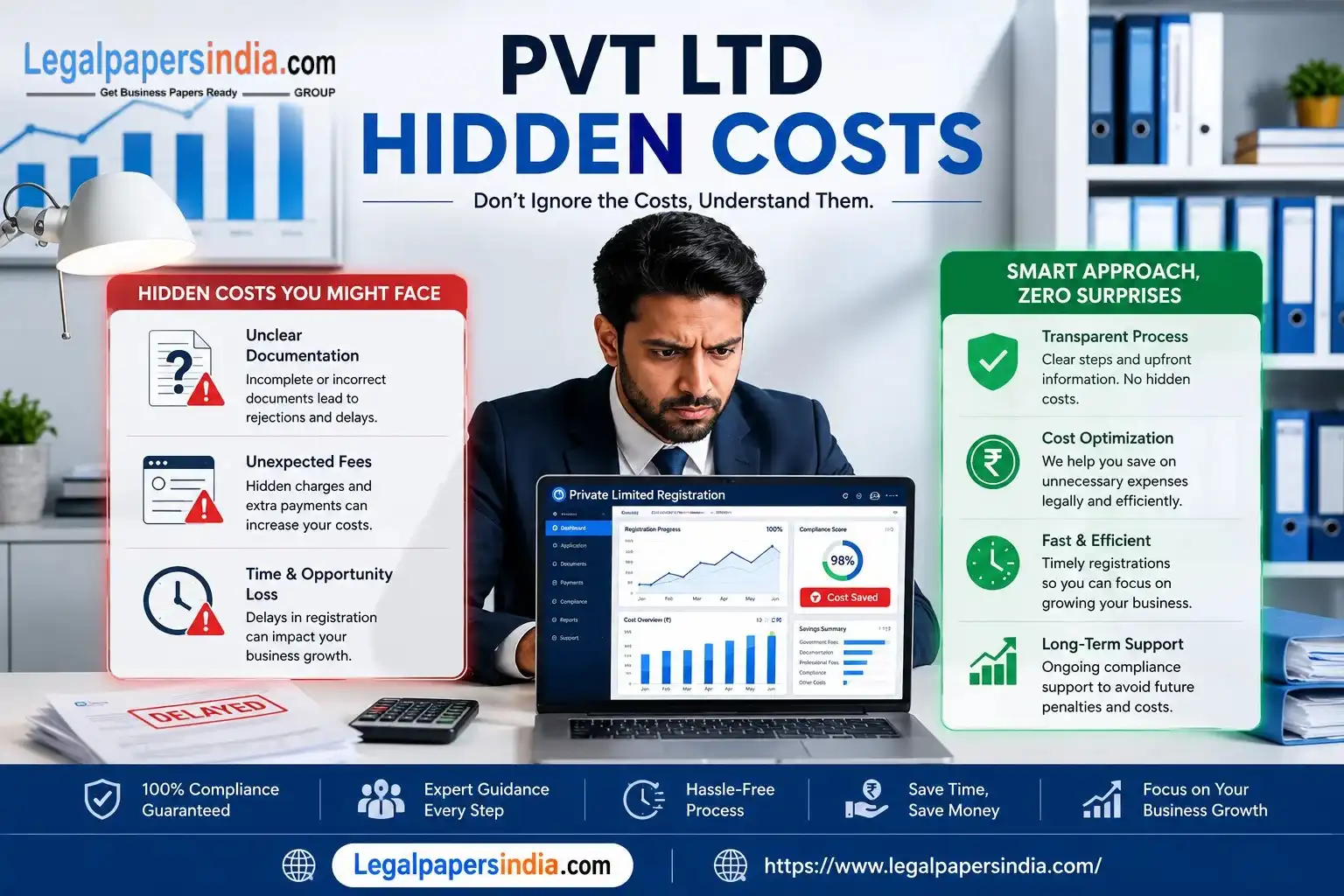
DSC charges. DIN filing. Stamp duty. PAN-TAN fees. Professional fees. Compliance packages. Mandatory filings you weren’t expecting.
At this stage, most people stop wondering “Should I register a Pvt Ltd?” and start asking a more practical question:
“What will this actually cost me after everything is included?”
That hesitation is justified.
The issue is not that Private Limited Company registration is inherently expensive. The real problem is that many first-time founders evaluate only the advertised registration fee while ignoring statutory charges, post-incorporation compliance, and recurring obligations under the Ministry of Corporate Affairs framework.
If you're evaluating whether the structure is genuinely suitable for your business, understanding these hidden charges early can prevent poor financial planning, rushed decisions, and avoidable compliance stress later.
A Private Limited Company is usually worth the compliance cost if you plan to scale, raise funding, onboard co-founders formally, or build long-term credibility. However, many businesses underestimate recurring compliance expenses, professional fees, and statutory filings. The smarter approach is not avoiding the structure — it is understanding the full financial commitment before registration.
Why “Hidden Charges” Become a Problem in Pvt Ltd Registration
The term “hidden charges” is slightly misleading.
In most cases, these are legitimate statutory or compliance-related expenses. The problem is that they are often separated from the advertised registration quote.
A founder may assume:
- Government fees are included
- Annual compliance is optional
- Accounting can wait until revenue starts
- Filing deadlines are flexible
- Dormant companies have no maintenance cost
None of these assumptions are entirely correct.
This is where decision fatigue begins. Especially for small founders, consultants, freelancers, agencies, and early-stage startups operating on tight budgets.
If you're already comparing structures, reviewing the Private Limited Companyregistration service carefully before proceeding helps clarify what is operationally included versus what becomes a separate compliance responsibility later.
Who Should Choose a Private Limited Company Despite the Costs
A Pvt Ltd structure still makes strong business sense in several situations.
Choose it if:
- You have multiple co-founders and want defined ownership
- You expect investor discussions in future
- You plan to onboard employees formally
- Your clients prefer dealing with incorporated entities
- You want limited liability protection
- You anticipate higher turnover growth within 1–3 years
- You may apply for startup recognition, tenders, or institutional partnerships
In practical terms, founders building something long-term usually tolerate compliance costs better because the structure supports growth.
For example:
A digital agency earning ₹15–20 lakh annually with recurring clients may benefit from incorporation despite annual filing expenses because credibility, contracts, and banking become smoother.
Who Should Avoid It Right Now
This is where many founders make emotionally driven decisions.
Some people register a Pvt Ltd because it “sounds professional,” even when the business model does not justify the compliance load.
Avoid or postpone it if:
- You're still testing a side hustle
- Revenue is uncertain
- You operate alone with low risk exposure
- You do not need external funding
- Your annual income is still inconsistent
- You are uncomfortable handling recurring compliance deadlines
- You want the simplest possible tax and filing setup
At this stage, most founders start asking whether the structure itself is becoming a burden rather than a growth tool.
That is usually a sign the business may need a lighter structure first.
Key Decision Criteria Before Proceeding
Use this checklist honestly before registering.
Decision-Ready Checklist
- Can you handle yearly compliance costs even during slow business months?
- Do you understand that annual filings continue even with zero revenue?
- Will the company have at least two active stakeholders?
- Is formal ownership documentation important for your business?
- Are clients, investors, or vendors expecting a registered company?
- Can you maintain basic accounting discipline from day one?
- Are you comfortable hiring a CA or compliance professional regularly?
- Do you expect the business to exist for more than 2–3 years?
If most answers are “no,” delaying incorporation may actually be the smarter financial decision.
Cost & Compliance Considerations Most Founders Miss
Here is where the “hidden charges” conversation becomes practical.
1. Government & Statutory Fees
These may include:
- DSC (Digital Signature Certificate)
- DIN processing
- PAN & TAN generation
- Stamp duty (varies by state)
- MCA filing charges
Some service providers include these. Others separate them later.
2. Annual ROC Compliance
Even inactive companies generally require filings.
Typical recurring obligations include:
- Annual return filing
- Financial statement filing
- Board resolutions and record maintenance
- Auditor appointment compliance
Missing these can trigger penalties under Ministry of Corporate Affairs regulations.
3. Accounting & CA Costs
A very common misconception:
“We’ll hire an accountant once revenue grows.”
In reality, transaction recording, bookkeeping, and filing discipline start immediately.
Even a small Pvt Ltd company often needs:
- GST support (if applicable)
- Accounting maintenance
- TDS handling
- Financial statement preparation
- Audit coordination
4. Registered Office & Documentation Costs
Sometimes overlooked expenses include:
- Address documentation
- Utility proof updates
- Rental agreement requirements
- NOC documentation
These are not major individually, but they accumulate.
5. Delayed Filing Penalties
This is where costs escalate unexpectedly.
A founder trying to “save money” by postponing compliance may eventually pay significantly more in penalties and professional recovery fees.
In many real situations, revival and correction costs become more expensive than maintaining compliance properly from the beginning.
Risk Factors to Evaluate Before You Commit
Compliance fatigue
Many founders are enthusiastic during incorporation but become overwhelmed by ongoing deadlines.
Underestimating professional dependency
Unlike simpler business structures, Pvt Ltd companies usually require periodic professional involvement.
Cash flow mismatch
If your business revenue is seasonal, recurring compliance costs may feel heavier during low-income periods.
Co-founder disputes
Formal shareholding sounds attractive initially, but unclear founder expectations often create friction later.
Step-by-Step Action Plan Before Registration
Instead of rushing into incorporation, follow this order.
Step 1: Estimate your first-year total cost
Include:
- Registration
- Accounting
- GST (if applicable)
- ROC filing
- Audit support
- Professional fees
Do not evaluate only incorporation pricing.
Step 2: Validate business stability
Ask yourself:
“Will this business realistically continue beyond the experimental stage?”
That single question prevents many premature incorporations.
Step 3: Clarify founder roles early
Document:
- Ownership percentages
- Responsibilities
- Capital contribution
- Exit expectations
Ignoring this early becomes expensive later.
Step 4: Choose a service provider carefully
A low registration quote is not automatically a low-cost experience.
Evaluate:
- Transparency of inclusions
- Compliance guidance
- Ongoing support clarity
- Filing assistance
- Responsiveness
Step 5: Plan compliance operations from day one
Even simple systems help:
- Separate business bank account
- Organized invoices
- Monthly bookkeeping habit
- Deadline tracking
Founders who establish discipline early usually experience far fewer compliance surprises.
Common Decision-Stage Mistakes
Choosing based only on registration price
This is probably the biggest mistake.
A ₹999 headline offer tells you very little about actual operational cost.
Registering too early
Some founders incorporate before validating demand, partnerships, or revenue consistency.
That often creates unnecessary maintenance pressure.
Ignoring dormant company obligations
Even inactive companies may require filings and maintenance.
This catches many founders off guard.
Not understanding director responsibilities
Directors carry legal and compliance obligations.
Many first-time entrepreneurs focus only on branding benefits while overlooking governance responsibilities.
Assuming “everything is included”
If the proposal is unclear, ask specifically:
- What statutory charges are included?
- What recurring filings are extra?
- Is audit support included?
- Are government fees separate?
- What happens after incorporation?
Practical Scenarios That Help Clarify the Decision
Scenario 1: Early-stage freelancer
A solo designer earning inconsistent freelance income probably does not need a Pvt Ltd immediately.
The compliance load may outweigh practical benefit initially.
Scenario 2: SaaS startup with co-founders
Two founders planning product investment, hiring, and investor conversations may benefit significantly from formal incorporation despite higher compliance cost.
Scenario 3: Small family trading business
If the business mainly operates locally with limited expansion plans, simpler structures may remain operationally easier.
Scenario 4: Agency targeting enterprise clients
Many enterprise clients prefer dealing with registered companies for invoicing and contracts.
In this case, a Pvt Ltd structure may strengthen operational credibility enough to justify ongoing compliance expense.
Final Decision Summary
A Private Limited Company is not “cheap,” but it is also not unnecessarily expensive when matched with the right business stage.
The real issue is misalignment.
Problems usually happen when:
- founders register too early,
- misunderstand recurring obligations,
- or evaluate only the initial registration quote.
If your business has growth intent, formal partnerships, or long-term operational goals, the structure can absolutely be worth the additional compliance commitment.
But if you're still experimenting, uncertain about continuity, or trying to minimize administrative responsibility, slowing down before incorporation may save both money and stress.
Frequently Asked Questions
Are hidden charges in Pvt Ltd registration illegal?
Not necessarily. Most charges relate to statutory filings, professional services, or compliance obligations. The issue usually arises when providers advertise only base registration pricing without clearly explaining recurring or government-related costs.
What are the recurring costs after Pvt Ltd registration?
Recurring costs may include ROC filings, accounting, audit support, GST compliance, professional fees, and annual documentation maintenance. Even companies with limited activity may still need mandatory filings.
Can a dormant Pvt Ltd company avoid compliance costs?
No. A dormant or inactive company may still require annual filings and regulatory compliance under MCA rules. Ignoring these obligations can lead to penalties and additional restoration costs later.
Is Pvt Ltd registration worth it for small businesses?
It depends on growth plans, risk exposure, funding expectations, and operational goals. Businesses planning long-term expansion often benefit more from the structure than very early-stage or experimental ventures.
What should I check before choosing a registration service provider?
Check whether the proposal clearly mentions government fees, annual compliance support, filing assistance, audit scope, and recurring costs. Transparent inclusion breakdowns usually matter more than extremely low advertised pricing.
Conclusion
A Private Limited Company can create strong long-term advantages — but only when the decision is made with full visibility into the financial and compliance responsibilities involved.
If you're currently evaluating whether the structure genuinely fits your business stage, taking time to understand the complete operational picture is far more valuable than rushing toward the lowest registration quote.
You can also learn more about Legal Papers India and its professional approach before deciding your next step.
The best registration decision is rarely the cheapest one.
It is the one you can realistically sustain as the business grows.
Legal Papers India provides professional Private Limited Company registration services for startups and businesses across India. We assist with company incorporation, documentation, and compliance support for a smooth registration process.
Contact Legal Papers India for fast and reliable Private Limited Company registration assistance. Our experts help with online filing, legal documentation, and business registration support.
Social Share: